
Engineering, Infrastructure & Construction Sales Training
In engineering, infrastructure, and construction, technical expertise earns a place on the shortlist, but certainty wins the work, and it is usually built before the bid. Richardson Sales Performance helps the firms that design, engineer, and build, and the suppliers that sell into them, earn that certainty earlier and more consistently.
Trusted by Engineering, Infrastructure, and Construction Organizations Like Yours





01
Win Position Before the Process Starts
Shortlists form before the request for qualifications goes out, and specifications are written before the order is placed. In public procurement, contact is often restricted once the process opens. The strongest teams build the relationship, and their understanding of the buyer’s project, early, while there is still room to shape the decision.
02
Sell to Every Link in the Chain
A decision rarely rests with one person. Owners, engineers, specifiers, contractors, procurement teams, and distributors each care about something different, such as schedule certainty, reputation, cost, or availability. The best teams find out who is involved and speak to what each person owns.
03
Turn Technical Expertise Into Relevance
Many of the people who win work in these fields came up through the technical or operational side, and their buyers are not technical experts. The strongest professionals translate what they know into what matters to this buyer, use only the technical detail that helps the buyer decide, and uncover needs the buyer has not said yet.
04
Hold Value and Momentum Under Pressure
Schedules are compressed, lead times stretch, and value engineering puts price in the spotlight. The strongest teams protect what makes their offer worth choosing and keep the buyer moving, so a long lead time or a budget review does not become a reason to wait.
Technical Expertise Earns the Shortlist. Certainty Wins the Work.
In engineering, infrastructure, and construction, being qualified is table stakes. The teams that win are the ones buyers feel sure about. Four capabilities make the difference.
Every Role Has a Different Conversation. Every Buyer Needs Confidence to Choose.
Engineering, infrastructure, and construction covers a wide range of businesses. Some win work through qualifications and shortlists, some through a specification, and some one purchasing conversation at a time. Whether you design, engineer, build, or supply, from data centers and power to water, transportation, and industrial projects, the buyer is deciding who to trust before any bid, order, or contract is on the table.
Roles across engineering, infrastructure, and construction differ in who they sell to, how long decisions take, and what each buyer risks by choosing wrong. The common thread: buyers choose the people they feel confident about, and conversation builds that confidence.
Design and Engineering Firms
Principals, Partners, Project Executives, Lead Engineers, Business Development Managers, Client Development Managers
Build the relationship before the request for qualifications goes out, then use the interview to show specific understanding of the owner’s project. Firms with similar qualifications are often separated on specificity.
Contractors, Construction Managers, and EPC Firms
Business Development Managers, Preconstruction Managers, Project Executives, Pursuit Leaders
Get involved while scope and delivery approach are still open, and speak to what each person on the owner’s team owns, such as procurement, operations, legal, and finance, so the decision keeps moving across reviewers and approvals.
Specialty and Trade Contractors
Owners, Principals, Business Development Managers, Project Executives
Earn a place on the general contractor’s list before bid documents exist, then offer useful input during preconstruction so you are the easy choice when work is awarded.
Business Development Leaders
Vice Presidents of Business Development, Directors of Business Development, Directors of Client Development
Build a repeatable way to win, defend, and grow accounts, so repeat work and longer agreements do not depend on a few relationships, and give new hires one standard to ramp against.
Building Product and Material Makers
Specification Sales Managers, Architectural Sales Representatives, Territory Sales Managers, Contractor Sales Representatives
Earn the specifier’s trust before the specification is written, then stay in the conversation through contractor pricing and value engineering, where a substitution can quietly replace your product.
Power, Cooling, and Electrical Equipment Makers
Strategic Account Managers, Data Center Sales Managers, Sales Engineers
Engage owners, EPC firms, and consultants early, often before a request for proposals exists, and help each stakeholder plan around lead times that can run to a year or more.
Construction Software and Technology
Enterprise Account Executives, Account Executives
Learn how project managers, operations leaders, and executives each judge a change to how work gets done, and make the case in terms of each person’s own work.
Distributors and Independent Reps
Outside Sales Representatives, Account Managers, Inside and Counter Sales Representatives, Sales Project Managers, Agency Principals, and Specification Sales Representatives
Advise across the contractor’s full job, not only the product. Distributors see what is actually being ordered, which gives them a view of the job that no one else has.
Sales Managers and Enablement Leaders
Business Development Directors, Sales Managers, Sales Enablement Managers
Coach the behaviors, not only the pipeline, and give new hires and experienced professionals one standard to develop against.
Qualified Is Not the Same as Certain
In engineering, infrastructure, and construction, the buyer’s risk is rarely a bad product or an unqualified team. It is a choice that shows up later: a delayed schedule, a failed specification, a substitution someone has to explain. An owner’s opening date can depend on equipment that takes a year or more to arrive.
That is why qualified is only where the process starts. McKinsey’s March 2026 analysis of hyperscaler equipment buying says reliability, specification compliance, and on-time delivery matter most, and that even those are becoming table stakes.
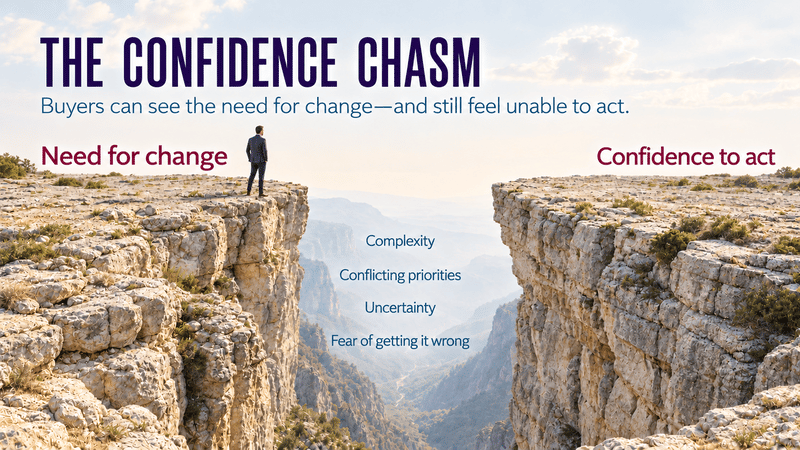
Richardson calls the gap between seeing that a firm or product could do the job and feeling confident enough to choose it the Confidence Chasm. The buyer sees that you are capable but does not yet feel sure enough to put their name, schedule, or budget behind you.
Closing it takes more than technical proof. It takes the sense that you understand their project, their constraints, and what is at stake if it goes wrong. That sense is built in early conversations: with an owner or developer before the request goes out, with a specifier before the specification is written, with a general contractor before it decides which subcontractors to invite. Deltek’s 2025 study of architecture and engineering firms found that strategic capture planning is increasingly happening before an RFP is released. Many of the people in those conversations came up through the technical or operational side, so the skill is one to learn: asking questions that surface what the buyer has not said, speaking to what each person involved owns, and moving at the buyer’s pace.
The harder part is doing it across a team. As the data center buildout adds demand, firms add people, and new people need time to learn. Onboarding rarely addresses each person’s gaps, and managers rarely have time to find them. In Deltek’s 2025 study of 692 architecture and engineering firms, finding time to nurture client relationships was the top business development challenge, ranked among the top three by 57% of firms. Crossing the Chasm consistently takes a shared standard for what good looks like, development tied to real pursuits, and managers who coach to the same standard.
Solutions Built to Help Engineering, Infrastructure, and Construction Teams Cross the Confidence Chasm
The right solution depends on the buying situation. Richardson helps organizations choose the approach that fits their sales motions, roles, and customer conversations. Whichever approach fits, a shared methodology gives new team members a clear way to ramp and keeps the whole team showing up the same way as demand grows.
Keep Every Decision Maker Moving Together
For teams whose work is decided by owners, committees, specifiers, procurement teams, or contractors, often over a long pursuit with changing priorities. Participants learn to map the decision process and the people with power, then build a collaboration plan with the buyer, a shared plan of the steps that lead to a decision. Opportunity Vitals, five checkpoints (pain, power, vision, value, and consensus), show how strong each pursuit is and what to do next, so momentum survives between meetings.
Understand Each Buyer Before Recommending
For professionals who get limited time with busy owners, engineers, and specifiers, and who need to translate technical knowledge into what matters to the buyer. Participants learn to prepare, connect quickly, ask questions that uncover what each person is accountable for, and position value in the buyer’s terms, using six critical skills: presence, relating, questioning, listening, positioning, and checking. They learn a repeatable way to resolve objections, whether about cost, schedule, or fit.
Give Expert Buyers a Reason to Choose Something New
For teams whose buyers already know the technical details and are comfortable with a familiar supplier. Participants learn Challenger, a methodology built on research into how buyers and sellers behave. They learn to teach the buyer something new about their own project, such as a risk, a cost, or an option they have not weighed, using a planned conversation guide that earns credibility, reframes the problem, shows the impact, and only then presents the solution. They also learn to tailor the message to each stakeholder and guide the group toward a decision.
Solutions for the Moments That Decide the Deal
Some situations need a more specific solution. To support these needs, Richardson offers training content focused on building specific capabilities for specific conversations.
Open Doors Before the Request Exists
For business development professionals and territory teams who need to reach owners, specifiers, and contractors before a request goes out. Participants build a prospecting plan with a clear target audience, a mix of touches across phone, email, video, social, and events, and value-based messages. They use the Prepare, Engage, Advance framework (plan the outreach, start the conversation, move it toward a meeting) and learn when to shift into pursuing an opportunity.
Grow the Accounts You Already Have
For teams that manage repeat owners, general contractors, distributors, or national accounts. Participants identify priority accounts, assess the organization, its stakeholders, and the competition, and build a plan to find white space, the products and areas where an account is not yet buying from you, and deepen relationships beyond a single contact.
Protect Value When Price Takes Over the Conversation
For teams that negotiate with procurement, finance, and purchasing groups, or defend their offer when value engineering puts price in the spotlight. Participants learn to engage decision makers early, prove economic value so offers are harder to commoditize, convert a demand into the need behind it, and trade with purpose instead of conceding.
Raise Prices Without Losing the Relationship
For teams that own pricing in existing relationships, when costs rise and customers push back. Participants learn a three-stage framework, Prepare, Notify, and Respond (plan the message, deliver it, and handle the customer’s reaction), practice it in two virtual workshops with optional coaching on a real deal, and build negotiation strategies that protect margin and trust.
From Relationship Selling to a Repeatable Sales Process

Zachry Group provides turnkey construction, engineering, maintenance, turnaround, and fabrication services to power, energy, chemicals, manufacturing, and industrial customers. Relationship selling had long been its strength, but business development managers were working in silos, which limited how much of Zachry’s value they could bring to a customer. Customer purchasing processes were rigid, so managers became reactive and ended up compared with competitors on price.
Richardson provided sales process consulting to break down the silos and build a more collaborative approach. Zachry then put Consultative Opportunity Pursuit, Consultative Coaching, and Consultative Negotiations in place to improve customer conversations and sales strategy, and adopted workflow tools so the process was applied consistently. The team built it for Engineering first and repeated it for maintenance and turnaround, taking a crawl, walk, run approach to deciding what to reinforce first.
2-3x
Increase in revenue
28%
Increase in pipeline value across all three revenue segments
Zachry Group, engineering and construction services, Richardson client story
Why Engineering, Infrastructure, and Construction Organizations Choose Richardson
People in engineering, infrastructure, and construction trust experience, so the training should come from people who have it. Here is what you can expect.
Customization That Reflects Your Business
Scenarios, role plays, and practice reflect your products, buyers, terminology, and sales motions, so the learning looks like your teams’ real conversations, whether that is an interview for a new project, a specification review, or a conversation with an owner’s procurement team.
One Standard That Helps New People Ramp
A shared methodology gives new hires and experienced professionals one definition of strong, and gives managers something consistent to coach against. Teams can ramp on the same approach whether they are adding business developers, project leaders, territory managers, or account executives.
Skills That Hold Up in the Field
A workshop is not enough for people who balance delivery work with winning work and spend their time on projects and in the field. Accelerate Prism, Richardson’s AI-orchestrated system for turning training into lasting behavior change, brings practice, manager coaching, and measurement into the flow of work. Teams rehearse conversations with AI Roleplay, managers use the data to focus their own coaching, and leaders see where new skills take hold. Organizations adopt the capabilities that fit their technology and governance requirements.
Experience That Earns Credibility With Your Buyers
Richardson has been training sales teams for more than 45 years, and our work includes engineering, construction, equipment, and building products organizations such as Zachry, ABB, Schneider Electric, Caterpillar, and James Hardie. This has helped us build a deep bench of facilitators who have trained teams across the industry.
Meet Some of Our Engineering, Infrastructure, and Construction Facilitators
Miriam Abbey

Miriam has taught sales teams with Richardson since 2004, after running a corporate university at a technology company that trained everyone from sellers to engineers. She helps teams learn to speak their customer’s language, and has worked with James Hardie, Honeywell, and Raytheon.
Mark Shank

Mark started as a Xerox sales rep and won the President’s Award, so he knows the job from the inside. His workshops are practical and a little fun, and he has worked with teams at Cummins and Chevron.
Pam Young

Pam has spent 24 years in training and leadership and loves a complicated sales cycle. She led an account team at IBM, holds a Stanford project management certification, and has trained teams at Emerson and Honeywell.
Ron van der Maarel

Ron has trained more than 300 customers in 20 years and believes learning should be fun. He ran global sales enablement for a playground-equipment manufacturer, trains in Dutch, German, and English, and has worked with Kone, Schneider Electric, and Fugro.
Engineering, Infrastructure, and Construction Sales Training FAQ
Sales training for engineering, infrastructure, and construction builds the skills teams need to earn a buyer’s confidence early and keep a decision moving. It serves two groups: the firms that design, engineer, and build, and the manufacturers, distributors, and software companies that sell into them. The buyers differ, from owners and public agencies to specifiers, contractors, and procurement teams, but the challenge is similar. Technical credentials get a team considered, and what separates the choice is whether the buyer feels certain. Effective training gives teams a shared approach to preparing for conversations, asking questions that surface what the buyer has not said, speaking to each person involved in terms of what they own, and guiding the group toward a decision. It is built around the roles, language, and buying processes of the people being trained, not a generic sales process.
The buyer, the buying process, and the moment of influence change, but the underlying task is the same: build confidence before the formal decision. Design and engineering firms often win through qualifications and shortlists, and the relationship with an owner usually has to exist before a request goes out. Contractors and construction managers often win through early involvement, when scope and delivery approach are still open. Specialty and trade contractors depend on general contractors who draw on their existing lists first. Product makers sell to specifiers who write a product into the project documents, then defend that choice through contractor pricing and value engineering. Equipment makers sell to owners, EPC firms, and consultants whose procurement increasingly starts before any request for proposals. Software companies sell to project managers, operations leaders, and executives who each judge a change differently. Training is tailored to these differences and scoped to the situations your teams actually face.
By becoming a trusted partner in the customer’s longer-term plan, not only a bidder on the next project. Large owners such as hyperscalers decide with many people involved, and each cares about something different: procurement about cost and schedule certainty, sustainability leaders about carbon and water use, data center operations about execution risk and labor availability, legal about compliance and liability, and finance about forecasting accuracy. Firms that win understand those priorities and speak to each in terms that matter to that person. They also notice cues, the details in what a customer says, and clues, the details in what the customer’s account shows, which point to needs the customer has not named. For example, a customer facing long grid connection timelines may be quietly exploring other ways to power a site, and a firm that asks about energy strategy can find that need first. Many customers also prefer to work with people they know, so firms that build the relationship early and offer useful insight along the way are better placed for repeat work and longer agreements.
Technical experts struggle because expertise answers a different question than the one the buyer is asking. Buyers assume a qualified team can do the work. In March 2026, McKinsey reported that hyperscalers prioritize equipment suppliers that are reliable, specification compliant, and on time, and that even those demands are becoming table stakes. The pull to share what you know is strong, and it can crowd out the questions that reveal what the buyer needs. Strong professionals hold back the urge to advise, listen for what the buyer has not said, and use only the technical detail that helps the buyer decide. These are skills, and they can be taught. In seller-doer firms, where engineers, architects, and project managers also bring in work, they matter even more, because the same person has to deliver the project and win the next one.
Build the relationship, and your understanding of the owner’s needs, before the procurement opens, then use the formal process to show you understand this project specifically. In the United States, federal design work follows qualifications-based selection under the Brooks Act, which ranks firms on qualifications and negotiates price only after a firm is selected. Public owners also commonly limit contact with the selection committee once a procurement is announced, outside of formal questions. That puts the weight on earlier conversations and on the interview, where firms with similar qualifications separate on how specifically they understand the owner’s project. Deltek’s 2025 study found that strategic capture planning is increasingly happening before an RFP is released. Teams prepare by learning what the owner is trying to accomplish, who is involved in the decision, and what could go wrong, then bring that understanding to the interview. Rules vary by country, state, and agency, so teams should follow the procurement rules that apply to each pursuit.
Specification selling means earning a place in the project documents, not only winning an order. On larger projects, owners engage engineers and architects, engineers write specifications, contractors bid to them, and distributors and manufacturers fulfill what has been defined, so influence begins upstream. The risk comes later, because a substitution can be approved in a value engineering session the manufacturer never knew about. Suppliers protect their position by building trust with the specifier early, then staying in the conversation with the contractor and distributor. They learn who can substitute a product and under what conditions, and they help the contractor see the cost and risk of changing it. This takes different skills than calling on distributors and dealers, which is where many product-maker teams have spent their time.
Early involvement moves the sale into preconstruction. Owners increasingly bring contractors in during design, and general contractors draw on their existing lists of trade partners first, sometimes months before bid documents are ready. For specialty contractors, that means work is often won by earning a place on the list and offering useful input during preconstruction, not by waiting for a bid invitation. For general contractors and construction managers, it means the conversation with the owner starts while scope and delivery approach are still open. Teams that treat early conversations as business development, not a one-time bid, build the relationships that produce a steady backlog.
Engage early, and sell the schedule as much as the product. McKinsey reported in March 2026 that lead times in North America for medium-voltage switchgear and transformers can reach 80 weeks and 50 weeks, and that equipment procurement no longer starts with a request for proposals. It starts with data center builders looking for suppliers that can engage at the chip-engineering level, and hyperscalers expect suppliers to join early in the design phase. Buyers include hyperscalers, colocation providers, EPC firms, and consultants, and they weigh delivery risk heavily. Professionals who sell in this market learn to ask what the buyer’s schedule depends on, find the people who feel the risk, such as procurement, operations, and delivery leaders, and show how their offer reduces uncertainty. That conversation is harder when the buyer has not said what is keeping them up at night, which is why questioning and listening matter as much as product knowledge.
Understand the customer’s longer-term plan, not only the project in front of you, and earn a place in it. Many customers prefer to work with people they know. In McKinsey’s 2026 Global B2B Pulse Survey of nearly 4,000 decision makers across 13 countries, 53% were relationship-oriented buyers who value trust and familiarity and often default to known suppliers, up from 44% in 2024. That favors firms and suppliers who ask about the customer’s multi-year plans, learn what is holding them up, and offer something useful along the way, such as a view on lead times or interconnection. Account planning helps teams find where else they could help and who else they should know. For firms, that can mean moving from project-by-project bids toward longer agreements with repeat customers.
The right approach depends on the main gap. If the gap is the quality of customer conversations, such as discovery, trust, and positioning, Consultative Selling develops those skills. If pursuits run through many stakeholders, long timelines, and approvals, Consultative Opportunity Pursuit helps teams map the decision and keep momentum. If buyers are experts who already know the technical details and favor a familiar supplier, Challenger helps teams bring insight that changes how the buyer sees the problem. Richardson also offers situational programs for prospecting, account planning, negotiation, and pricing. A conversation about your buyers and sales motions is the best way to choose.
Keep development close to the work. Time is the constraint: in Deltek’s 2025 study of 692 architecture and engineering firms, 57% ranked finding time to nurture client relationships among their top three business development challenges. Traditional onboarding separates learning from execution and rarely addresses each person’s gaps. A better approach gives everyone one methodology, then supports it with short practice tied to real pursuits, such as rehearsing an interview or a specification conversation with a realistic AI buyer, and gives managers data to focus their coaching. Learning in the flow of work lets people build skills between deadlines instead of leaving the project behind.
Start with a baseline and connect behavior data to outcome data over time. Behavior data shows whether people are applying what they learned: practice results, coaching observations, and whether they are asking better questions, finding the people who influence the decision, and making specific requests. Outcome data from the CRM shows what happened: win rate, opportunity progression, deal size, and cycle time. Behavior data alone shows activity, and CRM data alone shows results with no explanation. Together they show which behaviors drive results and where managers should coach next. Accelerate Prism, Richardson’s AI-orchestrated system for turning training into lasting behavior change, includes a measurement capability called Signal, which uses data and visibility to show progress and inform next steps, and it can connect with systems an organization already uses, including CRM.
Ready to Build More Confident Conversations in Engineering, Infrastructure, and Construction?
Every team in engineering, infrastructure, and construction has someone buyers already trust. The opportunity is making that trust something the whole team can build, early and every time.
Resources for Engineering, Infrastructure, and Construction Teams

Published: November 24, 2026 · Last updated: November 24, 2026