The Sales Leader Playbook: 11 Capabilities Every Sales Manager Needs
Sales performance improvement

Written by: Chris Tine, EVP Enterprise Solutions
Published: October 16, 2026
The sales leader may be one person, but they are not one job.
The modern sales organization requires a sales leader who is as dynamic as the sales pursuit. In one moment, the sales leader must rally the team around a central goal. In the next, they must deliver in-the-moment coaching to help a seller turn a corner in the last stretch of the pursuit.
Sales leaders must shift from one skill to another within the course of a day, or even a single conversation. Doing so requires agility.
Richardson's 48 years of experience with some of the most effective selling organizations show that the core skills of an effective sales leader can be distilled to a list of key capabilities. The playbook below covers 11 of them, each belonging to one of three areas of a powerful sales organization. For each capability, you'll see why it matters, how it works, and what leaders need to do to put it into practice.
Key Takeaways
- A sales leader playbook should define 11 core capabilities in three areas: leading salespeople, creating a sales culture, and driving sales performance.
- Each capability works as a repeatable routine, not a personality trait.
- Effective routines focus on outcomes, not just activity, and on helping sellers discover what to do next rather than telling them.
- Sales leaders must learn and develop these capabilities. They do not emerge on their own.
Why Does a Sales Leader Need a Playbook?
McKinsey's global survey of 2,190 respondents found that 57% of organizations with a highly successful transformation reported top-quartile performance against their peers — nearly three times the likelihood of organizations that had not yet transformed.
Few get there. McKinsey classed 264 of the 838 transforming organizations in its survey (31%) as highly successful. The rest delivered incremental results.
Part of the challenge is definition. Sales managers understand they must be the driving force of a transformation, but they are less certain where to start because the core capabilities of an effective sales leader are not always well defined. Here, we identify those capabilities and how they work.
"Engage with managers early and often and having them really drive the success of a program will be critical." — Amber Boll, Director, Sales Global Process Owner, Rich Products Corporation
What Are the 11 Capabilities in a Sales Leader Playbook?

| Area | Capability | What it helps a leader do |
|---|---|---|
| Lead Salespeople | Sales Coaching | Coach sellers in the moment with a three-part approach |
| Vital Conversations | Address a persistent issue with a seller through a structured model | |
| Leading Strategic One-on-Ones | Make one-on-one time meaningful with a six-part plan | |
| Managing Different People Differently | Tailor coaching to what drives each seller | |
| Motivating Sales Professionals | Connect the job to each seller's inner drivers | |
| Create Sales Culture | Driving Salesperson Accountability | Set clear goals and metrics for every seller |
| Strengthening Sales Culture | Define, plan, and sustain the culture the team needs | |
| Leading Sales Team Meetings | Keep meetings brisk, recognizing wins and building skills | |
| Drive Sales Performance | Coaching in the Field | Coach during a live pursuit, then give balanced feedback |
| Reviewing Pipelines | Find the gaps, blockages, and leaks that stop sales | |
| Reviewing Opportunities | Focus time and selling effort on the right pursuits |
How Does a Sales Leader Lead Individual Salespeople?
Five capabilities help leaders coach, correct, motivate, and understand each person on their team.
Consultative Coaching
Modern coaching seeks to develop, not direct. Periodic and formal sit-down discussions no longer work in a setting of constant disruption. Coaching must be ongoing. It must help sellers quickly develop skills in the field, and those skills must have direct relevance to what is happening today. Incremental growth is key to lasting change and adaptation in the moment.
Coaches need a structured approach powered by a process. That process consists of three parts:
- Prepare. Preparation is both an act and a mindset. It enables the sales manager to engage sellers, minimize defensiveness, ask thought-provoking questions, and share perspective, feedback, and ideas. It also means being ready to pivot into coaching mode when the moment presents itself. Managers need clarity on the purpose of the conversation, their perceptions, and a plan for the discussion.
- Engage. This is where behavior changes start to occur. The Engage phase has three parts: Connect, Coach, and Commit. The coach and seller align on the purpose, move through mutual exploration and idea sharing, and conclude with agreed actions. The approach works because it is built around a collaborative framework. The manager sets the context, helps the seller discover ways to build on strengths, helps them improve through effective problem solving, and seeks their commitment to a clear action plan.
- Advance. Advancing means effecting change, building accountability, and moving the coaching relationship forward after every conversation. Managers need best practices for systematically ensuring that they and their sellers continue to learn. That includes self-reflection before asking sellers for feedback, summarizing notes to keep track of conversations, and preparing for follow-ups.
"We're able to coach specifically to, hey, how are reps doing with understanding needs? How are reps doing with connection? How are reps doing with recommending our products?" — Darnetta Daire, Sales Enablement Manager, Hollister Incorporated
Vital Conversations
A vital conversation is what happens when the conversation gets real.
Sometimes a sales manager needs a new approach after making multiple attempts to address an issue with a seller. These conversations are not about overall performance. They focus on one area of the seller's work that must change. Without a model, they can become emotional, contentious, and disorganized.
An effective model prepares the manager with five key questions:
- Is a vital conversation necessary? It carries a lot of weight, so confirm that the issue has been discussed before and has remained despite a request for change.
- Is the issue supported by facts and data? Objective information removes the emotion and confirms that the issue is persistent and problematic. A few supporting numbers are enough to offer confirmation without overwhelming the seller.
- Is there a clear talk track? A talk track organizes the key points and places them in the right order. The manager needs a way to disarm the seller if defensiveness surfaces early, present the data, confirm next steps, and make sure the talk happens in the right place at the right time.
- Is there confirmation of the plan? Seeking input from a peer helps reduce bias or emotion that would otherwise go unseen, and gives the manager a chance to reflect on the plan.
- Is any prework needed? If the conversation covers topics like proposal quality, CRM notes, or client-specific work, the seller may need to bring information to the meeting.
Leading Strategic One-on-Ones
A strategic one-on-one builds both the seller's skills and their relationship with the manager.
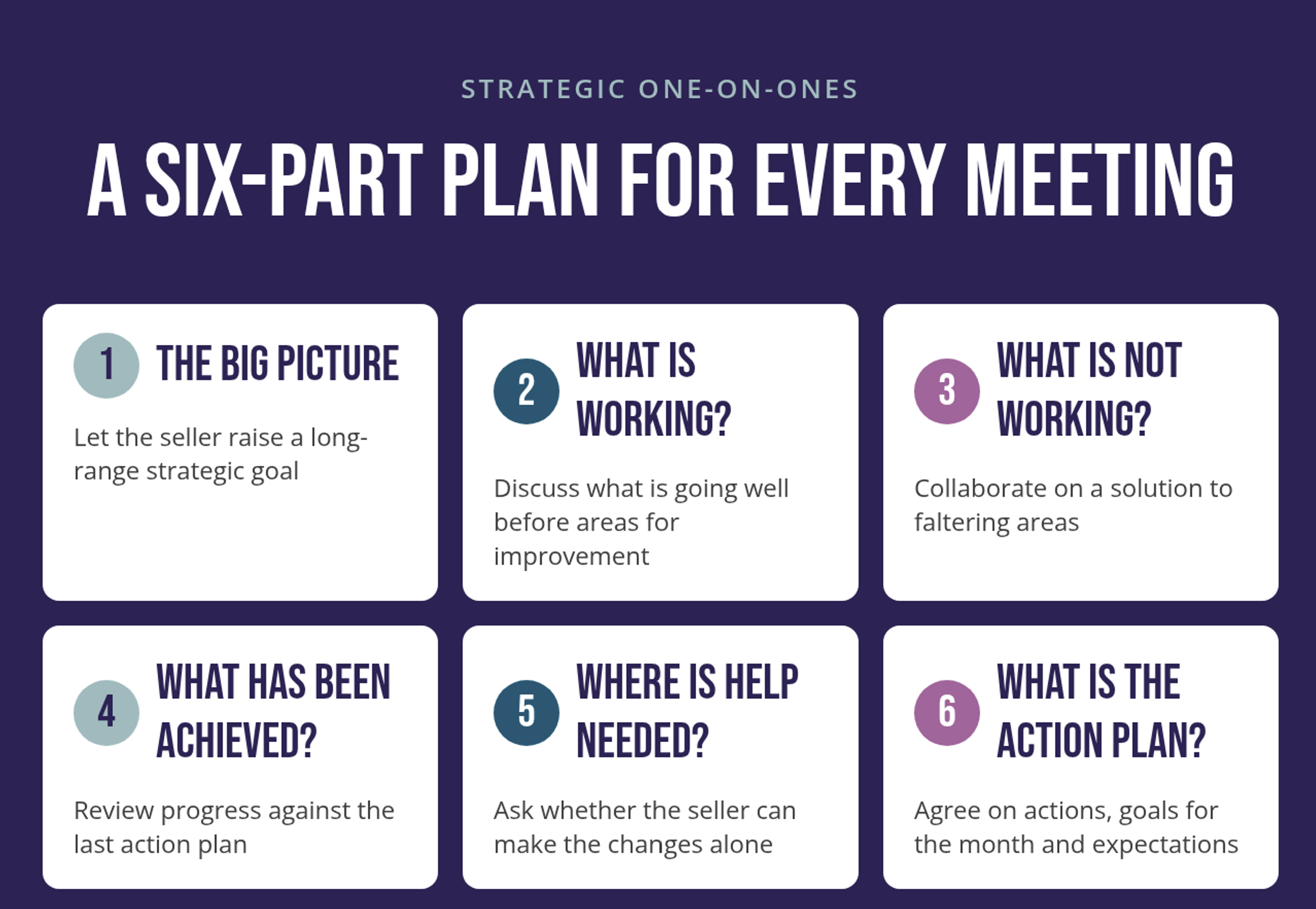
The seller's and the manager's time is valuable. Both are stepping away from their selling activities, so the manager has a responsibility to make the time meaningful. Doing so means having a plan. A well-rounded plan for strategic one-on-ones consists of six parts:
- The big picture. Start by giving the seller a chance to discuss a strategic goal or an aspect of their selling that spans a long period. This gives them room to share information that may not show up in traditional performance metrics.
- What is working? Feedback only works when it is balanced. Before discussing areas for improvement, discuss what is going well. Success is not limited to numerical metrics. It can also be defined by the innovation or overall drive the seller brings.
- What is not working? Which areas of the seller's performance are faltering? This part can be presented as an opportunity for the seller to relieve the stress of an unmet challenge. The manager and seller then collaborate on a solution.
- What has been achieved? Shift to a more tactical discussion and review the seller's progress against the action plan from the previous one-on-one. Ask about new relationships, highlights from the previous month's pursuits, and ongoing focus areas.
- Where is help needed? A one-on-one delivers real value when it converts the seller's challenges into a specific, actionable plan. Some plans will require help from the manager. First, though, ask whether the seller can make the changes on their own, because intervening can tax the manager's time and diminish the seller's sense of control.
- What is the action plan? Both parties answer what specific actions can address the issues, what the goals are for the coming month, and what expectations the manager has of the seller.
Managing Different People Differently
Individual performance starts with understanding what drives each seller.
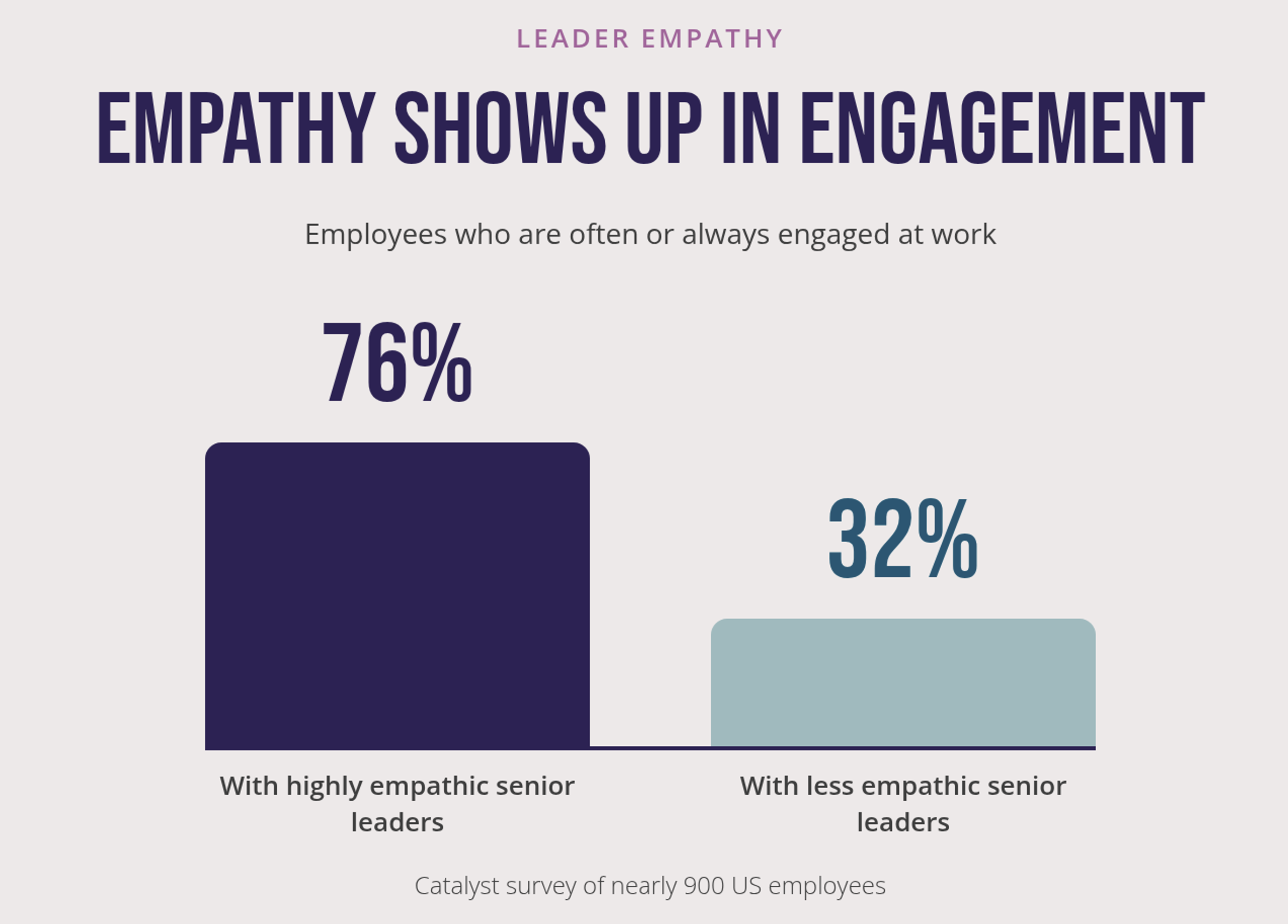
Managers have long understood that their team consists of different people. What is less understood is that, even at the individual level, many factors influence a seller. A Catalyst survey of nearly 900 US employees found that 76% of people with highly empathic senior leaders reported often or always being engaged at work, compared with 32% of people with less empathic senior leaders. Sales managers need a framework for recognizing and addressing the many parts of each seller:
- Broaden the thinking. Sellers are multifaceted and come from different life experiences. Consider whether the person is an introvert or extrovert, their level of motivation, their experience, and their skill level. One person can entail many parts.
- Gain a deeper understanding of the seller. Managers cannot take the same approach to every seller. Learn each seller's personality, what they value in their job, their skill strengths and weaknesses, and what motivates them. It is easy to assume you already know these things, but you learn them only through conversation. These conversations often reveal whether the seller is intrinsically or extrinsically motivated. In nearly all cases, it is an uneven combination of the two.
- Individualize the coaching routine. Decide how often to meet with each seller, the format that works best, how much recognition is needed to motivate them, and how much feedback they need. The answers shape how each coaching session is structured.
- Validate the coaching and management approach. An individualized plan is iterative. Observe where and why a seller's performance falters, then adjust as needed. Share the coaching plan and seek the seller's feedback. The approach does not need to match everything the seller wants.
Motivating Sales Professionals
A sales manager cannot motivate someone until they understand them.
Motivation combines intrinsic and extrinsic factors. Many sales managers believe they have no influence over intrinsic motivation, which comes from within. They can, in fact, influence it by helping the seller see how characteristics of the job connect to their inner drives.
An individual's drivers commonly fall into one of three categories from McClelland's Theory of Needs. Everyone has a combination of the three, but one or two are usually more dominant:
- The need for power. Rooted in reputation and self-esteem. These sellers enjoy being in charge and having a sense of agency, and they like professional respect from others. They often seek more responsibility and want to marshal the resources needed to execute the selling approach they think is best.
- The need for achievement. These sellers have an urge to compete and are motivated by challenges. They seek feedback, see achieving a goal as the most valuable reward, and take personal responsibility for finding solutions. They often want clear, definitive goals so that their achievement is unambiguous.
- The need for affiliation. These sellers are motivated by strong interpersonal relationships and a collaborative environment. The team's success is the reward, and they take special interest in work that provides companionship and social approval.
Managers who understand the differing needs within a seller can motivate them with communication that resonates. A manager who recognizes that a seller is motivated by power might stress the importance of reaching a quarterly revenue goal and, in turn, set a positive tone for others. A seller motivated by affiliation might need to hear that reaching the goal is necessary for the success of the team.
How Does a Sales Leader Create a Sales Culture?
Three capabilities turn culture and accountability from vague norms into deliberate design.
Driving Salesperson Accountability
Accountability depends on clarity and commitment. A seller cannot be accountable without a well-defined understanding of what is expected of them. Three steps build that clarity:
- Develop clear goals. The sales leader must understand how the seller's focus translates to outcomes. This chain of events reveals where and how a seller's intent can lead to unintended results. In many settings, for example, a focus on the quantity of selling activities, which is easy to measure, can distract from their quality. Leaders should develop metrics for each link in the chain: focus – activity (quantity and quality) – pipeline – results. Each link should have a metric, a measurement, and a tracking tool.
- Revise the accountability system. Developing clear goals will almost always change what the sales leader tracks, so the accountability system must focus on the right measurements. Communicate the changes to the team and explain why the metrics were selected. Without that explanation, they appear arbitrary.
- Individualize goals. The most effective way to align sellers to a set of goals is to develop them together. This collaboration also allows the manager to customize goals and measurements to the right people. An individualized approach helps the seller see goals as a reflection of their specific actions, not of a group they are just one part of. Group performance matters, but each member must know what their specific contribution must be.
Strengthening Sales Culture
Sales leaders must construct their sales culture intentionally because it answers the question: How do we sell?
Too often, culture is a vague set of norms that emerge from circumstances rather than intentional design. That is a problem because culture underpins how a selling organization performs. It is the structure the whole team stands on. Getting intentional about culture means doing three things:
- Define the culture. Culture is intangible, abstract, and influenced by many factors, so it is often effective to define the existing culture as a team. It appears different to different people. Then the sales manager defines what the culture should be within the next 12 months. Limiting the description to five characteristics often helps.
- Develop a plan. The leader distills the intended culture into a single statement and gets clear on their own role in making it real, using "I must … so that …" language. Once the what is clear, the manager can think about the how: aligning the team to the intended culture through management disciplines, the specific management and coaching routines that let the culture pervade the team.
- Drive performance. Foster the skills that serve the intended culture by focusing on a consistent set of practices, including practical coaching, observational coaching, team meetings, and one-on-one meetings. Culture tends to drift, so leaders need to revisit their culture statement and confirm their management is true to it. The most common cause of drift is resistance to change on the sales team. When they encounter pushback, leaders should listen, look for trends, and understand the specific reasons. It is fine to adjust some goals slightly, but leaders should remain committed to their statement.
Leading Sales Team Meetings
The most effective sales team meetings focus on structure as much as message.
Over time, sales meetings can devolve into a formality performed out of habit. Effective sales managers prevent this drift with a structured approach built on three parts: simplicity, recognition, and capabilities.
- Simplicity. The pace of the meeting must be brisk to keep the team engaged. For most leaders, focusing on updates, recognition, and one capability is enough to boost team cohesion and skill without losing the participants' focus. Three areas fit within that kind of window, and keeping the segments distinct adds variety.
- Recognition. Recognition draws attention to sellers who put good practices to use, and it builds morale. It brings team-wide visibility to a seller's win while showing the connection between the selling methodology and a closed deal. It sets a positive tone and primes the team for learning.
- Capabilities. Set the context for the new capability and explain why it matters. Make this portion interactive by having sellers practice. Skill building empowers sellers and restores their sense of control over outcomes. The capability should be a skill that can be taught fast, focused on one clear action, and broadly applicable to all sales pursuits, so sellers can leave the meeting and use it immediately.
How Does a Sales Leader Drive Sales Performance?
Three capabilities keep leaders and sellers focused on the right deals, the right actions, and the right outcomes.
Coaching in the Field
Great coaches look at the field, not just the scoreboard.
Field coaching differs from one-on-one coaching because it is specific to a moment. It often occurs while a pursuit is in play and focuses on the details of a particular deal. One-on-one coaching, in contrast, examines annual or quarterly trends. Though field coaching happens in the middle of a sales action, it is not spontaneous. It begins with preparation, then moves to coaching and feedback.
- Prepare. The sales leader learns the details of the seller's current pursuit while collaborating in a way that eases any stress of being coached. That information shows which skills to develop and which role to take: an observer who offers feedback after customer conversations, a model who displays the specific behaviors they want to see, or a subject matter expert who provides insight at a pivotal moment in the sale.
- Coach. An effective coach intervenes only when the consequences of not doing so are significant. For example, they might step in if the seller moves forward without fully understanding the customer's needs, if the customer is about to decide based on incorrect product information, or if the seller is doing all the talking and not asking enough questions. After stepping in, the coach must know how to step out and hand the situation back. Holding back the urge to intervene builds the seller's critical thinking, lets them exercise control over the situation, and helps them develop their own responses.
- Give feedback. Begin with what went well in the customer call. Let the seller cite where they were effective, then share what the coach thought they did well. Next, ask what they intend to do differently next time. Finally, be clear about what you want to see next time. Feedback works when it is balanced (the coach listens as much as they talk), honest (it identifies the most important areas for improvement), and direct (it is communicated succinctly).
Reviewing Pipelines
Pipeline management brings early visibility to challenges that might otherwise prevent the sale.
Pipeline management is the process by which sellers and sales managers track and analyze opportunities as they enter and move through the sales process. It focuses on pursuing the right opportunities, accelerating sales, and closing more business. Making it work means first helping the seller see that pipeline management is not just a management practice. It has considerable benefits for the seller too. An effective approach has three steps:
- Understand the components of a healthy pipeline. Start with a clear goal. For most teams, that means the right balance between deal sizes and number of deals, the right mix of products across deals, a balance of opportunities across stages of the sales process, and opportunities in alignment with business goals.
- Analyze the pipeline. Understand where the challenges reside and what causes them. Three are common:
| Challenge | Often caused by |
|---|---|
| Gaps | Insufficiently qualified opportunities, improperly valued deals, and a lack of customer questions |
| Blockages | Pricing challenges, inaccessible stakeholders, and a lack of internal teamwork |
| Leaks | Competitive pressure, poor articulation of value, and an incomplete assessment of needs |
- Develop a pipeline discipline. Pipeline discipline is about committing to a schedule. Set a frequency for reviewing progress with sellers, and watch for challenges that appear across many pipelines. If numerous sellers share a common point of failure, the manager needs the discipline to act early and develop a solution that addresses them all.
Reviewing Opportunities
Even the best selling skills are of little value unless they are focused on the right pursuits.
Opportunity reviews ensure better qualification, more accurate forecasting, better resource use, and more closed sales. Consistent, well-run opportunity reviews make the seller and the team more efficient. Three principles guide them:
- Emphasize outcomes over activities. Activities feel like progress, and CRM platforms record them, which offers a sense of accomplishment. The problem is that more activities do not always yield more results. The most effective reviews analyze what verifiable outcomes have been achieved and the specific actions needed to reach the next intended outcome. The manager's job is to keep the conversation on the selling moves that advance the buyer through the pipeline.
- Make data-driven decisions. Managers must choose where to focus their limited time. Many choose subjectively, which often leads to inconsistent results. An effective review uses an objective, data-based approach. That means the seller keeps CRM data up to date and the manager clearly communicates which data they consider meaningful to the pursuit.
- Be selective about which opportunities to review. Reviews keep the manager focused on the right opportunities, not just the seller on the right actions. It is not feasible to review every opportunity each seller is pursuing. Consider the financial value of the pursuit, the fit between the solution and the customer, and the seller's access to key stakeholders.
Can Sales Leaders Learn These Capabilities?
Yes — and they need to. Succeeding means knowing the range of capabilities sales managers need to drive performance across the team. Sales leaders must learn and develop these capabilities. They do not emerge on their own. They belong to a deliberate strategy for building cohesive teams that win.
"Richardson has helped us establish a common sales language and create greater alignment across our global sales organization. They have strengthened both selling and coaching capabilities while supporting a structured development journey for sales professionals and leaders." — Patrick Klein, Sales Enablement Manager, Endress+Hauser
How Does Richardson Help Sales Leaders Build These Capabilities?
Richardson's sales manager training has a module for each of the 11 capabilities in this playbook, built around the routines described above. Consultative Sales Coaching anchors the curriculum, and Richardson customizes the training to each client's selling environment.
The approach works at scale. For one global manufacturing client, Richardson trained 15,000 sales professionals and 2,000 sales managers, and certified 92 internal trainers, delivering the program in nine languages.