Will AI Replace Salespeople? What Generative AI Changes — and What Stays Human
Sales performance improvement

Written by: Andrea Grodnitzky, CMO
Published: November 4, 2026
Generative AI is no longer a passing interest to sales organizations. It’s quickly becoming a primary tool.
As adoption grows and sales leaders recognize the technology’s power, they don't know how to implement it for maximum benefit. Generative AI’s open-ended nature requires users to think critically about how and where to direct its potential.
Key Takeaways
- AI is taking over a growing share of seller work, including research, outreach drafting, account prioritization, and deal-risk analysis.
- It is not replacing the human side of selling: reading a buyer’s emotions, building trust, and exercising judgment in high-stakes conversations.
- Sellers who use the time AI frees up to build those skills are best positioned to win.
What is generative AI already doing in sellers’ work?
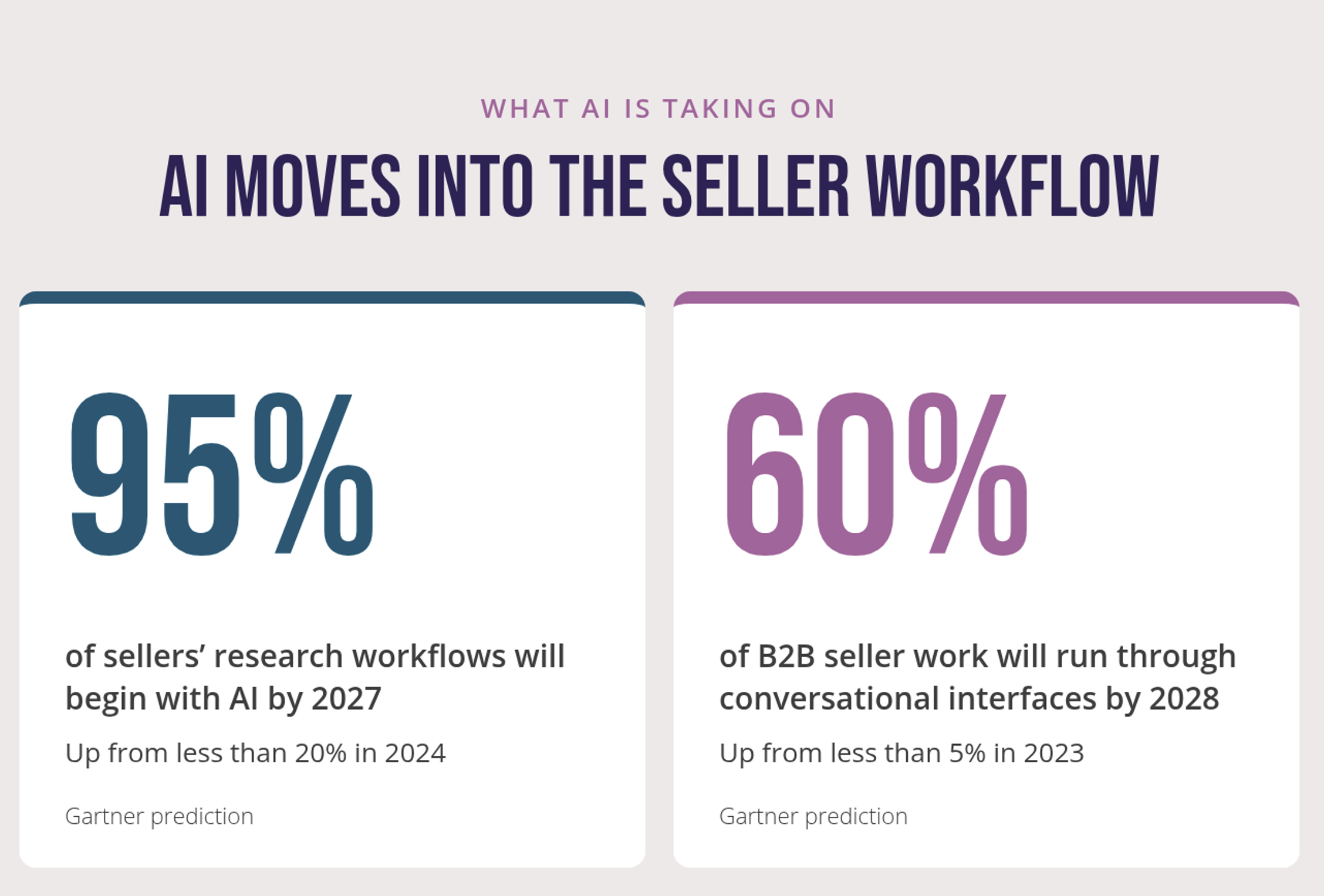
As the technology begins to replace some of the seller’s work, leaders need a plan for adopting it in a way that yields benefits beyond productivity gains and emphasizes the unique skills that only humans can deliver. The time for that plan is now. Gartner predicts that by 2027, 95% of sellers’ research workflows will begin with AI, up from less than 20% in 2024.
Gartner also predicts that by 2028, 60% of B2B seller work will be executed through conversational user interfaces via generative AI sales technologies, up from less than 5% in 2023. Even so, Gartner’s guidance for chief sales officers is that AI improves how tasks get done without replacing human sellers.
In sales, four use cases stand out.
Hyper-personalization at scale
Generative AI enables sellers to create highly customized outreach content, including emails, LinkedIn messages, and call scripts. The technology can tailor these messages to a specific buyer’s role, industry, company goals, and even recent news. Sellers struggled to generate early-stage opportunities because doing so required cutting through the noise and getting noticed, and finding the time to create bespoke messaging at scale was even harder. Sellers can now use AI to develop outreach that piques the prospect’s curiosity, reframes their thinking, and drives action.
How to do it: Sellers must act as curators rather than creators. They review AI-generated content for messaging material rather than building it from scratch. With this approach, the messaging becomes relevant across multichannel communications and resonates in a way that compels buyers to act.
AI-assisted account intelligence
AI synthesizes massive data sets — CRM data, public filings, social media, and more — to surface ideal customer profiles. Sellers can quickly identify companies that match their ideal customer profile and are seeking a solution, based on account-level intent data. This goes beyond static company data like revenue and organizational structure by analyzing digital signals that indicate a company is considering solutions similar to those the seller offers.
How to do it: Rather than blanketing a territory with a generic approach, sellers use AI to prioritize accounts for business development activity, then engage the right personas. A greater focus on the accounts likely to purchase improves prospecting yields and opportunity creation.
Revenue intelligence for deal coaching
Sellers use generative AI to analyze buying signals in live conversations and offline communication. They can identify deal risks like relying on a single contact, lack of buyer engagement, and competitive risk. When AI presents these risks in data visualizations, sellers and managers can quickly identify critical, actionable deal information.
How to do it: Sales managers are always short on time. With AI, they can proactively manage deal risk across a diverse set of opportunities without too many demands on their schedule. That efficiency leads to higher win rates and greater sales cycle velocity.
Behavioral analytics to diagnose alignment to methodology
AI also offers critical information about sellers. It can assess how well a seller demonstrates the specific, measurable, and observable behaviors that drive wins in front of customers and prospects. Selling organizations can listen to sales conversations to see how well sellers use the skills and practices aligned to the organization’s methodology. This real-time data shows how well a sales transformation is occurring and where to calibrate the enablement strategy.
How to do it: Map specific sales performance metrics to the sales behaviors that drive them. That shows leaders how to move those metrics and drive better performance. The process shouldn’t be a one-time event — run it as a cycle, so revenue-relevant selling behaviors continuously evolve.
AI can extend a manager’s coaching reach, which matters most for the people coaching at the edge of their capacity. As Darnetta Daire, Sales Enablement Manager at Hollister Incorporated, puts it:
“I’m a team of one, so I’m not everywhere. Our managers may not have the capacity to do a lot of that coaching. I think with this system, it now allows us to be places that we can’t be.” — Darnetta Daire, Sales Enablement Manager, Hollister Incorporated
Where does a seller still add unique value?
Pre-pandemic Gartner research found that buyers spend only 17% of their purchase time meeting with potential suppliers, and about two-thirds of it researching, learning, and meeting with peers on their own. That makes every seller moment count.
More recent buyer data points the same way. A 2026 Gartner survey of 645 B2B buyers found they were 32 percentage points more likely to say a sales rep made them feel confident in the purchase decision than to say the same of GenAI, and 39 percentage points more likely to say a rep understood their needs. Gartner adds that AI is well suited to account research, personalized messaging, signal monitoring, and next best actions, while sellers remain differentiated in empathy, judgment, contextual understanding, and value framing.
Buyers rely on both logic and emotion when purchasing. AI is well suited to serve the customer’s need for logic. It can make a rational business case, prepare an agenda and talking points, and use research to demonstrate an understanding of the buyer’s business. The more challenging task — appealing to the customer’s emotional state — belongs to the seller.
That matters because Forrester research finds that B2B buyers often choose the lowest-risk option rather than the best one, because they expect most of the risk to land on them personally and most of the reward to go to their company.
Bain’s B2B Elements of Value, published in Harvard Business Review in 2018, identifies 40 types of value in five tiers. The base tier, table stakes, is meeting specifications at an acceptable price, complying with regulations, and upholding ethical standards. Bain found that subjective concerns often play a surprisingly large role in business purchases. As AI levels the playing field, higher-order skills help sellers understand the complex, real-world challenges that gain the buyer’s attention and trust.
Those skills draw on behavioral science and an understanding of how people buy. People have biases that distort rational decision-making, and sellers need to understand how those tendencies emerge at each stage of the buying journey. Many buyers have a strong affinity for the status quo, which they see as more comfortable, safe, and familiar than any alternative. Kahneman and Tversky’s 1979 work on Prospect Theory showed that people weigh losses more heavily than equivalent gains, so a seller who understands loss aversion can help frame the status quo as a decision that threatens loss more than it offers gains. Later in the sale, sellers also manage concepts like choice overload and regret aversion to ease worries about late-stage risk.
What skills will set sellers apart as AI levels the playing field?
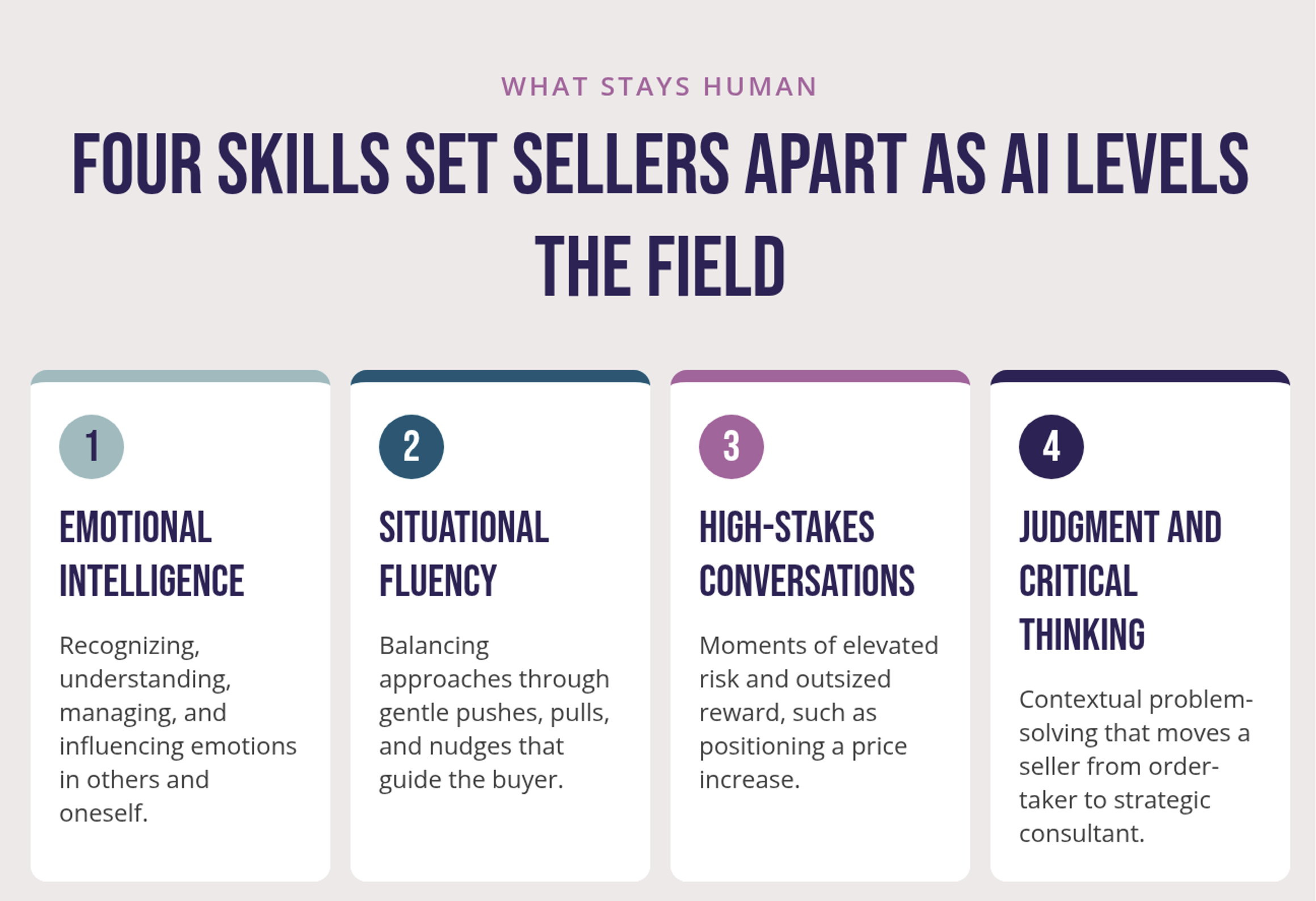
As widescale AI adoption equips every sales organization with efficiency and productivity advantages, sellers will need a more sophisticated approach to engaging customers — one that goes beyond data, value propositions, and logistics. It requires focus in four areas.
Emotional intelligence
Emotional intelligence means recognizing, understanding, managing, and influencing emotions in others and oneself. It’s crucial in the business of influence and persuasion, because sellers have just a few valuable opportunities to engage with buyers. Making the most of those moments takes Richardson’s Six Critical Skills: Presence, Relating, Questioning, Listening, Positioning, and Checking.
These skills separate average sellers from excellent ones. Sellers who have mastered Presence demonstrate the quality of their preparation and establish credibility within the first 60 seconds. Further into the sale, they apply Questioning with an intentional approach to pacing and phrasing, which deepens the dialogue, reframes the customer’s thinking, and reveals unrecognized needs while building trust. They use Checking to confirm the buyer is following at every step. And they use all of it repeatedly as the buying team grows, to manage multiple stakeholders and drive consensus.
Situational fluency
Situational fluency balances different approaches based on a dynamic assessment of the situation. The seller’s job is to guide the buyer toward the best decision for themselves and their company through a series of gentle pushes, pulls, and nudges. Four core behaviors equip sellers to be that guide:
- Constructive tension. Not tension between buyer and seller, but challenging the customer’s beliefs and assumptions, surfacing hidden pains, and pushing the buyer to think differently. Sellers read the emotional temperature and know when to dial the tension up or down.
- Discovery. A questioning strategy that surfaces recognized and unrecognized needs, balancing drilling down, floating ideas, and trading information.
- Balancing storytelling with business cases. Fact-based arguments have their place, but sellers balance them with accessible, relatable details that emerge from a narrative.
- Employing ROI and COI. At different stages of the buying journey, sellers address the buyer’s changing behavioral biases. Sometimes that means citing the cost of inaction (COI) to disrupt the status quo. At other times it means showing how the return on investment (ROI) supports the case for action.
High-stakes conversations
High-stakes conversations present elevated risk but also outsized rewards. They are the moments when the best sellers differentiate themselves — for example, positioning a price increase or managing an adversarial negotiation.
The risks:
- There is an existing conflict, or potential for conflict to ensue.
- A customer feels pressured, threatened, or at risk of losing internal credibility or control.
- The seller appears self-serving or pushy, which erodes trust.
- The seller needs to offer a perspective the customer doesn’t want to hear.
The rewards:
- Helping customers clarify and align their thinking, eliminate waste and delays, make the best decision, and reach their business outcomes faster.
- Creating a differentiated buying experience and positioning yourself as a trusted advisor.
- Steering things forward in a way that produces the best outcome for the customer and yourself.
Judgment and critical thinking
A customer’s problems and concerns are often complex, dynamic, and messy. Critical thinking involves creative, contextual problem-solving based on lived professional experience. Judgment involves assessing stakeholders, the solution’s fit, negotiation strategies, and competitive positioning. Together, they take a seller from reactive order-taker to strategic consultant who can steer large deals through organizational complexity to a close.
Sellers tailor both to specific stakeholders. When speaking to a CFO, a seller thinks critically about the solution’s impact on revenue generation or cost reduction and appeals to the CFO’s need for measurable impact. When speaking to a CTO, a seller uses judgment to contextualize the solution’s value within the existing tech stack.
Amber Boll, Director, Sales Global Process Owner at Rich Products Corporation, describes what it looks like when these skills take hold:
“When you put those behaviors into practice — questioning and listening, having facilitated sessions with coaches that actually get in there and can coach them along the way — our teams are better able to actually apply some of those behaviors in the moment with their customers.” — Amber Boll, Director, Sales Global Process Owner, Rich Products Corporation
What does the difference look like in practice?
Consider two sellers who both adopt generative AI for all the right reasons: faster research, drafted prospecting messages, and profiles of potential buyers. The productivity gains give both more time. What differentiates them is how they use it.
| Seller one | Seller two | |
|---|---|---|
| How they spend the time | Fills it with emails, admin, and back-to-back meetings | Practices opening meeting dialogue and pacing and listening skills |
| Preparation | Spends less time researching and thinking about content | Preps the full range of strategic questions and anticipates objections and how to resolve them |
| Skill focus | Stays busy but doesn’t get better | Masters constructive tension |
By using AI to handle research, the second seller can focus on the behavioral skills that make a difference in the crucial, fleeting moments in front of the customer — the interpersonal skills and behaviors AI can’t replicate. That positions them not just to win, but to grow into a trusted advisor.
What should sales leaders do next?
AI has enabled more productivity in seller workflows, and with that productivity comes more time. Sellers have an opportunity and a responsibility to use that time to build the emotional intelligence that will make them stand out. Leaders start by prioritizing the most pragmatic AI use cases, then measure whether the behaviors that matter are actually showing up in customer conversations.
The results of building those behaviors are measurable. Across Richardson’s client base, participants in sales team training see, on average, a 24% improvement in skill proficiency and a 35% increase in knowledge proficiency, and client revenue grows between 5% and 12% depending on the industry. After launching a Sales Effectiveness initiative with Richardson, Cargill’s top performers increased revenue by 30%.