What Is Consultative Prospecting?
Sales performance improvement

Written by: Ben Taylor, MBA, Content Marketing Manager, Richardson
Published: November 23, 2026
Effective sales prospecting requires agility because targeting the right customers, creating compelling, contextual messaging, and seeking engagement are all iterative processes.
Sales professionals must learn, and re-learn, the customer's setting because earning their attention means speaking to the specifics of their world. The challenge is that those specifics are changing fast. Industry convergence drives much of this change.
Key Takeaways
- Consultative Prospecting is a structured prepare – engage – advance approach to outreach.
- Sales professionals research each prospect's business, lead with insight rather than a pitch, and tailor their targeting, messaging, and cadence to that prospect.
- It replaces the "numbers game" — one message sent to a large list — with outreach that fits each prospect's situation.
What is Consultative Prospecting?
Consultative Prospecting is a clear, repeatable, and structured approach built on a prepare – engage – advance pattern. It embraces the dynamic nature of prospecting and integrates specific techniques, skills, and tools to progress each interaction.
- Prepare is about building acumen around the prospect's business and industry. It is about creating an outreach plan and developing messaging and call flows.
- Engage is about gaining the appointment and seeking referrals.
- Advance is about reflecting and assessing the best next step.
Moving at the pace of industry change means becoming agile with a cycle-based mindset and using short bursts of activity that revolve around key moments of conversation with the prospect. This methodology allows the sales professional to adjust at any time and be relevant in the moment, so that each cycle results in a mini close. Each conversation equips the sales professional with the knowledge needed to assess the next best move. Sales professionals plan and execute a single cycle at a time, and adapt future cycles based on the outcome of cycles completed.
Consultative Prospecting works because it moves alongside the customer's changes and even benefits from new, unexpected information. As details emerge, the sales professional gains more insight into the customer's needs and can improve their prospecting by delivering focused messaging. This is fundamentally different from traditional methodologies, which rely on messaging that is broad but shallow.
Why does prospecting demand this kind of agility?
Industry convergence occurs when the boundary separating two seemingly unrelated industries begins to blur. This is the natural result of digital transformations that enable businesses to grow through the adoption of digital processes and technology. As businesses embrace new technologies, they begin to resemble a new entity driven by different needs and goals. This trend has existed for decades. Consider that Nokia began as a pulp and paper mill, or that American Express was originally an express delivery company.
Today, the speed and pervasiveness of this development are intensifying. PwC's research describes a third wave of industry convergence that, unlike the previous two, affects industries across the board. Industry convergence is the reason terms like fintech, agtech, and insurtech have become popular.
Convergence creates new challenges for prospecting because stakeholders' needs change enormously when their business enters non-core industries. Understanding where and how industries intersect reveals, for example, that the most pressing needs of a manufacturing customer are not related to manufacturing itself, but to the challenges of "Industry 4.0," in which technologies unite digital information from both physical and digital sources.
It is no longer enough to understand the prospect's core business. Sales professionals must develop the agility to understand the expanding sphere of the business — and that agility must be visible in their actions.
How is Consultative Prospecting different from the "numbers game"?
The traditional notion that prospecting is a "numbers game" is not relevant in today's market. The numbers game approach suggests that the same message deployed across a large enough group will eventually yield a result. Lacking in rigor and sophistication, it merely churns through leads and encourages prospects to view the sales professional and the solution as a commodity.
Generalized messaging is not effective when each prospect faces a unique and unmatched set of challenges. Sales professionals can increase their odds of success by improving every facet of prospecting: their approach, their targeting, their messaging, their cadence, and their conversations. Taking the time to identify the ideal prospects also lets the sales professional apply more focus to the messaging they draft.
How do you prepare to engage a prospect?
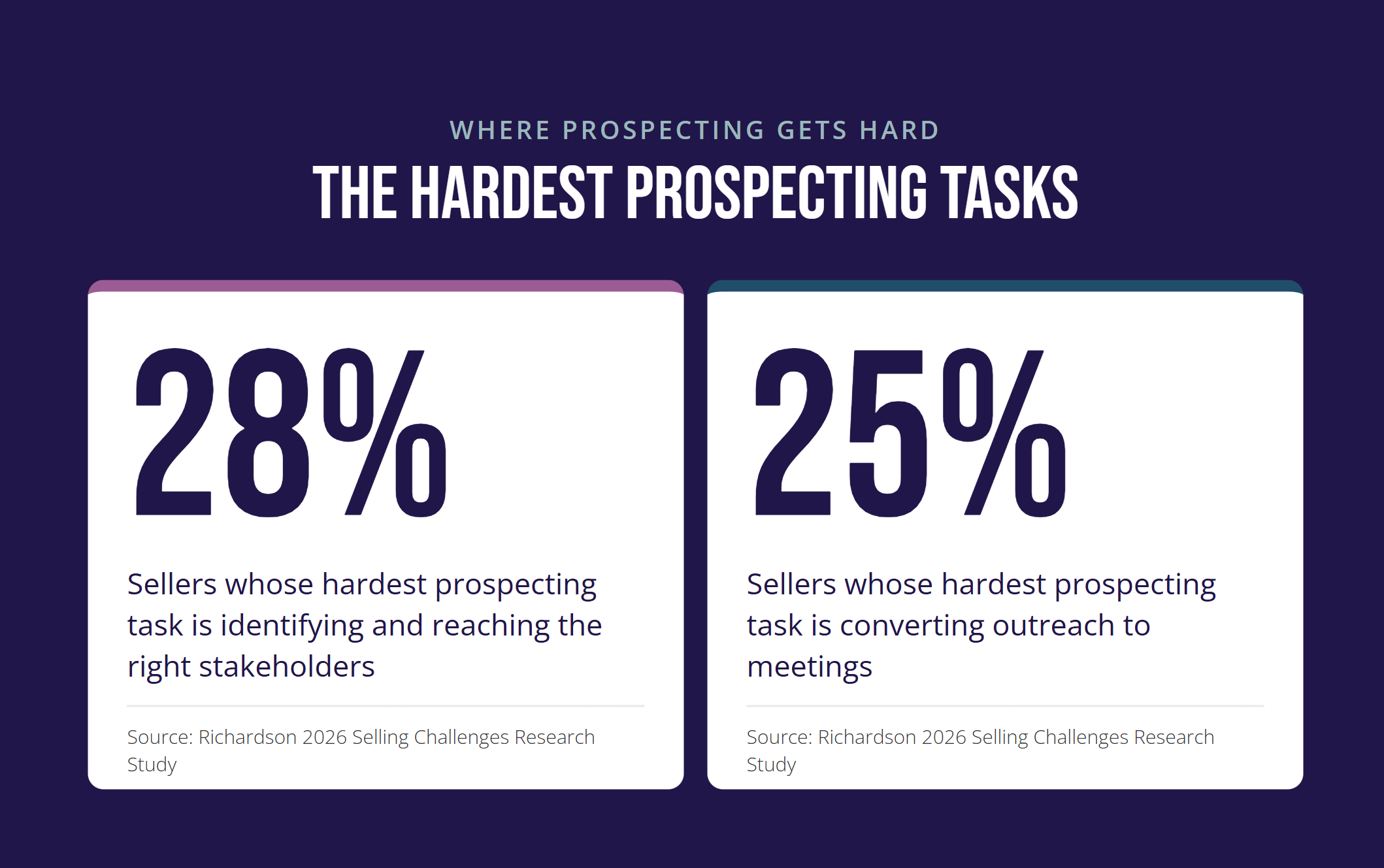
Customers want sales professionals to add value during every exchange. That makes it critical to build an understanding of the customer's business and industry by developing a research cadence and protecting that time. Richardson's 2026 Selling Challenges Research Study found that sellers' hardest prospecting tasks are identifying and reaching the right stakeholders (28%) and converting outreach to meetings (25%).
Listen
Listening means setting and monitoring alerts that keep the sales professional up to date on the latest developments within an industry or a prospect's business. It also means exploring the prospect's social "footprint," which offers insight into the prospect's thinking and possible future direction. Most prospects are broadcasting their thinking — especially in their posts and publications — as long as the sales professional knows where to tune in.
Network
To begin networking, consider how to respond to the prospect's posts in a meaningful way. The key is to share relevant content and insights that invite responses and are searchable. Individually, these actions do not advance the sale. They do provide a solid base on which the relationship can be built, so that when the time comes to make a request — for the prospect's time, attention, or information — the communication continues.
Connect
When it is time to connect, strike a balance in which the communication is professional but not impersonal. The sales professional might cite a common acquaintance or congratulate the prospect on a recent achievement. Delivering messaging that is customized to the prospect is a form of reciprocity.
“They’ve done a fantastic job of actually running through the process that they teach on their end — understanding what we’re trying to solve for, understanding at what level each salesperson is at, and where we need to get them to be.”
— Mike McDonald, Executive Vice President, Sales and Marketing, Affiliati
How do you build trust with a prospect who doesn't want to be sold to?
Most prospects are not eager to talk with someone trying to sell them something, but they are eager to engage with a sales professional who has the goal of constantly providing value and insight in an authentic manner. Two ideas make this work: reciprocity and authenticity.
Reciprocity
When a person offers something of value, the other feels compelled to eventually offer something in return. Sales professionals can engage the law of reciprocity by offering a valuable insight to the customer. In time, the customer responds in kind. They offer some of their time, important information about their needs, or details about the decision-making process within their organization. All three are valuable to the sales professional and rarely learned any other way. The sales professional should never offer insights that only connect to the value proposition of the solution.
Authenticity
Authenticity emerges from genuine curiosity about the prospect's business and a sincere interest in helping them. When actions are driven by these things, the prospect's trust develops because the initial conversations are not about the product or service. Every insight must also answer the question, "So what?" The sales professional must make clear how the information they bring connects to the stakeholder's challenge. Otherwise, their status as an outsider only strengthens. The goal is to blur or erase the line that separates the sales professional from the stakeholders.
Authenticity is not a strategy. It is a mindset — the result of a sincere commitment to the customer's challenges. Sales professionals cannot make authenticity a goal. Instead, they must develop a genuine interest in understanding the business issues, including how the stakeholder's business works and the direction of the industry. In the race to close the sale, too many sales professionals forget that most purchasing initiatives end in no decision. Stakeholders need a compelling sales professional to clarify the challenge.
Who should you prospect?
Most sales professionals are ultimately held responsible for attaining their quota or other targets. Too often, this means relying on lead generation from other sources. Sales professionals must be able to nurture relationships, engage as thought leaders, and more directly create curiosity with prospects in traditional and non-traditional ways. That starts with identifying the ideal customer.
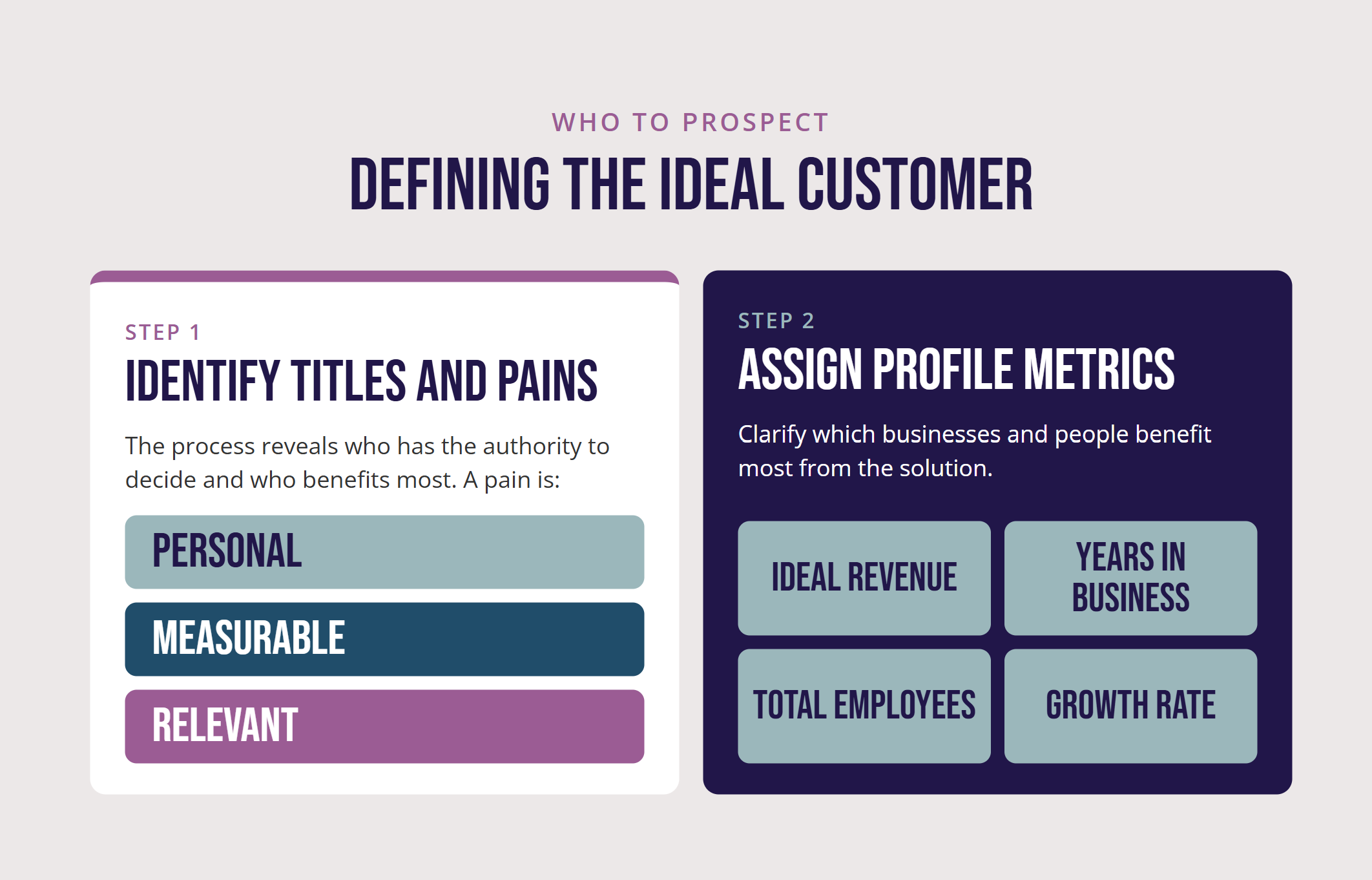
Some ideal customer criteria — the business issues underlying a potential opportunity — are not always easy to find. Approach this by identifying the relevant titles and pains, remembering that a pain is something that is personal, measurable, and relevant. The process also reveals who in the prospect's organization has the authority to make a decision and who can benefit most from the solution.
Sales professionals should also assign specific metrics to the ideal customer profile, such as ideal revenue, years in business, total employees, and growth rate. The purpose is to gain clarity on what kinds of businesses and people can benefit most from the sales professional's solution.
How often should you reach out to a prospect?
Priming bias tells us that someone becomes more open to something the more they are exposed to it. There is a fine line between being professionally persistent and intrusive, and a consistent, multi-touch approach provides the exposure that makes the difference. The available channels include phone, email, direct message, tweet, video, webinar, virtual event, or social discussion group. Having so many channels lets the sales professional consistently "drip" content and messaging.
Some call this "bread crumbing" value. The idea is to rely on the incremental gains that come from repeatedly and reliably offering value to potential customers like a narrow trickle of water that slowly gathers to an ocean. The gradual build matters because the dominant challenge for sales professionals today is helping potential customers overcome the status quo. Any new idea or solution feels like an uncomfortable disruption. That force keeps many businesses rooted in place even during periods of great economic change. Some call this immobility "active inertia," the act of applying old, irrelevant strategies to new problems.
Planning a cadence is critical for three reasons. It makes the sales professional more likely to follow through. It builds a data set that shows when and where a prospect is most likely to respond. And it prevents the misstep of becoming too frequent. For many sales professionals, a four-part cadence is effective:
- Days 1–10: plan a high number of touches. On Day 1, make a "double touch" — a call followed by an email. Salesloft data shows that most top-performing cadences open this way, although these are averages that sellers should test against their own results. On Day 2, make a pair of calls, one in the morning and one in the evening. Allow breathing room between touches, and include social touches in the plan.
- After Day 10: increase the wait time between touches. This keeps the prospecting going without becoming too intrusive.
- Mix the message and the media. Consider one image in the second email. Infographics and simple one-page explainers add value, and short video communicates a succinct message without the cognitive load of written communication. Salesloft data shows that video performs best on Day 5 of a cadence, and that anywhere between Day 2 and Day 20 works well.
- After 15 touches, keep nurturing one to two times per month.
How do you write a message that earns a response?
Customers can and will disengage quickly if they don't perceive value or immediately feel there is a reason to speak with the sales professional. Resonant messaging means:
- Suggesting that you have helped similar businesses
- Implying that you have helped solve real business problems
- Articulating tangible value
- Describing how you have helped deliver results
- Prompting curiosity
- Differentiating the messaging from others
- Remaining relevant to the prospect
- Keeping the phrasing concise
- Avoiding unnecessary details around the solution
- Inviting action
Start with a value statement
A value statement is a structured message that links the sales professional's capabilities to a known or potential customer issue, which increases persuasiveness. It offers a template for communication that is concise and clear, and it has three parts:
- Issue: What is important to the customer?
- Action: How can you help?
- Value: So what?
Think of it as a 30-second commercial of what the sales professional can do for the customer. To be persuasive, it must be tailored to the customer and draw on the market intelligence within the selling organization. It must also be concise, because the customer's time is short, and delivered in a positive, confident tone.
Make it salient
Saliency bias tells us that information that stands out or seems relevant is more likely to affect our thinking and actions. Developing salient messaging is akin to broadcasting at the customer's frequency. To find that frequency, research the developments within the customer's business, the key concerns of the executive team, the looming challenges of the coming quarters, how the prospect's offering and customers are changing, and the prospect's competitive landscape. Understanding these factors and creating messaging to address them is what elevates a sales professional to a trusted advisor.
That research draws on internal resources, to see whether previous conversations with the lead have occurred and what was learned. It also draws on "trigger events" — actions that would make the sales professional's solution relevant — and on the details of current customers that are similar to the prospect.
Choose the right messaging style
As the sales professional learns the nuances of the prospect, a different messaging style may become appropriate.
- The customer success story encourages the prospect to think about whether they can relate to another customer's struggles. A clear, concise story cites the customer's industry, the critical business issue, the reasons underlying the issue, the capabilities offered to address it, and the quantifiable results. For example, if the main pain is "declining profitability," the results should cite something like "six months after implementation, profit margins increased by 5%."
- The value proposition quantifies the benefit a prospect can realize through specific capabilities, stating what the prospect can improve and by how much, in dollars or percentage. It is a very structured approach that should be built on research and extrapolated from a successful, comparable customer. Use it only when the seller can defend it and articulate the research and assumptions behind it. It reads as thought-provoking or even provocative, and it can be followed by a customer success story.
- The list of core challenges is a brief statement focused on the pains likely to be top of mind for the targeted job title, and it may reference relevant, successful customers to build credibility. It is purposely concise to create curiosity, and it works best early in a multi-touch cadence. When citing customers by name, get permission and make sure they are relevant for the target account.
Why does Consultative Prospecting fit a converging market?
Industries no longer have well-defined boundaries, because to remain competitive more businesses are converging with other entities to harness the capabilities of emerging technologies. Effective prospecting means seeing this change as it unfolds. Consultative Prospecting is built for this new reality. It equips sales professionals with the skills to deeply engage leads, market themselves, and access underlying customer needs.
“Richardson’s been a great consultative partner. All of the approaches that we’ve been bringing to our sales organization to make them more effective in their customer interactions — you guys walk the walk and talk the talk.”
— Jeanne Delancey, Director, Commercial Learning and Development, Cencora