What Should a New Sales Leader Focus on First?
Sales performance improvement

Written by: Claire Imber, Director of Content Strategy & Thought Leadership
Published: November 23, 2026
Like a 747 speeding down a runway, sales leaders stepping into a new role have only so much time before they need to reach cruising altitude. The problem: the runway is shorter than it has ever been.
The reason: advancing technology increases efficiencies, but it also increases expectations. We can do more, but more is expected — and sooner. Moreover, technological advantages erode as the competition uses these increasingly commoditized tools.
Key Takeaways
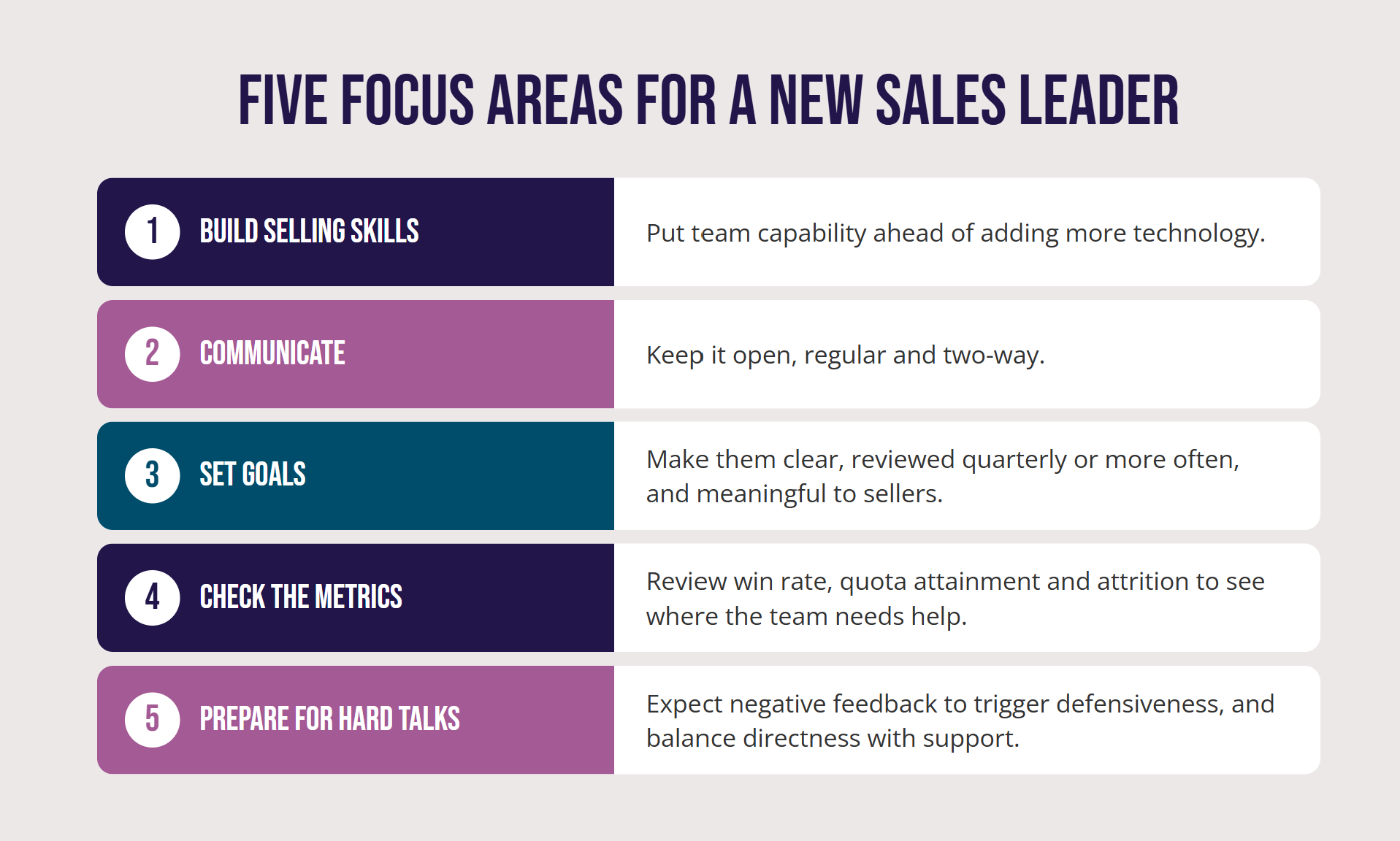
- Focus first on building your team's selling capabilities, not on adding more technology.
- Start with communication: keep it open, regular, and two-way.
- Set clear goals, review them regularly, and check win rate, quota attainment, and attrition to see where your team needs help.
- Prepare now for difficult conversations, because they are part of the job.
Why should a new sales leader focus on selling skills instead of more technology?
The answer is not more or better technology. It is stronger skills among those using the technology. McKinsey's global managing partner and a senior partner make a similar case: as AI spreads, human capability, not access to technology, is what sets organizations apart.
Selling organizations see this challenge every day. They intensify their focus on measurable activities within CRM systems. This time-consuming routine comes at the cost of a core selling practice: meaningful customer interactions. A strong sales leader closes that gap.
For this reason, it's critical to enter a leadership position with a plan to drive, above all else, the team's capabilities in selling.
How does a new sales leader keep a team motivated?
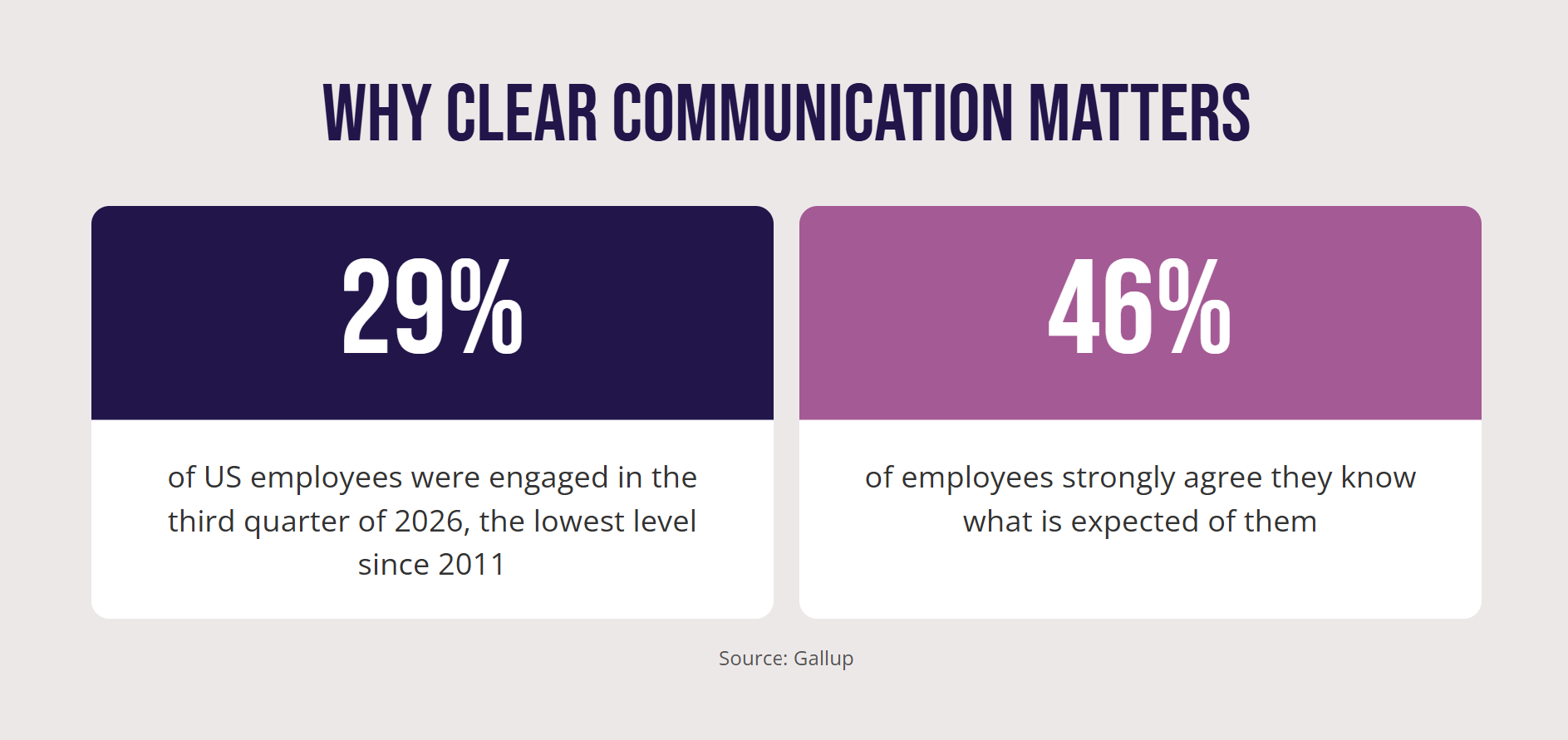
Motivation requires renewal, and communication drives it. Gallup found 29% of US employees engaged in the third quarter of 2026, the lowest level since 2011 — which means more than seven in 10 are not engaged at work. Fortunately, the factor most strongly associated with engagement is one leaders can influence: manager support. Only 46% of employees strongly agree they know what is expected of them, so clear, regular communication matters.
Keep communication open and regular. Doing so reminds the seller that they are critical to success and part of a larger team. Moreover, communication instills a sense of collaboration. The most successful teams thrive on shared contributions rather than one-way communication characterized by directives.
As more conversations unfold, the seller will be more likely to volunteer information. This openness creates opportunities for new ideas or solutions to emerging problems.
"One of the things that has been most important to me is having a common methodology and even a common vocabulary that we can use to describe where we are in terms of stages in the sales process with all of our team members." — Kristin Krawczyk, Senior Sales Director, Cencora
How should a new sales leader set goals?
Goals that drive results do three things. They are clear. That clarity stays ongoing through the review process. And they matter to, and resonate with, the people who own them.
Goals work best when sellers feel vested in their own success. Finding this level of engagement requires employees and sales leaders to revisit their goals quarterly or more often.
How can a new sales leader find out where the team stands?
In many cases, the business expects a new sales leader to do more than stay the course. Often the team needs to improve its performance. That is, after all, why the business needed a new leader in the first place. Therefore, the leader must determine where the problems reside. Doing so means reviewing a few critical selling metrics.
The benefit of numbers like win rate, quota attainment, and attrition is that they're relatively easy to measure. Leaders can get these numbers fast. They contain little ambiguity and underscore the most pressing challenges.
Metrics can also show what skill growth is worth. An enterprise software company working with Richardson raised its win rate from 48% to 69% in the first year of implementation, earning more than $8 million in additional revenue as a result.
When looking at these numbers, it's important for leaders to remember that this step instills anxiety in some team members. Therefore, make clear that the intention is to drive performance with skill growth and not a "rank and yank" approach.
How much of the team's success rests on the leader?
New sales leaders should remember the proverb "All roads lead to Rome." This phrase is a reminder that many different routes tend to result in the same outcome. That is, the effectiveness and cohesiveness of the team ultimately trace back to the sales leader.
This doesn't mean all responsibilities sit with the leader. It simply means that the leader must take the first steps toward involving the seller in their own performance and development.
Remember that the team's success is the leader's success. Sellers often work to avoid "seller-centric" behaviors. Similarly, leaders should avoid "leader-centric" behaviors. In doing so, they must demonstrate fairness and honesty.
"We chose to extend our partnership and work with Richardson for a second three-year term. … They have worked closely with us over the past 3 years to go above excellent training and actually deliver measurable and defined commercial results that supports meeting our sales goals." — Nick Hine, Global Commercial Learning Director, Veolia Watertech
How should a new sales leader handle difficult conversations?
Sooner or later, the leader will need to deliver negative feedback to a team member. Prepare for this inevitability.
Remember the power of cognitive dissonance. This is the stress experienced when confronted with information that conflicts with our beliefs. Even well-intentioned criticism can spark this common reaction. Leaders should remain mindful of this outcome. In doing so, they'll be better equipped to balance directness with support when offering feedback.
Additionally, leaders should remember the influence of negative bias, which makes negative experiences more memorable than positive ones. These traits can appear as defensiveness on the part of the seller.
The seller is responsible for their own emotions. However, the sales leader, who is prepared for these reactions, is in a better position to handle them.
"We're able to coach specifically to, hey, how are reps doing with understanding needs? How are reps doing with connection? How are reps doing with recommending our products?" — Darnetta Daire, Sales Enablement Manager, Hollister Incorporated
Where should a new sales leader start?
Nearly every aspect of successful sales leadership traces back to communication. It's a skill no one masters because there are always ways to improve. For the new sales leader, the key takeaway is this: communicate early and often. Driving change always starts with a conversation.