
Pharmaceutical Sales Training
Prescribers rarely lack data. They have read the trials, hospital committees have reviewed the evidence, and payers have compared the options. What moves a prescription forward is a sales professional who brings a unique perspective, with a case strong enough to overcome the status quo and buyer hesitation. Richardson Sales Performance helps pharma teams, from primary-care detailing to specialty and biotech to market access, build that ability and make it consistent.
Trusted by Pharmaceutical Companies Like Yours

01
Teach Prescribers Something New
Prescribers already know the clinical data, and product information is not insight. The strongest reps choose the evidence that matters most and connect it to how the prescriber's own practice runs. The result is a perspective that reframes how a prescriber sees a problem, not a recap of what they have already read.
02
Tailor to the Practice and the Room
Pharmaceutical reps engage a variety of stakeholders. Adjusting the message to each person's role and priorities helps each member of the buying group see relevant value, which builds consensus and moves the deal forward.
03
Guide the Path Through Every Gate
Every drug reaches a “yes” through different gates, for example formulary review by a hospital's Pharmacy and Therapeutics (P&T) Committee, payer coverage, and prior authorization. Guiding the buyer through every gate, with a clear what, why, who, and when, keeps the decision moving. Progress is judged by the customer's reaction, not the rep's activity. It also means finding the stakeholders who drive action and build support for change, and equipping them to make the case when the rep is not in the room.
04
Create a Reason to Act
Staying with what they know feels safe to a prescriber, and that comfort stalls a change. Helping the prescriber see a gap in their current approach, so that waiting feels riskier than acting, prompts a decision. A prescriber who has not changed is rarely unconvinced. More often, something hidden is holding them back from making a decision, and the best reps find it.
Prescribers Have the Data. Great Pharma Sales Professionals Bring the Reason to Decide.
The strongest pharma sales professionals do more than explain what a product does. Every prescribing decision serves a patient, so they connect their case to what the prescriber is trying to achieve for that patient. They add relevance, a new way to see the problem, and the discipline to bring every decision maker along. Clinical knowledge and strong relationships are table stakes. Great pharma sales professionals typically share four capabilities.
Every Pharma Role Has a Different Conversation. Every Prescriber and Committee Needs Confidence to Act.
Pharma sales roles differ in who they sell to, how long decisions take, and what each decision maker risks by saying “yes.” The common thread is that prescribers, committees, and payers act when they feel confident, and that confidence is built in conversation.
Role
Common Titles
How They Win Deals
Primary Care Detailing
Pharmaceutical Sales Representatives, Territory Managers
Earning attention by bringing a new perspective on the clinical data prescribers already know and connecting it to how their practice runs. According to a study by ZS, a healthcare consulting firm, physicians average nine face-to-face rep touchpoints a day, so your reps win when they stand out from the pack.
Specialty and Biotech
Specialty Sales Representatives, Oncology Sales Specialists, Hospital Sales Representatives
Building a case that holds up with the prescribers, pharmacists, and procurement leaders on a P&T Committee, many of whom the rep may never meet. Formulary reviews run on their own timeline, so winning also means tailoring insights to each person's priorities and treating tough questions as a good sign, because skeptics who test the evidence are often the ones who advocate.
Market Access and Key Account Teams
Key Account Directors, National Account Directors, Regional Account Directors
Winning formulary access and making it count in the field by effectively negotiating contracts and coverage terms with payers and health systems, then working with field teams on pull-through, which turns access into prescriptions. Proving economic value so offers are harder to commoditize, showing the cost of inaction, what a payer or health system gives up when access is delayed, and planning each account beyond a single contract.
Sales Managers and Enablement Leaders
Regional Sales Managers, Area Sales Managers, Directors of Commercial Learning and Development, Sales Enablement Managers
Coaching the behaviors, not just the pipeline: asking whether the rep brought something new, found the stakeholder who will drive action, and made a specific request, and judging progress by the customer's reaction rather than the rep's activity.
Prescribers Often Agree and Still Don't Change
A prescriber can agree that the data is strong and still keep writing what they have always written. Richardson calls the gap between seeing value and feeling confident enough to act the Confidence Chasm.
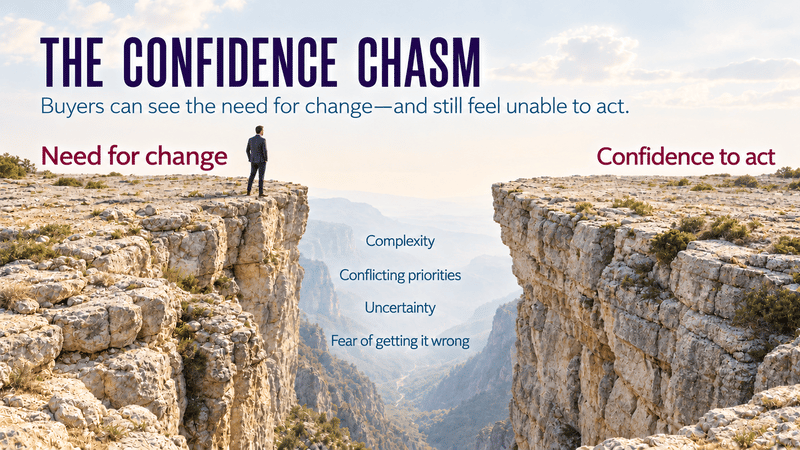
In pharma, the cost of a wrong decision is rarely only financial. A prescriber who changes a treatment answers for how the patient does, and habit is the safer choice when a patient is stable on what they take today. In specialty and biotech, hesitation stacks: a hospital's P&T Committee decides whether a drug reaches the formulary, and payer coverage can still stand in the way.
The hesitation differs by motion. A primary-care prescriber with a stable patient and a full schedule defaults to the familiar choice. A specialty prescriber may be ready to change while the P&T Committee asks for more evidence, and then payer coverage and prior authorization add questions of their own. Different hesitations, same result: the status quo.
More product information rarely closes the gap. The prescriber has already seen it. Crossing it takes an insight sharp enough to change a prescriber's mind in the room, and sturdy enough to keep making the case after the rep leaves.
Solutions Built to Help Pharma Teams Cross the Confidence Chasm
When prescribers think staying with what they know is safer than change, reps have to help them see challenges and opportunities in a new way. The solution that helps your team build that capability depends on the selling situation. Richardson helps organizations define the approach that fits their sales motions, roles, and customer conversations.
Give Prescribers a Reason to Change
For teams whose prescribers already have the data and feel safe staying put. Challenger is a methodology built on research into how buyers and sellers behave. Participants learn to run the Challenger choreography, a planned conversation guide that opens by earning credibility, reframes how the prescriber sees the problem, shows the impact in rational and human terms, and only then reveals the value of a new way forward. Delivering a commercial insight, the perspective at the center of that reframe, is only part of it. They also learn to tailor the message to each stakeholder, guide the group toward a shared “yes,” spot who will mobilize support and who will block it, and apply constructive tension that prompts action without pushing too far.
Keep Every Decision Maker Moving Together
For specialty and biotech teams whose decisions pass through P&T Committees, pharmacy and procurement leaders, and payer review. Participants learn to find the decision process and the people with power, then build a collaboration plan, a shared plan of the steps that help the buyer reach a decision, covering the solution, the implementation, and the financial case. Opportunity Vitals, five checkpoints (pain, power, vision, value, and consensus), show how strong each deal is and what to do next, so momentum survives between meetings.
Understand Each Prescriber Before Recommending
For reps who get limited time with busy prescribers. Participants learn to prepare, connect quickly, ask questions that uncover what each prescriber is accountable for, and position value in the prescriber's terms, using six critical skills: presence, relating, questioning, listening, positioning, and checking. They learn a repeatable way to resolve objections, whether about cost, coverage, or fit.
Solutions for the Moments That Decide the Deal
Some situations need a more specific solution. To support these needs, Richardson offers training content focused on building specific capabilities for specific conversations.
Reach Prescribers Who Limit Access
For teams facing restricted access, credentialing rules, and gatekeepers. Participants build a prospecting plan with a clear target audience, so limited time goes to the prescribers most worth pursuing, a mix of touches across phone, email, video, social, and events, and value-based messages. They use the Prepare, Engage, Advance framework (plan the outreach, start the conversation, move it toward a meeting) and learn when to shift into pursuing an opportunity.
Grow the Accounts You Already Have
For teams that manage key accounts such as health systems, integrated delivery networks (IDNs), and payers. Participants identify priority accounts, assess the organization, its stakeholders, and the competition, and build a plan to find white space, the products and areas where an account is not yet buying from you, and deepen relationships beyond a single contact.
Protect Value in Contract and Coverage Talks
For teams that negotiate contracts, rebates, and formulary terms with payers, health systems, and purchasing groups. Participants learn to engage decision makers early, prove economic value so offers are harder to commoditize, convert a demand into the need behind it, and trade with purpose instead of conceding.
See How We Customize Solutions for Your Business

When the Clock Is Running Out
A Pharma Commercial Team Facing a Patent Expiration
One pharma commercial team faced a patent expiring soon, with little time to grow prescriptions before generic competition arrived. Reps kept spending time with the prescribers they knew best, while prescribers who wrote occasionally, or not at all, where the real growth was, went unvisited. And when reps did get time with a prescriber, they rarely uncovered what was holding a script back.
Richardson helped the team focus on the prescribers with the most room to grow and structure conversations around the real barrier to prescribing, instead of repeating the same product pitch.
46%
Increase in new and existing prescriptions one month after training, maintained for nine months
Why Pharma Organizations Choose Richardson
Pharma commercial teams work in a competitive, highly regulated, high-stakes field where prescribers and committees already know the evidence and are hesitant to change. Richardson builds the skills and capabilities that help commercial teams build relationships and drive revenue.
Customization That Reflects Your Business
Scenarios, role plays, and practice reflect your products, prescribers, terminology, and sales motions, so the learning looks like your team's real conversations.
Methodologies Matched to Your Selling Situation
Whether the challenge is giving prescribers a reason to change, moving a committee decision forward, or earning trust visit after visit, Richardson helps each team define the approach that fits and builds the capabilities behind it.
Skills That Hold Up in the Field
Pharma sales professionals sell different types of drugs to different types of buyers, from a primary-care prescriber to a specialist to a P&T Committee or payer. Each conversation calls for applying different skills, so a workshop alone is rarely long enough to sustain results in the long term. Accelerate Prism, Richardson's AI-orchestrated system for turning training into lasting behavior change, brings practice, manager coaching, and measurement into the flow of work. Reps rehearse each type of conversation with AI Roleplay, practicing against a realistic AI buyer and getting feedback tied to the methodology. Managers coach what they observe, and leaders see where new skills are taking hold.
A Facilitation Bench With Relevant Experience
Our facilitators have firsthand experience working in pharma sales or have trained pharma teams, so they know how these conversations go and workshops are specific to the world your reps live in instead of generic.
Meet Some of Our Pharma Facilitators
We are proud of the bench we have built for pharma. More than 15 of our facilitators have worked inside pharma companies or with pharma clients, and they are based in more than 10 countries, so your team can learn from people who know the territory and the customer. We’re excited to introduce you to a few of them.
Tyrone Edwards
United States

Tyrone knows pharma from the inside as a former senior vice president of sales and commercial operations at Merck, which gives Tyrone a commercial leader’s view of what pharma teams are up against.
Christina Richter
United States

Christina has trained sales teams in pharmaceutical and healthcare settings, with clients including Amgen, and brings extensive training experience from work across a wide range of industries.
Walter Machold
Germany

Walter has spent 21 years in healthcare leadership, including leading the Abbott Vascular business unit in Germany, and has worked with pharma clients including Roche. That gives Walter a business leader’s view of what commercial teams are up against.
Calvin Strachan
Canada

Calvin has worked with Novo Nordisk and Johnson & Johnson, and brings extensive experience training sales teams.
Pharmaceutical Sales Training FAQ
Pharmaceutical sales training develops the skills and capabilities commercial teams need to lead effective conversations with the buying groups who decide whether to prescribe, cover, or contract for a therapy. It builds the ability to bring buyers a unique perspective strong enough to overcome the status quo, tailor it to each decision maker, and guide the decision. It is built for pharmaceutical sales representatives and territory managers in primary care, specialty and oncology sales specialists, hospital sales representatives, and market access and key account teams, along with the sales managers and enablement leaders who coach them. Because buyers range from individual prescribers to hospital committees and payers, effective training reflects who is on the other side of the table, not only what is being sold.
In pharmaceutical sales, the buyer and the source of hesitation change, but the winning move is the same: bring a unique perspective with a case strong enough to overcome the status quo. In primary care, that means standing out from a crowded field of reps, where a prescriber's habit makes the status quo the competitor. In specialty and biotech, it means building a case that also holds up with a P&T Committee and payers, people the rep never meets. For market access and key account teams, it means negotiating coverage and contracts around economic value, then working with field teams on pull-through. Training solutions reflect that split, so each role builds the skills for the conversation it actually has.
In a regulated field like pharmaceutical sales, reps cannot sweeten their case with incentives or off-label claims. Insight instead looks like helping a prescriber see how approved evidence applies to their patients and their practice in a new way, and what it costs to wait. Challenger builds commercial insight through a process that brings sales, marketing, and product expertise together. In pharma, that process can include medical, legal, and compliance reviewers so every insight stays within approved evidence. Accelerate Prism's AI Roleplay lets reps rehearse these conversations before the stakes are real. Its scenarios are based on the prescribers, products, and objections a team actually encounters, so practice can be built around an organization's own approved messaging, and teams build the skill inside those boundaries.
The cost of a wrong decision is rarely only financial. A prescriber who changes a treatment answers for how the patient does. A hospital P&T Committee answers to clinical staff, pharmacy, and finance. A payer answers for coverage and cost. A group like this leans toward consensus, and consensus often leans toward the status quo. More information rarely resolves it. A reason to change, brought credibly and tailored to each person's priorities, can.
Different therapies reach a “yes” through different gates. A hospital formulary decision runs through a P&T Committee, and payer coverage and prior authorization can still stand between a prescription and a patient. Each gate has different people asking different questions, and progress with one can stall at another. ZS has found that access restrictions are felt most acutely in IDNs, where standardized care protocols lead organizations to expect reps to focus on what fits the organization's own priorities. Challenger research found that stakeholders tend to fall into three types: Mobilizers, who drive action and build support for change and often show healthy skepticism before they advocate, Talkers, who share information but do not act, and Blockers, who prefer the status quo. Reps identify the Mobilizer by how a stakeholder reacts to an insight, not by title, tailor the message to each person's priorities, and give the Mobilizer what is needed to build consensus when the rep is not in the room.
Market access and key account teams have a different conversation than a prescriber-facing rep. They negotiate contracts, rebates, and formulary terms with payers and health systems, then work with field teams on pull-through. Those conversations call for different skills from winning a prescriber's attention, such as engaging decision makers early, proving economic value so an offer is harder to commoditize, converting a demand into the need behind it, and trading with purpose instead of conceding. Richardson offers two programs for these teams: Consultative Negotiations, which builds the skills to hold value in contract and coverage talks, and Prosperous Account Strategy, which helps teams plan how to grow key accounts such as health systems and payers.
Start with a baseline, then connect two kinds of data over time. Behavior data shows whether reps are applying what they learned: practice results, coaching observations, and whether they are delivering a tailored insight, finding the stakeholder who will drive action, and making specific requests. Outcome data from the CRM shows what happened: prescriptions, opportunity progression, and account results. Behavior data alone shows activity, and CRM data alone shows results without explaining why. Together they show whether specific behaviors are driving results, where gaps in skill execution remain, and what managers should coach next. Satisfaction scores and self-reported impact show how participants felt, but they do not show behavior change on their own. Accelerate Prism includes a measurement capability called Signal, which uses data and visibility to show progress and inform next steps. Prism can connect with systems an organization already uses, including CRM, so leaders can read behavior and outcomes side by side.
In Accelerate Prism, AI supports and orchestrates the learning at the individual contributor level. It uses signals about each rep's capability, learning, practice, and behavior to decide what the rep needs next, then delivers targeted learning, reinforcement, AI-enabled nudges, and AI Roleplay, with feedback tied to the training methodology. Practice results also show managers where to coach. In pharma, adoption depends on an organization's privacy, security, and compliance requirements, so organizations can adopt the capabilities that fit their governance. AI guides what reps and managers do next, while the methodology, the coaching, and the quality of the training define the path to behavior change and revenue attainment.
Ready to Build More Confident Prescriber Conversations?
Every pharma organization has sales professionals who already know how to give a buyer a reason to act. The work is helping every team do it consistently.
Resources


Published: November 6, 2026 · Last updated: November 6, 2026