
Healthcare Sales Training
Healthcare buyers are experts, and they rarely lack data. Clinicians know the evidence, committees have weighed it, and procurement has compared the alternatives. What moves a decision forward is a sales professional who offers a fresh way to see the problem and a case for change they can trust. Richardson Sales Performance helps healthcare teams, from pharma and medical device to provider, payer, and animal health, build that skill and apply it consistently.
Healthcare Isn’t One Sales Motion. Find Yours.
Whether you sell to clinicians, hospital committees, purchasing organizations, or health plans, the challenge to drive momentum is significant. Use the links below to learn more about Richardson’s expertise in common healthcare specialties. We provide training across all healthcare specialties, so contact us to learn more about our experience in your specialty.
Pharmaceutical
Learn how to earn the next conversation with prescribers by teaching them something new about their own practice, within the access rules institutions set.
Explore Pharma Sales Training →Medical Device and MedTech
Learn how to tailor one insight to clinical, financial, and procurement stakeholders and guide the group to a shared “yes,” from value analysis committees to capital budgets.
Explore MedTech Sales Training →Life Sciences and Diagnostics
Learn how to teach buyers, from lab directors to research scientists to procurement leads, what to look for in a technology or test they have not evaluated before, so the evaluation points toward what sets your solution apart.
Explore Life Sciences Sales Training →Trusted by Healthcare Organizations Like Yours



























01
Teach Buyers Something New
Healthcare buyers are usually specialists and rarely lack data. Product information is not insight. The strongest sellers teach clinicians something new about their own practice and lay out a clear case and path for change.
02
Tailor to Everyone in the Room
Healthcare sellers engage a variety of stakeholders. Adjusting the message to each person’s role and priorities, from the clinician to the lab director to the CFO to the security lead, is what Challenger calls tailoring. When each person in the buying group sees value in their own terms, consensus follows and the deal moves.
03
Take Control of the Buying Path
Every product reaches a “yes” through different gates, for example value analysis committees for preference items, capital budgets for equipment, formulary committees for drugs, security reviews for technology, grant cycles for research labs, and supplier qualification for manufacturing sites.
Moving the buyer through each gate with a specific what, why, who, and when is how Challenger defines taking control. Progress is judged by the customer’s reaction, not the seller’s activity. It also means finding the Mobilizers, the stakeholders who drive action and build support for change, and equipping them to make the case when the seller is not in the room.
04
Create Constructive Tension
Staying with what they know feels safe to many healthcare buyers, because a wrong decision can have life-or-death consequences, and that comfort and fear stall a change.
Helping these buyers see a gap in their current approach, so that waiting feels riskier than acting, is what Challenger calls building constructive tension. A buyer who has not changed is rarely unconvinced. More often, something hidden is holding them back from making a decision, and the best sellers find it.
Healthcare Buyers Need a Compelling Reason to Defy the Status Quo
In healthcare, clinical knowledge and strong relationships are table stakes, not differentiators. In a field where buyers are experts, their decisions are high-stakes, and their work serves a mission like patient care or scientific discovery, the sellers who stand out connect each decision to that mission and help buyers think about their challenges and opportunities in new and relevant ways. Challenger, a methodology built on research into how buyers and sellers behave, teaches teams how to bring this insight at scale.
Every Role Has a Different Conversation. Every Buyer Needs Confidence to Act.
Healthcare sales roles differ in who they sell to, how long decisions take, and what each buyer risks by saying “yes.” The common thread is that healthcare buyers act when they feel confident, and that confidence is built in conversation.
Pharmaceutical
Pharmaceutical Sales Representatives, Specialty Sales Representatives, Oncology Sales Specialists, Hospital Sales Representatives
Add something new to the clinical data prescribers already know: teach them something about their own practice. According to a study by ZS, a healthcare consulting firm, physicians average nine face-to-face rep touchpoints a day, and institutions add their own access rules on top of that, so time with any one rep is scarce and each short interaction has to earn the next.
Medical Device and MedTech
Territory Managers, Territory Account Managers, Account Executives, Capital Equipment Specialists
Build a case that holds up with clinical, financial, and procurement stakeholders, often alongside clinical specialists and on the timeline of a value analysis review or capital budget cycle. Tailor insights to each person’s priorities, and treat a physician champion’s tough questions as a good sign, because skeptics who test the evidence are often the ones who advocate.
Life Sciences and Diagnostics
Account Executives, Territory Account Managers, Key Account Managers, Technical Sales Specialists, Field Application Specialists, Clinical Sales Specialists
The customer may be a research lab, a clinical lab, a contract research organization, or a biomanufacturing site, and the person who uses the product, the person who funds it, and the person who qualifies it are often different people. Teach buyers what to look for in a technology or test they have not evaluated before, such as how to judge it, what to compare, and what a good outcome looks like, so the evaluation points toward what sets your solution apart.
Health Technology and AI
Account Executives, Named Account Executives
Teach buyers how to buy safely. Quantify the cost of inaction, link the technology to measurable outcomes, and tailor the story to the clinical, compliance, finance, and IT stakeholders who each review the decision from a different angle.
Healthcare Distribution
Account Managers, Strategic Account Managers, Sales Directors
Product, brand, and price are table stakes, so the sales experience is what sets suppliers apart. Across industries, a Gartner analysis of nearly 5,000 customer interactions found it drove 53% of customer loyalty (repurchase, recommendation, and openness to new offers). Distribution teams deliver that experience by advising across a customer’s full portfolio, not only supplying products.
Hospital and Provider Services
Account Executives, Business Development Managers
Committee decisions stall in the gaps between meetings. Find the stakeholder who will drive action when the seller is not in the room (a Mobilizer), equip that person to build consensus, and prescribe each next step with a clear what, why, who, and when.
Health System, IDN (Integrated Delivery Network), and Purchasing Group Accounts
Key Account Managers, Strategic Account Managers, Contract Specialists
Sell on two levels: to the organization that holds the agreement and to the clinicians who will use the product. When an RFP and a price benchmark set the terms, insight changes what is being compared, so the conversation is not only about price.
Health Plan and Payer
Account Executives, Payer Sales Executives
Senior stakeholders look for unique insight beyond feature lists. Whether selling to health plans or on behalf of them, reframe the conversation around outcomes for members and employers and tailor it to each executive’s measures of success.
Animal Health
Sales Representatives, Account Managers
Customers’ needs are changing, and companion and production animal customers each measure success differently, so supplying products is not enough. Teach each customer something new about their own goals, such as patient care and practice economics for a veterinary practice or herd performance for a producer, and guide them toward an actionable plan.
Sales Managers and Enablement Leaders
Regional Sales Managers, Area Sales Managers, Directors of Commercial Learning and Development, Sales Enablement Managers
Coach the behaviors, not just the pipeline. Ask whether the seller delivered a tailored insight, found a Mobilizer, and made a specific request, and judge progress by the customer’s reaction rather than the seller’s activity.
Healthcare Buyers Often Agree and Still Don’t Act
Healthcare buyers often recognize the value of a new approach but hold back on making a decision because value alone is not a compelling enough reason to change. Richardson calls the gap between seeing value and feeling confident enough to act the Confidence Chasm.
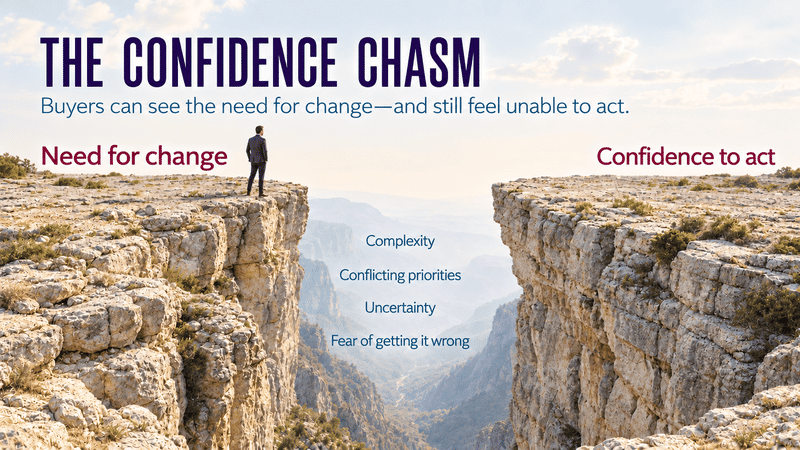
In healthcare, the cost of a wrong decision is rarely only financial. A clinician who changes practice answers for the patient outcome. A hospital committee approving a new device answers to clinical staff, finance, and compliance at once. A procurement team answers for cost and contract terms. A health plan changing vendors answers to regulators and members. A group like this leans toward consensus, and consensus often leans toward the status quo, even when many people involved would like to change.
Hesitation lasts as long as the decision does. A clinician may decide over a few conversations, while an implant may wait on a value analysis review, a capital purchase on an annual budget cycle, and a contract on renewal. Each wait gives indecision more time to win.
Another round of product detail rarely closes the gap. It can give an already cautious group more reasons for caution. Crossing it takes a reason to change that the buyer trusts enough to act on, and a way to bring the whole group along.
Solutions Built to Help Healthcare Teams Cross the Confidence Chasm
When buyers think staying with what they know is safer than change, sales professionals have to help them see challenges and opportunities in a new way. The solution that helps your team build that capability depends on the selling situation. Richardson helps organizations define the approach that fits their sales motions, roles, and customer conversations.
Give Buyers a Reason to Change
For teams whose buyers already have the data and feel safe staying put.
Participants learn to run the Challenger choreography, a planned conversation guide that opens by earning credibility, reframes how the buyer sees the problem, shows the impact in rational and human terms, and only then reveals the value of a new way forward. Delivering an insight is only part of it.
They also learn to tailor the message to each stakeholder, guide the group toward a shared “yes,” spot who will mobilize support and who will block it, and apply constructive tension that prompts action without pushing too far.
Keep Every Stakeholder Moving Together
For teams whose decisions pass through value analysis committees, capital budgets, group purchasing agreements, or governance reviews.
Participants learn to find the decision process and the people with power, then build a collaboration plan, a shared plan of the steps that help the buyer reach a decision, covering the solution, the implementation, and the financial case, including references, site visits, and vendor approvals. Opportunity Vitals, five checkpoints (pain, power, vision, value, and consensus), show how strong each deal is and what to do next, so momentum survives between meetings.
Understand Each Buyer Before Recommending
For sales professionals who get limited time with busy clinicians and administrators.
Participants learn to prepare, connect quickly, ask questions that uncover what each buyer is accountable for, and position value in the buyer’s terms, using six critical skills: presence, relating, questioning, listening, positioning, and checking. They learn a repeatable way to resolve objections, whether about cost, workflow, or fit.
Solutions for the Moments That Decide the Deal
Some situations need a more specific solution. To support these needs, Richardson offers training content focused on building specific capabilities for specific conversations.
Reach Buyers Who Limit Access
For teams facing restricted access, credentialing rules, and gatekeepers. Participants build a prospecting plan with a clear target audience, a mix of touches across phone, email, video, social, and events, and value-based messages. They use the Prepare, Engage, Advance framework (plan the outreach, start the conversation, move it toward a meeting) and learn when to shift into pursuing an opportunity.
Grow the Accounts You Already Have
For teams that manage key accounts such as health systems, IDNs, and distribution customers. Participants identify priority accounts, assess the organization, its stakeholders, and the competition, and build a plan to find white space, the products and areas where an account is not yet buying from you, and deepen relationships beyond a single contact.
Protect Value When Procurement Steps In
For teams that negotiate with finance, procurement, and purchasing groups, which often consolidate vendors and compare products. Participants learn to engage procurement early, prove economic value so offers are harder to commoditize, convert a demand into the need behind it, and trade with purpose instead of conceding.
Raise Prices Without Losing the Relationship
For teams that own pricing in existing relationships, when costs rise and customers push back. Participants learn a three-stage framework, Prepare, Notify, and Respond (plan the message, deliver it, and handle the customer’s reaction), practice it in two virtual workshops with optional coaching on a real deal, and build negotiation strategies that protect margin and trust.
See How We Customize Solutions for Your Business
→
Clinical Expertise Is the Start. Insight Selling Is What Aerogen Added.
Aerogen
Aerogen is a global medical device company focused on aerosol drug delivery in acute care. Many of its sellers come from clinical backgrounds in intensive care or respiratory therapy, so their knowledge of medical topics runs deep. The company saw an opportunity to combine that expertise with the Challenger approach and trained its international selling team.
Sellers describe the change in practical terms. They start conversations differently, identify the right stakeholders earlier, and guide the buying process with more confidence. One business development manager reached an account that had been among the hardest to access by working with more stakeholders and taking a different strategy.
54%
Increase in quota attainment
73%
Increase in seller efficiency
67 days
Decrease in average sales cycle
Aerogen, medical device company, Challenger success story
“Many of our sellers have a professional background in intensive care or, in our case, as respiratory therapists, so they have excellent knowledge of medical topics. We saw an amazing opportunity to lead our teams to even greater performance by combining this expertise with the Challenger approach.”
Jacqueline Lüttjohann, Global Commercial Training and Education Manager, Aerogen
Why Healthcare Organizations Choose Richardson
Experience That Earns Credibility With Your Buyers
Richardson has been training sales teams for more than 45 years, and our work with healthcare spans pharma, medical device, distribution, provider, payer, animal health, and more. Our past clients include Eli Lilly, Cencora, Anthem, Aerogen, and OB Hospitalist Group.
Customization That Reflects Your Business
Scenarios, role plays, and practice reflect your products, buyers, terminology, and sales motions, so the learning looks like your teams’ real conversations.
Proven Results
Richardson and Cencora earned a Gold award from Brandon Hall Group for Best Program for Sales Training and Performance in 2025. Cencora, OB Hospitalist Group, and Bausch + Lomb have also shared results from their work with Richardson. Programs can start with a skills baseline, as Cencora’s did, and add coaching observations and business indicators, so leaders can see what changed.
Skills That Hold Up in the Field
Healthcare sales professionals work in the field, inside strict limits on what they can say, so a workshop is not enough to translate new information into execution. Accelerate Prism, Richardson’s AI-orchestrated system for turning training into lasting behavior change, brings practice, manager coaching, and measurement into the flow of work. Teams rehearse conversations with AI Roleplay, managers coach what they observe, and leaders see where new skills take hold. Organizations adopt the capabilities that fit their technology, privacy, and compliance requirements.
A Facilitation Bench With Healthcare Experience
Our deep bench of facilitators has firsthand experience working in healthcare or training healthcare teams around the world, so workshops reflect how these conversations actually go instead of staying generic.
Meet Some of Our Healthcare Facilitators
Our healthcare bench is built from people who have worked inside healthcare companies or with healthcare clients. More than 50 of our facilitators fit that description, and they are based in more than 20 countries, so your team can learn from people who know your region and your buyers. Here are a few of them.
Jordan Chen
China

Jordan knows healthcare from the inside, having spent eight years at GE Healthcare China and served as marketing and sales director at THINK Minimally Invasive. Jordan has also worked with clients including BD and Philips.
Christina Richter
United States

Christina has trained sales teams across healthcare, pharmaceutical, and medical device markets, including work with clients such as Amgen.
Minty Singh
United Kingdom

Minty has led training from the inside as internal training lead at a medical products and technology company, and has worked with clients including ConvaTec.
Calvin Strachan
Canada

Calvin has worked with Novo Nordisk and Johnson & Johnson and brings extensive experience training sales teams across industries.
Healthcare Sales Training FAQ
Healthcare sales training develops the skills and capabilities commercial teams need to lead effective conversations with the buying groups who decide whether to prescribe, adopt, purchase, or contract. It builds the ability to bring buyers a unique perspective strong enough to overcome the status quo, tailor it to each stakeholder, and guide the decision. Because buyers range from individual clinicians to hospital committees, purchasing organizations, and health plans, effective training gives teams an approach, skills, and capabilities to meet the needs of the people on the other side of the table, not only to explain what is being sold.
In healthcare sales, the buyer and the source of hesitation change, but the winning move is the same: bring a unique perspective with a case strong enough to overcome the status quo. For example, in pharma, a prescriber often knows the clinical data before the conversation starts, so repeating it earns nothing. In one study by ZS, a healthcare consulting firm, 60% of oncologists preferred a rep with deep knowledge of their clinic or institution over deep clinical or product expertise. The seller who teaches something new about the prescriber’s own practice earns the next conversation. In medical device, a decision often involves clinicians, finance, and procurement, so one insight has to be tailored three ways and the group guided toward a shared “yes.” In diagnostics and life sciences, the customer may be a research lab, a clinical lab, or a manufacturing site, and buyers may be evaluating a technology or test for the first time, so the seller teaches what to look for before presenting a solution. In health technology, security, privacy, and clinical governance reviews join the decision committee, so the seller helps the group see the cost of waiting and the way through each review. In payer sales, senior stakeholders want unique insight about outcomes for members and employers rather than feature lists, whether a team sells to a health plan or on behalf of one. Distribution and provider services teams often manage broad portfolios and long relationships, where the sales experience itself drives loyalty. Training solutions reflect these differences, so each role builds the skills for the conversation it actually has.
Yes. In regulated settings, insight does not mean new claims. It means helping a buyer see how approved evidence applies to their patients, their practice, or their institution in a new way, and what it costs to wait. The Challenger methodology, built on research into how buyers and sellers behave, teaches sellers to deliver commercial insight, a perspective that reframes how a buyer sees a problem. The insight is built through a process that brings sales, marketing, and product expertise together, and in healthcare that process can include review from medical, legal, and compliance experts so every insight stays within approved evidence. Accelerate Prism, Richardson’s AI-orchestrated system for turning training into lasting behavior change, includes AI Roleplay, which gives sellers a place to rehearse these conversations with a realistic AI buyer and get feedback tied to the methodology before the stakes are real. Its scenarios are based on the buyers, solutions, and objections a team actually encounters, so practice can be built around an organization’s own approved messaging and the rules its customers set, and teams build the skill inside those boundaries.
Healthcare sales cycles range from a few conversations to a full annual budget cycle, depending on what is being sold and who has to sign off. A prescribing decision can move over a few conversations, although formulary and institutional access reviews add their own schedules. A physician preference item may wait on a value analysis committee that meets on a set calendar. Capital equipment often follows an annual budget cycle, and technology purchases add security, compliance, and procurement review. Supply and service contracts may open to competition only at renewal. Published benchmarks vary widely, so a more useful question is where your teams lose momentum along the buying path. Sellers who guide that path, recommending clear next steps and checking the customer’s reaction, keep decisions moving whatever the length of the cycle.
Healthcare deals stall because the cost of a wrong decision is rarely only financial. A clinician who changes practice answers for patient outcomes. A hospital committee approving a new device answers to clinical staff, finance, and compliance. A procurement team answers for cost and contract terms. A health plan changing vendors answers to regulators and members. A group like this leans toward consensus, and consensus often leans toward the status quo. More information rarely overcomes the status quo. A reason to change, brought credibly and tailored to each person’s priorities, can.
Challenger applies by teaching buyers something new about their own situation instead of repeating what they already know. The Challenger methodology, built on research into how buyers and sellers behave and applied in healthcare, starts from the fact that healthcare buyers are already experts in their field: physicians know the clinical data, committees have reviewed the evidence, and procurement teams have compared prices. Product information is not insight, so a Challenger-trained sales professional delivers what Challenger calls commercial teaching, a planned conversation that highlights something the buyer has not fully weighed, such as an overlooked gap in patient care, the total cost of the current approach, or the cost of inaction. A strong reframe, a new way of seeing the problem, is surprising, sizable, and solvable. The conversation follows a six-step choreography: a warmer that earns credibility, a reframe of the problem, rational impact that quantifies the cost of the status quo, emotional impact that makes the problem personal, a new way forward, and only then the solution. The Challenger approach also teaches sellers how to build constructive tension, tailor messaging so it carries relevant insight for each stakeholder, and take control to keep the group moving toward a purchase decision.
Committee decisions change selling because no single conversation wins the deal. Sellers have to reach every person who has a say, tailor the message to each, and keep the group moving between meetings. Hospitals use committees where the spend is high: according to Definitive Healthcare, physician preference items account for 40 to 60% of a hospital’s total supply costs, which is why many hospitals route them through a value analysis review that includes finance, supply chain, and clinical leaders. Capital equipment follows a capital budget process, and drugs go through a formulary committee, so each purchase brings its own people and its own questions. Challenger, a methodology built on research into how buyers and sellers behave, found that stakeholders tend to fall into three types: Mobilizers, who drive action and build support for change and often show healthy skepticism, Talkers, who share information but do not act, and Blockers, who prefer the status quo. Sellers identify the Mobilizer by how a stakeholder reacts to an insight, not by title, and give the Mobilizer what is needed to build consensus when the seller is not in the room. Consultative Opportunity Pursuit is a Richardson program for running deals that involve many stakeholders. Sellers learn to find the decision process and the people with power, build a collaboration plan with the buyer, and track each deal against five checkpoints (pain, power, vision, value, and consensus) to keep it moving. OB Hospitalist Group, which serves hospitals and integrated delivery networks, achieved a 7-percentage-point increase in closed win rates through its work with Richardson on this approach.
They move part of the decision to the organization that holds the contract, so sellers have to sell on two levels: to that organization and to the clinicians who will use the product. Group purchasing organizations (GPOs) and integrated delivery networks (IDNs) pool buying power and standardize purchasing across many facilities. That can mean a decision at one hospital depends on a contract or approved vendor status held at the network level, and that a local clinical champion has less room to choose alone. When buyers arrive with an RFP and a price benchmark, the conversation drifts toward price, and sellers who bring a perspective the buyer has not considered change what is being compared. Sellers also need to align activity and account planning with the organization’s contracting calendar, since some opportunities open only at renewal or during a bid. Because contracts renew and costs change, some of the most important conversations are about renewal terms and price. Those call for different skills from winning new business, such as negotiating with finance and procurement or positioning a price increase, and teams that own pricing conversations benefit from practicing them. ZS, a healthcare consulting firm, has found that access restrictions are felt most acutely in IDNs, where standardized care protocols lead organizations to expect sales professionals to focus on what fits the organization’s own priorities.
Healthcare sales teams sell AI and digital health products by teaching a group of reviewers how to evaluate and buy safely, not by demonstrating features. Health systems often review new AI and digital tools through governance committees that include clinical leaders, information security, privacy, legal, compliance, and procurement. Some route every new AI tool through several committees before approval. Chief medical information officers (CMIOs) interviewed by Becker’s Hospital Review said they now weigh governance, transparency, and clinical risk management more heavily than hype. Challenger, a methodology built on research into how buyers and sellers behave, uses commercial teaching, a conversation built around an insight, to help sellers quantify the cost of inaction, link the technology to measurable outcomes, and tailor the story to the clinical, compliance, finance, and IT stakeholders who each ask different questions. Richardson’s Selling AI in Healthcare brief covers how to diagnose buyer hesitation across compliance, clinical, and cost dimensions.
Large healthcare organizations keep training consistent by applying a shared standard for what good looks like through each unit’s own products, buyers, and language. Richardson builds learning around a common methodology, customizes scenarios by role and business unit, and supports it with coaching and measurement through Accelerate Prism, Richardson’s AI-orchestrated system for turning training into lasting behavior change, so the same behaviors stay relevant inside each clinical and commercial setting.
Measure it by starting with a baseline and connecting behavior data to outcome data over time. Behavior data shows whether sellers are applying what they learned: practice results, coaching observations, and whether they are delivering a tailored insight, finding the stakeholder who will drive action, and making specific requests. Outcome data from the CRM shows what happened: win rate, opportunity progression, deal size, and cycle time. Behavior data by itself shows activity, and CRM data by itself shows results with no explanation. Together they show whether specific behaviors are driving results, where gaps in skill execution remain, and what managers should coach next. Satisfaction scores and self-reported impact show how participants felt, but they do not show behavior change on their own. Accelerate Prism, Richardson’s AI-orchestrated system for turning training into lasting behavior change, includes a measurement capability called Signal, which uses data and visibility to show progress and inform next steps. Accelerate Prism can connect with systems an organization already uses, including CRM, so leaders can read behavior and outcomes side by side.
A rollout varies by program, audience, and organization, but it combines workshops, delivered virtually or in person, with practice and coaching. For example, training in Challenger, a methodology built on research into how buyers and sellers behave, covers five modules: the Challenger sales conversation, constructive tension, commercial teaching, tailoring and taking control, and becoming a Challenger. Participants complete pre-work e-learning, then attend a single day in-person workshop or virtual sessions spaced about a week apart, building a commercial teaching message for their own customers along the way. Reinforcement is planned to begin right after the workshop. How quickly results show depends on how well managers reinforce the new behaviors, so it helps to agree on the baseline and the business indicators you will track before the first workshop. That is how leaders can see what changed, and where to coach next.
Richardson uses AI orchestration to support methodology execution, individual skill development, and coaching, not to replace them, and organizations adopt only the capabilities that fit their privacy, security, and compliance requirements. In Accelerate Prism, Richardson’s AI-orchestrated system for turning training into lasting behavior change, AI supports and orchestrates the learning at the individual contributor level. It uses signals about each seller’s capability, learning, practice, and behavior to decide what the seller needs next, then delivers targeted learning, reinforcement, AI-enabled nudges, and AI Roleplay. AI Roleplay lets sellers rehearse realistic buyer conversations and get immediate feedback tied to the training methodology, not generic AI advice, before the stakes are real, and practice results show managers where to coach. AI guides what sellers and managers do next, while the methodology, the coaching, and the quality of the training define the path to behavior change and revenue attainment.
Ready to Build More Confident Healthcare Conversations?
Every healthcare organization has sales professionals who already know how to give buyers a reason to act. The opportunity is helping every team do it, every time.
Resources


Published: November 4, 2026 · Last updated: November 4, 2026