What Should a New Sales Leader Do in the First Six Months?
Sales performance improvement

Written by: Ben Taylor, MBA, Content Marketing Manager, Richardson
Published: November 23, 2026
If you're reading this, then you are probably a sales leader who has recently taken a position with a new company, or has been promoted to head of sales with your existing employer. You're probably in your new position because the sales leader before you was not successful, or was redundant as the result of a merger or acquisition.
In Richardson's experience, most new sales leaders take over organizations that require some sort of turnaround to get performance back on track. As a new sales leader, you've also inherited the title of turnaround leader. You have the opportunity to make a huge impact on your organization. Expectations are high and the spotlight is on you.
Key Takeaways
- Spend the first six months in five time-boxed stages: assess, prioritize, train, then execute in two phases.
- Assess your people, process, and tools before you change anything.
- Focus on the two or three changes that will make the most impact.
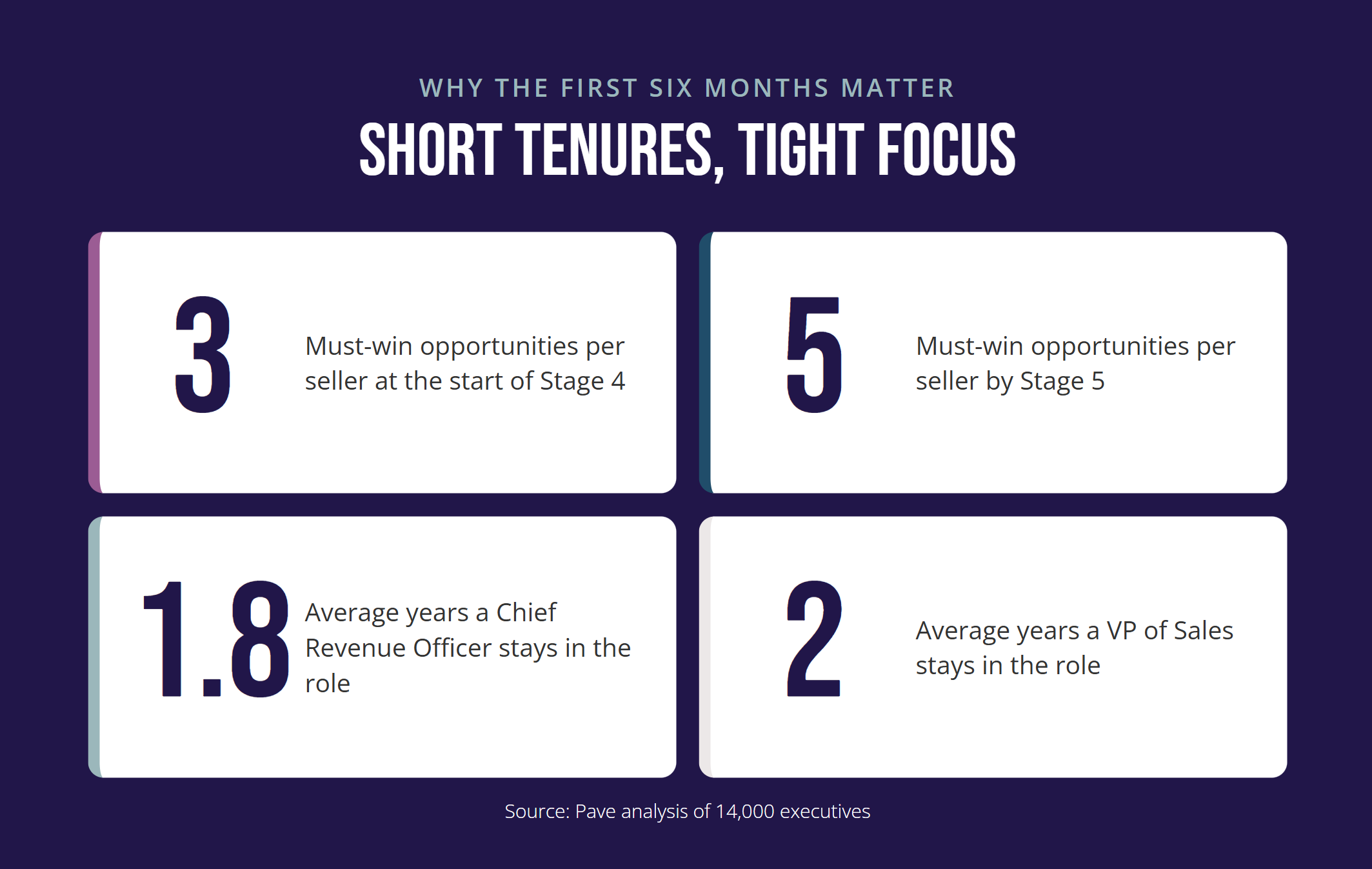
- Begin with three must-win opportunities per seller, and widen to five.
Why does the first six months matter so much?
New sales leaders often have a brief honeymoon period to get their arms around their organization and make changes. There are a number of potential levers that you can pull to improve performance. However, you want to make sure that you focus your efforts on the changes that will make the most impact.
Pave's analysis of 14,000 executives found that VPs of Sales average about two years in the role, and Chief Revenue Officers average 1.8 years. This means you won't have many chances to go back and start over, so you want to get this right the first time.
What does a six-month plan for a new sales leader look like?
Richardson Sales Performance's Six Month Win program follows an agile approach through five sprints. Each sprint has a fixed length and ends when time runs out. This lets you execute your change program quickly. You want to be thinking in terms of weeks and months as opposed to months and years.
The five stages add up to 26 weeks, about six months:
| Stage | Duration | Focus |
|---|---|---|
| 1. Assessing Your Current State | Two weeks | Assess the people, processes, and tools in your sales force |
| 2. Laser Focus: Establishing Your Priorities | Two weeks | Prioritize improvements and set clear goals |
| 3. Laser Learning | Two weeks | Provide highly focused learning on critical selling challenges |
| 4. Laser Execution I | 10 weeks | Focus on a finite set of accounts, opportunities, and methodology priorities |
| 5. Laser Execution II | 10 weeks | Ramp up account, opportunity, and observable behavior expectations |
Each stage works across three areas: the right people, the right process, and the right tools.
How do you assess the current state of your sales force? (Stage 1: two weeks)
Start with the people, processes, and tools you've inherited.
- People: Assess the behaviors and skills of your people to identify where they best fit in your organization and any gaps they need to address through training and development.
- Process: Understand how your customers buy and where your process is misaligned with the buyer's journey. Then look at sources of sales process adoption challenges to determine why your process isn't being followed and what you can do to improve.
- Tools: Review your CRM system and sales enablement tools objectively to determine which are adding value and which aren't, and where you have opportunities to streamline.
Deliverables from this stage: a talent audit, a skills assessment, a sales process audit, your top three sales challenges, a view of your management system, a CRM analysis, and an enablement tools review.
How do you decide what to fix first? (Stage 2: two weeks)
Synthesize the findings from your current state analysis to prioritize the improvement efforts that will lead to the most significant impact on performance. Then establish clear and precise goals so you can track progress toward them.
- People: Optimize your organization and establish clear roles, competencies for each role, and the top three capabilities.
- Process: Develop process playbooks for managing complex opportunities and strategic accounts, as well as a cadence for your sales managers to inspect and coach performance improvement across their teams.
- Tools: Re-establish rules for proper CRM engagement and other sales enablement tools that you expect your sellers to use. Establish key performance indicators and a management dashboard to track execution and progress.
How do you prepare your team for the changes? (Stage 3: two weeks)
Impart the necessary knowledge and skills across your executive management and frontline sales ranks. Use what you learned in the current state assessment to determine the two or three things that people in each role need to improve to make the greatest impact.
For each role, create a playbook that holds the necessary information in one convenient, accessible resource. The playbooks also contain rules for CRM engagement and sales enablement tools, forecasting and pipeline management procedures, and key performance indicators against which people and the overall initiative will be measured. This gives your entire organization a common language and approach to keep everybody on the same page, as well as standards of performance that everybody is clear about.
How do you put the changes into practice? (Stage 4: 10 weeks)
Once you've trained and equipped your people with playbooks, monitor prioritized behaviors in real-life application.
- Sellers: Start with three must-win opportunities for each seller.
- Account managers: Start with three strategic accounts that each account manager must retain and grow.
- Managers: Provide the coaching that drives reinforcement and performance improvement. Opportunity and account coaching tools make your sales managers' jobs easier.
Tools in this stage include account coaching, opportunity coaching, social media coaching, and manager coaching.
"Engage with managers early and often and having them really drive the success of a program will be critical." — Amber Boll, Director, Sales Global Process Owner, Rich Products Corporation
How do you make the new behaviors permanent? (Stage 5: 10 weeks)
In this stage, the goal is to make the new skills and behaviors necessary to drive results permanent. You want the way your sales team functions to become second nature to them.
Increase the pace from the top three to the top five must-win opportunities, and from the top three to the top five new account acquisition targets. By this time, your people will be much more familiar with the tools available to enable efficient execution of their jobs. They will also be more skilled and knowledgeable, and sales managers will have improved coaching skills to enable the higher productivity that you expect. Continue to monitor and measure "second level" observable behaviors, and keep reinforcing them.
"It's a behavior change, right? So you can't expect results right away. But the more consistent you are with training and bringing people along with you, the more it becomes part of that normal language." — Darnetta Daire, Sales Enablement Manager, Hollister Incorporated
Why does a focused six-month plan work?
A focused, time-boxed plan keeps you and your team concentrated on the change that will lead to the greatest impact. Each stage ends when the time does, so effort stays on what matters most.