What Makes AI Roleplay Effective for Sales Training?
Sales performance improvement

Written by: Ben Taylor, MBA, Content Marketing Manager, Richardson
Published: November 23, 2026
Without roleplay, your customers become your practice targets — and there is no greater expense than learning on a sales call. Sellers need practice, and they need to do it without risking deals.
Traditional in-person roleplay provides that safety, but it doesn’t scale. AI made roleplay scalable. But scale alone doesn’t build better sellers. Richardson has identified four principles that separate effective AI roleplay from ineffective implementations.
Key Takeaways
- Effective AI roleplay prepares sellers for the uncertainty and resistance of real customer conversations.
- That takes four things: buyers that push back, a proven sales methodology, scoring of behaviors rather than keywords, and a place inside a larger learning system.
- Scale alone doesn’t build better sellers.
Why isn’t scalable roleplay enough?
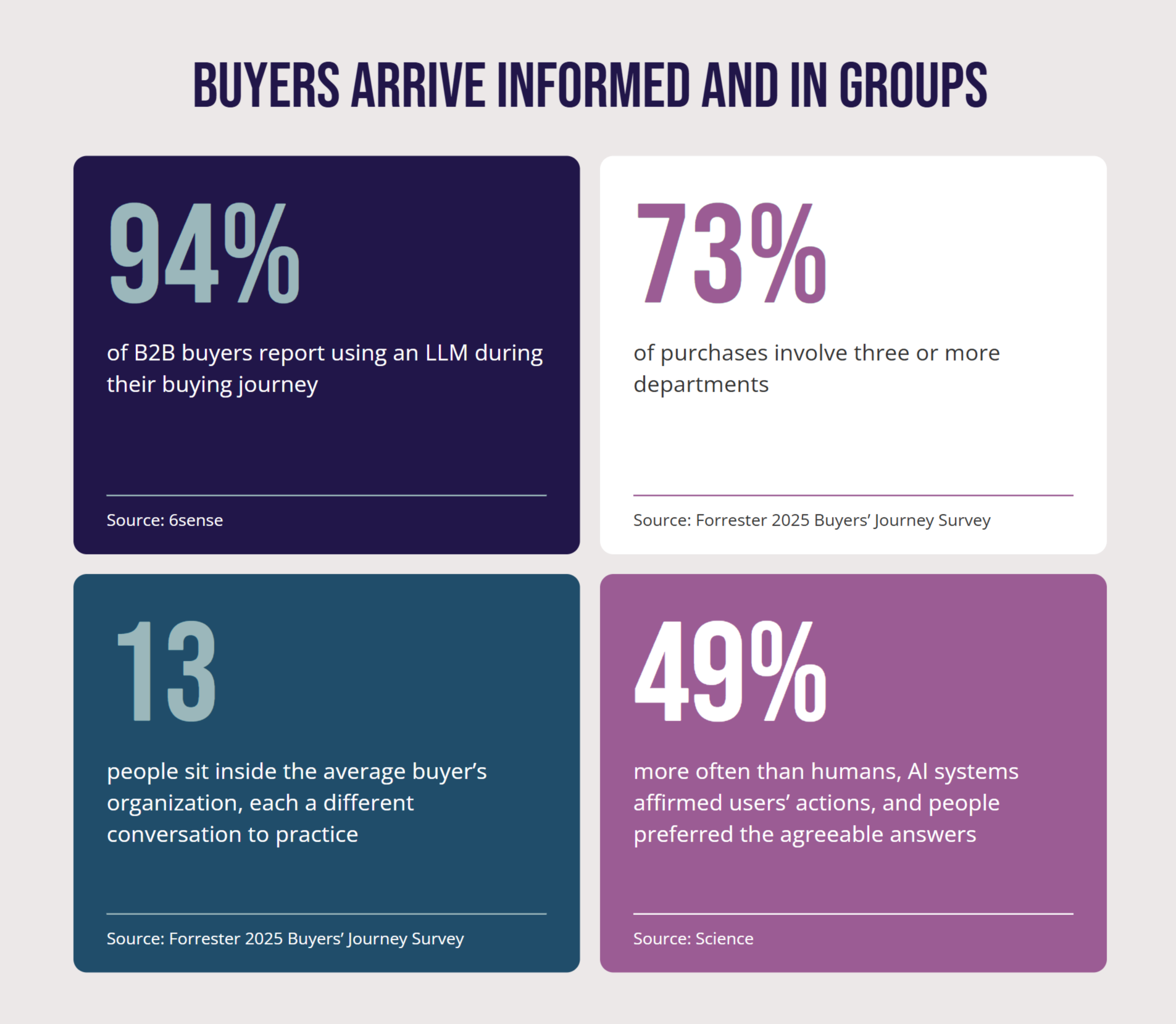
Rapidly changing B2B buying behavior complicates the equation. As buyers increasingly begin their search with AI, they’re arriving more informed and more decided than ever. There isn’t enough time to simulate the variety of conversations, information, and objections sellers may encounter. Forrester’s 2025 Buyers’ Journey Survey found that 73% of purchases involve three or more departments, with an average of 13 people inside the buyer’s organization. That’s a lot of roleplay scenarios to practice.
Many sales organizations have turned to AI to solve the scalability problem. But sales leaders now face a new challenge: they lack a clear framework for evaluating which AI roleplay solutions actually improve sales outcomes. They understand that AI roleplay has potential, but they’re unsure what it takes to turn that potential into real-world results.
Does the AI buyer push back like a real one?
To be effective, AI roleplay must reflect how real buyers behave. Real buyers are pressed for time, skeptical, and distracted. Research from 6sense found that 94% of B2B buyers report using an LLM during their buying journey. This raises the specter of misinformation, incorrect pricing perceptions, or incomplete product pictures that sellers must be ready to uncover and address. Even buyers who come straight to a seller may be reluctant to share information. They may still be forming their needs, or pushing back more aggressively than expected. For AI roleplay to build genuine selling skills, it must reflect all these complexities.
Scenarios, not scripts
In a script-based approach, sellers know what’s coming and can execute a predetermined response. In a scenario-based approach, sellers must adapt in real time. They don’t know whether the customer will be cooperative or resistant, whether they’ll provide information or withhold it, whether they’ll accept a proposal or challenge it. This unpredictability forces sellers to draw on multiple skills and make real-time judgments about which approach will work.
Without this unpredictability, AI roleplay creates a false sense of ease. Research published in Science found that AI systems affirmed users’ actions 49% more often than humans did, and that people trusted and preferred the agreeable responses. The study looked at personal advice rather than sales training, but the lesson carries over: users prefer affirming AI, so a practice tool has to be designed to push back.
When sellers practice primarily in simplified, cooperative environments, they have the feel of practice without real skill growth. They may execute perfectly within the boundaries of the training scenario, but when a real customer pushes back unexpectedly or withholds information, they’re caught off guard. They haven’t built the adaptive capacity or resilience needed to navigate genuine resistance.
Realism isn’t a nice-to-have feature. It’s the foundation of actual preparation. Sellers need to train with AI agents that push back and require them to earn every bit of engagement.
Is the roleplay grounded in a proven sales methodology?
Even the most realistic AI roleplay will be less effective if it isn’t grounded in a proven methodology. AI is well suited to simulating conversations, but those interactions must guide sellers toward the behaviors that work in the field. Very few AI roleplay solutions have this kind of foundation because an effective, time-tested sales methodology requires years to develop.
Deloitte’s 2022 research on skills-based organizations points the same direction: organizations that embed a skills-based approach are 63% more likely to achieve results than those that have not adopted skills-based practices. Richardson’s view is that the same holds for sales practice: practice without clear behavioral targets doesn’t reliably improve performance.
Without clear targets, sellers risk practicing endlessly without direction, and they optimize for platform performance rather than customer outcomes. A seller may discover that they can reliably succeed when they deliver a response that satisfies the AI’s requirement to hear specific words. This is the “good enough” trap: the solution looks effective because sellers consistently improve their scores, but they’re not developing the behaviors that actually win deals.
An underlying methodology solves this by creating a clear north star. Every practice attempt has a purpose. Every iteration moves the seller closer to mastery of a specific, revenue-relevant skill.
It also creates accountability. Sellers need more specificity than “get better at discovery.” They need direction such as “demonstrate the ability to ask questions that reveal functions in the customer’s business impacted by their key pains.” That specificity makes it easy for coaches to track progress, and leaders can see which sellers advance through skill development and which plateau. The methodology transforms AI roleplay from a practice tool into a development roadmap.
Darnetta Daire, Sales Enablement Manager at Hollister Incorporated, describes what that specificity makes possible for coaches: “We’re able to coach specifically to, hey, how are reps doing with understanding needs? How are reps doing with connection? How are reps doing with recommending our products?”
Does the scoring measure concepts or keywords?
AI roleplay platforms with generic scoring systems can create the illusion of improvement while undermining transfer to real customer conversations. Sellers see their scores rising on the platform, but fail in the field because they’ve been optimizing for platform metrics, not behavioral mastery. Research published in Administrative Sciences found that some learners using AI-enabled simulation training optimized scores without internalizing professional judgment, and that practice spread over time, not repeated attempts alone, predicted whether skills carried over to a live consultation.
While many AI roleplay solutions score conversations, few are purpose-built to assess whether the seller truly executed the selling behaviors needed in a given scenario. Fewer still can do it across a proven methodology, your call types, and your buyer contexts without manual setup. Put simply, too few AI roleplay solutions can answer the question, “what does good look like?”
Answering it requires customization, so sales leaders can ensure conversations match the customers, products, and objections sellers encounter in real customer conversations. When the AI roleplay closely resembles the real world, the scoring accurately reflects how the seller would have performed in a real interaction with a buyer.
Customization also keeps the scoring system consistent across the organization. Each seller works toward the same clear, highly relevant definition of success, so enablement teams can roll out practice across a broad and diverse sales organization. This is where AI’s power becomes visible: it’s possible to score hundreds of conversations simultaneously and give sellers and managers clear insight into performance right after the call, so they can put the feedback to work right away. The depth and breadth of that feedback is far more comprehensive than what a time-strapped manager could offer a large, diverse group of sellers with different needs.
Is AI roleplay part of a learning system?
AI roleplay reaches its potential when positioned as part of a comprehensive, personalized learning system, not as a standalone tool. Roleplay in isolation, without what came before or what comes after, produces practice without context. Roleplay integrated within a learning system produces development.
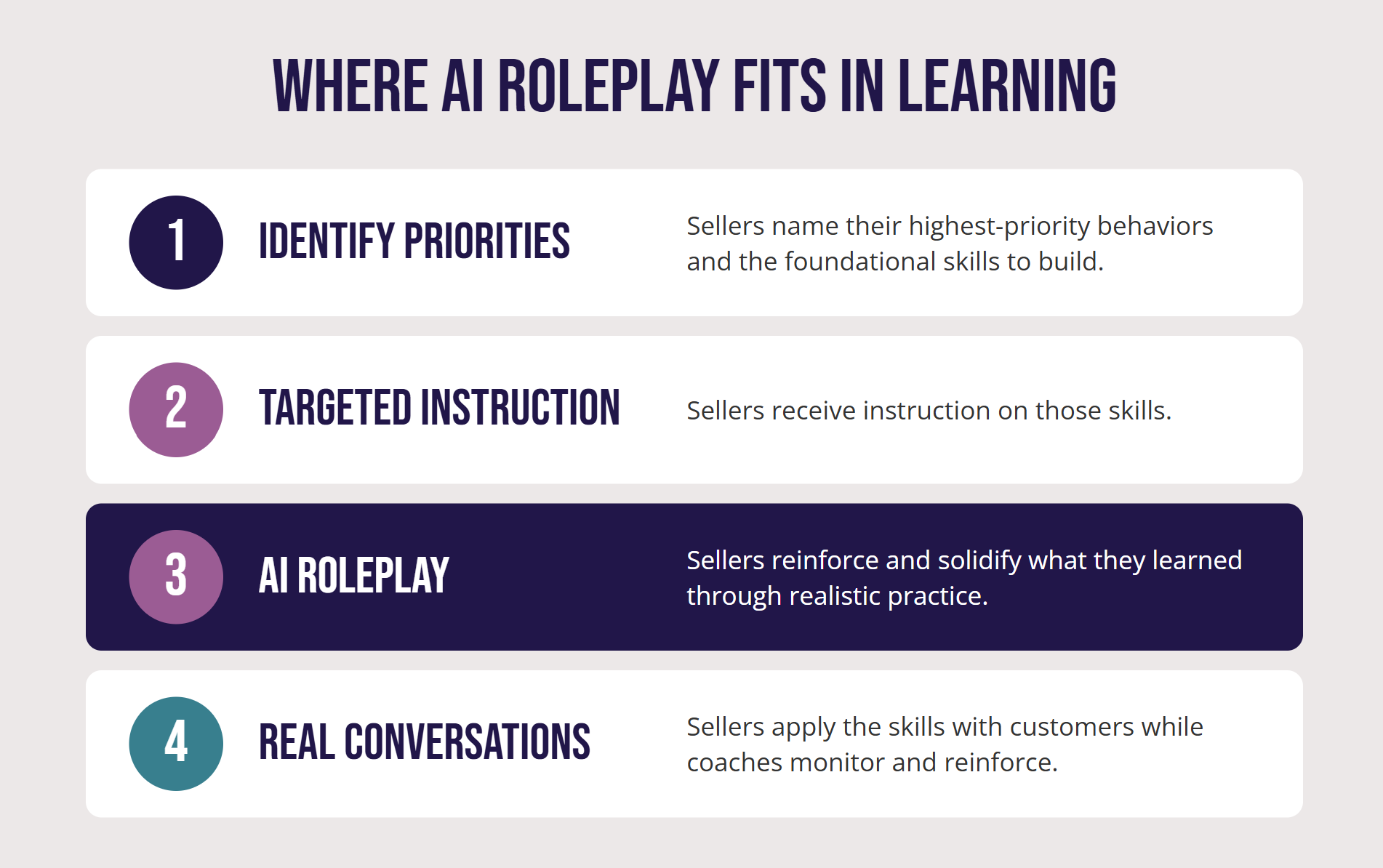
An effective learning system has a clear progression:
- Sellers identify their highest-priority behaviors and the foundational skills they need to develop.
- They receive targeted instruction on those skills.
- They use AI roleplay to reinforce and solidify what they’ve learned.
- They apply those skills in real customer conversations while coaches monitor and reinforce.
This sequence matters because each phase builds on the previous one.
AI roleplay works best in the reinforcement phase. By this point, sellers understand what they’re practicing and why it matters. They’re not encountering concepts for the first time within the roleplay conversation; they’re reinforcing foundational knowledge through realistic practice. That makes AI roleplay highly targeted and efficient, so sellers practice the behaviors most relevant to their needs and gaps.
Integration also gives coaches visibility. Because roleplay connects to the broader learning progression, coaches can see where each seller is in their development journey. They understand not just how well a seller performed in a roleplay conversation, but why, including whether the seller struggled due to foundational skill gaps or couldn’t land due to execution issues. Coaches can intervene at the right level and at the right time.
For Darnetta Daire, Sales Enablement Manager at Hollister Incorporated, that visibility matters because of how few people are available to coach: “I’m a team of one, so I’m not everywhere. Our managers may not have the capacity to do a lot of that coaching. I think with this system, it now allows us to be places that we can’t be.”
The right AI roleplay solution integrates into a structured learning system, surfaces opportunities to practice at the right time, and connects to what sellers have learned before and what comes next.
What happens when AI roleplay is only “good enough”?
Without these elements, organizations risk scaling practice without scaling performance. Sellers get better at the simulation without getting better at selling. Some get worse. Practice that reinforces the wrong behaviors is a form of bad coaching, and AI roleplay that is merely good enough risks introducing it into the sales organization at scale.
It also means overlooking a greater opportunity. When AI roleplay combines realism, methodology, structured learning, and meaningful feedback, practice becomes a powerful engine for behavior change. Organizations can give every seller repeated opportunities to practice, adapt, and improve without making the customer part of the learning curve.
How does Richardson approach AI roleplay?
Richardson brings the methodology and learning-design layer that makes our AI Roleplay a differentiated development experience. We translate real selling motions into full-call scenarios and focused behavioral drills, then score performance against fixed, expert-built Richardson and Challenger criteria. Roleplay scores and completion status flow back into Accelerate Prism to inform learning recommendations rather than ending in an isolated practice dashboard.
Our approach rests on three things:
- Practice in the flow of learning. We deliver AI Roleplay through Accelerate Prism as part of a connected learning journey, not as a separate practice application.
- Methodology-based scoring. Sellers receive immediate, criterion-level feedback against consistent, behavior-anchored Richardson and Challenger scorecards — not AI-improvised or self-built criteria.
- A closed development loop. Practice results become part of the seller’s development picture, informing what they should work on next and providing visibility through Prism metrics.
Amber Boll, Director, Sales Global Process Owner at Rich Products Corporation, sees the same potential in that connection: “The AI orchestration that enables us to see a whole bunch of different data points that will then make recommendations on learning paths — I think all of that’s going to be very powerful.”