
Medical Device & MedTech Sales Training
MedTech buying decisions rarely rest with one person. Clinicians, committees, finance, procurement, and engineering each weigh in, and each has their own definition of value. What moves a decision forward is a sales professional who can bring them all to the same conclusion. Richardson Sales Performance helps MedTech teams, from implants and capital equipment to dental and distributor-led sales, build that ability and make it consistent.
Contact Us To Start Building Your Customized Training SolutionTrusted by MedTech Organizations Like Yours








01
Diagnose What Is Really at Stake
Products rarely win on features alone. The strongest sales professionals find out what the problem costs the customer, whether in procedure time, staff workload, complications, or lost volume, and help them quantify it. That gives every stakeholder a reason to care beyond the product.
02
Find the People With Power
The person who likes the product is often not the person who makes the final purchase decision. Power can sit with a hospital committee, a capital budget owner, biomedical engineering, a purchasing group, or a practice owner. Great sales professionals map who decides and how, and earn the right to have a conversation with them.
03
Align Everyone on Vision and Value
Each stakeholder judges value differently. Clinicians look at outcomes and workflow, finance at total cost of ownership, and procurement at risk and contract terms. Great sales professionals play back what they have heard, make the value case in each person’s terms, and bring the group to agreement on where things stand and where they need to go.
04
Keep the Decision Moving Between Meetings
Committees meet on their own calendar, and deals lose momentum between meetings. Great sales professionals build a plan with the buyer, anchor every conversation to it, and keep the buying committee engaged, so the decision advances even when they are not in the room.
Buyers Know the Product. Great MedTech Sales Professionals Move the Whole Decision.
In MedTech, clinical knowledge and strong relationships are table stakes. What separates the strongest sales professionals is how they handle everything around the product like who is part of the decision, what each person values, and how the group gets from interest to approval. Regardless of specialization, great MedTech sellers typically share some common capabilities.
Every MedTech Role Has a Different Conversation. Every Buyer Needs Confidence to Act.
MedTech sales roles differ in who they sell to, who decides, and what each stakeholder needs to see before agreeing. The common thread is that decisions move when the group reaches broad agreement on the value, and that agreement is built in conversation. The roles below show how that plays out across different MedTech selling environments.
Role
Common titles
How They Win Deals
Clinician-Preference Sales (Implants, Procedural Devices, and Consumables)
Territory Managers, Territory Account Managers, Sales Representatives
Earning the clinician’s confidence, then building a case that holds up when the product goes to a value analysis review, often without them in the room. According to Definitive Healthcare, physician preference items account for 40 to 60% of a hospital’s total supply costs, so these decisions draw scrutiny beyond one clinician’s preference.
Capital Equipment and OR Technology
Territory Managers (Capital Equipment), Territory Account Managers
Winning a decision that runs through clinicians, biomedical engineering, IT, and procurement, and then gaining final capital budget approval. Alexander Group reports that only 22% of hospitals plan to increase operating budgets in 2026, down from 66% in 2025, and capital budgets are tightening too, so sellers have to overcome more scrutiny and convince more stakeholders as buying teams become increasingly protective of budgets.
Health System, IDN, and GPO Accounts
Key Account Managers
Selling on two levels, to the organization that holds the agreement and to the sites that use the product, and planning around the contracting calendar, because contract status with an integrated delivery network (IDN) or group purchasing organization (GPO) often decides whether a customer can buy at all. As systems consolidate and standardize, the seller who arrives with a standardization and implementation plan, not a product catalog, helps the enterprise make a decision it can defend.
Ambulatory and Outpatient Sales (Surgery Centers and Physician Offices)
Territory Managers, Regional Account Managers, Inside Sales Representatives
Selling to ambulatory surgery centers, physician offices, and home care means more sites, smaller volumes, and decisions that often rest with a physician owner working alongside supply chain. Build the business case around each site’s economics, such as throughput, inventory simplicity, and procedure cost, and decide where in-person time pays off and where virtual engagement works.
Dental, Practice-Based, and Distributor-Led Sales
Territory Sales Representatives, Regional Account Managers
Earning the interest of the end customer directly, whether that is a practice owner, a group practice, or a dental service organization (DSO), while keeping the dealer or distributor who serves them equipped with a clear message about why the product matters. Teams used to working through distributors often have to build those direct conversations on purpose.
Sales Managers and Enablement Leaders
Regional Sales Managers, Sales Enablement Managers
Coaching the behaviors, not just the pipeline: asking whether the rep found the person with power, built a plan with the buyer, and moved a next step forward, and judging progress by what the customer does.
Everyone Sees the Value, Yet the Group Still Doesn’t Take Action.
Each person in a MedTech buying group can agree that a product is a good fit and still not move forward. Richardson calls the gap between seeing value and feeling confident enough to act the Confidence Chasm, and in MedTech it widens when the people in the group do not agree with each other.
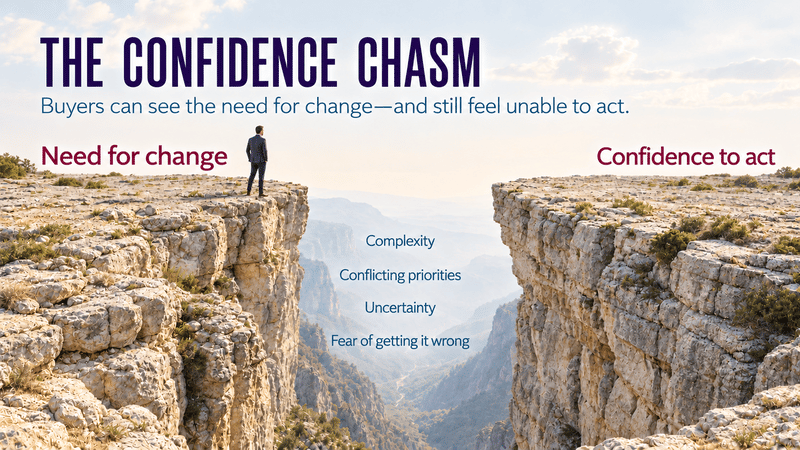
An investment in medical technology is rarely short term. It means capital, training, a change in how procedures run, and often years of service and supply from one manufacturer. Before anyone can say yes, the group needs confidence in three things: that the solution works, that the change can be absorbed, and that the investment is worth it over everything else competing for the budget. Each person holds a different definition of value and sensitivity to risk. For example, clinicians ask whether the solution works, engineering and operations ask whether the change can be absorbed, and finance asks whether the return justifies the investment.
How the misalignment shows up depends on the situation and stakeholder group. On an implant or procedural device, the clinician may be ready while the committee still wants the cost case. On capital equipment, the clinical case can be settled while finance and engineering are still weighing budget and support. In a system contract, individual sites may want to change while the network holds an approved vendor. In dental and distributor-led sales, the person who decides may sit one step away from the person who sells. In each case, someone is still waiting on an answer the others are not asking, and the deal ends in no decision.
More product detail rarely closes the gap, because the gap sits between the people involved, not in the evidence. The same value looks different to each stakeholder, so the case has to speak to each one in their own terms: outcomes and workflow for the clinician, cost and return for finance, risk and contract terms for procurement. When each person’s own needs have been met, the group can agree to move forward.
Solutions Built to Help MedTech Teams Cross the Confidence Chasm
When a decision has to pass through many people, no single conversation closes the gap. It closes when a sales professional makes the case to each stakeholder in their own terms, so each person’s needs are met and the group can agree to move forward. The solution that helps your team build that capability depends on the selling situation. Richardson helps organizations define the approach that fits their sales motions, roles, and customer conversations.
Keep Every Stakeholder Moving Together
For teams whose decisions pass through value analysis committees, capital budgets, group purchasing agreements, or governance reviews. Participants learn to find the decision process and the people with power, then build a collaboration plan, a shared plan of the steps that help the buyer reach a decision, covering the solution, the implementation, and the financial case, including references, site visits, and vendor approvals. Opportunity Vitals, five checkpoints (pain, power, vision, value, and consensus), show how strong each deal is and what to do next. Teams work in short selling sprints, so momentum survives between meetings.
Give Buyers a Reason to Change
For teams whose buyers already know the product and feel safe staying with the incumbent. Challenger, a methodology built on research into how buyers and sellers behave, teaches participants to run the Challenger choreography, a planned conversation that earns credibility, reframes how the buyer sees the problem, shows the impact, and only then reveals a new way forward. They also learn to tailor the message to each stakeholder, guide the group toward a shared “yes,” and apply constructive tension without pushing too far.
Understand Each Buyer Before Recommending
For sales professionals who get limited time with busy clinicians, engineers, and purchasing leaders. Participants learn to prepare, connect quickly, ask questions that uncover what each buyer is accountable for, and position value in the buyer’s terms, using six critical skills: presence, relating, questioning, listening, positioning, and checking. They learn a repeatable way to resolve objections, whether about cost, workflow, fit, or any other factor.
Solutions for the Moments That Decide the Deal
Some situations need a more specific solution. To support these needs, Richardson offers training content focused on building specific capabilities for specific conversations.
Reach Buyers Who Limit Access
For teams facing restricted access, credentialing rules, and gatekeepers, including inside and hybrid sales roles that work by phone and video. Participants build a prospecting plan with a clear target audience, a mix of touches across phone, email, video, social, and events, and value-based messages. They use the Prepare, Engage, Advance framework (plan the outreach, start the conversation, move it toward a meeting) and learn when to shift into pursuing an opportunity.
Grow the Accounts You Already Have
For teams that manage key accounts such as health systems, IDNs, and DSOs. Participants identify priority accounts, assess the organization, its stakeholders, and the competition, and build a plan to find white space, the products and areas where an account is not yet buying from you, and deepen relationships beyond a single contact.
Protect Value When Procurement Steps In
For teams that negotiate with finance, procurement, and purchasing groups, which often consolidate vendors and compare products. Participants learn to engage procurement early, prove economic value so offers are harder to commoditize, convert a demand into the need behind it, and trade with purpose instead of conceding.
Raise Prices Without Losing the Relationship
For teams that own pricing in existing relationships, when costs rise and customers push back. Participants learn a three-stage framework, Prepare, Notify, and Respond (plan the message, deliver it, and handle the customer’s reaction), practice it in two virtual workshops with optional coaching on a real deal, and build negotiation strategies that protect margin and trust.
Build One Way of Selling Across Business Units
For MedTech organizations with several product lines, business units, and regions, from consumables to capital equipment to software. Richardson helps define a common sales approach that flexes by business unit, site of care, and buyer, then reinforces it in daily work through manager coaching routines and opportunity reviews, connected to the CRM your teams already use. A structured change management approach sets clear expectations by role, so adoption holds across teams and markets.
See How We Customize Solutions for Your Business
Different Situations Call for Different Approaches
Richardson offers more than one approach so that each solution fits a customer’s specific circumstances. Some MedTech teams need every customer conversation to be consistently buyer-focused, because committee decisions are built one stakeholder at a time. Others need to give buyers who feel safe with the incumbent a reason to change. Hollister and Hu-Friedy show how we helped teams in each situation.
Hollister: Every Region, One Customer Conversation

Hollister Incorporated is a global medical products company. Before working with Richardson, its sales teams lacked a consistent message and a shared way of talking with customers. In the field, many customers did not understand what Hollister did or how it sold, and some of the sales messaging did not align with what the company wanted to put out into the market.
Hollister needed every rep to run customer conversations the same way: connect with the customer, understand what they need, and recommend the right solution. It rolled out Consultative Selling and built the methodology into everyday work. Whenever Hollister team members engage in sustainment activities or talk about products, the framework is part of the conversation, making the approach a natural part of how the organization works. Reps responded well, and managers got a framework that allowed them to coach to specific behaviors, such as how well a rep understands needs, connects with the customer, and recommends products.
Before
After
Reps in different regions and business units talked with customers in different ways
One framework and one vocabulary shared across regions and roles.
Sales messages that did not always match what the company wanted to say, so customers could not tell what Hollister did or how it sold
The same language and framework everywhere, which keeps the brand consistent
No shared framework for managers to coach to
Managers coaching to specific behaviors: understanding needs, connection, and recommending products
What worked in one market was hard to scale to others
Success in one market shared, with the metrics behind it, to bring the next country along
“With Richardson… we were able to scale the entire framework throughout our organization globally. So you’re getting that same language, that same framework with consistency, which keeps that brand.”
Darnetta Daire, Sales Enablement Manager, Hollister
Hu-Friedy: From Relationship Selling to Insight-Led Selling

Hu-Friedy Group, a dental instrument manufacturer, had a sales organization that was very relationship focused, with reps whose ties ran to distributors more than to end customers. With multiple product lines and growing distributor complexity, the team needed to change how it showed up, and quickly. It chose Challenger and rolled out three pieces of training: Challenger Insight Design, led by marketing; Challenge Yourself workshops for reps to practice delivering those insights, tailoring them to each buyer, and taking control of the conversation; and coaching to help managers reinforce those behaviors. Reps now move deals forward by delivering commercial insight that gives customers a new perspective on their challenges.
“This isn’t just a sales methodology. This is an organizational shift.”
Hilary McConkey, VP, Global Commercial Solutions and Sales Excellence, Hu-Friedy Group
Why MedTech Organizations Choose Richardson
MedTech commercial teams sell into regulated, savvy, and high-stakes buying groups that often require a lengthy approval process on an investment. Richardson builds the skills and capabilities that help those teams earn consensus and make it repeatable, and four things set our approach apart.
Customization That Reflects Your Business
Role plays are built around the conversations your teams actually have, such as a capital budget discussion, a contract renewal, a distributor business review, or a committee presentation, using your products, buyers, and terminology.
Methodologies Matched to Your Selling Situation
Whether the challenge is moving a decision through a committee, giving buyers a reason to change, or earning the trust of busy clinicians, Richardson helps each team define the approach that fits and builds the capabilities behind it.
Skills That Hold Up in the Field
MedTech teams often sell across many product lines, business units, and countries, so a workshop alone is rarely enough to keep one standard alive. Accelerate Prism, Richardson’s AI-orchestrated system for turning training into lasting behavior change, brings practice, manager coaching, and measurement into the flow of work. Reps rehearse conversations such as a procurement pushback or a price discussion with AI Roleplay, practicing against a realistic AI buyer and getting feedback tied to the methodology. Managers coach what they observe, and leaders see where new skills are taking hold.
A Facilitation Bench With Relevant Experience
Our facilitators have firsthand experience working in MedTech sales or have trained MedTech teams, so they know how these conversations go and workshops are specific to the world your sellers live in instead of generic.
Meet Some of Our MedTech Facilitators
We are proud of the bench we have built for MedTech. More than 30 of our facilitators have worked inside MedTech companies or with MedTech clients, and they are based in more than 15 countries, so your team can learn from people who know the territory and the customer. We’re excited to introduce you to a few of them.
Jordan Chen
China

Jordan knows MedTech from the inside, having spent eight years at GE Healthcare China and served as marketing and sales director at THINK Minimally Invasive. Jordan has also worked with clients including BD and Philips.
Walter Machold
Germany

Walter led the Abbott Vascular business unit in Germany and has spent 21 years in healthcare leadership, which gives Walter a business leader’s view of what MedTech teams are up against.
Pam Young
United States

Pam brings an account leader’s perspective to MedTech. Pam has worked with MedTech clients including BD, and has led an account team at IBM.
Gilbert Mordenti
Germany

Gilbert brings a sales enablement mindset to MedTech. Gilbert has worked with MedTech teams at clients including BD and Philips Healthtech, and has served as EMEA Sales Enablement Manager at Avaya.
Medical Device and MedTech Sales Training FAQ
Medical device and MedTech sales training develops the skills and capabilities commercial teams need to lead effective conversations with the buying groups who decide whether to adopt, purchase, or contract for a device, system, or service. It builds the ability to find the people with power, align stakeholders on value, and keep a decision moving. Because buyers range from individual clinicians to committees, engineers, procurement teams, purchasing groups, distributors, and practice owners, effective training reflects who is on the other side of the table, not only what is being sold.
In MedTech, the people who use a product, approve it, and pay for it often differ, and the mix changes by sale. For implants and procedural devices, a clinician’s preference matters, but the product usually has to clear a committee review. For capital equipment, clinicians, biomedical engineering, IT, and procurement all weigh in, and the purchase waits on a capital budget. In health system accounts, a contract held by an integrated delivery network (IDN) or group purchasing organization (GPO) can decide what sites are able to buy. In dental and other practice-based sales, the decision may sit with a practice owner or a dental service organization (DSO), often with a dealer or distributor in between. The winning move is the same: find the people with power and keep them moving together. Training solutions reflect those differences, so each role builds the skills for the conversation it actually has.
It depends on what is holding results back. Consultative Opportunity Pursuit, a Richardson program for running deals that involve many stakeholders, fits when decisions pass through committees, capital budgets, or purchasing contracts and the challenge is helping each stakeholder reach yes so the group can move forward. Challenger, a methodology built on research into how buyers and sellers behave, fits when buyers already know the product and feel safe with the incumbent, and the challenge is giving them a reason to change. Hu-Friedy Group, a dental instrument manufacturer with a relationship-focused sales team, used it to change how its sales professionals lead customer conversations. Consultative Selling, which builds trust through preparation, questioning, and listening, fits teams that want every customer conversation to be consistently buyer-focused. Hollister, a global medical products company, used it to build one consistent approach to customer conversations across regions and business units. For MedTech decisions that run through committees and capital budgets, Consultative Opportunity Pursuit is usually the stronger starting point. Richardson offers each and helps organizations define the approach that fits their sales motions, roles, and customer conversations.
Yes. In a regulated field, sales professionals can make only the claims their company’s regulatory clearances and approvals support, so insight does not mean new claims. It means helping a buyer see how approved evidence applies to their patients, procedures, or institution in a new way, and what it costs to wait. Challenger, a methodology built on research into how buyers and sellers behave, builds commercial insight, a perspective that reframes how a buyer sees a problem, through a process that brings sales, marketing, and product expertise together. In MedTech, that process can include medical, legal, and compliance reviewers so every insight stays within approved evidence. Accelerate Prism, Richardson’s AI-orchestrated system for turning training into lasting behavior change, includes AI Roleplay, which lets sales professionals rehearse these conversations with a realistic AI buyer before the stakes are real, so teams build the skill inside those boundaries.
MedTech deals stall because the cost of a wrong decision is rarely only financial. A clinician who changes a device answers for the patient’s outcome. A committee approving it answers to clinical staff, finance, and compliance. Procurement answers for cost and contract terms. A group like this leans toward consensus, and consensus often leans toward the status quo, so the deal ends in no decision rather than a no. More information rarely overcomes that. A case made to each stakeholder in terms of what that person needs can.
Value analysis committees change selling because no single conversation wins the deal. A value analysis committee (VAC) is a cross-functional hospital group, typically drawing on clinical, supply chain, and finance leaders, that reviews new products before they are approved for use. A clinician’s preference matters, but the committee decides whether the product is approved, and it runs on its own calendar. Consultative Opportunity Pursuit, a Richardson program for running deals that involve many stakeholders, gives sales professionals a way to work inside that reality. They learn to find the decision process and the people with power, build a collaboration plan with the buyer, a shared plan of the steps that lead to a decision, and track each deal against five checkpoints (pain, power, vision, value, and consensus) so momentum survives between meetings.
They move part of the decision away from the clinician and onto the organization’s own calendars and contracts. Capital equipment waits on a capital budget, so timing matters as much as the case. Group purchasing organizations (GPOs) and integrated delivery networks (IDNs) pool buying power and standardize purchasing across many sites, so a contract or approved vendor status held at the network level can decide what a hospital is able to buy. Sales professionals have to sell on two levels, to the organization that holds the agreement and to the sites that use the product. When buyers arrive with an RFP and a price benchmark, the conversation drifts toward price, so teams that negotiate with procurement and own pricing conversations benefit from practicing them. Richardson offers Consultative Negotiations and Positioning a Price Increase for those moments.
As procedures and treatment move from the hospital to ambulatory surgery centers, physician offices, and the home, the economics and the decision makers move with them. Bain & Company’s 2023 research found more than 25,000 ambulatory care sites in the US, about five times the number of call points in acute care, with lower procedure volumes and wider geographic spread than a hospital system. Accenture’s 2022 survey of 150 senior medtech executives found the shift will require medical device companies to rethink their business approach. An ambulatory surgery center may weigh throughput, inventory simplicity, and procedure cost more heavily than a hospital department, and the decision may rest with a physician owner working alongside supply chain. Sellers who build the business case around each site’s economics, and find who decides there, give buyers a reason to act that fits their setting.
Selling through medical technology distributors and dealers means influencing the end customer and equipping the distributor to carry your message when you are not in the room. Teams built on distributor relationships often need a different skill: reaching practices, group practices, and health systems with a perspective of their own. Challenger, a methodology built on research into how buyers and sellers behave, teaches sales professionals to bring commercial insight, a perspective that reframes how a buyer sees a problem, so the conversation does not depend on the distributor alone. Consultative Prospecting builds the skills to reach new buyers, and Prosperous Account Strategy helps teams plan how to grow key accounts such as health systems and DSOs.
Start with a baseline, then connect two kinds of data over time. Behavior data shows whether sales professionals are applying what they learned: practice results, coaching observations, and whether they are finding the people with power, building a plan with the buyer, and making specific requests. Outcome data from the CRM shows what happened: win rate, no-decision losses, opportunity progression, deal size, and cycle time. Behavior data by itself shows activity, and CRM data by itself shows results with no explanation. Together they show whether specific behaviors are driving results, where gaps in skill execution remain, and what managers should coach next. Satisfaction scores and self-reported impact show how participants felt, but they do not show behavior change on their own. Accelerate Prism, Richardson’s AI-orchestrated system for turning training into lasting behavior change, includes a measurement capability called Signal, which uses data and visibility to show progress and inform next steps. Prism can connect with systems an organization already uses, including CRM, so leaders can read behavior and outcomes side by side.
Richardson uses AI orchestration to support methodology execution, individual skill development, and coaching, not to replace them, and organizations adopt only the capabilities that fit their privacy, security, and compliance requirements. In Accelerate Prism, Richardson’s AI-orchestrated system for turning training into lasting behavior change, AI supports and orchestrates the learning at the individual contributor level. It uses signals about each sales professional’s capability, learning, practice, and behavior to decide what they need next, then delivers targeted learning, reinforcement, AI-enabled nudges, and AI Roleplay, with feedback tied to the training methodology. Practice results also show managers where to coach. AI guides what sales professionals and managers do next, while the methodology, the coaching, and the quality of the training define the path to behavior change and revenue attainment.
Ready to Build More Confident MedTech Conversations?
Every MedTech organization has sales professionals who already know how to bring a whole buying group along. The opportunity is making that the standard on every team.
Let’s Talk About Your Sales TeamResources


Published: November 6, 2026 | Last updated: November 6, 2026