How a Consistent Sales Process Improves Sales Results
Sales performance improvement

Written by: Ben Taylor, MBA, Content Marketing Manager, Richardson
Published: October 15, 2026
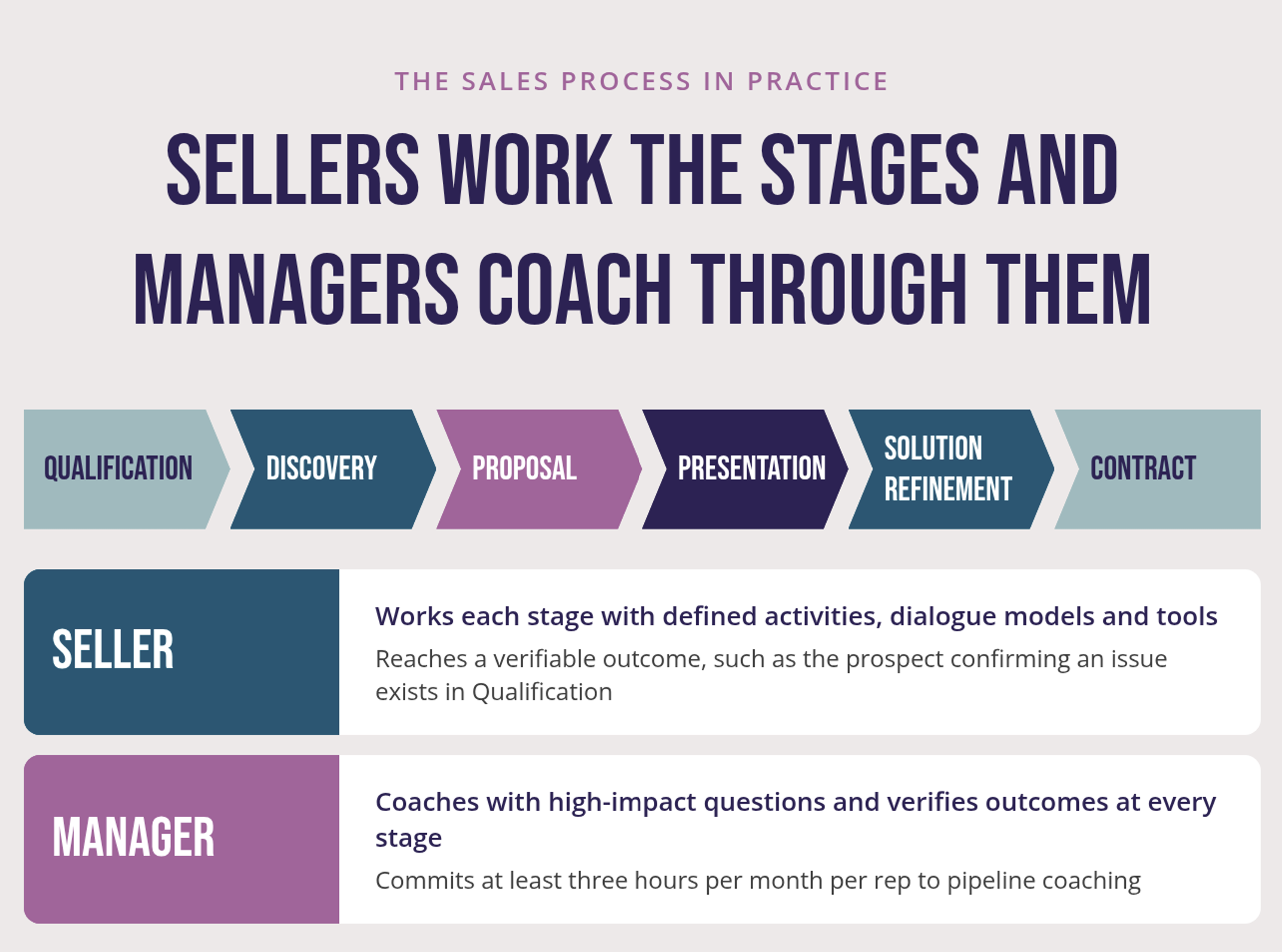
Two things unite virtually every sales organization: the desire to improve sales performance and the need to achieve results as quickly as possible. Change happens when a majority of people begin doing new things repeatedly. For organizations attempting a step change in performance, it starts with the sales process. An effective, intuitive process gives sellers and their managers a common language for discussing opportunities and their stage-by-stage progression through the pipeline.
Key Takeaways
- A consistent sales process gives sellers and managers a shared language, clear activities, and verifiable outcomes at every stage.
- Having a process isn't enough. It must align with the customer's buying process, give clear direction for activities and outcomes at each stage, and become part of the coaching conversation.
- Three KPIs show whether the process is working: forecast accuracy, sales cycle, and quota attainment.
Why Does a Common Language Matter in the Sales Process?
It's not only what people say, or how they say it, but what they mean when they use certain words. When people share a common language, they become more unified. They "get" what the other is saying. They're on the same page.
This doesn't mean everyone has to speak English or Spanish or German. Whatever their native tongue, sellers should speak the language of selling. At Richardson Sales Performance, we focus on terms like verifiable outcomes, which means leading indicators of success at each stage of the sales process. We use the same words consistently to create understanding across global organizations about the steps every seller needs to take, the outcome that should be reached, and how sales managers should coach their teams toward success.
When sales organizations link a common language to the sales process, they begin talking about selling activities in similar ways, with similar sequences. The nature of the conversation changes. Instead of just talking about activities, sellers and managers can talk about how the activity was conducted, exchange best practices, offer tips on how to do things better, and verify outcomes.
Consider the Discovery stage, where sellers undertake a number of activities to explore and assess an opportunity. Instead of just asking whether those activities were done, the sales manager can use a common language to dig deeper:
- "What kind of input did you get from the prospect when you used the Questioning Strategy Funnel?"
- "How did the prospect respond after receiving the validation letter that you sent? What feedback did you receive?"
When the process clearly outlines the activities, customer dialogue models, tools, and verifiable outcomes for each stage, conversations can be specific about progress achieved and milestones attained. That leads to more confidence in sales forecasts.
Clients tell us the same thing happens in their organizations. Using a common language starts by changing the conversation between sellers and their managers. That leads to behavior change that aligns with the sales process and its desired verifiable outcomes. The language sets clear expectations for sellers and for managers, who can better coach their teams throughout the process.
"One of the things that has been most important to me is having a common methodology and even a common vocabulary that we can use to describe where we are in terms of stages in the sales process with all of our team members." — Kristin Krawczyk, Senior Sales Director, Cencora
When sellers and managers use the same language to identify progress and bottlenecks, sales performance improves because people focus on what matters most. The sales cycle shortens because there is less inefficiency and misunderstanding of expectations.
What Makes a Sales Process Effective?
Sales leaders want to be confident in their teams' ability to be credible and valuable partners to their customers. They need a consistent way to determine what happens in the field and whether sellers have the skills to clearly articulate value.
Sellers also need to differentiate themselves from competitors. Consistency is part of the solution, both in process (what needs to be done) and in skills (how things are done).
As you might expect, just having a sales process doesn't guarantee success. To be effective, the process must meet three qualifiers:
- It aligns with the buying process of customers.
- It provides clear direction for sellers' activities and outcomes at each stage.
- It becomes part of the conversation sales managers have with their direct reports, coaching them to develop their skills and adopt desired behaviors.
With the Richardson Sales Performance sales methodology, the process is typically broken into stages such as Qualification, Discovery, Proposal, Presentation, Solution Refinement, and Contract. Richardson customizes each stage to the specific client organization and its customers' buying processes. Richardson sequences activities to deliver maximum value to buyers and identifies dialogue models, tools, and verifiable outcomes for each stage. The result is a consistent, repeatable, and effective process that sellers and sales managers can use to work opportunities through the pipeline as quickly and efficiently as possible.
A consistent process also lets sales managers quickly diagnose where the problems are and recommend changes in behavior, so their people are doing and saying the right things at the right times. The outcome should be greater consistency of selling behaviors across the organization, with a positive impact on the sales cycle.
How Does a Consistent Sales Process Improve Sales Forecasting?
For sales forecasts to be meaningful, they must be credible and accurate. Deals that slip unexpectedly, or are lost, undermine both.
The time to discover unexpected deal slippage or loss is not at the end of the forecasting period, whether quarterly or monthly. Pinpointing problems as quickly as possible allows for course corrections. That takes a dynamic sales process with a considered series of stages, activities, verifiable outcomes, and high-impact coaching questions. The process should be flexible and scalable, with room in the execution for good judgment by sales professionals.
Having a sales process is not enough on its own, though. Sales managers must use it to coach their teams and improve the quality of the dialogue by focusing on moving deals through the pipeline, not on forecasting. Too often, we have seen sales organizations stumble because they fail to recognize their sales managers as force multipliers and don't empower or enable them to become coaches. That leads to little change in behavior and only incremental impact on business results.
That's why we define verifiable outcomes as unambiguous leading indicators of movement through the sales cycle. Managers can track and coach to these outcomes, either spotting red flags or building confidence in forecasts. Verifiable outcomes also help screen and assess opportunities. Knowing what outcomes to expect provides guidance to be more rigorous about qualifying or discarding leads. The forecast becomes more reliable because opportunities that could never materialize disappear, leaving only those with true potential.
A well-crafted sales process also forces an honest look at opportunities, which changes the nature of conversations between sellers and their managers. Those conversations sound like this:
- "I'm not pursuing this prospect because they are not ready to buy and haven't allocated any budget."
- "There isn't an immediate need in the prospect's organization, and we cannot differentiate ourselves from competitors."
A process that encourages honest appraisals like these leads to better communication, greater consistency, and shorter, or at least contained, sales cycles. Leading companies with such processes have experienced significant change in cycle reduction, in their sellers' ability to articulate value, and in forecasting accuracy. We know this from what our clients tell us and from research, including our own surveys and those of Aberdeen Group and Harvard Business Review.
Why Does Sales Manager Coaching Make the Process Work?
The two keys are to have a credible process and to use it. The best way to make sure sellers use the process, and use it effectively, is through coaching conversations between sales managers and their teams.
The same survey found that companies whose managers spent at least three hours per month managing each rep's pipeline saw 11% greater revenue growth than those that spent less time. How those hours were spent mattered just as much. The authors, Jason Jordan and Robert Kelly, wrote that the primary focus of a pipeline meeting should be to help reps develop a game plan to move deals forward, not just scrub CRM data and forecast revenue.
At Richardson Sales Performance, we call this pipeline coaching: a conversation between sales manager and rep that focuses on deals in the works. The term is part of the common language we advocate for sales teams to keep everyone on the same page.
What Are High-Impact Coaching Questions?
High-impact coaching questions help managers confirm that their reps have the skills and knowledge needed to achieve verifiable outcomes at every stage. In the Qualification stage, for example, a verifiable outcome might be confirmation from the prospect that an issue or problem exists and needs to be addressed. The same questions help managers identify behaviors a rep needs to change, or is already changing, along with the rate of adoption.
If the verifiable outcome is confirmation of the need, a manager's questions might be:
- What are the business issues and compelling needs or pain points the prospect is trying to address?
- Who cares about these business issues, and why?
- What do they expect to achieve by addressing these issues?
- Why can't they achieve this today?
- Who confirmed that this need exists, and where does it fall in terms of priority?
If the verifiable outcomes involve feedback from the prospect about possible solutions, a manager's questions might be:
- Which solution is the best fit for this prospect?
- What did the decision maker say?
- How will the recommended solution meet this prospect's business needs now and in the future, according to the decision maker?
- What is our unique value proposition? Does the prospect agree with it?
- What benefit do they see in the unique value proposition?
- Why did the prospect say a competitor might be a better fit?
- Beyond price, what about capabilities, responsiveness, and level of trust?
- Who else will be involved in evaluating the solution?
- Have you met each of them? Describe their perception of us, in their words.
How Should Managers Observe Reps Without Taking Over?
Another way for managers to verify skills and knowledge is direct observation, through a ride-along or by participating in a sales call. The caution is that most sales managers used to be top sellers, and they find it difficult to step back and let their reps do their jobs.
Managers need to develop their skills in observing reps while curbing their tendency to step in. They need to pay close attention to what is being said and the behaviors displayed, and then coach accordingly. If managers interrupt their rep and take over, they do themselves and their reps a disservice. Instead of helping people improve their skills and move deals forward, they teach reliance on the manager.
To get the most out of the sales process, managers need to commit at least three hours per month per rep to ask high-impact questions, review the details of deals, and verify outcomes at each stage. Managers need to document and track these coaching sessions so they know which rep is at what stage in the pipeline and what commitments each rep has made to adopting new behaviors. This is how sales managers use a formal sales process to lead change and achieve their revenue goals.
"Richardson has helped us establish a common sales language and create greater alignment across our global sales organization. They have strengthened both selling and coaching capabilities while supporting a structured development journey for sales professionals and leaders." — Patrick Klein, Sales Enablement Manager, Endress+Hauser
How Does CRM Integration Strengthen the Sales Process?
Sales managers are the front line in promoting adoption of the sales process. They do it through consistent, ongoing coaching sessions focused on moving deals through the pipeline.
Integrating the sales process with your CRM sounds simple enough, but most companies treat their CRM as a data repository. Companies require reps to input and update information about their calls, and managers access the data to make and adjust forecasts. In reality, adoption of the CRM is limited because the tool itself offers limited value to reps. Typically, they use it to discuss their activities with their manager, schedule appointments, and set reminders. Some companies try to do more, adding marketing content at different stages of the sales process to align with the progression of the deal, such as a benefit analysis to share with the prospect, a white paper on an industry issue, or a blank contract to provide initial terms.
What we recommend at Richardson Sales Performance is to fully integrate the sales process with your organization's CRM platform to raise adoption of both the CRM and the process itself. When the two are joined, the CRM becomes the platform for coaching conversations because the activities for each stage are defined and sequenced.
- Reps can see where they are in the process and what they have to do next. They can access training and marketing materials within one platform, so they don't have to search for resources.
- Managers can access high-impact coaching questions, and the CRM can capture the results of coaching sessions, noting commitments made.
- Training teams can use the CRM to measure the success of training sessions, so outcomes can be verified and discussed.
- Conversations between manager and rep can focus on moving deals forward instead of adjusting forecasts to reflect current circumstances.
The organizations making the most progress are those where responsibility for CRM strategy resides with sales support functions, like sales operations. When the IT department is the product owner, the CRM is less likely to reflect a customer-centric vision that supports reps in being more efficient and effective. IT is better at security, policy, and technology, while sales operations has a more comprehensive understanding of collaboration among sales, marketing, and learning and development.
How Do You Measure Whether the Sales Process Is Working?
Sales is a measurement-based business. Sales teams track metrics for quota attainment, sales by product line, segment, and territory, new business versus renewals, forecast versus actual results, number of sales calls, and more.
Lagging indicators of success, like revenue, are cumulative. They describe commitments and deals that have occurred and mark the status of an opportunity at the end of the sales process. Leading indicators are incremental. They are based on actual customer behavior and reactions to what the rep does or says, so they predict future customer commitment and provide insight into an opportunity's status during the sales process.
Three sales KPIs everyone should follow blend both types, because both are necessary for transparency into the progression and ultimate outcome of opportunities. You may be able to capture some of these metrics in your team's CRM.
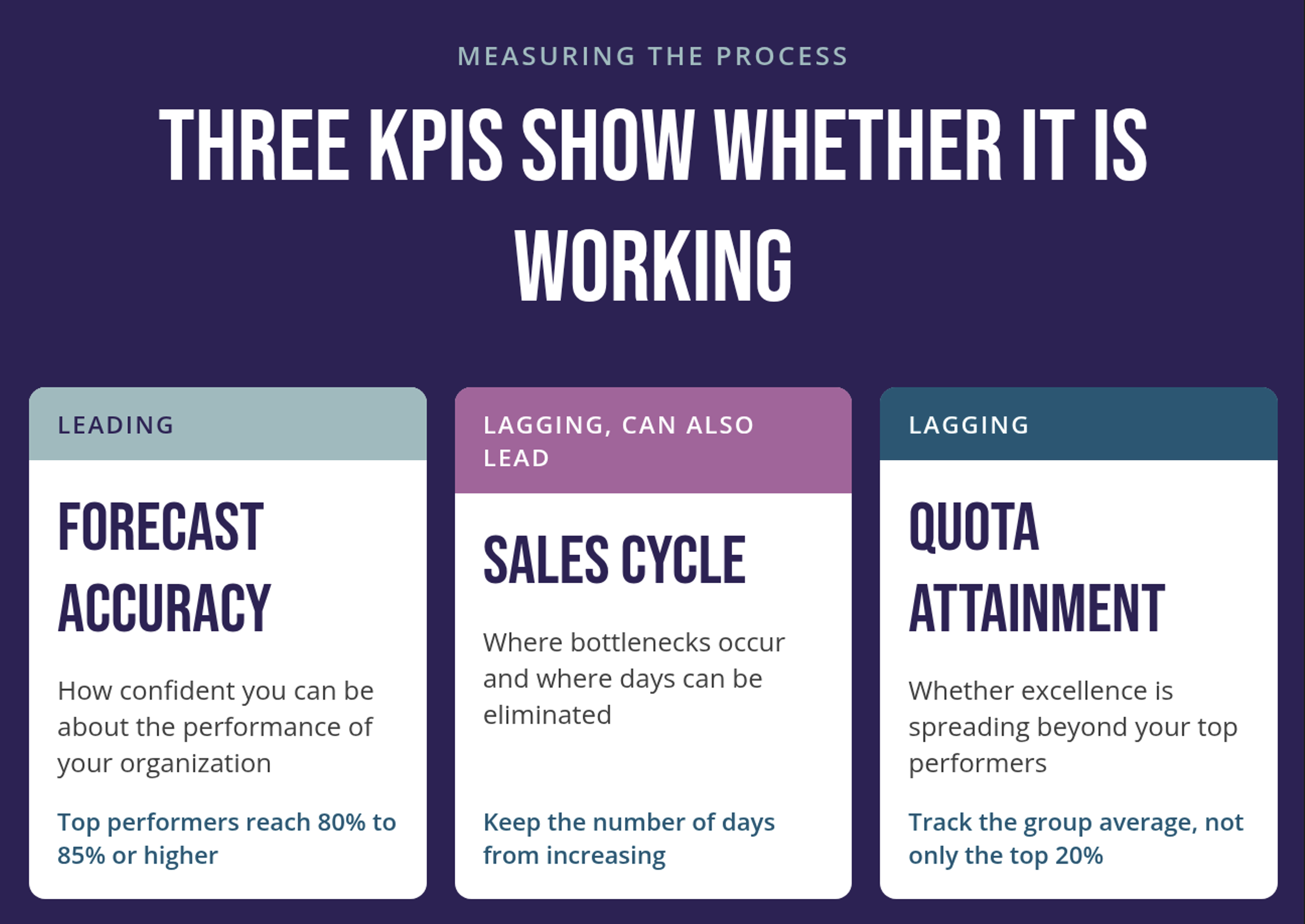
| KPI | Type | What it tells you |
|---|---|---|
| Forecast accuracy | Leading | How confident you can be about the performance of your organization |
| Sales cycle | Lagging (can also be leading) | Where bottlenecks occur and where days can be eliminated |
| Quota attainment | Lagging | Whether excellence is spreading beyond your top performers |
- Forecast accuracy. Forecast accuracy is an important leading indicator. The more it improves, the more confident you can be about the performance of your organization. The direction matters more than the starting point. If you are in the 50% range and trending higher, you are doing the right things. At 60% or 65% and improving, that is even better. At 80% to 85% or higher, you are among the top-performing organizations.
- Sales cycle. Sales cycle is typically a lagging indicator that provides good information for maintaining or improving efficiency. It's important to know before, during, and after the sale where bottlenecks occur and where days can be eliminated. Just as important as reducing the sales cycle is making sure the number of days doesn't increase. When managers can identify where opportunities tend to get stuck, this KPI becomes a leading indicator as well. If opportunities used to get stuck but now continue to progress, you know you are doing the right thing. And if opportunities are dropping out faster in the early stages of qualification, that is a good thing, because it means the overall process is more efficient.
- Quota attainment. Quota attainment is a lagging indicator, measured for every individual. The equally important data point is overall achievement. Tracking the group average is not about making your top performers perform better. It's about extending their level of excellence to the rest of the sales organization. Instead of focusing on, say, the 20% of high achievers who drive 80% of revenue, you can make more of an impact by focusing on the larger portion of your sales force and elevating their game.
Together, these KPIs give you a clear view into how well your sales organization and your sales process are working. If you improve forecast accuracy, control your sales cycle, and keep average quota attainment on the rise, you'll see the difference where it really counts — in revenue growth.