Accelerating Sales Performance with AI

Written by: Ben Taylor, MBA, Content Marketing Manager, Richardson
What is AI in sales enablement and how does it help?
AI in sales enablement refers to the use of artificial intelligence tools and analytics to improve productivity, streamline sales processes, enhance decision-making, and personalize customer engagement, making sales teams more effective and competitive.
In today’s rapidly evolving business environment, leveraging AI in sales enablement is no longer a luxury. It’s a necessity. Salesforce’s 2026 State of Sales report found that 87% of sales organizations now use some form of AI for tasks like prospecting, forecasting, and lead scoring. Sales enablement professionals are embracing AI to drive efficiency, refine strategy, and deepen customer connections.
In this article, we highlight four powerful ways AI is transforming the sales enablement landscape. Keep reading to learn:
- How AI boosts productivity by automating routine sales tasks and freeing reps to focus on strategy.
- How AI-powered insights streamline sales processes and remove bottlenecks.
- How data-driven insights from AI tools improve forecasting and decision-making.
- How AI enables personalization by tailoring content and conversation to individual customer needs.
Enhanced sales performance and productivity
AI boosts sales team performance by automating routine tasks such as:
- Data entry
- Lead qualification
- Follow-up communications
This automation frees up reps to focus on strategic, revenue-generating activities like relationship building and closing deals. With more time allocated to high-value tasks, teams see improved efficiency and accelerated deal cycles. Salesforce’s 2026 State of Sales report found that 55% of sales professionals already use AI for prospecting, with another 38% planning to.
Streamlined sales processes with AI-powered insights
AI enhances workflows and eliminates sales bottlenecks by:
- Identifying friction points in the sales funnel
- Recommending best practices
- Delivering actionable insights from real-time data
With AI-driven analytics, sales leaders can make smarter, faster decisions and ensure reps are focused on high-impact actions. In April 2026, Gartner predicted that by 2029, sales organizations with AI-driven enablement functions will achieve 40% faster sales stage velocity than those using traditional enablement approaches.
Smarter decision-making through predictive analytics
AI enables predictive forecasting and deeper insight into buyer behaviors. Key benefits include:
- Prioritizing high-potential leads
- Allocating resources more effectively
- Enhancing strategic planning
With accurate, data-backed insights, sales teams can improve conversion rates and drive sustained growth. Insight matters because many teams still lack it: Salesloft’s 2026 Revenue Benchmark, a survey of 500 U.S. sales and revenue decision-makers, found that only about 32% can instantly diagnose why a deal has stalled.
Personalized customer engagement at scale
In a competitive sales landscape, personalization is key. AI empowers reps to:
- Analyze customer behavior and preferences
- Craft tailored messaging and sales content
- Deliver relevant recommendations throughout the buyer journey
This hyper-personalized approach leads to higher engagement, stronger relationships, and better sales outcomes. Among sellers using AI, Salesforce’s 2026 State of Sales report found that 89% say it deepens their understanding of customers.
Where AI helps sales enablement
| Task | How AI helps |
|---|---|
| Data entry and CRM updates | Automates routine administrative work, freeing reps to focus on strategic selling and relationship building |
| Lead qualification | Automates qualification and prioritizes high-potential leads |
| Follow-up communications | Automates follow-up emails and other routine communications |
| Forecasting | Delivers predictive forecasting and actionable insights from real-time data |
| Customer engagement | Analyzes customer behavior and preferences to tailor messaging and recommendations throughout the buyer journey |
Why the tools aren’t the point
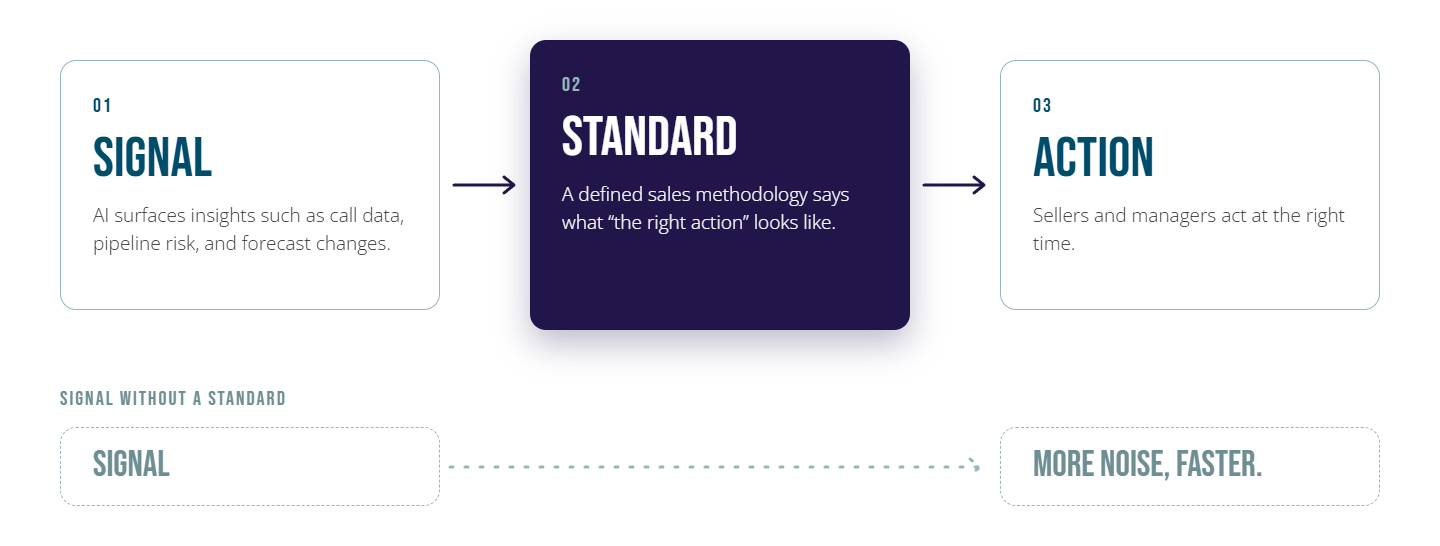
AI can surface more signal than a sales team could. But signal without a standard for what to do with it just produces more noise, faster. As Richardson Chief Product Officer Kate Lewis said: “The power of AI is not in replacing human judgment. It is in helping sellers and managers take the right action at the right time.”
That only works if there’s a defined methodology identifying “the right action.” Without that foundation, AI tools tend to automate whatever inconsistency already existed more efficiently.
Getting started with AI in sales enablement
Start with the routine tasks that take reps away from selling, like data entry, lead qualification, and follow-ups. Look for AI features built into the sales enablement tools you already use. Then pair them with training so reps know how to put the insights to work.
Managers are part of this too. Amber Boll, Director, Sales Global Process Owner at Rich Products, said: “I don’t think any of us are going to be able to do this successfully at scale long term without really, really embracing AI.”
Frequently Asked Questions: AI in Sales Enablement
Q. How is AI used in sales enablement?
A. AI is used in sales enablement to automate tasks, provide data-driven insights, improve forecasting, and personalize customer interactions. It streamlines workflows, enhances decision-making, and helps reps prioritize high-impact activities, from the first lead qualification through follow-up.
Q. What are the benefits of AI for sales teams?
A. AI boosts sales productivity, improves lead scoring, enhances pipeline visibility, enables smarter targeting, and delivers more personalized buyer experiences. Together, these lead to higher conversion rates and stronger customer relationships.
Q. What types of tasks can AI automate in sales?
A. AI can automate administrative tasks like data entry, follow-up emails, CRM updates, and lead qualification. That allows reps to spend more time on strategic selling and relationship building.
Q. Is AI difficult to implement in sales enablement programs?
A. It doesn’t have to be. Many sales enablement platforms now have built-in AI features that integrate with existing tools, which keeps the lift manageable. The bigger factors are a clear strategy, connected data, and training. Salesforce found that 51% of sales leaders with AI say disconnected systems are slowing their AI initiatives, so starting with the tools your team already uses is a practical first step.
Q. Can AI improve the personalization of sales outreach?
A.Yes. AI tools analyze buyer behavior, interests, and preferences to generate personalized messaging and content recommendations that are more relevant and timely, which leads to higher engagement.
How Richardson helps clients take advantage of AI
Richardson is proud to help our clients strategically take advantage of AI as part of their sales development by offering a suite of tools that are easy to implement and can produce immediate results for your team. Learn how our AI Roleplays help sellers in relevant scenarios get instant, real-time feedback, and explore our AI Smart Trackers that make every call an opportunity for growth. If you’re looking for a fully integrated solution, contact us to learn about Accelerate Prism, Richardson’s AI-orchestrated system for turning training into lasting behavior change.
Darnetta Daire, Sales Enablement Manager at Hollister, described what that looks like in practice: “I’m a team of one, so I’m not everywhere. Our managers may not have the capacity to do a lot of that coaching. I think with this system, it now allows us to be places that we can’t be.”