What Are the Biggest Challenges Facing B2B Sellers in 2026?
Sales performance improvement

Written by: Ben Taylor, MBA, Content Marketing Manager, Richardson
Published: November 3, 2026
AI reshapes how sellers work. Human judgment and influence still determine who wins deals.
Richardson's 2026 Selling Challenges Research Study surveyed more than 300 sales professionals about the challenges they expect to face in 2026. Across prospecting, pipeline management, complex buying groups, account growth, and commercial insight delivery, one pattern emerged clearly: the hardest parts of selling remain deeply human.
Sellers continue to struggle most with aligning stakeholders, creating urgency, delivering meaningful insight, and protecting value in complex negotiations. These capabilities require judgment, business acumen, and the ability to guide customers through difficult decisions — skills that technology alone cannot replace.
At the same time, sales organisations are rapidly adopting AI to increase efficiency and expand access to information. Many respondents see AI as both a powerful opportunity and a source of uncertainty. While AI accelerates prospecting, automates tasks, and improves data visibility, it raises an important strategic question: how can organisations use these tools without weakening the capabilities that actually drive customer decisions?
Put simply, AI is becoming widely available across the sales landscape. Competitive advantage comes not from having AI, but from knowing how to apply it effectively.
Key Takeaways
- Sellers struggle most with finding and aligning the right stakeholders, knowing which questions to ask, restoring buyer confidence, protecting price, growing accounts beyond a single contact, and helping buyers see the cost of the status quo.
- Buyers have more information than ever but struggle to decide.
- AI use remains fragmented. Fewer than 10% of respondents use AI extensively across their sales process.
- The advantage goes to organisations that apply AI to build human selling capabilities, not those that simply adopt it.
What Is the Top Challenge in Each Area of Selling?
| Area of selling | Top challenge | Respondents |
|---|---|---|
| Prospecting | Identifying and reaching the right stakeholders | 28% |
| Sales conversations | Asking purpose-driven questions that surface needs | 33% |
| Moving opportunities forward | Addressing stakeholder indecision or resistance | 28% |
| Complex buying groups | Aligning stakeholder groups and slow decision speed (tied) | 24% each |
| Negotiation | Protecting price and profitability | 36% |
| Account growth | Overreliance on a single point of contact | 36% |
| Delivering insight | Getting the customer to see the cost of the status quo | 30% |
| AI in the sales process | Emerging: piloting AI, but adoption is early and fragmented | 32% |
Why Is It So Hard for Sellers to Find the Right Stakeholders?
When prospecting in 2026, sellers told us that identifying and reaching the right stakeholders is their most difficult task. The top three responses:
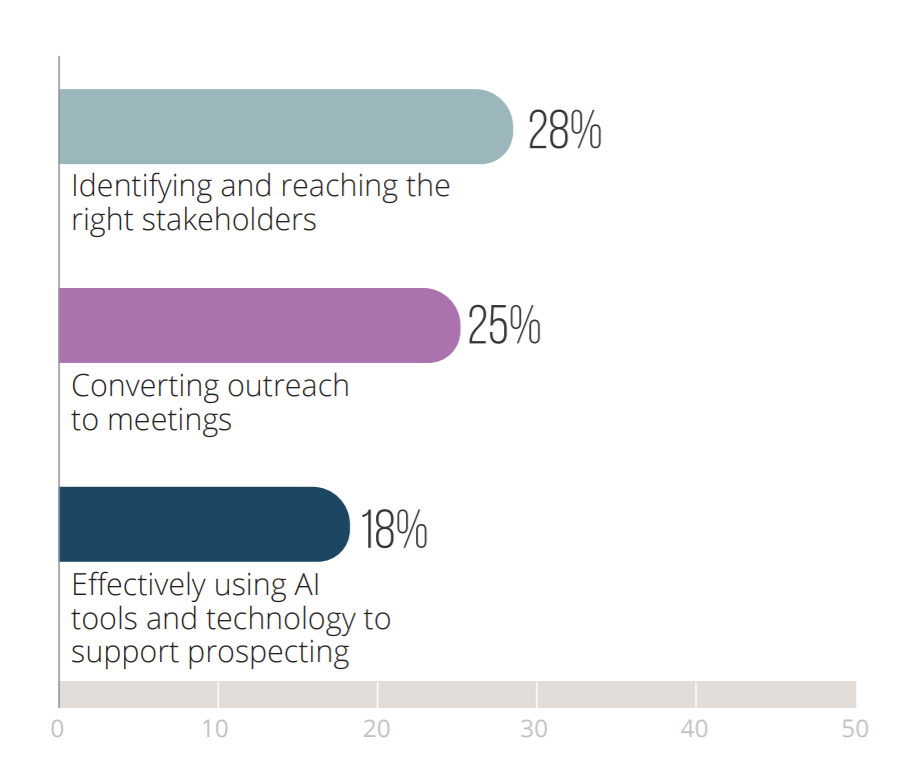
- Identifying and reaching the right stakeholders: 28%
- Converting outreach to meetings: 25%
- Effectively using AI tools and technology to support prospecting: 18%
Stakeholders are harder to pin down. Just as selling organisations turn to AI to become more efficient, so do buyers. They use AI to do more solution exploration on their own — 45% of B2B buyers used AI during a recent purchase — or use AI itself as the solution. That creates a problem-solution mismatch, because it removes the seller who guides buyers toward solutions relevant to their core challenges. As one respondent explained, “every customer now has AI reviews, and legal and procurement teams for their technology.”
Uncertainty makes it worse. Geopolitical tensions, changing economic policy, and a fragile consumer all affect stakeholder decision-making. Different stakeholders also enter and exit the pursuit as buying needs change.
What helps:
- Shift from contact acquisition to stakeholder ecosystem. Think in terms of roles and influence: who owns the problem, who controls the budget, who evaluates risk, who will use the solution, and who has executive authority.
- Engage in multithreading. Expand prospecting across the buying group. Sellers earn access to senior stakeholders through insight and strategic perspective, not persistence alone — and 73% of B2B buyers actively avoid suppliers who send irrelevant outreach.
- Take an issue-led approach. Explore the underlying causes of the customer's challenge and the business impact the seller can have, rather than leading with features.
Which Questions Get Buyers to Open Up?
The hardest skill to apply in a sales conversation is knowing the kinds of questions that reveal the customer's core needs. The top three responses:
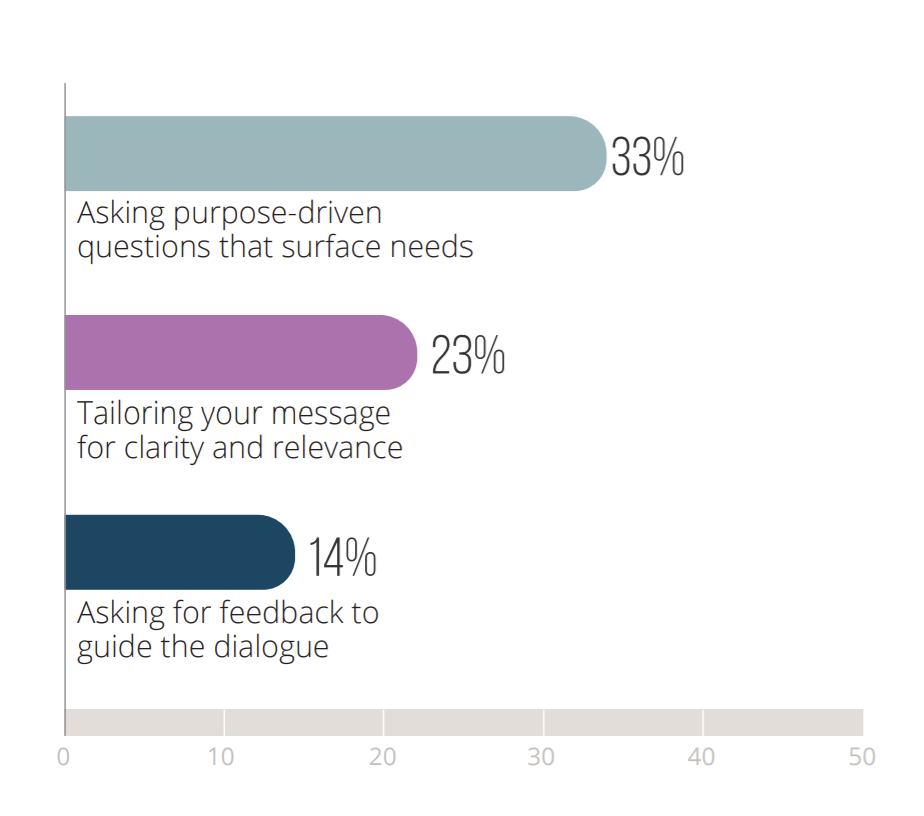
- Asking purpose-driven questions that surface needs: 33%
- Tailoring your message for clarity and relevance: 23%
- Asking for feedback to guide the dialogue: 14%
Knowing what to ask is getting harder. Many businesses are changing as they consider how to benefit from or respond to AI, so sellers need questions that uncover AI challenges even when the customer can't yet articulate them. As one respondent put it, “the only way to stand out is to connect value prop to business outcomes.”
A good questioning strategy is the first step toward defining problems, uniting stakeholders, and inspiring action. It also drives message tailoring, because a seller cannot draft a meaningful message without first uncovering the customer's challenges.
What helps:
- Take a sequenced approach. Think of a nesting doll. Start with the customer's objectives, then move to current situation, satisfaction with the current state, future needs, personal needs, and finally the decision-making process and selection criteria.
- Use the four Ps of questioning. Phrasing means asking open-ended questions. Prefacing means explaining the rationale behind a question. Pursuing means drilling down on vague statements. Pacing means using silence to encourage the buyer to elaborate.
- Remember self-determination theory. Self-determination theory holds that people have three fundamental needs: autonomy, competence, and relatedness. Sellers build stronger connections when they honour those needs — staying emotionally connected, avoiding anything manipulative, and creating a safe space to discuss sensitive situations.
These questioning skills are central to Consultative Selling.
How Can Sellers Help Buyers Out of the Confidence Chasm?
When it comes to moving opportunities forward, respondents named stakeholder indecision and driving urgency as the hardest challenges. The top three:
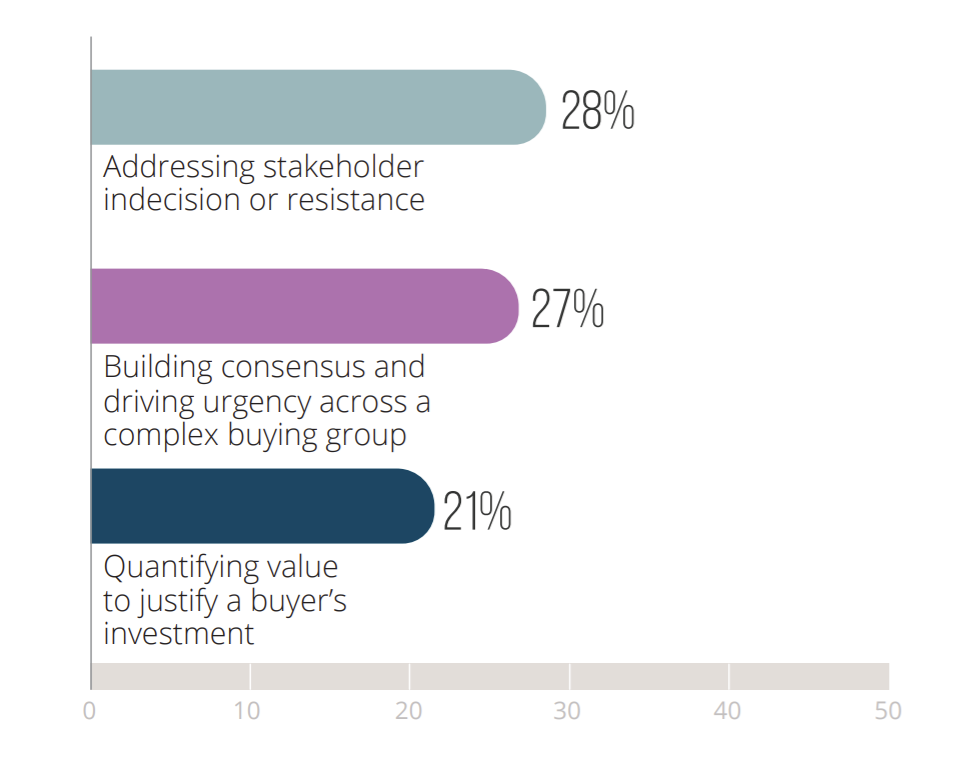
- Addressing stakeholder indecision or resistance: 28%
- Building consensus and driving urgency across a complex buying group: 27%
- Quantifying value to justify a buyer's investment: 21%
Complexity, information, and risk all weigh on buyers. We call the result the confidence chasm. Buyers have access to more information than ever but struggle to decide. With so much uncertainty, they go into defensive decision-making mode, convincing themselves that making no decision is a good decision.
Sales and enablement leaders have responded by investing in systems, technology, and analytics. Even so, the confidence chasm persists. Focusing purely on persuasion or productivity is not enough. Sellers also need to build buyer confidence through a better buying experience, because confident buyers are twice as likely to report a high-quality deal than buyers with low decision confidence.
What helps:
- Sell forward by restoring buyer confidence. Diagnose customer pain, clarify root causes, and quantify them. When buyers understand their core challenge, they become more confident in deciding.
- Create urgency for change. Highlight the cost of inaction — hidden risks, opportunity loss, competitive threats, and downstream consequences. The goal is not to scare the buyer, but to show they can get ahead of those risks by acting sooner.
- Remove the fear of messing up. Buyers fear making a mistake more than missing out. The JOLT Effect by Matt Dixon and Ted McKenna offers a four-part approach to break the buyer's inertia:
- Judge the level of indecision. Create a setting where decision makers feel comfortable talking about what's giving them pause.
- Offer a recommendation. Present a small list of factors to consider, then advocate for one specific course of action.
- Limit the exploration. Prove reliability by candidly explaining why buyers don't need more information.
- Take risk off the table. Anchor the customer to outcomes that are believable, practical, and doable.
Why Do Complex Buying Groups Struggle to Reach Consensus?
The biggest challenge in managing complex buying groups is a lack of alignment among stakeholders, which slows decisions. The top three responses:
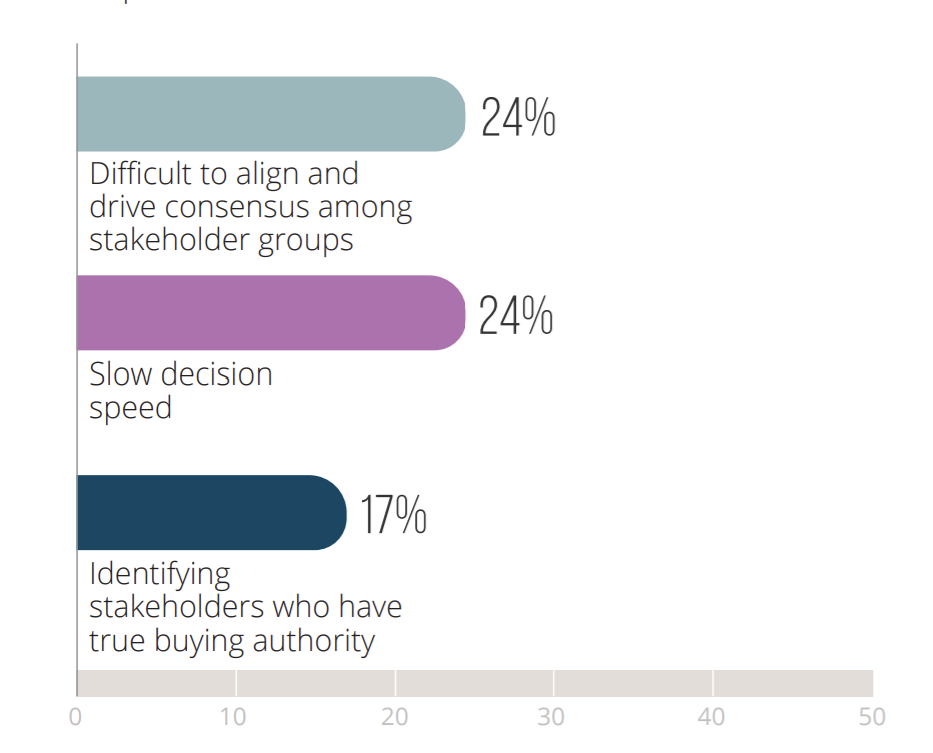
- Difficult to align and drive consensus among stakeholder groups: 24%
- Slow decision speed: 24%
- Identifying stakeholders who have true buying authority: 17%
The amount of information available today means it's possible to validate any strategy or opinion, which makes consensus harder to build. One respondent said that “risk aversion is high, resulting in low appetite to sign off on large and complex offers, so there is a ‘bite and bite’ approach emerging.”
Respondents also reported more difficulty identifying who holds true buying authority. Either buying groups are larger and more complex, or those with authority are reluctant to identify themselves, because a misstep carries professional risk. In both cases, sellers are the guiding voice that gives buyers the confidence to act.
What helps:
- Emphasise risk mitigation, not just ROI. Buyers care about scalability and integration. Predictability, reliability, and consistency carry a premium in an uncertain setting.
- Identify the hidden buyers. A hidden buyer has influence over the decision but isn't part of the selling conversations. Buyers rarely volunteer them, but asking how the decision chain flows reveals who is involved and opens the way to multithreaded relationships.
- Make the proof-of-concept sale. As buyers express more risk, they prefer to test a small purchase first. The first deal isn't the end goal. It earns the right to pursue the follow-through deal.
How Can Sellers Protect Price and Profitability?
Protecting price and profitability is the single biggest difficulty in negotiations as buyers grow more aggressive in their pursuit of value. The top three anticipated negotiation challenges:
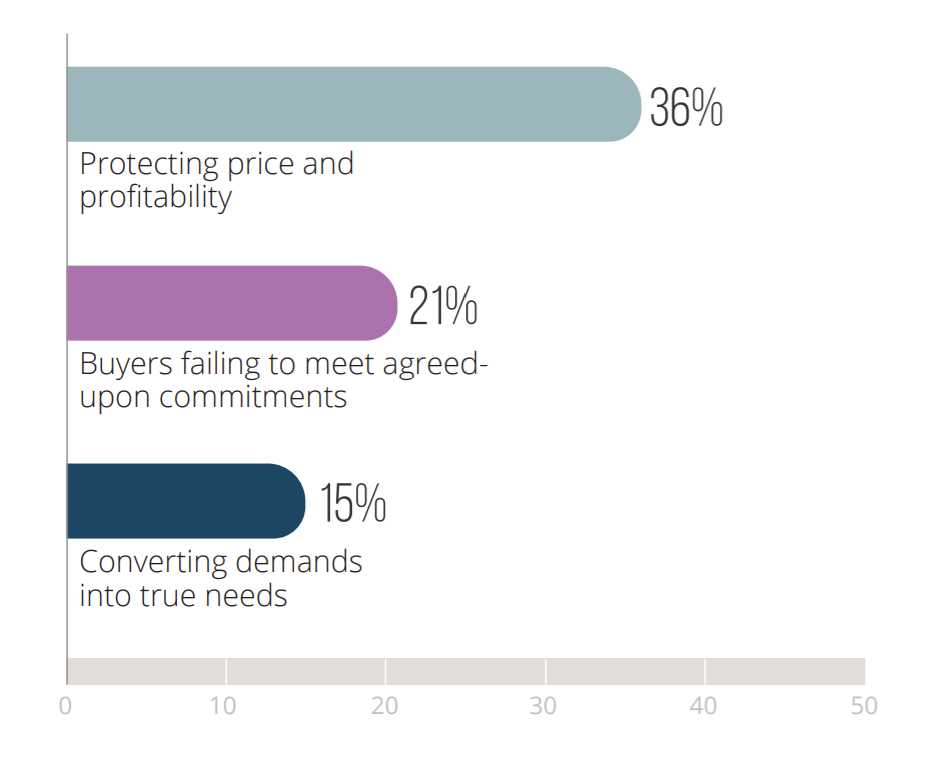
- Protecting price and profitability: 36%
- Buyers failing to meet agreed-upon commitments: 21%
- Converting demands into true needs: 15%
Buyers face intensified competitive pressure. Since COVID-19, businesses have become more efficient and direct teams to do more with less, which has made cost management part of the business model. Fragile and costly supply chains, new global trade costs, and low barriers to entry add to the pressure. At the same time, buyers enjoy greater price transparency and use it as leverage.
What helps:
- Adopt a defensive stance. Winnable deals are harder to find, so protecting them matters as much as creating new ones. Plan for competitive conversations ahead of time and set standards for price discipline. Before putting price and terms on the table, build the buyer's confidence by answering three questions: why choose this organisation, this solution, and this seller and team.
- Understand the zone of trading possibilities. A trade keeps a negotiation moving without giving something up for nothing. Define the space between your opening terms and worst-case scenario, and the customer's opening terms and bottom line.
- Convert demands to needs. A demand expresses an underlying need. “I can't pay that much” is a demand. “I need more flexibility in the payment schedule” is a need — and much easier to resolve. Acknowledge the demand neutrally, then use drill-down questions to reveal the need behind it.
Sellers build these skills in negotiation training.
After Ferguson gave its sales managers a consistent coaching methodology, the company reported a 50 basis point improvement in its trading margin. Read the Ferguson story →
How Do Sellers Grow Existing Accounts?
A strong relationship with one contact isn't enough when the whole account rests on it. The top three responses on growing existing accounts:
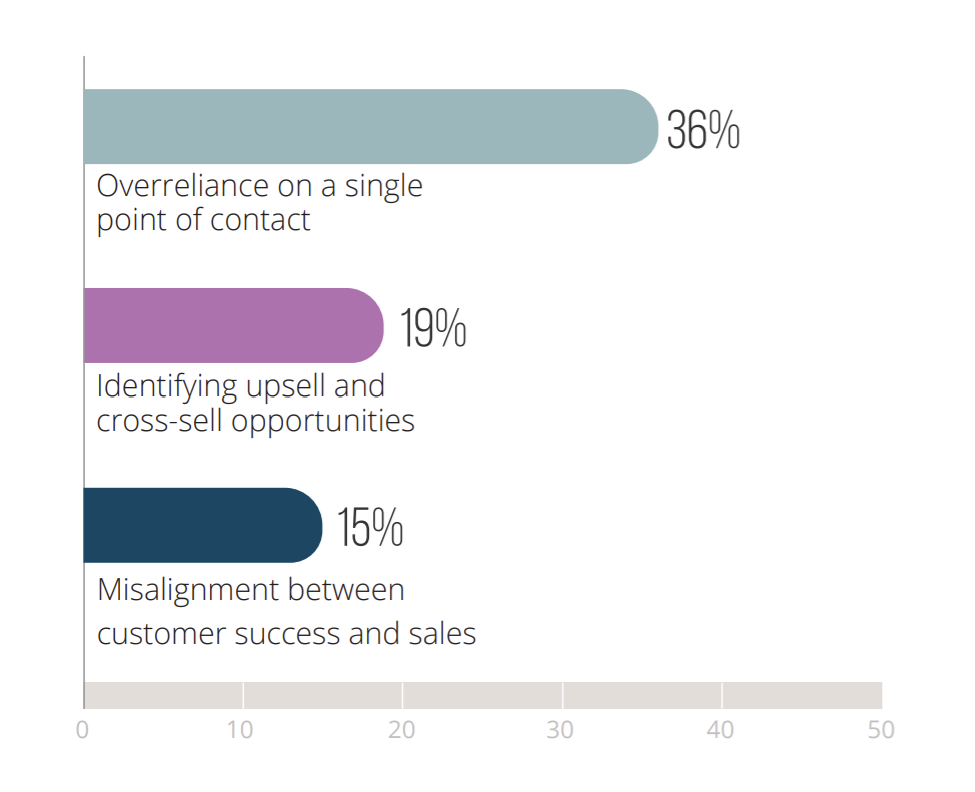
- Overreliance on a single point of contact: 36%
- Identifying upsell and cross-sell opportunities: 19%
- Misalignment between customer success and sales: 15%
Definitions of success vary between stakeholders, and they change from month to month. One contact may believe in the solution's value while others still need convincing. As one respondent said, their “reps are getting surprised at renewal,” because buyers are more proactive in reaching out to competing vendors. Sellers can no longer treat existing accounts as safe. They need visibility into customer health so they can see renewal risk early — across the whole buying team, not just their primary contact.
What helps:
- Develop Mobilizers in the organisation. Challenger research asked customers to assess themselves across 135 stakeholder attributes, traits, and perspectives. It found a type — Mobilizers — who drive change across their organisation and build consensus. Mobilizers are vendor-neutral, curious, and sometimes sceptical. They pressure test what sellers tell them, and their coworkers respect them and give them access. Account managers should partner with their main contact to identify and rally additional Mobilizers.
- Approach account expansion as new business. Think like you're selling to a new client. Read 10K reports and listen to earnings calls. Build a network of champions beyond one person.
- Consider the width and height of accounts. Map the stakeholders in each account to increase both the number of relationships (width) and their seniority (height). Use results achieved in one area of an account to earn access to others. Account planning puts this into practice.
Cargill worked with Richardson to build a customised sales framework that includes a stage for strengthening and expanding relationships. The company reported that volume doubled in one of its largest preferred accounts, and that one business unit acquired more than 10 new large accounts. Read the Cargill story →
How Can Sellers Help Buyers Move Past the Status Quo?
Delivering a reframe that reveals a new way of thinking about a business problem is harder because customers today face so much change. When we asked what challenges sellers face in delivering a commercial insight, they told us:
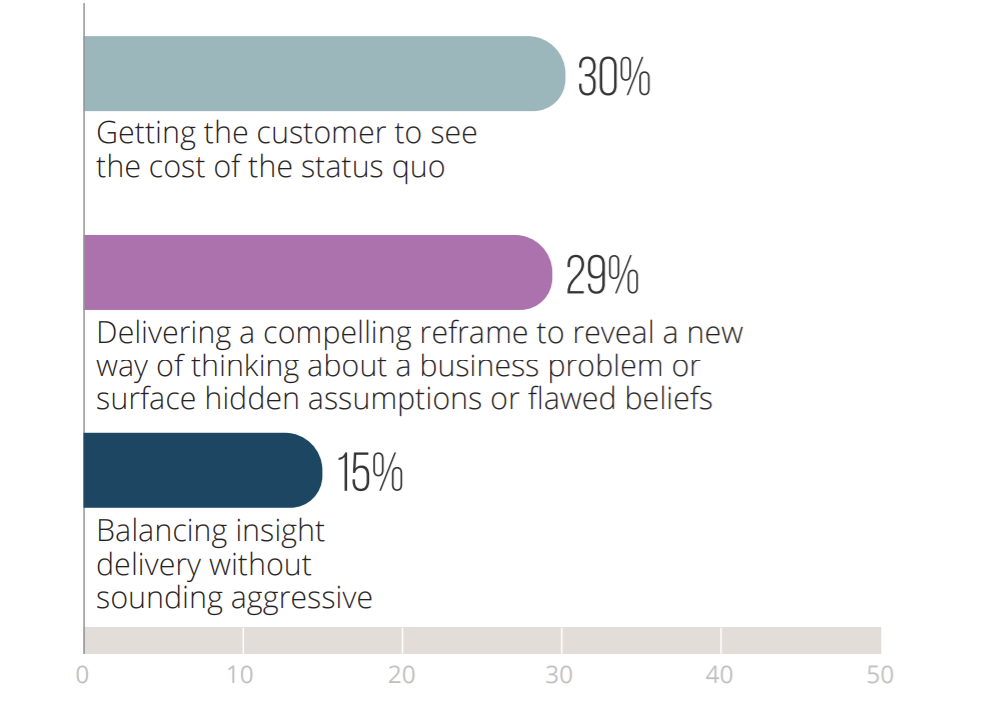
- Getting the customer to see the cost of the status quo: 30%
- Delivering a compelling reframe that reveals a new way of thinking or surfaces hidden assumptions or flawed beliefs: 29%
- Balancing insight delivery without sounding aggressive: 15%
In complex and volatile environments, the status quo feels relatively safe. It is also easier for a customer to defend, because it isn't an outcome they directly chose. But it becomes very expensive, because it allows problems to fester that the right investment could have solved. The cost is invisible and difficult to quantify, which is why sellers have an obligation to make it clear and show the buyer it's real.
What helps:
- Teach, tailor, and take control. Educate buyers with a message that challenges their underlying beliefs and assumptions, and tailor it to the customer's industry and company and the role and personality of each stakeholder. Control the sale and use the cost of inaction to drive urgency. This is the core of The Challenger Sale approach.
- Deploy constructive tension the right way. Constructive tension isn't tension between the seller and the customer. It's tension between the buyer and the status quo. Ask questions that help the buyer interrogate their reliance on it: “What would happen if your biggest competitor doubled their speed — how would you respond?” Then use silence to give the customer time to think.
- Understand the difference between aggression and effective insight delivery. The idea is to compel customers to consider their status quo, not to shock them into action. Sellers want buyers to ask themselves, “Am I approaching this business problem correctly, or am I putting myself and my organisation at risk by not considering a new way?”
How Should Sales Teams Use AI Without Losing What Wins Deals?
Many sales leaders see how AI can improve their win rate, but use remains fragmented across their business. When asked about AI in the sales process, the top three responses:
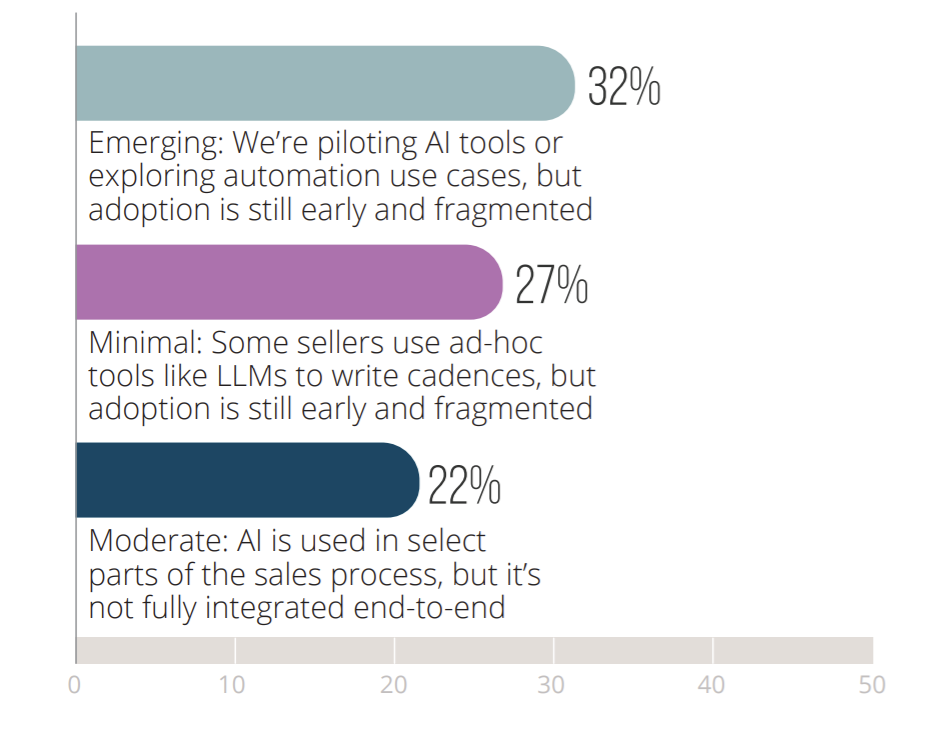
- Emerging (piloting AI tools or exploring automation use cases, but adoption is still early and fragmented): 32%
- Minimal (some sellers use ad-hoc tools like LLMs to write cadences): 27%
- Moderate (AI is used in select parts of the sales process, but isn't fully integrated end to end): 22%
Fewer than 10% of respondents say they use AI extensively — fully embedded across the sales process, with agentic AI connecting systems and custom GPTs supporting enablement. Most organisations are still working out how to make the technology work for them. Results vary, and most efforts look like experimentation without a plan. AI without structure gives sellers information but no way to act on it.
What helps:
- Pair AI with proven behavioural science. AI as a training tool is new, but the principles of behavioural science are not. Building AI tools on research-backed principles turns a shapeless, ad-hoc approach into a deliberate one.
- Achieve scalable change. Rather than using AI for point-in-time interventions, use it to turn the complexity of lasting behaviour change into clear, data-supported action. AI delivers personalised content, scenarios, role plays, and learning paths that keep sellers engaged long enough for new behaviours to take hold. See how AI reinforcement works in Accelerate Prism.
- Manage through leading indicators. Sellers lose hours every week to poorly integrated and underutilised software, and executives can't see team progress. Leaders revert to instinct, sellers revert to habits, and the organisation loses the ability to course-correct in time. Use AI to connect performance signals directly to the behaviours that matter, and turn those signals into guided action in real time.
Which Ten Skills Address These Challenges?
| # | Skill | Challenge it addresses |
|---|---|---|
| 1 | Shift from contact acquisition to stakeholder ecosystem | Finding the right stakeholders |
| 2 | Multithread relationships across the buying group | Finding the right stakeholders; single point of contact |
| 3 | Lead with business issues, not product features | Finding the right stakeholders |
| 4 | Use a sequenced questioning strategy | Knowing which questions to ask |
| 5 | Structure conversations with the four Ps of questioning | Knowing which questions to ask |
| 6 | Restore buyer confidence by diagnosing the problem | The confidence chasm |
| 7 | Create urgency by highlighting the cost of inaction | The confidence chasm; the status quo |
| 8 | Use AI to achieve scalable change | Fragmented AI use |
| 9 | Start with small wins through proof-of-concept deals | Consensus and slow decisions |
| 10 | Deploy insight and constructive tension to drive change | Disrupting the status quo |
Who Took Part in the Research?
Richardson asked sales professionals eight questions about the most urgent challenges they face as they look ahead to 2026, and heard from more than 300 sales professionals, sales leaders, enablement professionals, and other go-to-market leaders and staff.
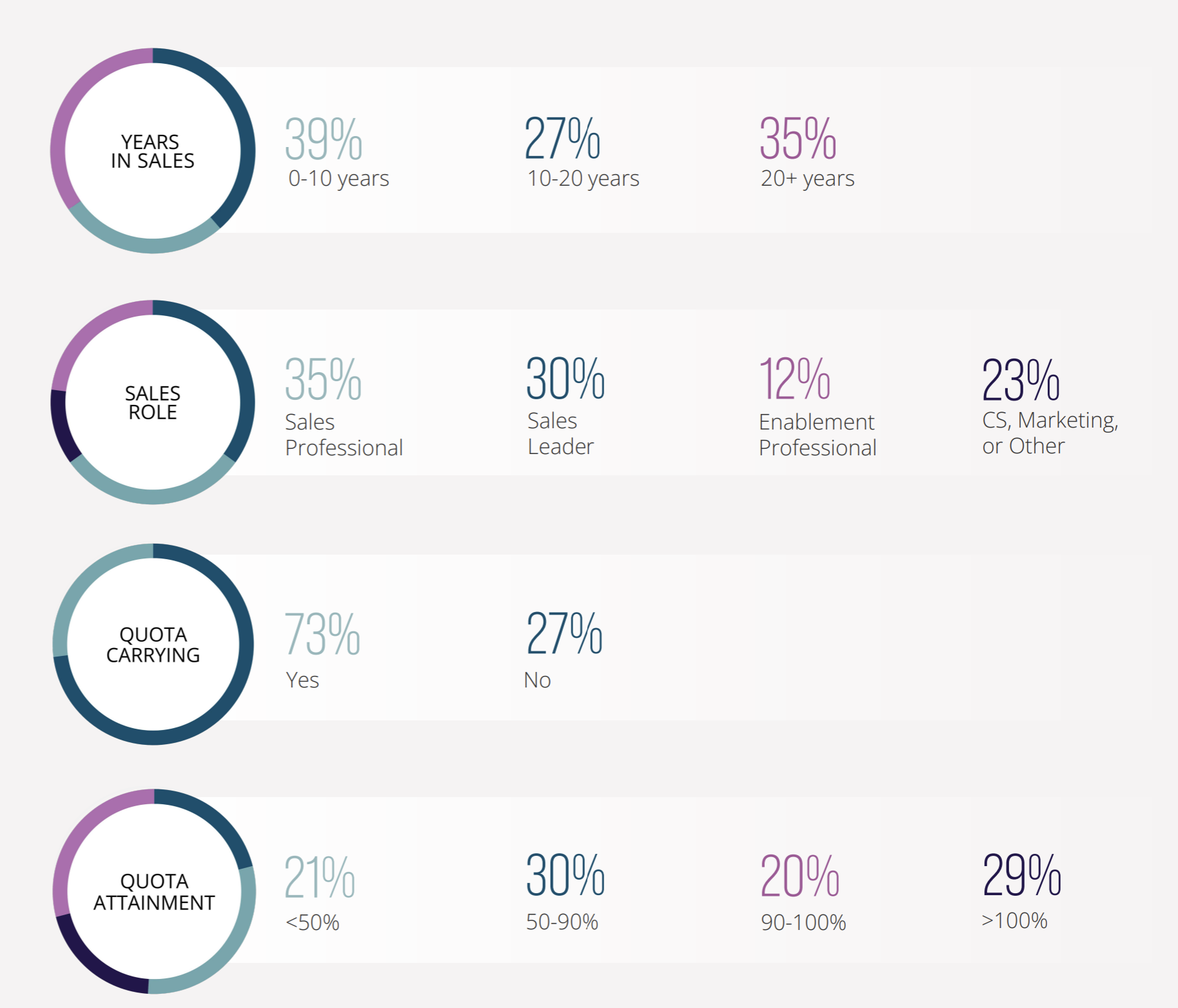
- Role: 35% sales professionals, 30% sales leaders, 12% enablement professionals, and 23% customer success, marketing, or other
- Quota: 73% carry a quota, and fewer than half achieved 90% of quota or more
- Experience: Respondents skewed younger, with revenue professionals who have fewer than 10 years' experience (39%) the largest group, followed by those with 20 or more years (35%) and 10 to 20 years (27%)
What Should Sales Leaders Do About These Challenges?
Richardson is a global sales training organisation — equipping sales teams to win more business in an increasingly cautious and complex environment. With AI, shifting buying patterns, and larger stakeholder groups, buyers now have far more input but struggle to make decisions.
Buying teams fall into a confidence chasm, dragging the sale down with them. To sell forward, Richardson shows you how to blend disruptive insights with consultative skills to move deals forward, orchestrate seller-personalised, AI-enabled learning to drive new behaviours that last, and analyse progress with data and visualisations that make it easy to see what's working — and what needs to change. That's why more than 900 industry leaders rely on Richardson to build confident sales teams who compel buyers to act.