What's the Difference Between Being Assertive and Aggressive in Sales?
Sales performance improvement

Written by: Ben Taylor, MBA, Content Marketing Manager, Richardson
Published: November 13, 2026
Attention is a limited resource. Priorities compete for the customer’s time, leaving little for sales professionals. This pressure explains why some sales professionals resort to aggressive tactics to earn the customer’s attention.
Key Takeaways
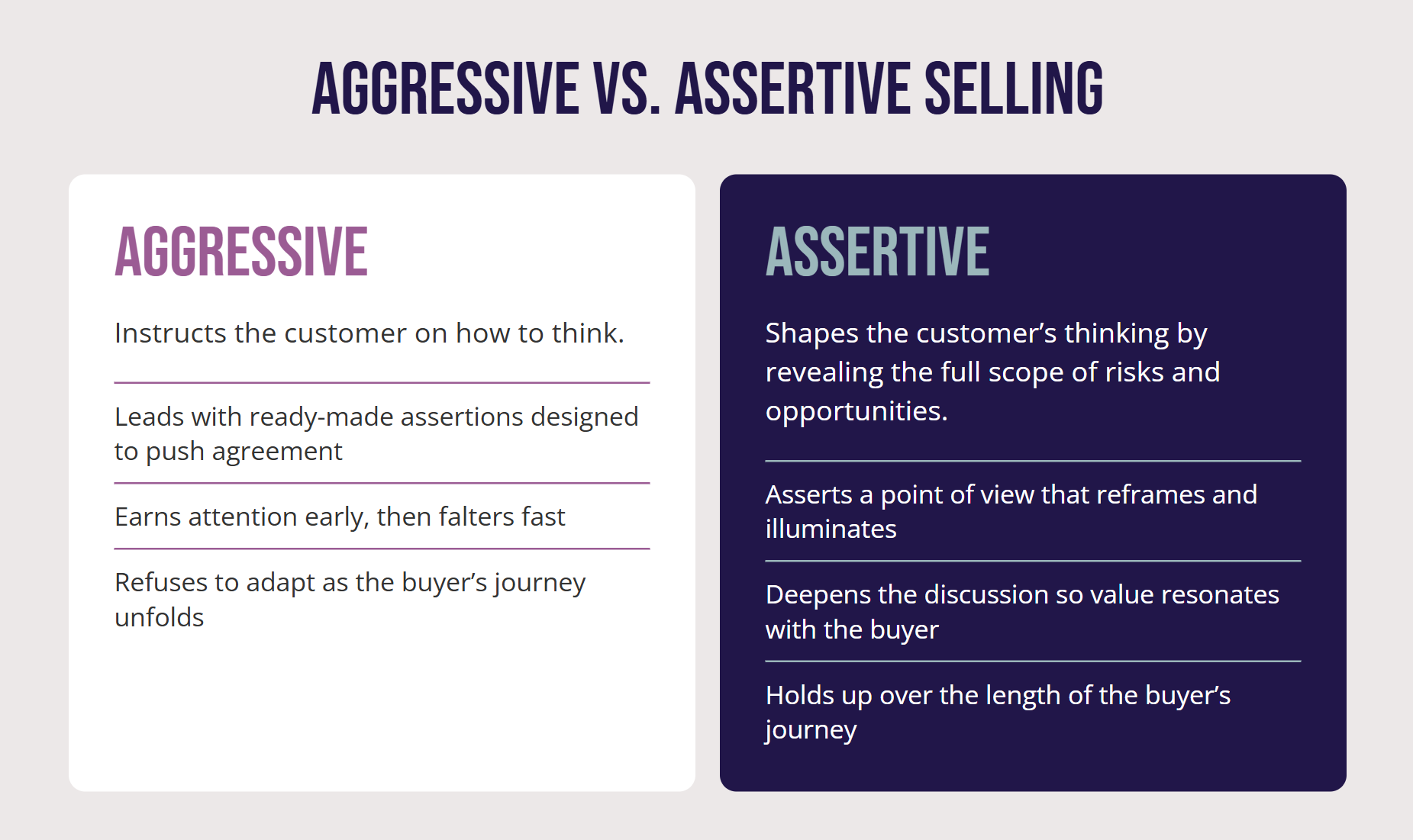
- An aggressive approach instructs the customer on how to think.
- An assertive approach shapes the customer’s thinking by revealing the full scope of risks and opportunities.
- In Richardson’s view, aggressive tactics earn attention early but falter over the length of a buyer’s journey.
What does aggressive selling look like?
Aggressive sellers lead the sales conversation with ready-made assertions designed to push the customer into agreement. While such an approach grabs the customer’s attention early, it lacks the sustainability of a more thoughtful approach: asserting a point of view.
Aggressive tactics are a short sprint in a long race. They earn attention early, then falter fast. The buyer’s journey is a force unto itself and refuses to take orders from anyone demanding control.
What does assertive selling look like?
An assertive seller asserts a point of view. Sales professionals reframe and illuminate the customer’s thinking to deepen the discussion. In doing so, the customer arrives at an understanding of the solution’s value that resonates with their thinking.
Sales professionals need to engage, not just impress. At Richardson, we believe there is a smarter way to earn the customer’s attention and make the sale, and the answer is asserting a point of view.
It takes a thoughtful approach, because the customer’s thinking represents the sum of their experiences and biases accrued over a career. Shaping these contours requires several strategies working in conjunction with one another.
Shawn Dooley, Senior Customer Success Enablement Manager at Iterable, puts the mindset this way: “How do you teach them something new? How do you switch their status quo? It’s not about us. How do you keep driving in on that problem and help them connect holistically?”
How do sellers assert a point of view?
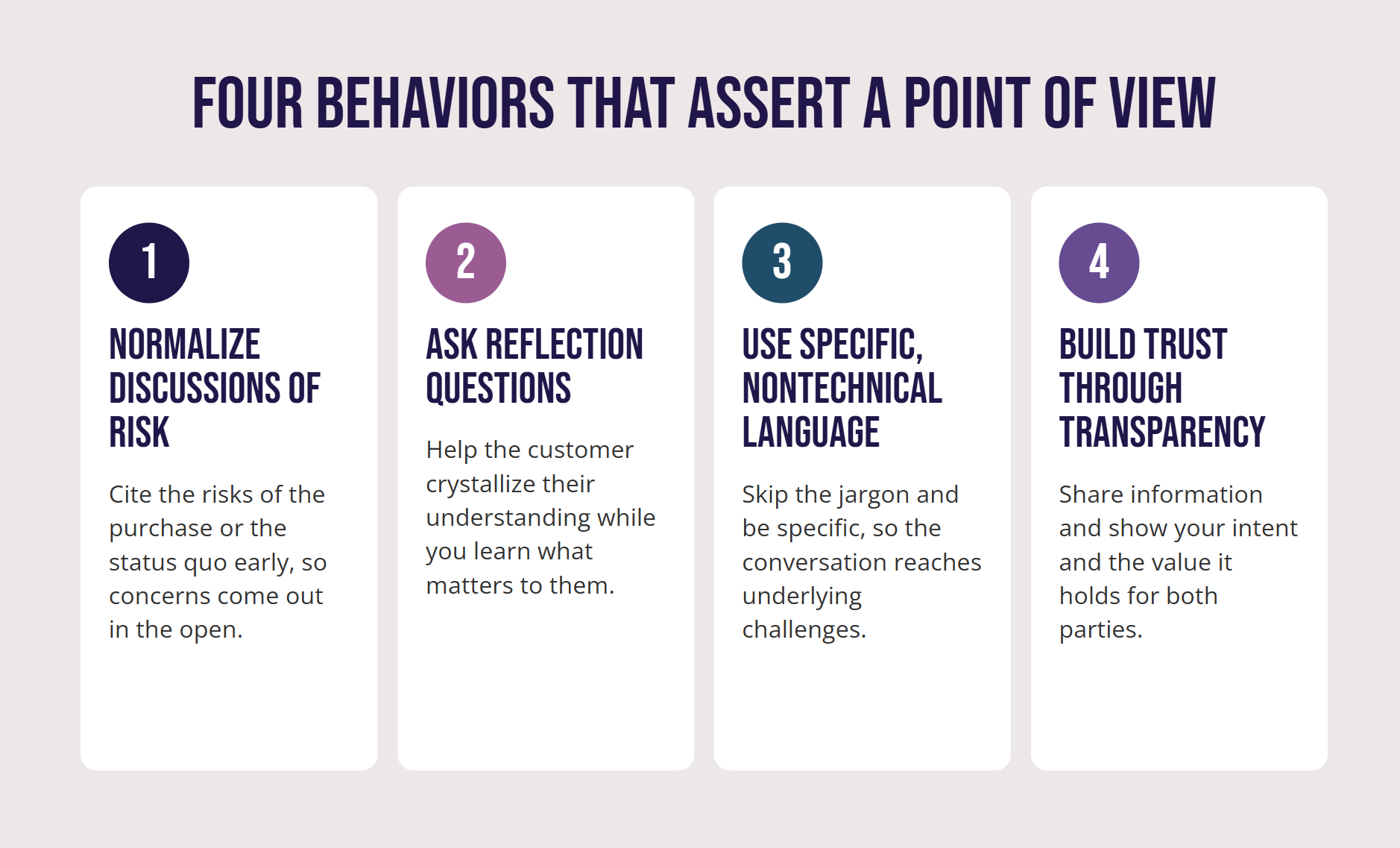
Four key behaviors work together.
Normalize discussions of risk
A sense of risk pervades every buying decision. The customer faces reputational risk and financial risk. In the urge to win the sale, it is tempting to assure the customer that the seller has identified and eliminated all risks. In truth, risk can never be fully removed. Every decision carries risk. Even the choice to preserve the status quo presents risk. What’s important is that the risks are calculated, rightsized, and outweighed by beneficial outcomes.
Achieving this end means normalizing discussions of risk. Discussing concerns in an open manner makes the risks less abstract. The sales professional reduces the customer’s fear and anxiety by adopting a tone that invites open discussion of concerns. As the discussion unfolds, the customer will become more comfortable with the change involved in adopting the solution.
This is the priming effect at work. The priming effect is the practice of using a stimulus now to prompt an idea later. Sales professionals normalize risk through the priming effect by citing the risks associated with a purchasing decision or the status quo early in the dialogue. Bring concerns of risk out and into the open where they can be addressed.
Ask reflection questions
Reflection questions encourage the customer to think more deeply about the topic and fully consider the sales professional’s viewpoint. These questions serve both parties. The sales professional learns more about what matters to the customer. At the same time, the customer is engaging in an exercise designed to help them crystallize their understanding of the challenges and goals they’re facing.
Reflection questions fall into five main categories:
| Category | Example question |
|---|---|
| Reactions | What are your thoughts on this approach? |
| Relevance | How does this solution affect your business? |
| Viability | How does this solution fit into your business model? |
| Value versus risk | What would be the value of this to your business? |
| Reservations | What hesitations do you have with regard to this solution? |
Reflection questions are a targeted way to check with the customer that the solution capabilities are resonating with their needs. They go further than simply asking, “How does that sound?” because they are specific and lead to details that the sales professional can seize on. Reflection questions, like the Socratic method, develop critical thinking skills and uproot faulty assumptions by engaging in discussion. This way of exploring an issue is useful for more complicated concepts that lack definitive characteristics.
Use specific, nontechnical language
Assertiveness is about making your position known. The best way to do so is with language free of jargon that makes the messaging clear. Jargon and technical language read as an attempt to distract or overwhelm the listener. Clear, direct communication in accessible language is effective because it is honest and free of pretension.
Developing this communication means being specific in observations. Doing so shows the customer that the sales professional is attentive to details. Specificity also gives more direction to the conversation because the sales professional and the customer can address underlying challenges rather than vague, surface-level issues.
Build trust through transparency
Asserting a point of view is of little use if it goes unnoticed by senior decision makers. Therefore, sales professionals must gain access to this group, and to do so, they must build trust. Building trust is difficult in selling scenarios because customers know a seller is selling to them.
Sales professionals can overcome this challenge by becoming transparent. They must show the customer their intent and the value it has for both parties. Simply put, they must share information. A study in The Open Psychology Journal by Wing Shing Lee and Marcus Selart found that information alone significantly shaped how people perceived ability and integrity. The researchers also found that people under uncertainty were “highly sensitive to additional information” when judging trust based on ability or integrity, even when that information wasn’t relevant to the judgment.
In Richardson’s view, sharing information is a direct and fast way to build trust early in the relationship, when it matters most. Without shared information, the customer’s only option is to deduce and infer truth through interpretation of the sales professional’s presence. This scenario erodes the sales professional’s influence.
Why does assertiveness hold up over a long buyer’s journey?
Effective sales professionals are prepared for the length of the buyer’s journey. They keep pace with and anticipate the twists and turns along the way. Entering the sales conversation with an expectation that the customer’s challenge is in focus and fully understood ignores the reality that the customer’s needs change throughout the sale.
Normalized risks, reflection questions, clear language, and transparency all work to help the sales professional assert a point of view without resorting to aggressiveness.