How to Tell a Customer About a Price Increase Without Damaging the Relationship
Sales performance improvement

Written by: Ben Taylor, MBA, Content Marketing Manager, Richardson
Published: November 13, 2026
Rising transportation, raw material, and labor costs are squeezing profit margins. Sales leaders need a plan for delivering price increases to customers while preserving the relationship.
Key Takeaways
- Plan the conversation in three parts: prepare, notify, and respond.
- Set the context and explain the rationale for the change while reinforcing the relationship.
- Acknowledge objections neutrally, restate value, and stay silent.
- Never trade on price. If you trade, get something of equal or greater value in return.
Why is delivering a price increase so difficult?
Positioning a price increase is a stress-inducing challenge. Customers push back on the new price, and the relationship comes under strain. Sellers enter the conversation with confidence when they have a clear plan.
A formal plan also lets sales leaders apply the same strategy across a diverse team of sellers.
The Producer Price Index for final demand rose 6.3% over the 12 months ended September 2026, the largest 12-month increase since December 2022, and employer compensation costs for private industry workers rose 3.3% over the year ended June 2026. Many businesses must offset higher costs with higher prices.
What does a three-part plan for delivering a price increase look like?
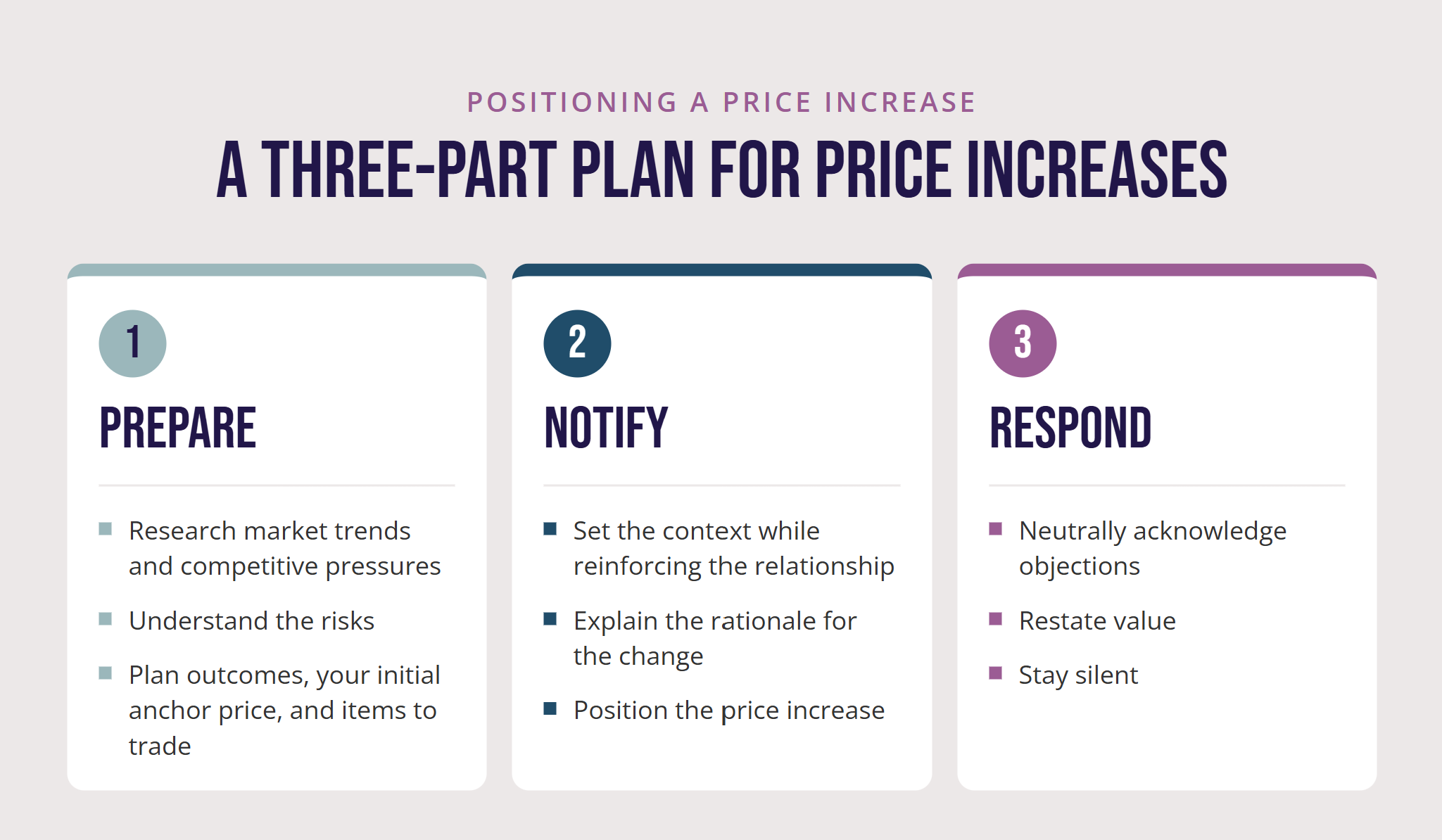
Richardson Sales Performance believes the most effective plan consists of three parts: preparing for the conversation, notifying the customer of the price increase, and engaging with the customer's response. Each part contains a specific set of behaviors. Richardson's Positioning a Price Increase training teaches sellers to put this three-part plan into practice.
1. Prepare
Sellers prepare by researching market trends and the competitive landscape. They also analyze the strengths and weaknesses of their solution and get clear on the outcome they want from the meeting.
- Understand the risks.
- Research market trends and competitive pressures.
- Plan the outcomes you want from the meeting, your initial anchor price, and the items you could trade.
2. Notify
When positioning the price increase to the customer, the seller takes deliberate steps to set the context for the increase while reinforcing the relationship and explaining the rationale for the change.
- Set the context for the request while reinforcing the relationship.
- Position the price increase.
3. Respond
When engaging with the customer's response, the seller must neutrally acknowledge any objections. A neutral acknowledgment does not mean agreeing or disagreeing with the customer. Instead, it means letting the customer know that their objection has been heard. This is a valuable opportunity to (re-)shape perceptions of value so that the customer can understand why the higher price is warranted.
- Neutrally acknowledge objections.
- Restate value.
- Stay silent.
How does customer psychology affect a price increase conversation?
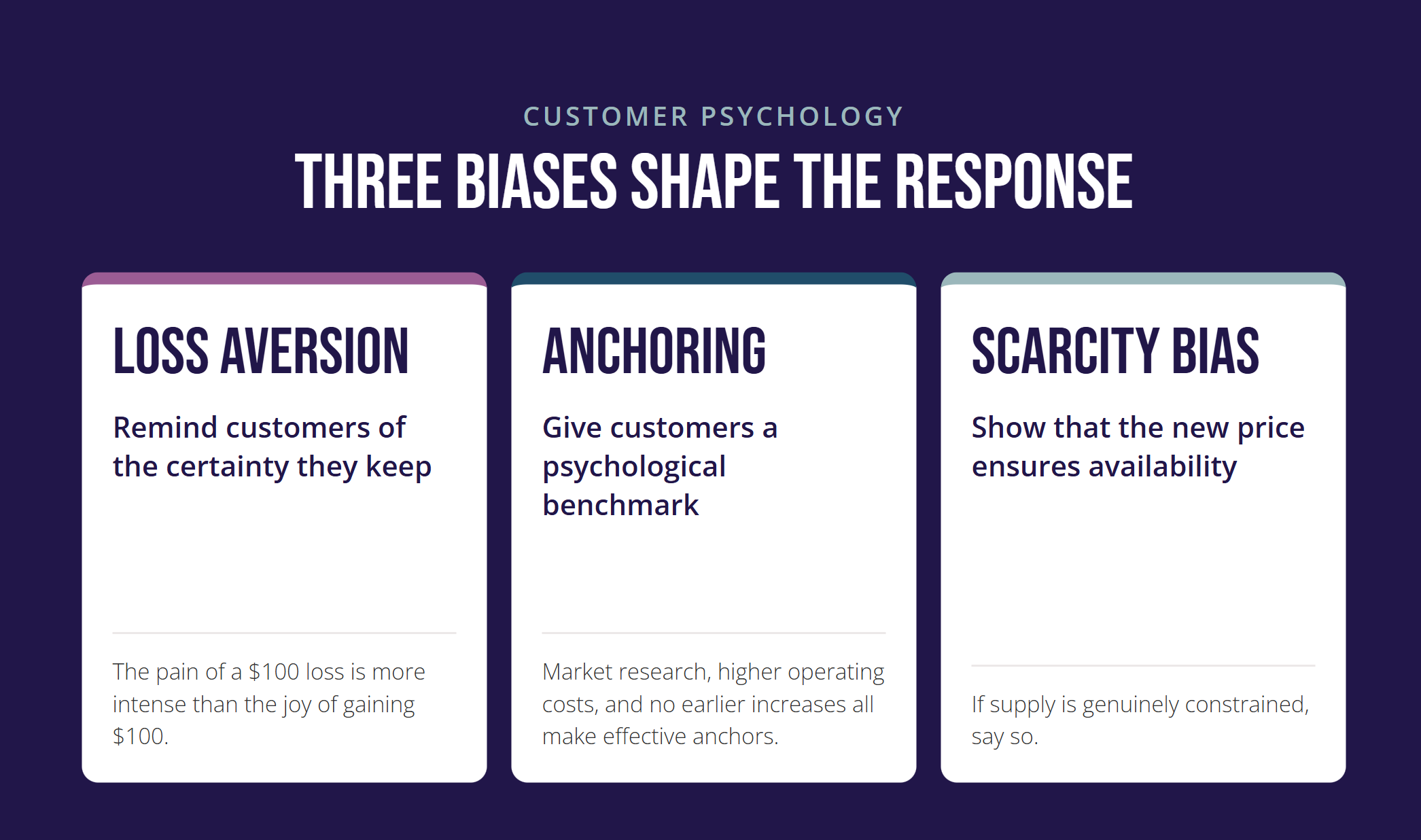
Purchasing decisions are not purely rational. This idea is central to behavioral economics, which explores the effect of psychological, social, and emotional factors on decisions. Sellers should consider three key biases that influence the customer's choices and use them to position a price increase successfully.
Loss aversion: remind customers of the certainty they keep
People generally feel the disappointment of losing something more strongly than the joy of gaining something of the same value. In other words, the pain of a $100 loss is more intense than the joy of gaining $100. People often place a high value on certainty, so sellers should remind the customer of the certainty they get from continuing with the solution, even at a higher price. If the customer rejects the higher price in search of a lower cost, they are exposing themselves to uncertainty, because other providers may be experiencing the same economic pressures.
Anchoring: give customers a psychological benchmark
People use a reference point when making decisions. This reference point acts as an "anchor," and all subsequent information is seen in comparison to it. Sellers should provide an anchor that allows them to set a psychological benchmark. Effective anchors include:
- Market research showing the elevated costs of similar solutions
- Higher operational costs in the seller's business
- The absence of price increases until this point
Scarcity bias: show that the new price ensures availability
People associate more value with a product or service that is considered scarce. If supply is genuinely constrained, say so: make it clear that part of the reason for the higher price is the scarcity of resources available, and that the new, higher price ensures availability despite economic disruptions.
What should a seller do if the customer pushes for a lower price?
Sometimes a trading strategy is needed. The most important part of this strategy is to never trade on price. Instead, consider other trades without falling into one of the most common traps in a negotiation: making a concession. A concession occurs when someone relinquishes something and receives nothing in return.
When a seller trades, they give something and get something in return. Put simply, trading is cooperative. Trading is also more complex than giving to get. An effective trading strategy means knowing what to trade, when to trade, and how to trade.
Know what to trade
Knowing what to trade means knowing the value of what is being traded. Before negotiating, a seller must understand the intrinsic and extrinsic value of every aspect of the commercial terms. This information is needed to determine if what is received in return is of equal or greater value.
Know when to trade
Space the trades in increments to make their value more perceptible. Presenting trades in a cluster gives the appearance that several trades are in fact just one, which diminishes the impact. Breaking up the trades also lets sellers deliver them in order of decreasing value.
Know how to trade
Use specific, intentional language that exudes confidence and clarity. The customer needs to be able to easily understand what the seller is offering and what is expected in return. If they cannot understand the proposed trade, they will become frustrated, and the already taxing experience of negotiating will intensify.
"I believe this will help me and my team in current and future pricing negotiations conversations. I have done a few sales and negotiation training sessions lately and this by far was the most beneficial." — Sales Manager, Becton, Dickinson and Company