8 Critical Selling Metrics to Measure Sales Training Impact
Sales performance improvement

Written by: Erin Smith, Chief Revenue Officer
Published: October 13, 2026
For a long time, sales performance metrics meant the slow, methodical accumulation of numbers into one cohesive picture. Many, citing the adage "what gets measured gets managed," accepted that valuable insights take time. But as competition escalates, many businesses lack the time and expertise to source and organize these data points.
The better move is to look at the data you already have differently. That gives a business an actionable read on how it performs as an organization driven, in part, by sales performance initiatives. Even the best intentions behind a performance improvement initiative will fall flat without measurement.
Key Takeaways
- Eight sales metrics are the most critical for revealing the effectiveness of sales training: win rate, quota attainment, time to productivity, attrition, contract value, profitability, pricing, and sales cycle.
- The metrics work because they are universal.
- No single metric tells the whole story
- The earlier a business begins measuring, the more complete the picture will be for leaders effecting change.
Which Sales Metrics Show Whether Sales Training Is Working?
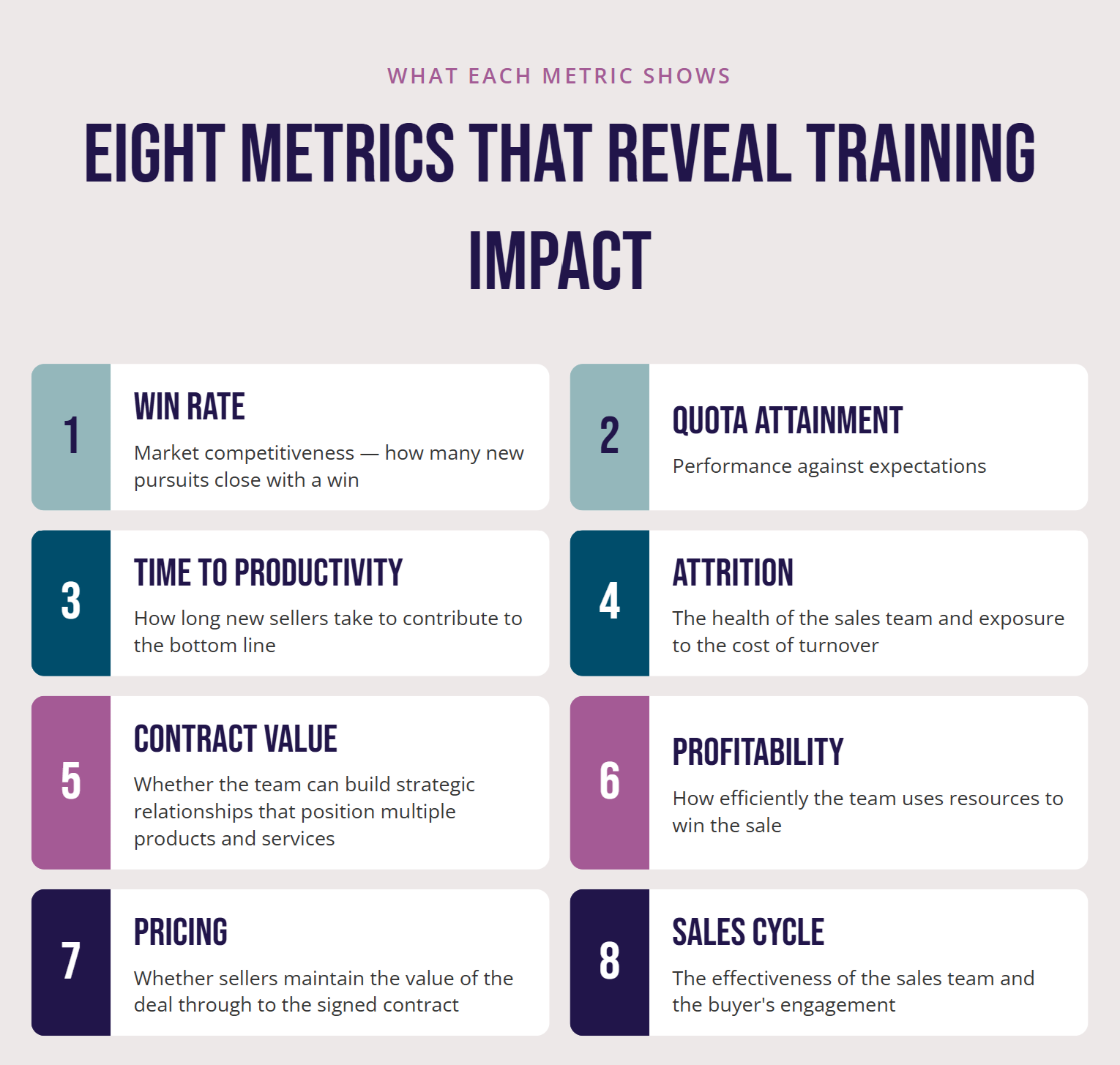
After decades of working with sales organizations across industries, Richardson Sales Performance has determined a core group of eight sales metrics that are the most critical for revealing the effectiveness of sales training. These metrics represent a variety of methods for understanding how a business is performing relative to the market.
| Metric | What it shows |
|---|---|
| Win rate | Market competitiveness — how many new pursuits close with a win |
| Quota attainment | Performance against expectations |
| Time to productivity | How long new sellers take to contribute to the bottom line |
| Attrition | The health of the sales team and exposure to the cost of turnover |
| Contract value | Whether the team can build strategic relationships that position multiple products and services |
| Profitability | How efficiently the team uses resources to win the sale |
| Pricing | Whether sellers maintain the value of the deal through to the signed contract |
| Sales cycle | The effectiveness of the sales team and the buyer's engagement |
Are Sellers Winning More, and Meeting Their Goals?
Win Rate
Win rate is the primary indicator of market competitiveness. The number is easy to track and easy to baseline. It shows how many new pursuits close as wins. Other aspects of the business tend to perform at a higher level when win rates increase.
By isolating competitive differentiation from demand creation, a company can see how well its approach to selling resonates in the field. Leaders can also compare win rates among teams or verticals to see which strategies work. But no leader should read win rates in isolation. The measurement is often a starting point that tells leaders where else to look for clues on business performance.
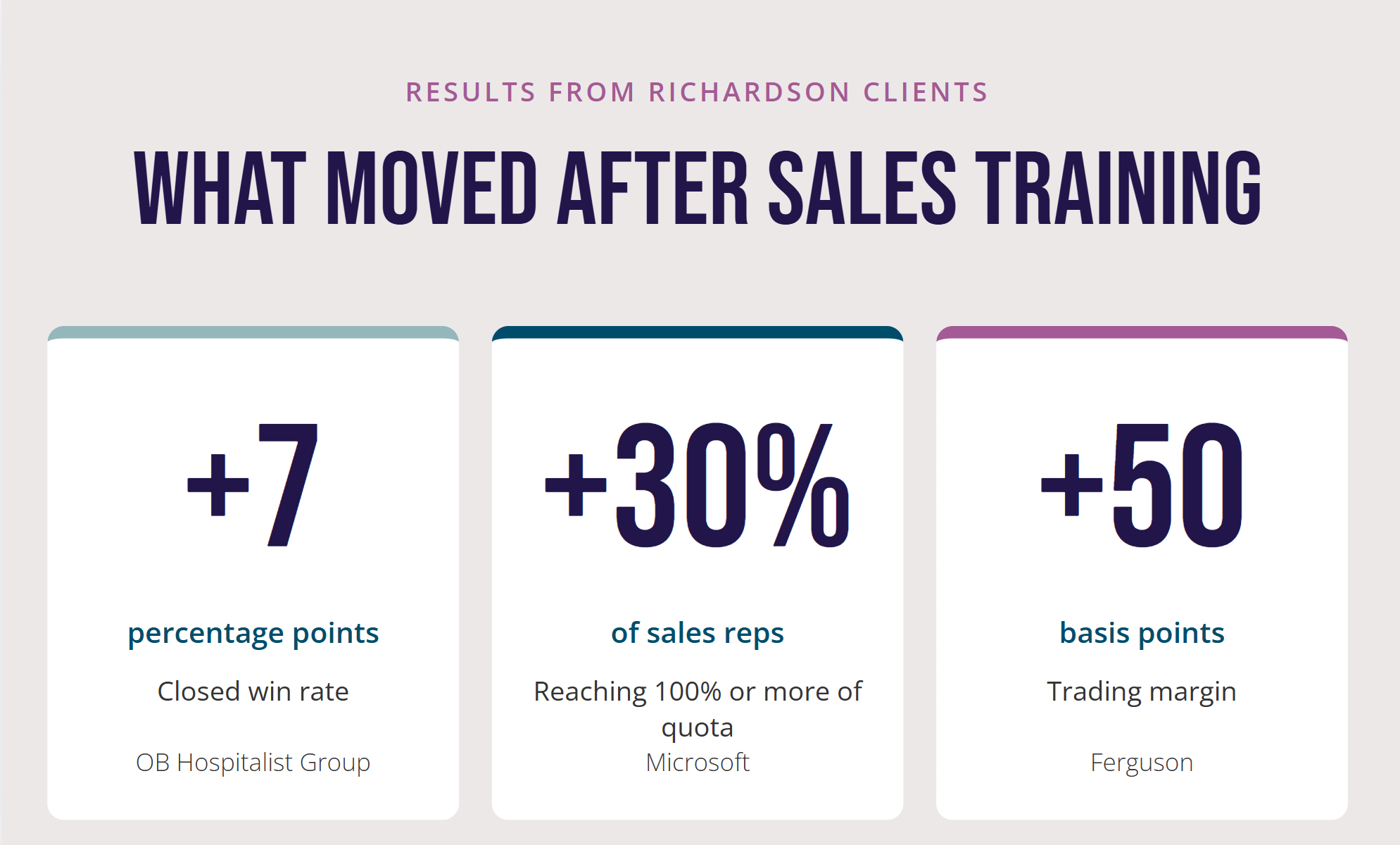
OB Hospitalist Group drove a 7-percentage-point increase in closed win rates through its work with Richardson on agile sales training.
Quota Attainment
When leaders want to compare performance with expectations, they turn to quota attainment. This number answers, "What percent of the sales team is meeting their goal?" It judges performance against expectations and is a function of how all initiatives are operating. Rather than a pass-or-fail measure, it signals the effectiveness of business strategies.
After Richardson trained more than 10,000 sellers, marketers, and partners worldwide, Microsoft saw a 30% increase in sales reps achieving 100% or more of quota.
How Quickly Do New Sellers Ramp, and Do They Stay?
Time to Productivity
Like a jet on a runway, a new seller has only so much time before they need to be "wheels up." Time to productivity measures the length of this runway. When new reps require more time to contribute to the bottom line, the productivity and profitability of the entire sales team diminishes.
This metric matters most when an organization wants to expand team capacity or faces high turnover. Tracking it shows what sellers can accomplish and helps managers staff their teams more effectively. With this information, a leader can step in to help a new hire earlier and correct course faster.
Attrition
Replacing a worker is expensive. Research reviewed by the Washington Center for Equitable Growth finds that turnover costs an average of 40% of a worker's annual salary. That's why attrition matters. It signals the health of the sales team and, to an extent, the demand for the product that the team is selling.
Attrition measures more than a company's exposure to the cost of high turnover. It is also a lagging indicator of other measures, such as ramp time, productivity, and engagement. High attrition signals problems, but understanding the underlying causes often requires a more detailed review.
The inquiry is worth the time: high attrition warns of systemic problems within the sales team.
Are Deals Getting Bigger and More Profitable?
Contract Value
Selling has gotten harder. Many competitive advantages have equalized as technology puts other players, big and small, on the same field. In response to this pressure, more sellers are seeking larger contract values so that the deals they close offer more value. Contract value shows how well a team is shifting to multi-divisional solutions.
Measuring contract value reveals the ability of a sales team to create strategic relationships that position the value of multiple products and services. Leaders must also weigh escalating contract values against rising sales and marketing expenses as a percent of revenues. In some cases, this dynamic can put pressure on profit margins.
Pricing
Adjustments to pricing are the primary driver of profitability. However, controlling pricing can be difficult, as market conditions often dictate movements. Still, effective sellers can control pricing, and therefore profitability, with strong negotiation skills that maintain the value of the deal through to the signed contract.
Justifying prices requires a sales team to create meaningful value throughout the sales cycle and eventually elevate themselves to the role of a trusted advisor. Given that companies pay most sellers based on revenue generation, adjustments to price can also influence motivation.
Profitability
Profitability is a function of price and product mix. Diminishing profitability may stem from price-cutting, which indicates a failure to convey competitive advantages. Sustaining profitability is ultimately about effectively improving the product mix, as different products carry different margins. For many organizations, product mix and discounting also shape profitability.
This key financial measurement shows sales leaders how efficiently they use resources to win the sale. Profitability encompasses all the other metrics here. It comes into greater focus when organizations segment the measurement across divisions, products, and even individual B2B customers.
After Richardson coaching training for its sales managers, Ferguson improved its trading margin by 50 basis points.
Is Selling Getting Faster and More Efficient?
A company's sales cycle reflects the effectiveness of the sales team and the buyer's engagement. As teams increase their productivity, the sales cycle decreases, which narrows the distance between the start of the pursuit and the contract. Longer sales cycles drive up costs and strain a company's resources. Changes to the sales cycle arise from the ability to adapt to a changing marketplace.
New customer acquisition also requires much more time than selling to an existing customer. A shorter sales cycle therefore emerges from improved customer loyalty.
Where Should You Start?
These metrics do more than answer key questions about the health of a business. They also show leaders where to explore further. Nearly every business has quick access to data that lets it use at least some of these eight metrics, so start with the ones you can already pull. The earlier a business begins measuring, the more complete — and therefore more useful — the picture will be for leaders effecting change.