How to Build a Coaching Culture in a Sales Organization
Sales performance improvement

Written by: Ben Taylor, MBA, Content Marketing Manager, Richardson
Published: October 14, 2026
All of the training in the world cannot "fix" the larger issue at stake for most organizations — that there is little to no reinforcement of that training through effective, ongoing coaching.
Key Takeaways
- Coaching has to start at the top — if senior leaders don't coach their managers, the managers have little reason to coach their teams.
- Coach to accelerate learning and change behavior first.
- Developmental coaching works in 20 minutes or less.
- Spend most coaching effort on middle performers, where the greatest room for growth sits.
- Teach sellers to self-coach with three simple questions.
- You can lay the foundation of a coaching culture in as little as 30 days.
Why Does a Coaching Culture Matter?
The strongest organizations have realized that investing in their people is the best investment they can make. And we don't mean monetary compensation. We mean developmental investment in people.
There are three key reasons to coach: to accelerate learning, to effect behavioral change, and to improve results. Most managers focus on the last one, because it addresses the metrics that most businesses run on. However, numbers don't change themselves, and a metrics-first coaching conversation sounds like this:
"You need to get your numbers up, so I advise you to start focusing on that."
Sellers are aware of the numbers. The real issue is "what is preventing that seller from making the numbers?" Improving results matters, but it won't happen until the first two reasons are addressed.
- Accelerate learning. Get people up to speed quicker and learning more efficiently. That is step one.
- Change behavior. Get people trying on new hats and experimenting with new ways of doing things. Then make the change permanent, not just visible while the manager is watching. If everything else around a seller is changing, their behaviors will too.
- Improve results. When learning has accelerated and behavior has changed, results follow. It rarely happens in reverse.
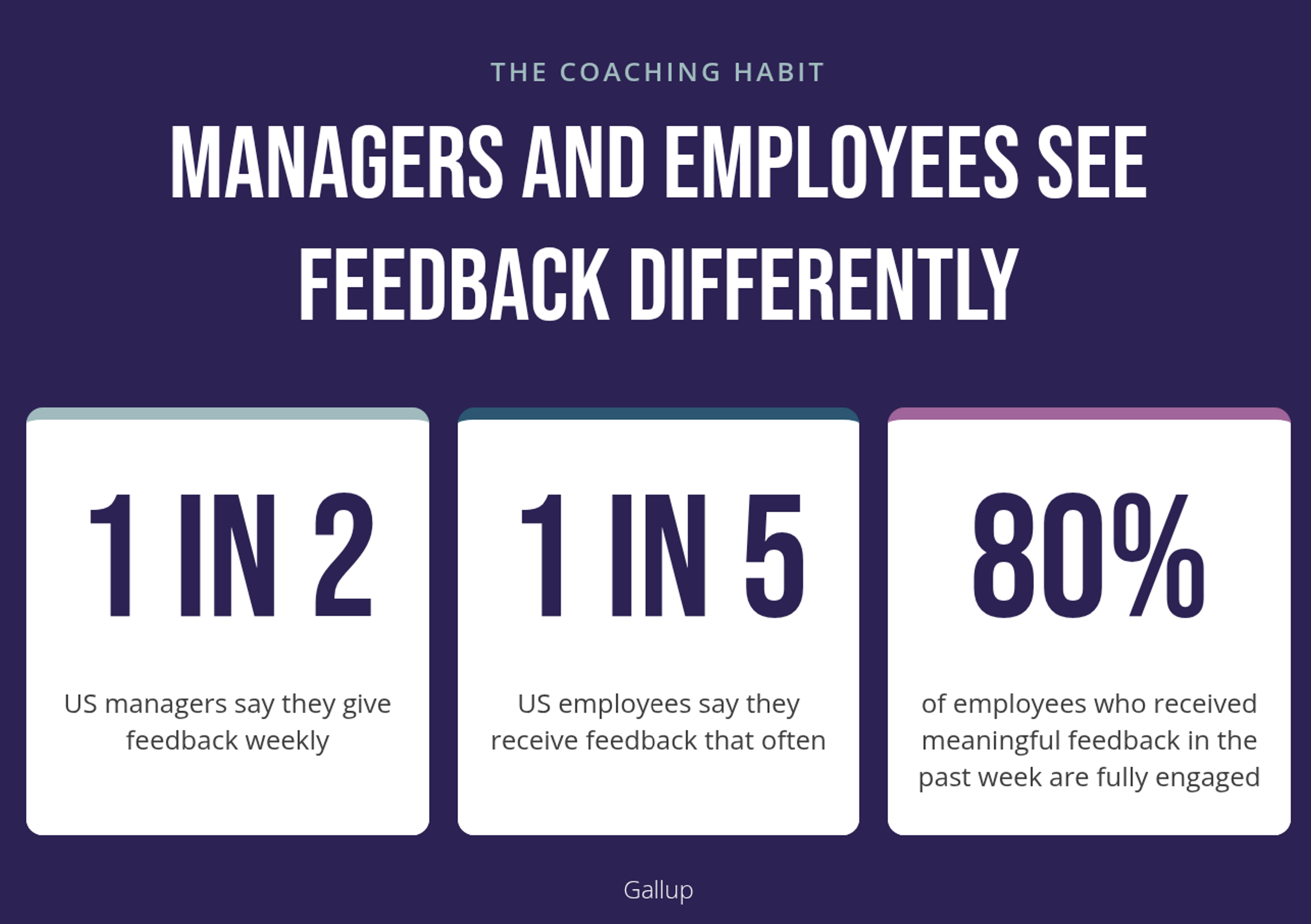
Many managers believe they coach more often than their teams experience. Gallup found that about half of US managers say they give feedback weekly, while only one in five US employees say they receive it that often. Gallup calls frequent, meaningful feedback the coaching habit and ranks it among the best predictors of engagement it has studied. The effect is large: 80% of employees who say they received meaningful feedback in the past week are fully engaged.
What Myths Keep Managers From Coaching?
Myth 1: "You only get coached when you have done something wrong."
Technically, this isn't a myth, because it is exactly what happens in most organizations. It takes on myth status because managers have come to believe it must be true, when it doesn't have to be. Coaching opportunities exist when things go wrong, and they exist when things go right. The more coaching you do when things go right, the more "right" things will happen. Nothing breeds success like success. Even when things don't turn out exactly right, a seller who tried something new or attempted a change deserves recognition.
Employees agree. Gallup found that recognition and appreciation for recent work ranks first among what makes a conversation with a manager meaningful, while discussing weaknesses is the one topic they see as less meaningful.
Myth 2: "Coaching takes too much time."
Most managers spend hours on one coaching session, trying to get a seller to change six or seven things and bombarding them with information. Truly developmental coaching focuses on one (maybe two) key things to change, and it works in 20 minutes or less. Praise alone takes a minute or two. Gallup's research points the same way: 15- to 30-minute conversations have a greater impact than 30- to 60-minute conversations when they happen regularly.
Myth 3: "People don't like being coached."
That's true when coaching is done the way most organizations do it today. But try to find one professional athlete who doesn't pay for a personal coach. Athletes have figured out the power of constant feedback, and they don't balk at investing the time and money. "Life coaches" have built whole careers on helping people plan their lives. The demand is there, and it exists inside organizations too.
If we believed this myth, we would have to assume that no one at work wants honest feedback that could help them improve. In reality, we know just the opposite. In its purest sense, coaching is the opportunity to share feedback with someone on their performance — what is working, what isn't — and to put together a plan of action for taking that performance to a higher level. Corporate goals don't go down every year, which asks teams to produce higher results with last year's skills.
How Do You Build a Coaching Culture?
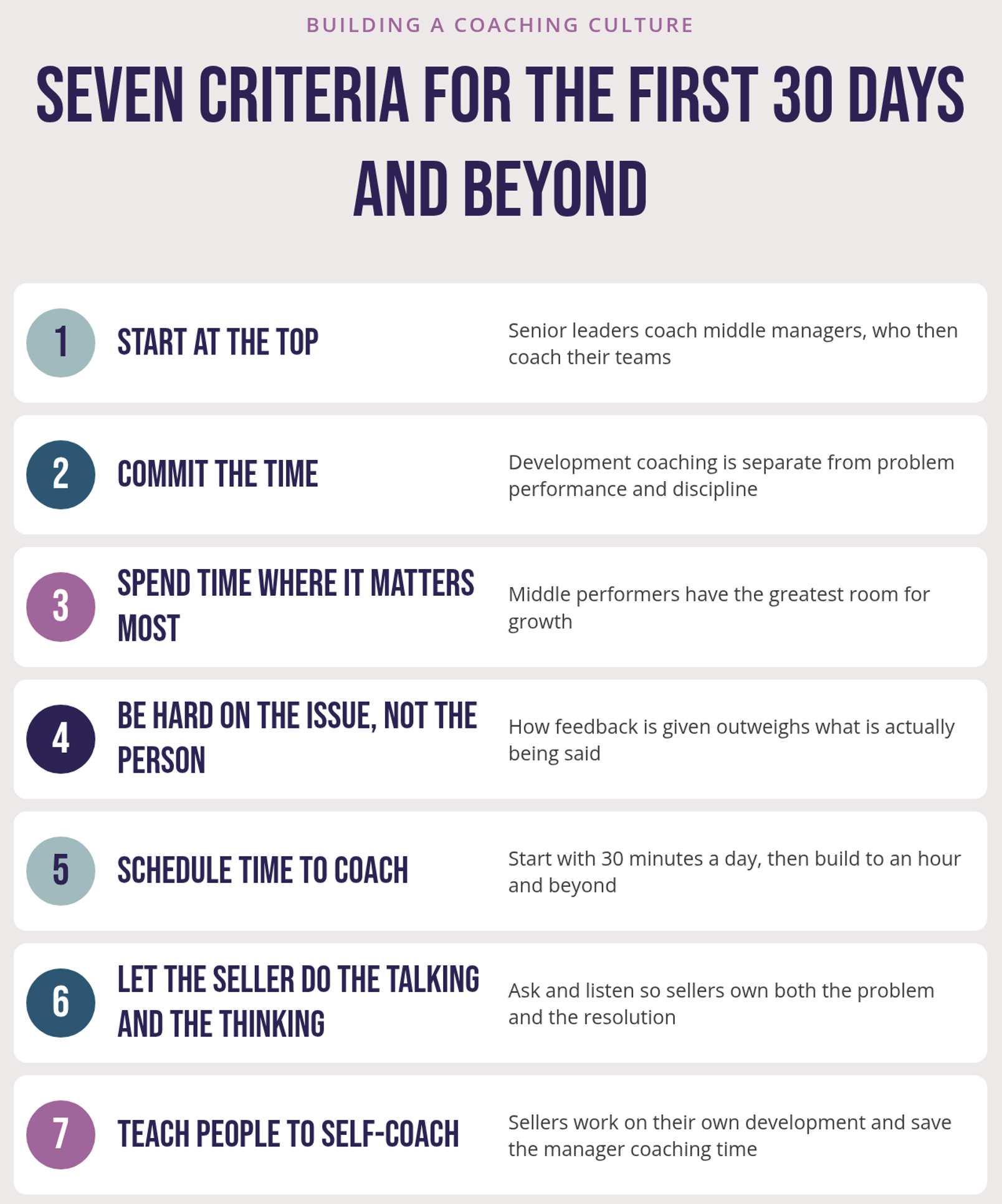
Recognize first that a coaching culture doesn't happen overnight. It takes time to build one, especially if the existing culture is viewed negatively, or if earlier attempts were never followed through. It is much easier when no culture exists at all. Even so, you can do it, and you can lay the foundation in as little as 30 days. Seven criteria guide the work.
"It's a behavior change, right? So you can't expect results right away. But the more consistent you are with training and bringing people along with you, the more it becomes part of that normal language." — Darnetta Daire, Sales Enablement Manager, Hollister Incorporated
1. Start at the top.
If senior management isn't coaching middle management, why should middle management coach the people below them? Is there a company sales vision? Is there a coaching vision, or a vision for people development, within the organization? Without these, the road to a coaching culture gets significantly steeper. There must be a "Do As I Do" environment, or failure is bound to happen.
2. Commit the time.
Development coaching is not the same as dealing with problem performers or disciplinary situations. We are talking about development here, not performance evaluation. Know the difference, and commit the right amount of time to it.
3. Spend time where it matters most.
You don't have to spend equal amounts of time with each seller.
| Group | What they need | Coaching effort |
|---|---|---|
| Top performers | Recognition, and continued challenge to reach higher levels. Invest in them, and be sure you don't reward good work with more work. | About 10% of coaching time |
| Middle performers | The most developmental coaching, because there is the greatest room for growth. Left to their own devices, productivity and performance can slip. | Up to 80% of coaching effort |
| Low performers | They may or may not be coachable. If there are severe performance issues, get to Human Resources immediately and start figuring out what needs to be done. | Escalate rather than coach |
The danger is timing. Most managers try to "save the unsaveable" when they should be spending time on their middle performers.
4. Be hard on the issue, not the person.
Let this be your coaching mantra. When it comes to giving feedback, how it is given outweighs what is actually being said. If a seller isn't open to the feedback or gets defensive, no learning will occur and current behaviors will be reinforced, not changed.
Consider a seller who isn't asking customers enough questions. That doesn't make them a bad person. They need to build skill in asking more and better questions to gain a deeper understanding of a customer's true needs.
| Hard on the person | Hard on the issue |
|---|---|
| "You need to get better at asking questions because if you ask more questions, you'll be a better salesperson." This comes across as confrontational and demeaning. | "Asking better questions is one way to gather in-depth information on your customers. Let's figure out where your questioning efforts are working for you and what is getting in the way." |
The mantra is simple in theory and extremely challenging in execution. It takes lots of practice, so start practicing now. Managers build this skill in Richardson's two-hour Coaching in the Field module, which focuses on giving feedback in real time based on observed behavior.
5. Schedule time to coach.
Carve out portions of each day for nothing but coaching. Don't let unimportant distractions get in the way. Start small: 30 minutes a day, every day for the first week or two. Then an hour a day for the next two weeks, and so on. Managers who start to see progress find additional pockets of time to keep going, because it makes a difference. Before you know it, you will be dedicating more time to coaching and less to putting out everyone else's fires. Your team can handle those for themselves.
6. Let the seller do the talking and the thinking.
The biggest mistake managers make is doing all of the talking during a coaching session, with not enough asking or listening. The coach understands what is going on and has ideas on how to fix it. But it isn't the coach's issue. It's the seller's, so they need to understand what is going on and how to fix it themselves.
By asking more and better questions, the manager gains a deeper understanding of what the seller thinks and how. When sellers come up with ways to fix the situation, they own both the problem and the resolution. It is quick and efficient for a manager to do all of the work, but then the only person whose behavior changes is the manager's. Reversing this takes lots of practice and lots of patience.
7. Teach people to self-coach.
In a true coaching culture, you coach not only downward but upward and sideways as well. Getting people to self-coach is the ultimate reward. It empowers them to work on their own development and saves the manager coaching time down the road — a win for everybody.
The three questions:
- What did I do well?
- What could I do differently?
- Where can I go to learn more?
Teach sellers to ask themselves these questions after particularly good situations and particularly bad ones. They will carve out key reflection time for themselves, and they will start to build their own action plans for professional development.
Proof in Practice
"Richardson has helped us establish a common sales language and create greater alignment across our global sales organization. They have strengthened both selling and coaching capabilities while supporting a structured development journey for sales professionals and leaders. Their methodologies, training programs, and planning tools have contributed to both capability development and long-term behavior change." — Patrick Klein, Sales Enablement Manager, Endress+Hauser
"We're able to coach specifically to, hey, how are reps doing with understanding needs? How are reps doing with connection? How are reps doing with recommending our products?" — Darnetta Daire, Sales Enablement Manager, Hollister Incorporated
What Does a Coaching Culture Require?
Creating the right culture, especially one built on coaching, doesn't happen by chance. It starts with a vision and a deep commitment to developing people. It needs a framework to ensure consistency of effort, plus a core set of skills that allows managers to role model what needs to be done at all levels. And it requires genuine concern for helping people succeed and for recognizing progress, no matter how small.
Richardson's Consultative Sales Coaching training teaches managers to coach in short cycles — Prepare – Engage – Advance — and to use an Assess – Analyze – Address model that helps sellers find their own path to improvement.
People are starving for good, honest feedback. It is management's job to find the most effective way to deliver it.