How Can Sales Professionals Become Better Listeners?
Sales performance improvement

Written by: Ben Taylor, MBA, Content Marketing Manager, Richardson
Published: November 9, 2026
Good listening is not passive. Those who possess this rare skill understand that listening requires more work than talking. They know the effort is worthwhile because when someone realises they are being heard, they feel encouraged to continue talking. This dynamic has major implications for sales professionals attempting to learn about their customer's needs.
Given the benefits of great listening, it is surprising that so few can do it well. Listening is such a powerful skill that it can be the difference between life and death. In his book Never Split the Difference, former FBI lead international kidnapping negotiator Chris Voss asks, "Who has control in a conversation, the guy listening or the guy talking?" His answer: "The listener of course. That's because the talker is revealing information."
Key Takeaways
- Great listening in sales is a skill built on four habits: encouraging the speaker, mirroring, confirming key points, and slowing down.
- Encourage the speaker with open-ended "how" and "what" questions that invite detail.
- Mirror the speaker's tone, cadence, and attitude to put them at ease.
- Confirm key points by summarising what you heard, and keep a pace that leaves room for the speaker to think.
Why do so many sales professionals neglect to listen?
Three reasons stand out:
- They feel they must justify their presence. Many sellers articulate the value of their solution at length, so they spend more time talking than listening.
- Silence is uncomfortable. Sellers talk to avoid the discomfort instead of learning more about the customer.
- Talking feels empowering. It feeds our innate need for control in the high-stakes setting of a sales conversation.
The good news is that the benefits of strong listening are available to everyone. Being a great listener does not come naturally, but the payoff is one of the strongest competitive advantages in selling, and it costs nothing but a bit of time and attentiveness.
What are the four habits of a great listener?
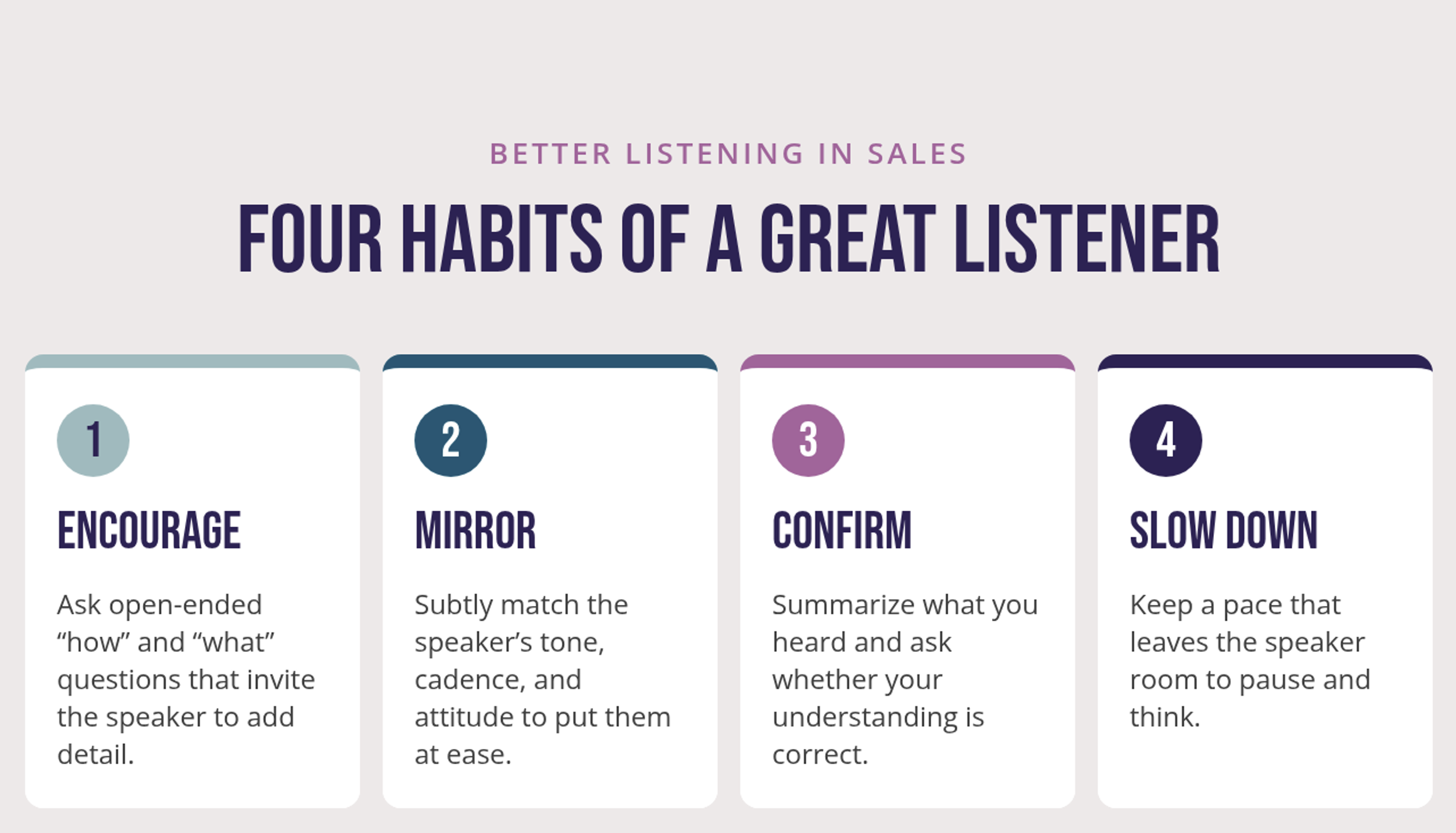
1. Encourage the speaker
If the speaker talks long enough without receiving a response, they begin to feel they are talking to themselves. The listener must be quiet enough to let the speaker talk, but vocal enough to elicit more of the other person's thoughts. The challenge of striking this balance explains why so many consider good listening an art form.
The right balance comes from speaking only when the other person has left details unexplored. If the speaker offers only surface-level information, seize the opportunity to go deeper by asking a question. The right kinds of questions carry names like "reflection questions," "calibrated questions," and "open-ended" questions. They all describe the same thing: non-leading questions that ask the speaker to provide more detail.
These questions cannot be answered with a simple yes or no. They also help the listener avoid the misstep of telling the other person what to think. "What's the biggest challenge you face?" is an example of a good question. Use "how" and "what" questions that invite the speaker to reveal the kind of information that articulates needs.
2. Engage in mirroring
Mirroring is the tendency for a listener to mimic the speech, cadence, gestures, and even attitude of the person speaking. It often happens unconsciously. Good listeners shift this behaviour from the unconscious to the conscious so they can connect more fully with the speaker. Some term this the "chameleon effect."
Mirroring puts the speaker at ease. As a result, they are more likely to volunteer information and offer important details. It works because it signals that the listener is empathetic. Chartrand and Bargh's 1999 experiments found that people who are naturally more empathetic tend to mirror others more. In a 2008 negotiation experiment with MBA students, 10 of 15 buyers who subtly mimicked their counterpart reached a deal, compared with 2 of 16 who did not.
Mirroring works best when it is subtle. A 2023 study found that mimicry the other person notices can reduce liking and trust.
The logic holds even without the numbers. Mirroring proves to the speaker that you are listening, because you can only reflect the tone, gestures, attitude, and cadence of another if you are tuned into those signals.
3. Confirm key points
Questions do more than encourage the speaker. They also confirm the speaker's key points, which matters because even an attentive listener can misunderstand the message. Miscommunication often occurs when the listener misreads the speaker's tone. The listener might also become confused when the speaker articulates the contrasting perspective of another stakeholder.
To confirm the message, summarise your understanding of what you heard and ask the speaker whether that interpretation is correct. This seeks clarity, and it also invites the speaker to say more. Even when the answer is yes, speakers often take the opportunity to expand and elaborate, which helps them crystallise their own thoughts.
You can ask confirmation questions at any time, but they are most effective at the end of the conversation, when the speaker has shared everything they have to offer. Effective confirmation questions require note taking. Record the key points in writing so that nothing is lost, and let those notes become the basis of your questions. Balance matters here: too much note taking costs you the nuance of the speaker's words, and too few notes cost you important points.
4. Slow down
Sellers work under constant pressure, and the urge to move fast is ever-present. But sellers learn the most valuable information only when the customer feels they have time to fully articulate their thoughts.
Good listeners stay mindful of how fast they talk. If they speed up, the speaker might feel obligated to do the same. In the high-stakes setting of customer conversations, most people default to a hurried pace, so stay aware of your speed when asking questions. After you ask, become comfortable waiting while the speaker pauses to think. A slow pace communicates that the speaker has your undivided attention.
A slow pace also creates a more relaxed setting, an atmosphere that is informal without sacrificing professionalism. It is the easiest and most effective way to reduce the tension that pervades most selling scenarios.
Can sales professionals learn to listen better?
Yes. We hear almost everything that is said to us, but we listen to very little of it. Unlike hearing, we are not born with the ability to truly listen. It is a skill we must develop and maintain, and it grows through practice and coaching.
Amber Boll, Director, Sales Global Process Owner at Rich Products Corporation, describes what that looks like in her organisation: "When you put those behaviours into practice — questioning and listening, having facilitated sessions with coaches that actually get in there and can coach them along the way — our teams are better able to actually apply some of those behaviours in the moment with their customers."
Coaching works best when it targets specific behaviours. Darnetta Daire, Sales Enablement Manager at Hollister Incorporated, says it lets her team coach to questions like these: "How are reps doing with understanding needs? How are reps doing with connection? How are reps doing with recommending our products?"
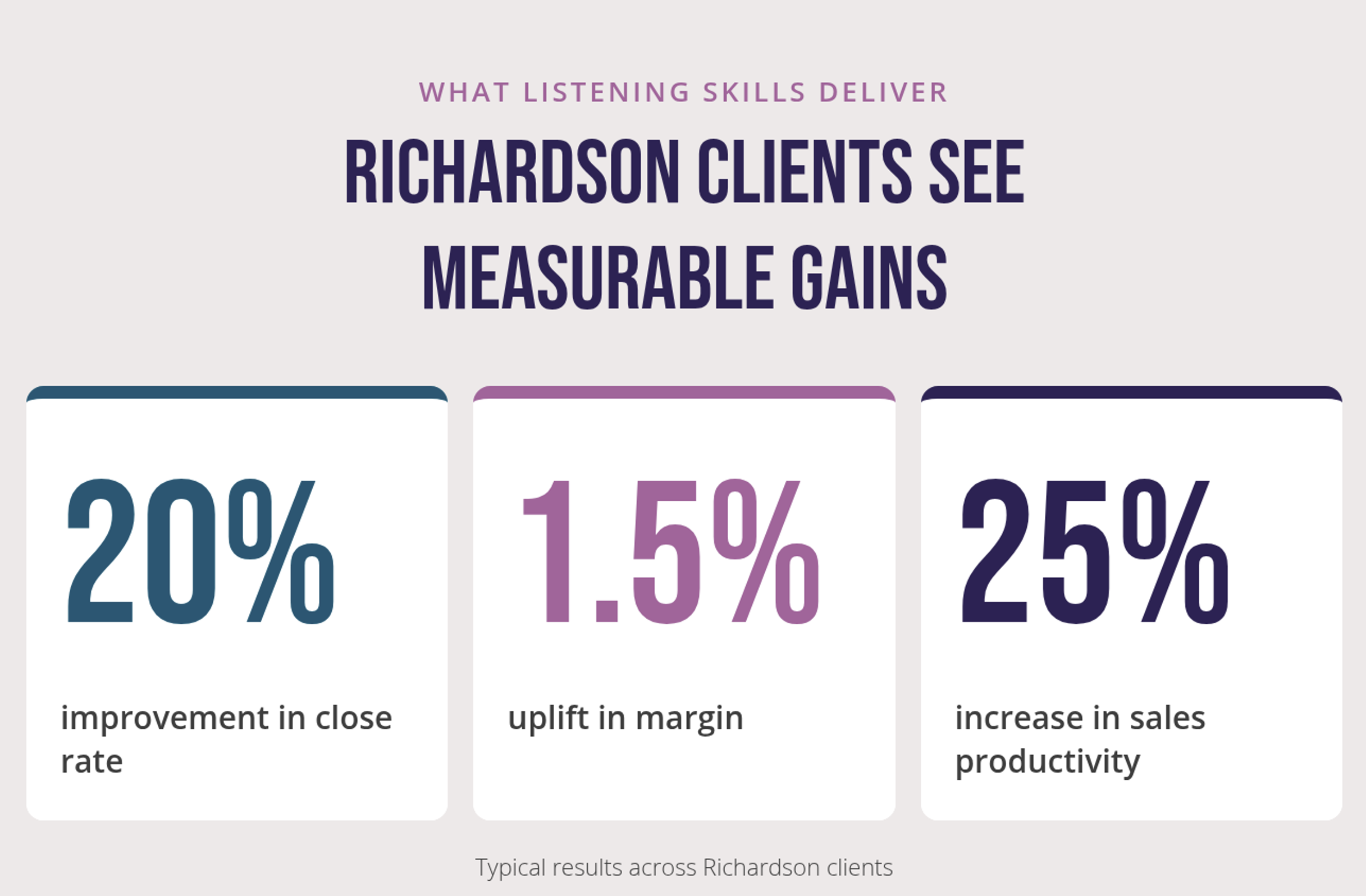
Listening is one of Richardson's Six Critical Skills, alongside Presence, Relating, Questioning, Positioning, and Checking. Richardson defines Listening as the ability to understand both the content and the emotional message. Richardson clients typically see a 20% improvement in close rate, a 1.5% uplift in margin, and a 25% increase in sales productivity.