Why Is Your Deal Size Declining, and How Do You Reverse It?
Outbound sales

Written by: Claire Imber, Director of Content Strategy & Thought Leadership
Published: October 21, 2026
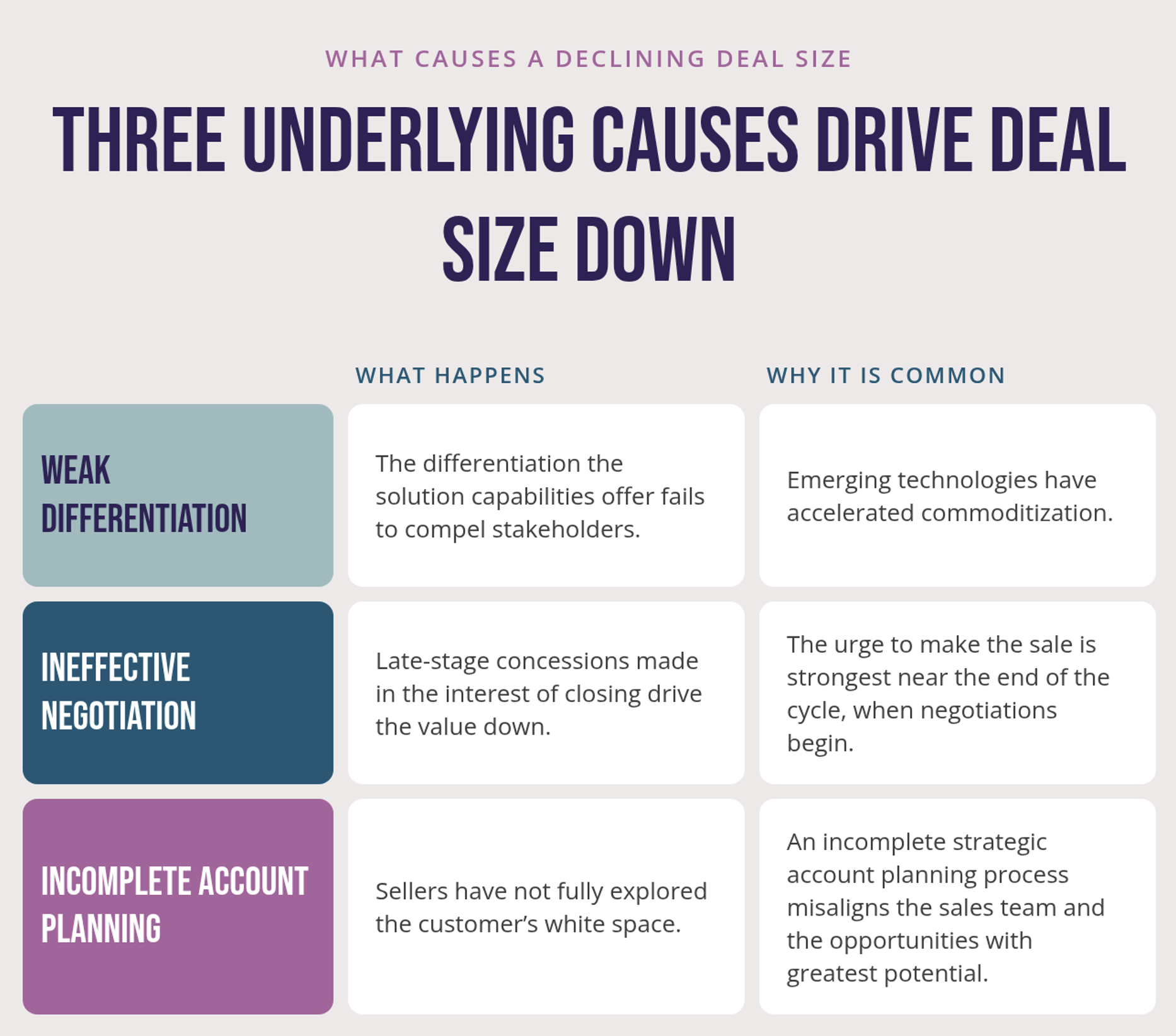
Reversing a declining deal size means addressing the three underlying causes.
First, deal sizes decline when the differentiation offered by the solution capabilities fails to compel stakeholders. This challenge is rising because emerging technologies have accelerated commoditization.
Second, ineffective negotiations create a bottleneck that reduces the deal size. This outcome is common because the urge to make the sale is strongest near the end of the cycle when negotiations begin. As a result, late-stage concessions made in the interest of closing drive the value down.
Third, a diminished deal size signals that sellers have not fully explored the customer’s white space. An incomplete strategic account planning process drives this scenario by misaligning the sales team and the opportunities with greatest potential.
A declining deal size might be the result of one, some, or all of these factors. The key is to isolate which of the three are at the source and to act accordingly.
Here we offer ways to address each of the three challenges behind a declining deal size in sales.
Key Takeaways
- A declining deal size usually traces to three underlying causes: weak differentiation, ineffective negotiation, and incomplete strategic account planning.
- When differentiators are rare, customers often treat price as the deciding factor, so the differentiators that matter sit where uniqueness meets customer value.
- Late-stage concessions drive deal value down, and three skills protect it: opening on common ground, converting demands to needs, and trading in increments.
What Causes a Declining Deal Size?
Reversing a declining deal size means addressing three underlying causes.
| Cause | What happens | Why it is common |
|---|---|---|
| Weak differentiation | The differentiation the solution capabilities offer fails to compel stakeholders. | Emerging technologies have accelerated commoditization. |
| Ineffective negotiation | Late-stage concessions made in the interest of closing drive the value down. | The urge to make the sale is strongest near the end of the cycle, when negotiations begin. |
| Incomplete account planning | Sellers have not fully explored the customer's white space. | An incomplete strategic account planning process misaligns the sales team and the opportunities with greatest potential. |
A declining deal size might be the result of one, some, or all of these factors. The key is to isolate which of the three are at the source and to act accordingly.
How Do You Stand Out When Differentiators Are Rare?
Technology that was once expensive and inaccessible is now affordable and available to more businesses. This development has brought more competing players onto the same field. As a result, differentiators are increasingly rare.
When solution differentiators are rare, customers often consider price to be the deciding factor. This scenario leaves the sales professional with few paths to win the deal. Moreover, a lack of differentiators invites the customer to see the solution as a commodity, which further devalues the product or service. Addressing this problem means getting strategic about identifying and communicating differentiators.
Start With the Customer's View
This strategy begins with a customer-centric approach because true differentiation is in the eye of the customer. What looks like a meaningful differentiator to the sales professional does not necessarily look like one to the customer. Isolating the differentiators that matter to the customer means understanding which features sit at the intersection of uniqueness and customer value.
- A capability that is unique relative to the competition will not advance the sale if it has little relevance within the nuanced context of the customer's world.
- A capability that is meaningful to the customer but ever-present among the competition is little more than "table stakes."
- A capability that is both unique and valuable to the customer is a true differentiator.
The sales professional must take the time to assess each of the individual capabilities within the solution and identify which ones represent both.
This exercise is crucial for success because the customer's value perception is constantly shifting. Delivering a distinctive experience today means satisfying the customer's need for value that is relevant, perceptible, and unmatched.
LexisNexis Risk Solutions, for example, recognized that the customer experience was its key differentiator and built a value-based sales approach with Richardson around the buyer's journey.
How Do You Protect Deal Value in Negotiations?
Richardson's 2026 Selling Challenges Research Report asked over 300 sales professionals and managers about the challenges they experience during negotiations. 36% cited "protecting price and profitability," making it the single most common difficulty among participants.
It’s clear that sellers need a better way to preserve the value of the sale. What remains elusive for many is how to do it. The answer consists of three skills.
Open With Common Ground
The opening of a negotiation sets the tone for the rest of the exchange, and that tone should be one of cooperation. Sales professionals should begin by recapping common ground. The opening is an opportunity to highlight areas of agreement and create positive momentum. This approach makes clear from the outset that the negotiation will not be adversarial in nature. Reviewing common ground is also an effective way to check whether anything has changed since the last conversation with the customer.
Convert Demands to Needs
Customer demands are inevitable in negotiations. Learning to deal with them is critical because demands handled poorly lead to concessions or early trading that diminishes the value of the sale. The sales professional who can convert a demand to a need will succeed because they can meet that need in ways that do not require sacrificing valuable factors like payment terms, pricing, or the scope of the sale.
Know What to Trade, and Trade in Increments
Knowing what to trade means knowing the value of what is being traded. Before a negotiation, a sales professional needs to fully understand the intrinsic and extrinsic value of every aspect of the deal. Without this information, a seller cannot gauge whether what comes back carries equal or greater value. Sellers should also space trades in increments to make their value more perceptible.
How Does Strategic Account Planning Open Up More White Space?
White space is the part of a customer's business where your solution could create value but does not yet. Often, a diminished deal size is the result of a problem that begins before the first sales conversation: a lack of strategic account planning. Without a thoughtful approach to account planning, sales professionals end up pursuing customers that offer only limited partnerships. Sales professionals need to intensify their focus on identifying priority accounts so that the deals they pursue allow for expanded revenue opportunities.
Keep the Account Plan Agile
To be effective, a strategic account planning process must be agile. Sales professionals must engage with customers who have changing needs and expect more changes throughout the year. Ongoing change is now part of how businesses plan. In a McKinsey survey of CFOs at leading companies, 90% said they use at least three scenarios to support their planning. Sales professionals must have the agility to track which of these many scenarios the customer faces. They need to review account plans more frequently, identifying drivers, initiatives, and opportunities earlier as conditions change.
Build Account Width and Height
Strong account planning also considers the width and height of accounts. This approach means increasing the number of relationships in an account (width) and increasing the level of the relationships (height). Account managers can begin this process by asking existing contacts for referrals within the account. With these referrals and a carefully conducted white space analysis, account managers can uncover unaddressed areas of the business where their solution can yield benefits.
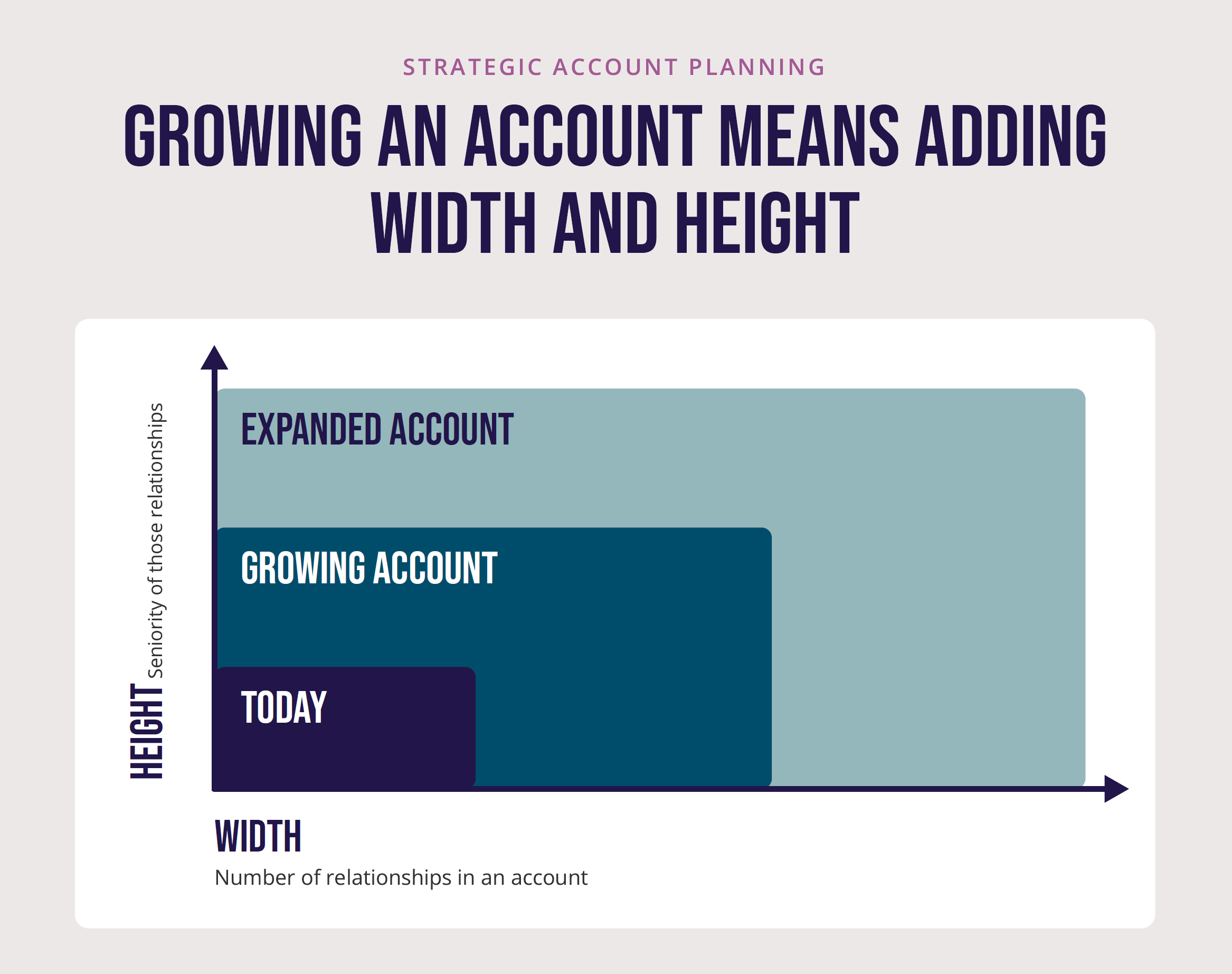
Internal referrals are also a powerful way to communicate that the account manager's acumen and abilities come pre-vetted. If an account manager is seen favorably by one area of the business, they are likely qualified to engage with another area.
Cargill worked with Richardson on a sales effectiveness initiative aimed in part at growing share of business in key accounts. The company reported volume in one of its largest preferred accounts doubled and added more than 10 new large accounts in one business unit.
How Do You Turn a Smaller Deal Into Realized Potential?
A declining deal size means that sales professionals and their solutions have unrealized potential. Capitalizing on that potential means acting to remedy the three underlying causes: fully exploring and articulating differentiators, improving negotiation skills, and rethinking the account planning process so that efforts focus on viable opportunities that represent future growth.