How to Build a Sales Coaching Culture: Start by Changing the Conversation
Sales performance improvement

Written by: Andrea Grodnitzky, CMO
Published: November 11, 2026
Sales coaching is the key to sales success and to improving the performance of the sales organization. It is the most important job a sales manager has. Richardson Sales Performance examined why coaching is so difficult to master and what great coaching must look like to overcome the barriers.
Most sales managers know that they have to drive performance through their team if they are ever to have a shot at making their goal. A team goal simply can’t be achieved by one single sales manager. Yet we often see sales managers making Herculean efforts and resorting to hero tactics to win deals for their team members. They put in the longest hours — more than their direct reports. They put themselves in front of the customer when the stakes are high, and they consistently carry the burden themselves.
If you ask a sales manager whether coaching is an important part of their role, most are sure to agree that it is. In the fast-paced, modern sales environment, though, where almost everyone has more priorities, more initiatives, more customer issues, and more administrative work, developmental activities are often the first thing to slip.
Key Takeaways
- A coaching culture starts when managers shift their focus from hitting the numbers to accelerating learning and changing behavior.
- Building one means changing the conversation, not having more conversations — from telling and directing to collaborative problem solving.
- Managers can turn routine inspections into coachable moments and coach one thing at a time.
Why does a coaching culture start with learning instead of numbers?
Most managers focus on results. They focus on the numbers. Here’s where there needs to be a shift in mindset. Coaching is not about numbers. Coaching is about learning and behavior change. Numbers are indicators; they tell you where there is success or pain. If you accelerate learning and affect permanent behavior change, the numbers will come.
Coaching does three things, and they build on each other:
- It accelerates learning. Whether you manage new sellers or seasoned veterans, the world is constantly changing. Customers are constantly changing. The competitive environment is constantly changing. Everyone needs ways to overcome challenges and reach success faster.
- It achieves behavior change. Trying new skills and strategies can feel uncomfortable and risky, and it’s easy to slip back into old habits quickly. To achieve permanent behavior change, team members need ongoing, consistent support and feedback.
- It improves results. All businesses face pressure to increase goals and to achieve more with less. By accelerating learning and affecting permanent behavior change, you position your team members to achieve and exceed goals.
Research on how people learn points the same way. A widely cited learning model from the Center for Creative Leadership, often called 70-20-10, suggests that about 70% of development comes from on-the-job experience, 20% from relationships such as coaching and mentoring, and 10% from formal training. It is a general guideline rather than a precise measure.
Why is a coaching culture so hard to build?
If the path to sales success is driven through the team, and coaching is so critical, why is it so hard to build a sustained coaching culture? In Richardson’s work with thousands of front-line sales managers, we have heard every reason — not enough time, too many competing priorities, lack of trust in the team. And yet, when you peel those reasons away, the problem persists. To build a sustained, high-performance coaching culture, you first have to understand the true barriers. There are six.
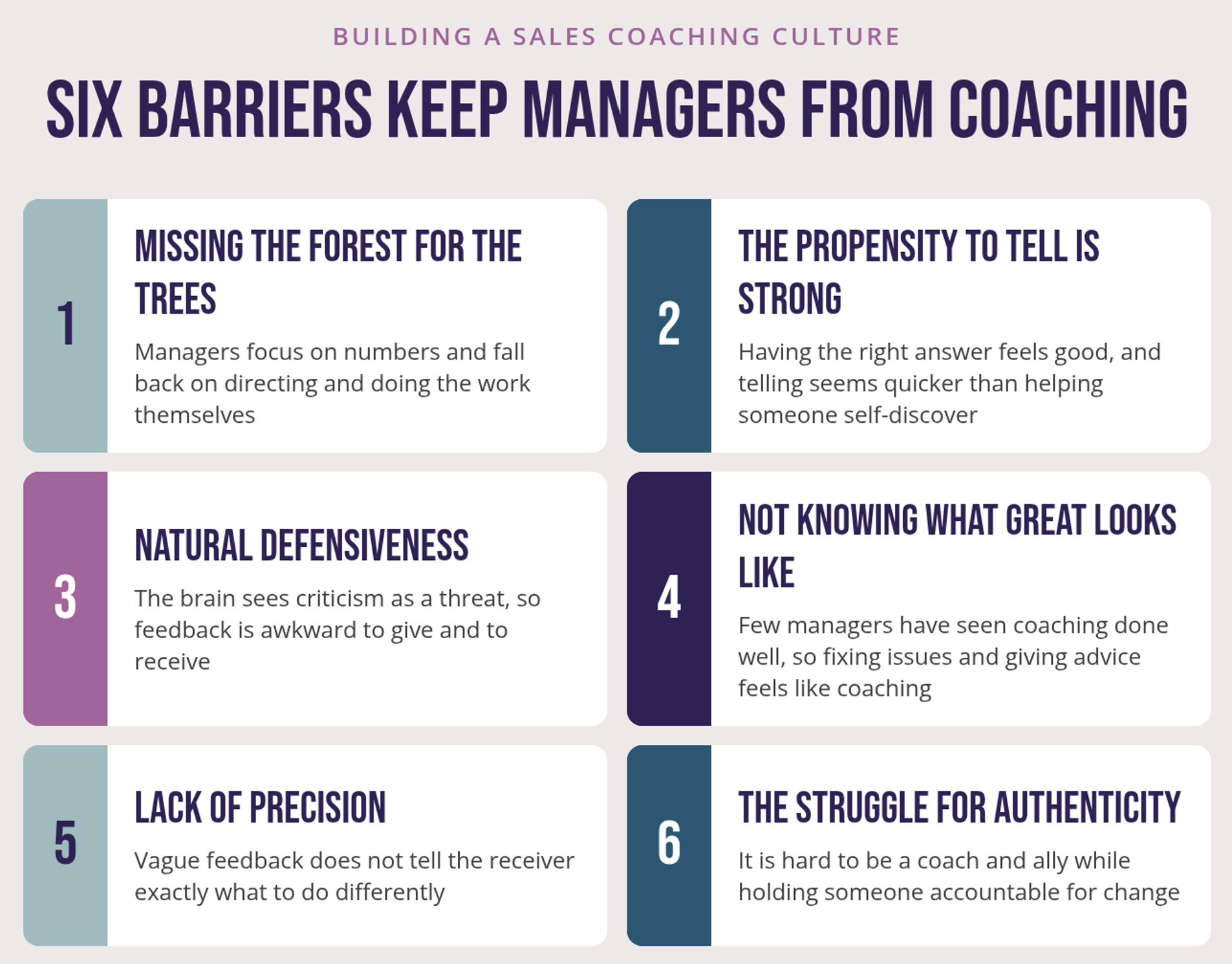
1. Sales managers often can’t see the forest for the trees
Most sales managers are primarily focused on numbers. They often fall back to tactics and behaviors that might save the month but will prevent long-term, sustained growth. Intense pressure tests and compromises focus and discipline.
Many managers think they are effectively coaching when they are actually directing, telling, and often doing the work themselves. The manager gets stuck in a cycle of doing the problem solving and fixing for the team member in order to achieve the numbers, rather than accelerating learning and affecting behavior change. Without a change in team member behavior, there is little to no lift in results for the whole team.
2. The propensity to “tell” is strong
Sales managers are used to telling. Having the right answer makes them feel like the hero, and naturally, being a hero feels good. Telling can also seem quicker and easier than collaboratively assessing a problem and helping someone self-discover the answer.
Many managers also believe they must have all the answers. This is especially true for new managers and for managers who lead sellers who were once their peers. In truth, not only do managers not have to have the answers, the best ones rarely do. The best managers see it as their job to elicit and collaborate on answers, and their confidence comes from their approach.
Even the best managers can fall victim to sellers who consciously or unconsciously encourage telling. Some are testing a new manager. Others are transferring ownership of the issue to the manager. Team members who lack confidence often crave the reassurance of a manager doing the fixing, which makes them more dependent and less self-reliant.
3. Natural defensiveness
Most people don’t look forward to receiving negative feedback, and many feel awkward giving it. Part of the challenge is a lack of skill in providing effective feedback and a lack of positive experiences receiving it. Few of us can say we have had exceptional coaches whose feedback we received openly.
The other part of the challenge can be found in brain science. Our brains see criticism as a threat to our safety and survival. Receiving “constructive” criticism can trigger cognitive dissonance — the mental stress we feel when faced with information that conflicts with what we believe. A common reaction is to relieve the stress by defending our point of view or blaming the person giving feedback.
Negativity bias helps explain why unpleasant remarks and experiences stick with us much more than nice ones. Bad information is processed more thoroughly than good.
Feedback is still an integral part of growth and the learning process. We all have blind spots and can benefit from an outside perspective.
4. Not knowing what great coaching looks like
It is tough to do something when you have never seen it done well, and even harder when you have a false understanding of what good looks like. Given the natural propensity to tell and to make short-term decisions based on revenue pressures, there aren’t a lot of truly great coaches running around. Because most managers have never seen coaching done well, many believe they are practicing effective coaching when they are fixing issues, answering questions, and giving advice.
5. Lack of precision
Like any good diagnosis and prescription, the more specific the feedback, the better. Yet many managers are too vague or generic. Perhaps they don’t want to damage the relationship, or they fear the reaction, or they are looking to wrap up quickly. Feedback like “Next time, you need to be more prepared” lacks the clarity and specificity to tell the receiver exactly what to do differently. Missing the opportunity to give precise feedback is like dropping the ball right before the goal.
6. The struggle for authenticity
Many managers say they struggle to feel authentic in coaching conversations. It is hard to balance being a coach and ally while holding someone accountable for change and growth. Yet authenticity and trust are what preserve a relationship when there is conflict. In the long term, when we see our manager as someone who is direct, honest, fair, balanced, and specific, while maintaining a collaborative tone, we begin to trust. And when we trust, we become more open and more willing to try new things and to become more independent.
What changes when managers move from telling to developmental coaching?
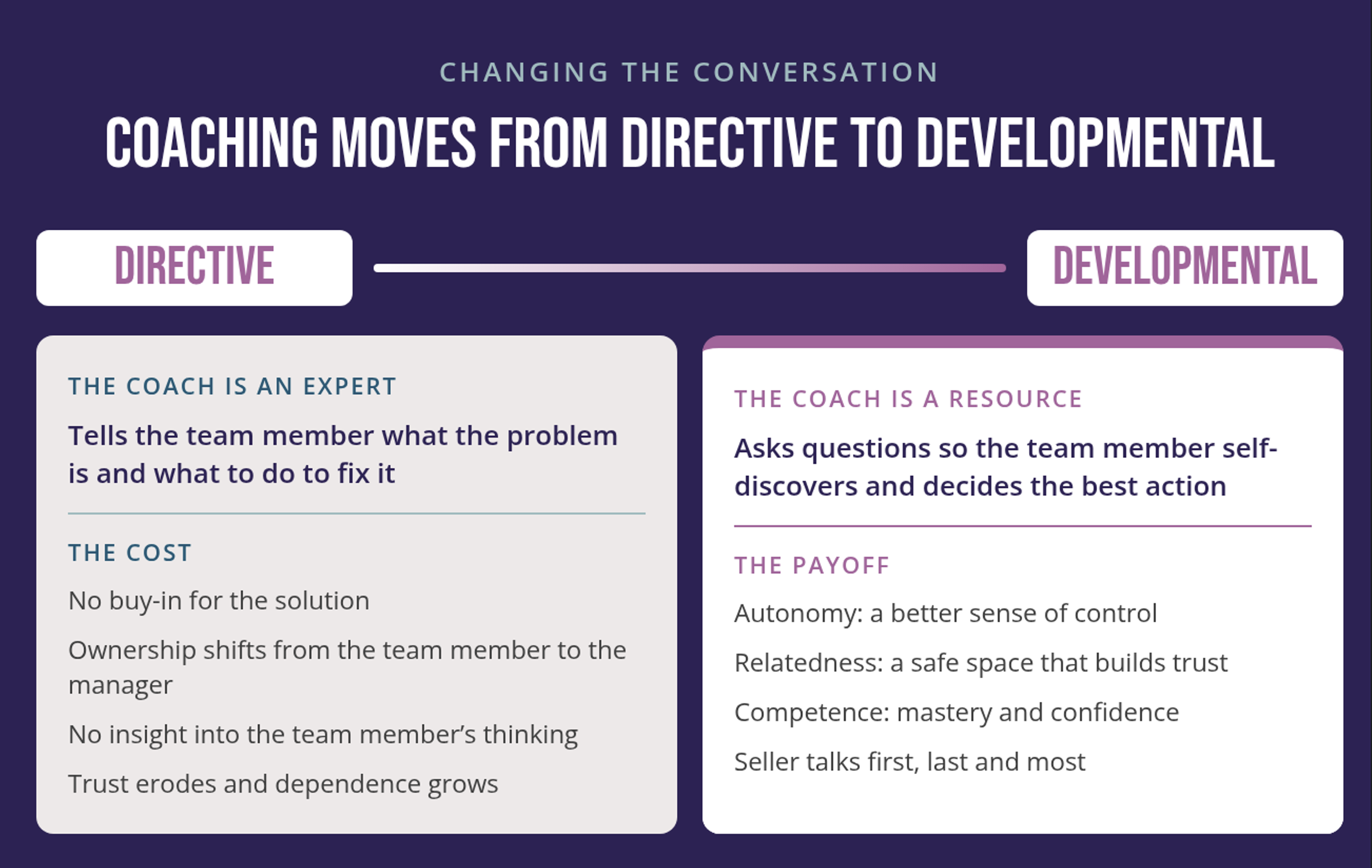
Making the transition to more effective coaching means changing the conversation. It’s not about having more conversations. It’s about changing the dynamics of the conversation from telling and directing to collaborative problem solving, where you help team members self-assess and self-discover ways to use strengths and improve performance.
Approaches to coaching fall on a continuum. At one end is directive coaching, where the coach serves as an expert, telling the team member what the problem is and what to do to fix it. At the other is developmental coaching, where the coach serves as a resource and asks questions to help the team member self-discover and decide on the best action.
Telling and fixing has a cost:
- It doesn’t create buy-in for the solution.
- It takes ownership and accountability away from the team member and places it on the manager.
- It doesn’t give the manager insight into the team member’s thinking, which is needed to offer the right guidance.
- It can make the team member feel disrespected, which erodes trust.
- It doesn’t help the team member learn to problem solve for themselves.
- It creates dependence on the manager rather than accelerating learning about how to prevent or fix issues independently in the future.
What does developmental coaching look like in practice?
The goal of developmental sales coaching is to create an environment where team members feel self-motivated to grow, excel, and take greater responsibility for what they do. Richardson Sales Performance’s coaching methodology rests on a few core tenets:
- Sellers should be involved and responsible for their own performance and development.
- Every person has blind spots that cannot be seen clearly or completely, so everyone needs an outside perspective.
- The manager’s role as coach is to be a thought partner and resource — to ask questions, listen, and learn — and to offer perspective that helps the team member gain insight and inspiration.
- Trust is essential. The seller must trust that the manager’s intent is to help and support, not criticize, judge, or control.
Ensure the seller talks first, last, and most
Developmental coaching moves sellers toward more self-motivated behavior because it meets three inherent psychological needs, which self-determination theory identifies as:
- Autonomy: Asking questions to help sellers self-assess and self-discover gives team members a better sense of control than being told what to do.
- Relatedness: A safe, nonjudgmental environment to learn and grow builds trust and strengthens relationships.
- Competence: Focusing on performance needs helps the seller feel mastery over their work environment and increases their confidence.
Ask more than tell
The heart of the coaching conversation lies in the manager’s ability to engage in a collaborative process that helps sellers self-assess and self-discover ways to improve performance. Coaching by asking:
- Opens conversations, which reveals more and better information for both manager and seller to diagnose needs accurately.
- Gives the manager a chance to identify gaps in their own thinking before giving feedback.
- Shortens the coaching conversation by reducing defensiveness and getting to the underlying issue quickly.
- Increases seller ownership of and buy-in to the solution.
- Helps sellers become stronger problem solvers and more independent by using the process itself to self-coach.
- Strengthens the relationship between manager and team member.
Diagnose before prescribing
Behind every performance gap lies an underlying root issue that is the true blocker to improved performance. Identifying and agreeing on the performance gap or opportunity is only the starting point. A manager must take the next step to identify the root issue that is preventing the desired behavior before choosing a solution. There is little value in taking action against the wrong problem.
Turn routine inspections into coachable moments
A key opportunity for performance improvement lies in turning routine management inspections into coachable moments. Coachable moments exist everywhere in our daily interactions and routines. Taking advantage of planned and unplanned coachable moments is the cornerstone of a manager’s success in creating an engaged team that meets and exceeds goals.
Focus on one thing at a time
Learning is accelerated by continuously focusing on incremental growth. Focusing on one thing at a time allows coaching to happen in targeted, quick, efficient bursts.
Richardson has put this approach to work at scale. For Cencora, Richardson designed an enterprise-wide development initiative for more than 1,050 commercial team members, including Consultative Coaching for sales managers.