How Sales Teams Turn Customized Sales Training into Real-World Revenue Outcomes
Published: July 15, 2026 | By Andrea Grodnizky, Chief Marketing Officer
Customized Sales Training Makes Skill Development Revenue Relevant
Sales training creates revenue impact only when sellers can apply what they learn in the customer conversations that matter most. That requires more than changing the logo on a workbook or adding company terminology to a slide. It requires learning that reflects the seller’s role, market, buyer, deal context, and the specific behaviors needed to move opportunities forward.
Customized sales training is a learning approach that adapts content, scenarios, practice, coaching, reinforcement, and measurement to the seller’s role, industry, buyer dynamics, and real selling situations. The purpose is not simply to make training feel more familiar; it is to help sellers apply the right behaviors in the moments that influence opportunity progression and revenue.
This is where many organizations face a familiar trade-off: they need to scale training across teams, regions, and roles, but they also need the experience to feel specific enough that sellers use it in the field. The most effective sales organizations do both. They build enterprise-wide consistency while tailoring the learning experience to the realities of each seller’s world.
That specificity matters because B2B buying has become more complex, more digital, and less seller-led. Gartner describes B2B buying as a complex process shaped by disruption, uncertainty, and the need for the right mix of digital and human interaction. McKinsey reports that B2B customers use an average of ten interaction channels during the buying journey, up from five in 2016.
At Richardson, customization is not treated as an add-on. It is one of the ways training becomes relevant enough to change behavior. The goal is to translate field context into practice, coaching, reinforcement, and measurement so sellers can improve the conversations that drive revenue.
Customized sales training matters because it narrows the distance between the seller’s real environment and the behaviors they are expected to use in that environment.

Make Training Relevant to the Way Your Team Sells
What Prevents Sales Training from Becoming Real-World Behavior?
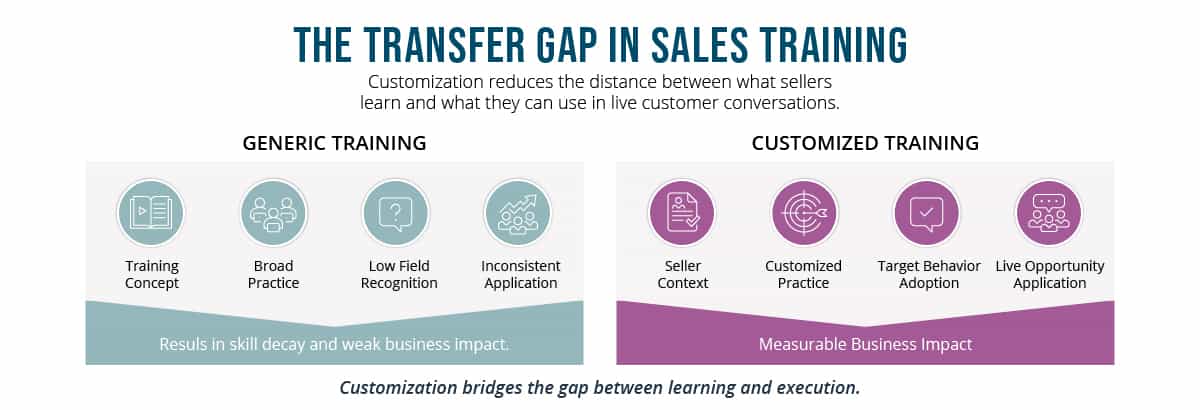
Sales training often breaks down in the gap between learning and execution.
A seller may understand the concept introduced in training. They may remember the framework, the model, and the key behaviors. But when they return to a live opportunity, the situation is more complex than the exercise they practiced. The buyer has competing priorities. The language is different. The objection is more specific. The decision process includes stakeholders who were not reflected in the workshop scenario.
This gap is often described as a training transfer problem. Training transfer refers to the degree to which learners apply the knowledge, skills, and attitudes gained in training to the job.
Research on training transfer also distinguishes between maintaining learning over time and generalizing it to new situations.
When the training environment does not resemble the selling environment, sellers struggle to recognize when and how to use the skill.
The disconnect usually shows up in predictable ways. Scenarios are too generic, so sellers do not see how the skill applies to their real opportunities. Role-plays are too scripted, so sellers are not prepared for resistance, skepticism, or ambiguity. Messaging is not aligned to the market, so sellers revert to product-led conversations. Managers are not equipped to coach the same behaviors, so training becomes an event instead of a performance system. Measurement stops at completion, so leaders cannot tell whether behavior changed.
The result is familiar: sellers leave training with short-term enthusiasm, then gradually return to familiar habits.
Customization changes that equation by making practice look and sound like the work sellers actually do.
Why Customization Makes Sales Training More Transferable
Customization matters because it reduces the distance between the training environment and the seller’s actual selling environment. When sellers practice with the same types of buyers, objections, decision dynamics, messaging, and business pressures they face in the field, the learning becomes easier to apply.
The benefit is not just higher engagement. It is better transfer. Sellers are more likely to recognize when to use a skill, how to adapt it to the buyer in front of them, and how to apply it in the moments where opportunities advance or stall.
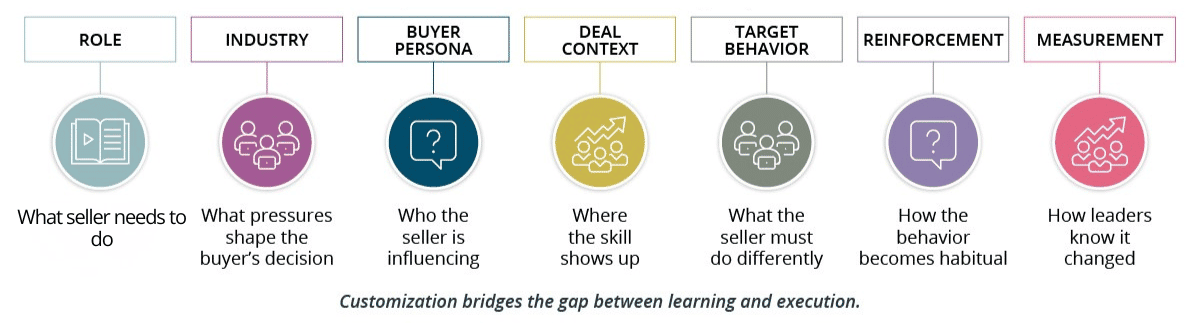
This is why customized sales training should be built around the seller’s actual context: their role, industry, customer segment, sales motion, deal stage, and priority behaviors. A new-logo seller needs different practice than a strategic account manager. A manager coaching opportunity progression needs different reinforcement than a seller preparing for an executive conversation. A team navigating procurement scrutiny needs different scenarios than a team trying to expand existing accounts.
When customization is done well, sellers do not have to translate generic concepts into their world on their own. The training has already done that translation for them.
That makes customized training more practical, more credible, and more likely to show up in live sales execution.
Revenue Relevance: How Customization Connects Training to Outcomes
Customization only matters if it changes what sellers do in the field.
The goal is not simply to make training feel familiar. The goal is to make skill development specific enough that sellers can use the right behaviors in the conversations that influence pipeline, opportunity progression, and revenue.
That means customization has to connect three things:
What sellers face in the field → what they practice in training → what leaders need to see change in performance
When those three elements are connected, customization becomes more than a content decision. It becomes a performance lever.
For example, customizing a discovery module for a healthcare seller is not valuable simply because the scenario mentions physicians, procurement, or clinical outcomes. It is valuable because the seller practices how to uncover the clinical, operational, and financial pressures that shape the buyer’s decision.
That behavior can then show up in better discovery notes, stronger value positioning, more complete stakeholder alignment, and improved opportunity quality.
The same logic applies across roles and industries. A strategic account manager needs practice identifying white space and building alignment across an account. A new-logo seller needs practice creating relevance quickly and converting early interest into a qualified opportunity. A technology seller may need to build urgency around transformation value, while a manufacturing seller may need to connect operational risk to financial impact.
A behavior-based capability framework gives leaders a common language for defining what sellers need to do differently, coaching those behaviors consistently, and measuring whether customized development is showing up in opportunity execution.
Customization becomes revenue-relevant when it helps sellers answer four practical questions:
- What situation am I in?
- What does the buyer care about?
- What behavior should I use now?
- How will this move the opportunity forward?
When training answers those questions, sellers are more likely to apply what they learn. Managers are better able to coach the same behaviors. Leaders gain clearer visibility into whether the learning is influencing sales execution.
That is how customization connects skill development to measurable outcomes.

Learn how To Adapt learning to your sellers’ roles, buyers, sales motions, and priority selling moments.

How Richardson Customizes Sales Training
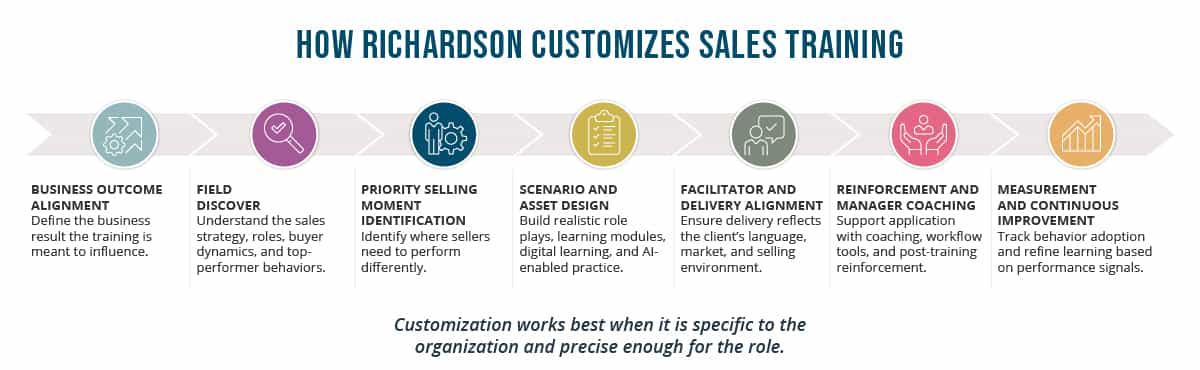
Richardson’s customization process starts with the client’s field reality, not with a prebuilt course. The goal is to understand how the organization sells, what customers care about, where opportunities stall, and what sellers need to do differently in the conversations that matter most.
That means customization goes beyond changing terminology, swapping in a logo, or adding industry references to a workbook. Richardson interviews people inside the client’s organization, including sales leaders, managers, sellers, and top performers, to understand the sales strategy, culture, customer conversations, sales motions, regional considerations, industry dynamics, and priority selling situations.
From there, Richardson builds learning experiences that reflect the seller’s actual world.
1. Align on business outcomes and implementation priorities
The process begins with a kickoff conversation with key project stakeholders. Richardson uses this discussion to confirm the project scope, desired outcomes, timeline, deliverables, and major milestones. This step also identifies the subject matter experts who should be involved in the customization process.
The question is not simply, “What course should we deliver?” It is, “What business result does this initiative need to influence, and what seller behaviors need to change to support that result?” Those outcomes might include improving win rates, increasing deal size, strengthening opportunity quality, reducing stalled deals, increasing account growth, improving forecast confidence, or helping sellers create more relevant customer conversations.
2. Identify the customer challenges sellers need to address
Different industries, markets, and customer segments create different selling challenges. A healthcare seller may need to navigate clinical outcomes, procurement scrutiny, regulatory requirements, and operational risk. A manufacturing seller may need to connect value to supply chain resilience, productivity, cost reduction, or operational efficiency. A financial services seller may need to address risk, compliance, trust, and stakeholder confidence.
Richardson uses discovery to understand the business issues sellers must be able to uncover, diagnose, and address. This helps ensure the training is not just industry-aware, but relevant to the actual customer problems sellers encounter in the field.
3. Interview leaders, managers, sellers, and top performers
Richardson’s customization process includes discovery interviews with people inside the account. These conversations help Richardson understand what is working, what is not working, where sellers struggle, and what top performers do differently.
Interviews may explore questions such as:
- What customer conversations are most difficult for sellers today?
- Where do opportunities tend to stall?
- What objections or points of resistance come up most often?
- Which stakeholders are hardest to access or influence?
- What language do customers actually use when describing their needs?
- What regional, market, or industry dynamics affect the conversation?
- What do top performers say or do that average performers do not?
This is the step that turns customization from surface-level tailoring into field-relevant design. Richardson is not just adapting content to a broad industry. It is gathering real examples from the client’s own sales environment and using them to shape practice.
4. Select the highest-priority selling situations
After the discovery interviews, Richardson identifies the most important selling situations to use as the basis for practice activities. These may include discovery conversations, objection handling, executive conversations, stakeholder alignment, competitive differentiation, negotiation, account expansion, or opportunity strategy.
Richardson then reviews the discovery summary with the client through a virtual walkthrough. This gives stakeholders an opportunity to confirm that the selected situations are accurate, relevant, and high priority. Any necessary edits are incorporated before the learning assets are developed.
This step matters because customized training should focus on the moments that have the greatest impact on sales execution. The goal is not to include every possible scenario. The goal is to build practice around the conversations that sellers most need to improve.
5. Build realistic scenarios, simulations, and role plays
Once the priority situations are confirmed, Richardson develops realistic scenarios, role plays, simulations, and practice conversations that mirror the client’s actual selling environment.
These scenarios can reflect the client’s:
- Customer conversations
- Sales motions
- Buyer personas
- Regional considerations
- Industry dynamics
- Competitive pressures
- Product or solution context
- Common objections
- Decision-making processes
- Manager coaching priorities
For example, a role play for a healthcare sales team should not simply ask sellers to “practice resolving an objection.” It should reflect the type of objection that seller actually hears from a physician, procurement leader, clinical stakeholder, or value-analysis committee.
That level of specificity helps sellers practice in a safe environment without stripping away the complexity, tension, and ambiguity of real customer conversations.
See the Difference Between Broad Skill Use and Buyer-Relevant Execution
Example of Generic Training Content
This example shows a seller applying the general structure of the skill, but the conversation is broad. The objection is not deeply connected to the buyer’s world; the seller’s response is less specific, and the practice does not fully reflect the pressures of a real customer conversation.
Example of Customized Training Content
This example shows the same skill applied in a customized scenario. The buyer’s concern is more specific; the seller must respond to realistic resistance, and the conversation reflects the language, priorities, and decision context sellers are likely to encounter in the field.
The difference is not cosmetic. Customized practice helps sellers understand what strong execution sounds like in the customer conversations they actually have.
6. Customize messaging and value conversations
Richardson also adapts messaging and value conversations to reflect the client’s market, buyer priorities, and business outcomes.
Every industry and customer segment has its own language. Sellers need to be able to speak in terms that resonate with the buyer’s priorities, whether those priorities involve risk reduction, operational efficiency, revenue growth, clinical outcomes, transformation value, compliance, cost control, or stakeholder confidence.
This helps sellers move beyond product-led messaging. They learn how to connect their solution to the business issues buyers are trying to solve.
7. Align the learning experience to the buyer’s decision process
Buying journeys vary by industry, market, and customer type. In financial services, sellers may need to navigate risk, compliance, and trust across multiple stakeholders. In healthcare, sellers may need to engage clinical, operational, procurement, and executive decision-makers. In manufacturing, sellers may need to influence technical evaluators, operations leaders, and executive sponsors. In technology, sellers may need to support transformation initiatives, integration requirements, and ROI justification.
Richardson adapts the learning experience to reflect those decision-making environments. This ensures sellers are not just practicing isolated skills; they are practicing how to use those skills inside the buying dynamics they face every day.
8. Review, refine, and validate the customized materials
Each customized scenario and role play is reviewed with the client to ensure it feels realistic, accurate, and useful. This review helps confirm that the materials reflect the seller’s language, customer environment, industry context, and day-to-day sales situations.
This validation step is important. Customized training only works when sellers recognize the scenario as something they might face in a real opportunity.
9. Extend customization through reinforcement and Accelerate Prism
Sellers need reinforcement that helps them apply new skills to active opportunities and real customer conversations.
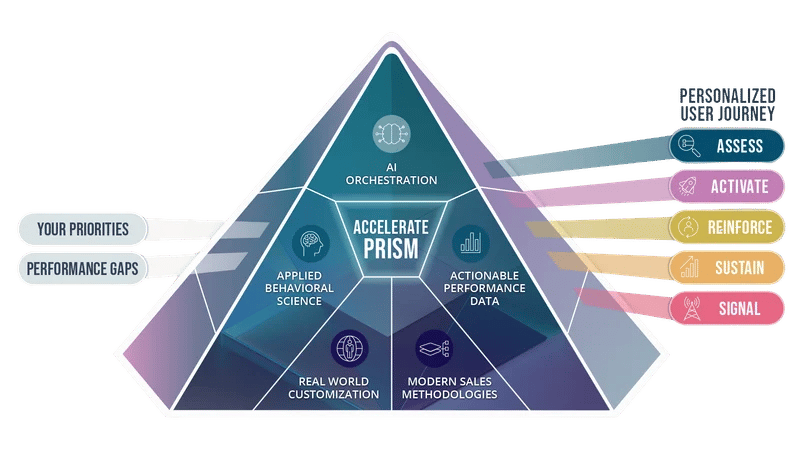
Accelerate Prism, Richardson’s sales excellence system, extends customization by connecting learning, practice, coaching, workflow tools, AI-enabled role plays, and performance insight into an ongoing development experience. Sellers can receive relevant reinforcement resources and activities tied to their role, industry, selling situation, and development needs.
This keeps the learning connected to the field. Instead of asking sellers to step away from their work to maintain new behaviors, reinforcement can meet sellers in the places where they already work, including collaboration tools such as Slack where enabled.
10. Use AI-enabled role play for realistic practice
AI-enabled role play can give sellers another way to practice realistic customer conversations without risking revenue or credibility in a live opportunity.
These simulations can reflect customer objections, skepticism, competing priorities, time pressure, and uncertainty. Sellers can practice navigating difficult conversations with buyers who may be unconvinced of the solution’s value, pressed for time, or not yet trusting of the seller.
When customized by organization, role, industry, and market, AI-enabled practice helps sellers prepare for the kinds of customer concerns and challenges they are likely to face in the field.
The value is not just repetition. It is relevant repetition. Sellers get more opportunities to practice the behaviors that matter most in the conversations that shape pipeline quality, opportunity progression, and revenue outcomes.
How Accelerate Prism Makes Learning Continuous
Customization should not stop when the workshop ends.
A workshop can create alignment and build skill, but sellers need continued support when they return to active opportunities. That is where customization becomes continuous. The learning experience has to keep adapting to the seller’s development needs, selling situation, and performance.
That’s where Richardson’s sales excellence system, Accelerate Prism, shines. Accelerate Prism moves sales reps through a continuous, fully customized learning journey that continuously drives relevant performance improvement.
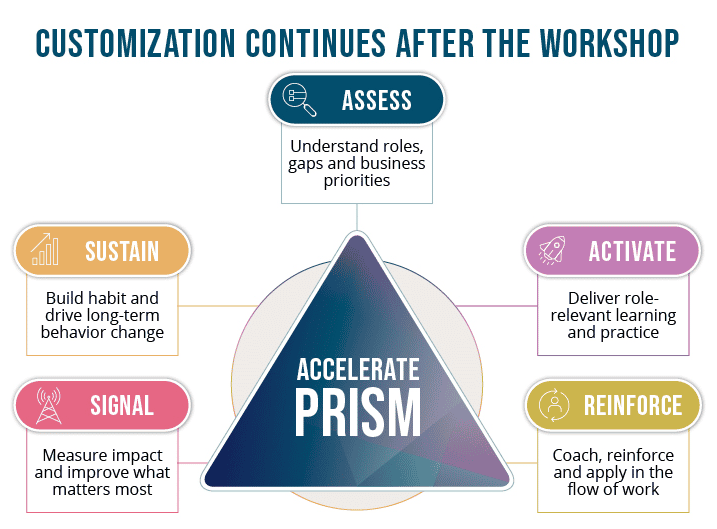
Accelerate Prism extends customization by connecting assessment, digital learning, practice, coaching, workflow tools, AI-enabled role plays, and performance insight into one ongoing development experience. Instead of treating customization as something that happens only during program design,
That matters because selling conditions do not stay fixed. Buyer priorities shift. Markets change. New objections emerge. Competitive pressures intensify. Sellers need reinforcement and coaching that keep pace with those changes.
In practice, continuous customization means sellers receive more relevant learning, practice, and guidance after the initial training event. Digital learning and AI-enabled role plays can be customized by organization and by role within that organization, helping sellers practice in situations that reflect their actual sales motion, buyer persona, customer context, and priority behaviors.
Managers also gain better visibility into where sellers need support, which behaviors are improving, and where coaching should focus next.
Training research and learning-transfer guidance consistently point to the importance of manager support and reinforcement after training. Training Industry describes managers and supervisors as a bridge between learning and performance and notes that support before, during, and after training helps drive real-world behavior and results.
The value of Prism is not just that it extends learning. It extends learning in a way that remains connected to the seller’s real work.
Take A Guided Tour of Richardson’s AI-orchestrated Sales Excellence System
How to Choose the Right Custom SAles Training Provider
A custom sales training provider should be able to show how it turns business context into sales behavior.
For organizations evaluating customized corporate sales training providers, the key question is not which partner has the most content, but which partner can translate business context into observable seller behavior.
That partner should start with business outcomes, not course content. It should understand the client’s sales roles, motions, buyer dynamics, and performance priorities. It should interview leaders, managers, sellers, and top performers to identify the moments where sellers need to perform differently.
It should also be able to build realistic scenarios that reflect customer resistance and decision complexity. This means tailoring messaging and practice to the client’s industry, buyer personas, deal stages, and competitive environment.
Just as important, the partner should equip managers to coach the same behaviors after training. If managers are not part of the reinforcement strategy, customization remains trapped in the workshop.
Finally, the partner should help leaders measure whether behaviors are changing and where additional support is needed. Completion data alone is not enough. Sales leaders need visibility into whether the customized learning experience is influencing live execution.
The strongest partners do not force the seller’s world into a prebuilt program. They adapt the learning experience to the seller’s world, then reinforce and measure the behaviors that matter most.
Find Out If Richardson Is Right For You
Click here to request a call with one of our sales experts.
Move from Broad Training To Customized Learning
Broad training can create awareness. Customized learning creates application.
For sales leaders, the question is not simply whether training content is relevant. The question is whether the training experience helps sellers perform better in the moments that determine revenue outcomes.
That requires a more disciplined approach to customization. It means defining what good looks like by role and selling motion. It means building practice around real buyer dynamics. It means reinforcing the right behaviors through managers, workflow tools, AI-enabled practice, and continuous learning. And it means measuring whether those behaviors are showing up in live opportunities.
Customized sales training works when it turns field reality into behavior change.
That is how skill development becomes revenue-relevant.
Key Takeaways
Customized sales training works when it reflects the seller’s role, industry, buyer, deal context, and target behaviors.
The value of customization is not familiarity alone; it is helping sellers apply the right behaviors in the selling moments where opportunities advance or stall.
Richardson customizes training by interviewing people inside the account, identifying the highest-priority selling situations, and building realistic practice around the client’s unique customer conversations, sales motions, regional considerations, and industry dynamics.
Leaders can evaluate customization by looking for target behavior adoption, manager reinforcement, improved opportunity quality, and measurable business impact.