What to Look for in an AI Sales Roleplay Solution
Sales performance improvement

Written by: Claire Imber, Director of Content Strategy & Thought Leadership
Published: October 15, 2026
Choosing an AI roleplay tool that changes seller behavior takes more than a strong demo. The questions below help you tell the difference between a tool that makes practice easier and one that makes sellers better.
Key Takeaways
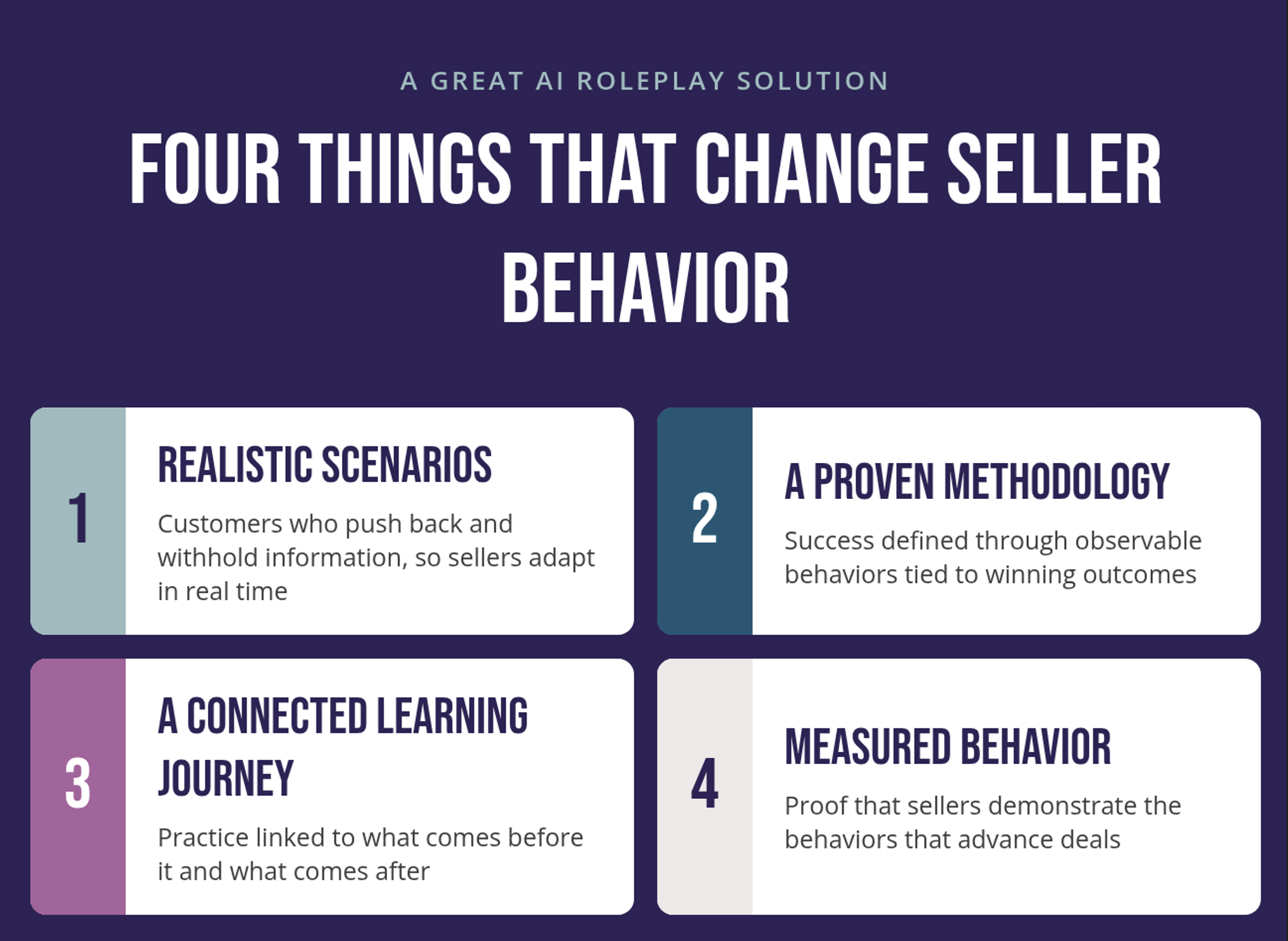
- A great AI roleplay solution combines four things: realistic scenarios, success defined through a proven sales methodology, practice embedded within a larger learning journey, and measurement of whether sellers demonstrate the behaviors that actually advance deals.
- A methodology gives practice direction. Without one, sellers don't reliably develop revenue-relevant skills.
- Scoring should measure behavior, using criteria an expert built and validated, not generic metrics that mislead sellers into optimizing for the score.
Do the Scenarios Reflect Real Customer Behavior?
The best scenarios don't let sellers predict what comes next. Look for practice that reflects how customers actually behave, including when they push back.
- Do the roleplay scenarios reflect real customer behavior? Scenarios should be based on actual customer interactions, not simplified versions that let sellers off the hook.
- Can the AI customer be resistant, skeptical, and withhold information? Sellers should not know what's coming. They need to adapt in real time, like they would in actual customer conversations.
- Do scenarios include the messiness of real deals, like multiple stakeholders, competing priorities, and unexpected objections? If scenarios are too clean or orderly, sellers will develop false confidence that doesn't transfer to field complexity.
- Is the customer behavior grounded in real data, not AI-improvised responses? The more realistic the customer's behavior, the more accurately it prepares sellers for what they'll encounter.
Why does this matter? A 2026 study in Science found that 11 leading AI systems affirmed users' actions 49% more often than other people did. An AI customer built on that tendency may go easy on the seller, building false confidence that doesn't transfer to real customer conversations.
Is the Solution Grounded in a Proven Sales Methodology?
A proven methodology defines what "good" selling looks like, so sellers know what they're practicing and the tool knows what to measure.
- Is the solution grounded in a proven, time-tested sales methodology? Without a clear methodology, sellers practice without direction and don't reliably develop revenue-relevant skills.
- Are specific selling behaviors defined and tied to winning outcomes? You want clear, observable behavioral standards, not vague goals like "get better at discovery."
- Can sellers see how well they executed against clearly defined behavioral targets? Iterative learning requires sellers to understand exactly what they're working toward and how close they are to mastery.
- Does the vendor provide examples of what "good" looks like in specific situations? Specificity eliminates ambiguity and ensures sellers focus on the right behaviors.
How Should the Tool Score Performance and Deliver Feedback?
Scoring should measure whether sellers executed the behaviors that matter, and feedback should be quick and specific enough to use on the next attempt.
- Is the tool scoring behavioral execution? Generic metrics such as "asked three discovery questions" mislead sellers into optimization. Behavioral scoring measures whether they actually executed the behaviors that matter.
- Did an expert define the scoring criteria? Are the scoring criteria fixed? You want criteria an expert human built and validated, not AI-improvised or self-built standards that shift.
- Are the scoring criteria customized to your sales context and customer types? "Good" discovery looks different selling to a CEO versus a department manager. Scoring must reflect your specific scenarios.
- Does feedback arrive immediately after practice? Immediate, criterion-level feedback allows sellers to put insights into their next attempt, not weeks later.
- Is feedback specific and actionable? Sellers should know exactly which behaviors they executed well and which need refinement.
Can the Solution Deliver Consistency at Scale?
AI's scale advantage only helps if every seller is measured against the same expert-built standard.
- Does every seller in your organization work toward the same definition of behavioral excellence? Consistent criteria across the sales organization ensure everyone develops the same revenue-relevant skills.
- Can the solution scale to score hundreds of practice conversations without manual review? You need AI's scale advantage, but grounded in expert-built criteria, not algorithmic guessing.
- Does the platform include safeguards to prevent sellers from chasing scores and avoiding real skill development? The best platforms build in safeguards, so practice incentivizes real development, not score inflation.
“With Richardson, what I love about it is we were able to scale the entire framework throughout our organization globally. So you're getting that same language, that same framework with consistency, which keeps that brand.” — Darnetta Daire, sales enablement manager, Hollister Incorporated
Does Practice Connect to the Rest of Your Learning System?
Practice produces development when it connects to what comes before it and what comes after.
- Does the AI roleplay exist within a connected learning system, one that links to what comes before (skill identification, foundational learning) and after (real-world application)? Isolated roleplay practice produces repetition without context. Integrated practice produces development. Roleplay should be part of a complete learning journey, not disconnected from the rest of training.
- Do roleplay results flow back into learning recommendations or coaching plans? If practice scores end in an isolated dashboard, they're not shaping what sellers work on next.
- Can coaches see each seller's complete development picture, not just isolated roleplay scores? Coaches need visibility into the full learning journey to know where to intervene.
Will Better Roleplay Performance Show Up in Real Deals?
Improvement inside a practice tool isn't the goal. Better conversations with real buyers are.
- Does the vendor have evidence that improved roleplay performance translates to field performance? Platform improvement doesn't automatically mean real-world results. You need proof of transfer.
- Does the solution train the behavioral skills that drive revenue outcomes? Effective roleplay trains skills that matter in revenue outcomes, not just sales process execution.
- Is there coach visibility into what specific behaviors or skills are driving results in real customer conversations? Coaches need to be able to see what actually works, and to prioritize it in future roleplay practice.
- Is there coaching visibility into which sellers are ready for advancement, and which need intervention? Coaches should be able to see development progression, not just practice volume.
One Richardson customer describes what that transfer can look like.
“When you put those behaviors into practice — questioning and listening, having facilitated sessions with coaches that actually get in there and can coach them along the way — our teams are better able to actually apply some of those behaviors in the moment with their customers in ways that they weren't able to previously.” — Amber Boll, director, sales global process owner, Rich Products Corporation
What Should You Expect from the Vendor?
Implementation matters. A roleplay partner has to understand how people learn, not just how the tool works.
- Will the solution integrate with your existing learning platform or LMS? The solution should work seamlessly with your learning system, not exist as a separate, disconnected dashboard.
- Does the vendor provide support and expertise in technology, consulting, and change management? A roleplay partner must understand learning design, not just tools.
- Can the vendor provide customer references from organizations like yours? Peer validation from similar companies provides critical evidence.
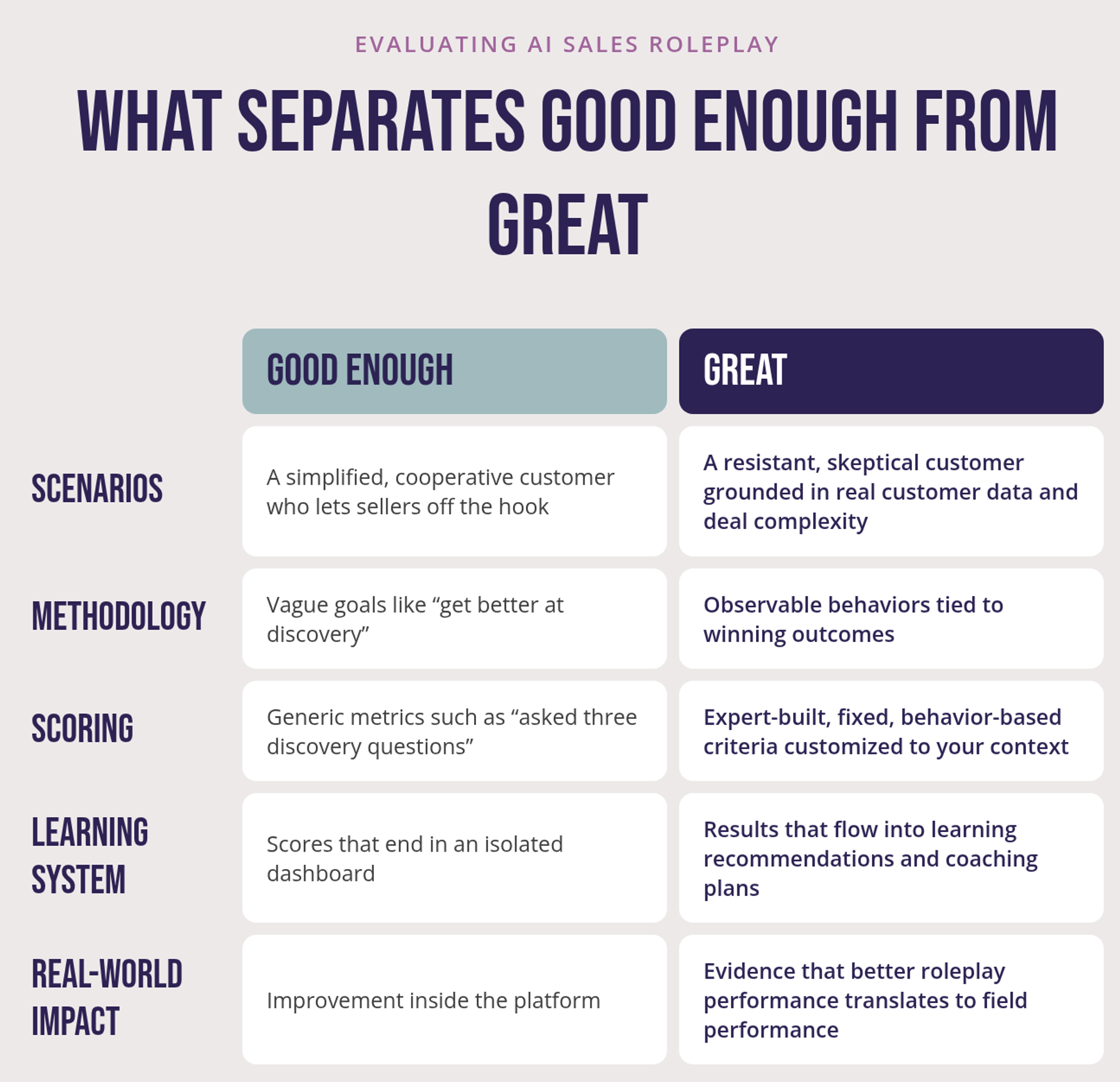
What Separates Good Enough from Great?
The difference comes down to five areas.
| Area | Good enough | Great |
|---|---|---|
| Scenarios | A simplified, cooperative customer who lets sellers off the hook | A resistant, skeptical customer grounded in real customer data and deal complexity |
| Methodology | Vague goals like "get better at discovery" | Observable behaviors tied to winning outcomes |
| Scoring | Generic metrics such as "asked three discovery questions" | Expert-built, fixed, behavior-based criteria customized to your context |
| Learning system | Scores that end in an isolated dashboard | Results that flow into learning recommendations and coaching plans |
| Real-world impact | Improvement inside the platform | Evidence that better roleplay performance translates to field performance |
How Does Richardson AI Roleplay Approach These Questions?
Richardson AI Roleplay in Accelerate Prism works on a simple principle: AI powers the practice, and Richardson defines the standard.
- Methodology-based scoring. Expert-built scorecards translate Consultative Selling and Challenger into observable selling behaviors. Sellers practice against the same standards they learned in training and that managers are expected to coach.
- Practice built around your selling environment. Richardson configures AI Roleplay around your selling environment, so sellers can rehearse the moments that matter most to your business — from opening a conversation and uncovering needs to handling resistance, building consensus, and moving decisions forward.
- Immediate feedback and another try. Sellers rehearse a realistic buyer conversation, see what worked and which key behaviors were missed, then adjust and try again.
- Connected through Accelerate Prism. AI Roleplay sits in the Reinforce step of the Accelerate Prism learner journey, so practice results help guide what sellers strengthen next, where managers should coach, and how teams can see development progress over time.