When Revenue Declines: What Sales Leaders Should Do
Sales performance improvement

Written by: Ben Taylor, MBA, Content Marketing Manager, Richardson
Published: November 13, 2026
Given a long enough period, every company experiences a drop in revenue. It is one of the few unifying characteristics of all businesses, from burgeoning startups like GoPro to established behemoths like GE. The biggest problem, however, is not the decrease in revenue itself. Instead, the problem is how companies react.
Key Takeaways
- Resist the quick fix and invest in your sales team for the long term.
- Drive motivation through engagement, not financial incentives alone.
- Build a scalable, team-based selling strategy for larger, more complex deals.
- Coach sellers to understand the customer's challenge before they pitch.
Why do quick fixes fail when revenue drops?
Too often, businesses react with impulsive, short-term solutions. This practice has become so commonplace that the phrase "short-termism" has entered the modern business lexicon. Quick fixes don't work.
A 2017 McKinsey Global Institute study of 615 large and mid-cap US public companies from 2001 to 2015 found that companies classified as long term outperform their shorter-term peers on a range of key economic and financial metrics. Between 2001 and 2014, the cumulative revenue of long-term companies grew 47% more, on average, than the revenue of other firms. Long-term companies also added nearly 12,000 more jobs on average between 2001 and 2015.
The study describes differences in past performance rather than proving cause and effect, but the pattern is clear: long-term companies outperformed. FCLTGlobal, a nonprofit that advocates for longer-term decision-making, still cites this research for the finding that long-term companies outperform on revenue, earnings, and job creation.
Despite the clarity of the findings, short-termism is on the rise.
Sales leaders facing a revenue decline should let this research guide their strategies. The best way to react to red ink is with a long-term focus on developing your team. Three approaches put that into practice.
How do you keep a sales team motivated when revenue is under pressure?
Drive motivation with engagement. Dan Ariely, a behavioural economist at Duke University, argues in a TEDx talk that driving motivation is more important than ever because we live in a "knowledge economy." In this kind of economy, knowledge is a product. Motivating sales professionals is therefore critical, because much of the value of the product stems from the individual's engagement.
In a frantic rush to restore revenue, leaders focus on financial measures alone. Financial metrics matter, but Ariely argues that the focus on motivation is lacking. Leaders treat motivation and financial gain as the same thing. The truth is that there are more pieces to the puzzle. In his words, "The reality is that we should probably add all kinds of things to it — meaning, creation, challenges, ownership, identity, pride, etc." In short, sales motivation comes from ownership of the process.
This is a key takeaway for leaders and managers, Ariely argues, because they focus only on the measurable characteristics of the job. That pulls attention away from less quantifiable aspects. Concepts like identity and fulfilment are difficult to quantify, but they matter enormously.
Sales leaders act on this by investing in their sales team. Training demonstrates their commitment to the team's success, and sales professionals respond with a higher level of ownership and buy-in to long-term sales goals.
How do you build a scalable selling strategy?
Business challenges have become more complex. As more companies struggle against commoditisation, they're forced to draw on the nuances of fewer differentiators. The solutions that sales professionals bring are therefore increasingly customised, and the challenge is articulating how capabilities connect to needs. Effective sales leaders embrace this challenge with a scalable selling strategy that draws on team selling.
The buying side keeps growing. Forrester's 2026 State of Business Buying report found that the typical buying decision now includes 13 internal stakeholders and nine external influencers. Sales professionals, while skilled in positioning solutions to buyers, often work alone. They need a framework and the tools to build a well-organised team. Winning the sale today requires higher-level performance that draws on the distinct capabilities of different sales professionals in one cohesive meeting.
Every member of the team has a role to fulfil. Effective team leaders ensure that each player is clear on what is expected of them. The more specific the expectations, the better suited team members will be to carry out their tasks. Sales professionals must also practise fulfilling their roles in a team setting, which means rehearsing handoffs and developing a consistent value statement.
"Richardson has helped us establish a common sales language and create greater alignment across our global sales organization. They have strengthened both selling and coaching capabilities while supporting a structured development journey for sales professionals and leaders." — Patrick Klein, Sales Enablement Manager, Endress+Hauser
A team dynamic gives sales leaders a "go-to" solution for larger, more complex deals. Richardson senior consultant Michael Dalis, author of Sell Like a Team, puts it plainly: closing deals and driving results means "you're going to have to sell with others."
How do you keep sellers from becoming seller-centric?
Avoiding seller-centric behaviours sounds intuitive, but sellers rarely practise it. When revenue declines, seller-centric behaviour becomes an involuntary reaction to intensified selling pressure. As a result, customers trust the seller less.
Sales leaders help their teams overcome this tendency by underscoring the importance of understanding the customer's challenge. Doing so fosters insights that build credibility. This can only happen with a mindset of authenticity — the sales professional must first seek to understand before seeking to be understood.
"How do you teach them something new? How do you switch their status quo? It's not about us. How do you keep driving in on that problem and help them connect holistically?" — Shawn Dooley, Senior Customer Success Enablement Manager, Iterable
Authenticity matters because it fosters trust, and because it helps when positioning the solution. When sales professionals take the time to understand the details of the customer's challenge, they more effectively articulate how their solution satisfies the need. They emphasise the value of the solution in a context that's meaningful to the customer.
What does a long-term response look like?
Occasional declines in revenue are a natural part of all business cycles. What matters is how the business reacts. Sales leaders who drive motivation with engagement, build a scalable selling strategy that can capitalise on large sales, and avoid seller-centric behaviours give their teams a durable response to red ink.
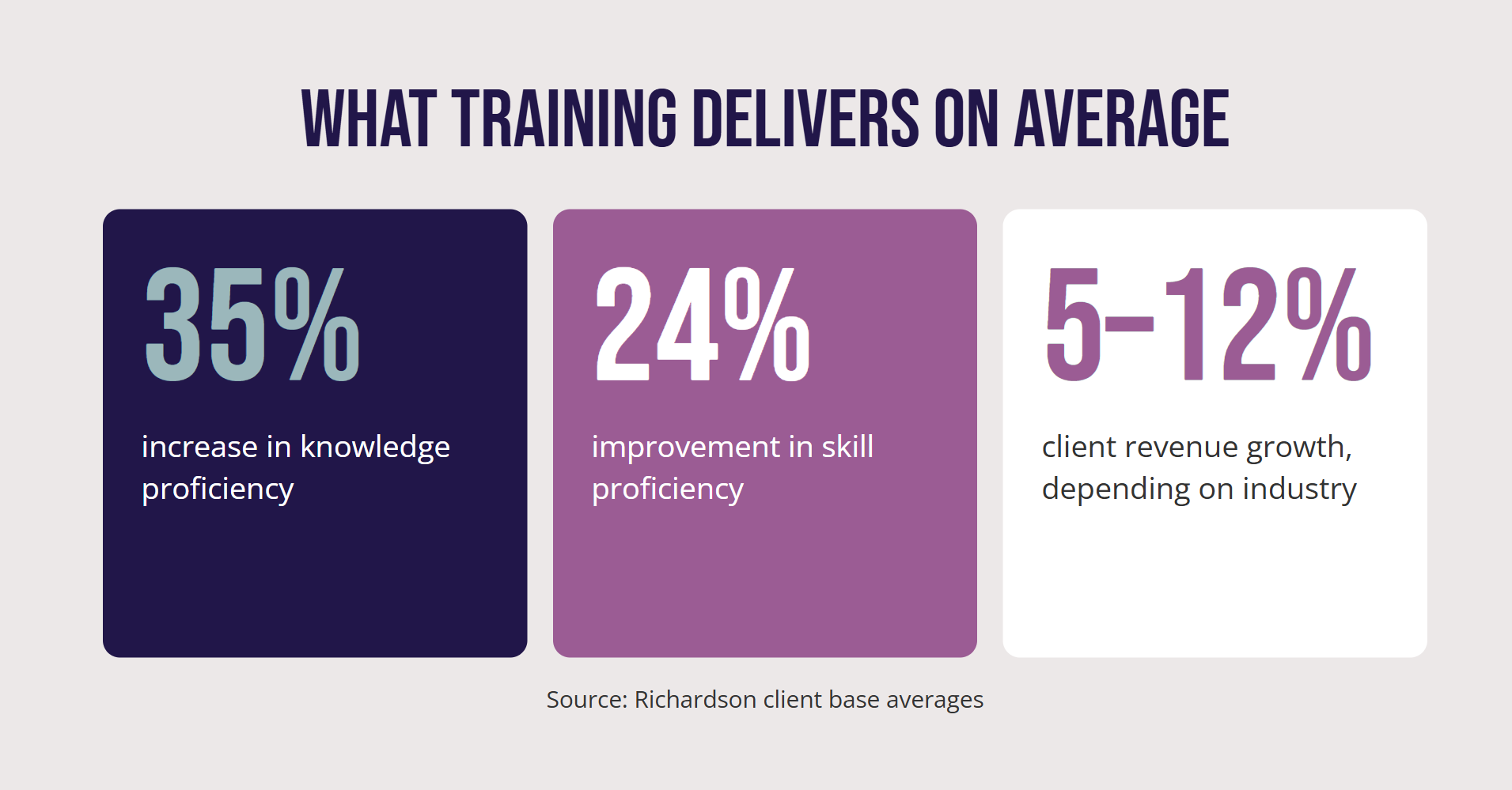
Across Richardson's client base, training drives, on average, a 35% increase in knowledge proficiency, a 24% improvement in skill proficiency, and 5–12% client revenue growth, depending on industry.
"It's a behavior change, right? So you can't expect results right away. But the more consistent you are with training and bringing people along with you, the more it becomes part of that normal language." — Darnetta Daire, Sales Enablement Manager, Hollister Incorporated