How Can Sales Enablement Simplify the Buying Process for Customers?
Sales performance improvement

Written by: Ben Taylor, MBA, Content Marketing Manager, Richardson
Published: November 9, 2026
Repeated decision making is exhausting, and research suggests each additional decision a buyer makes can deplete their resolve to advance to the next step.
Consider a 2011 study published in the Proceedings of the National Academy of Sciences of the United States of America, which found that this phenomenon appears even among experienced judges making highly consequential parole decisions. The percentage of favourable rulings "drops gradually from ≈65% to nearly zero within each decision session."
The researchers noted an increased tendency to rule in favour of the status quo as rulings piled up, and buyers facing mounting choices may do the same. It is a reminder that becoming better at sales enablement means getting better at buyer enablement. When sales enablement professionals give sellers insights and information designed to simplify the customer's decision process, they are practising buyer enablement.
Key Takeaways
- Sales enablement simplifies buying by giving sellers material that reduces the number and weight of decisions a buyer has to make.
- In practice, that means concise data, one or two options, and a plain-language path to implementation.
- The material works best when it matches where the buyer is in the journey and reaches the seller fast.
Why is the buying process getting harder for customers to navigate?
The buyer's journey is not linear. It is dynamic and iterative. Stakeholders enter and exit the picture. Needs change, and competing internal priorities can slow or even stop the buying process.
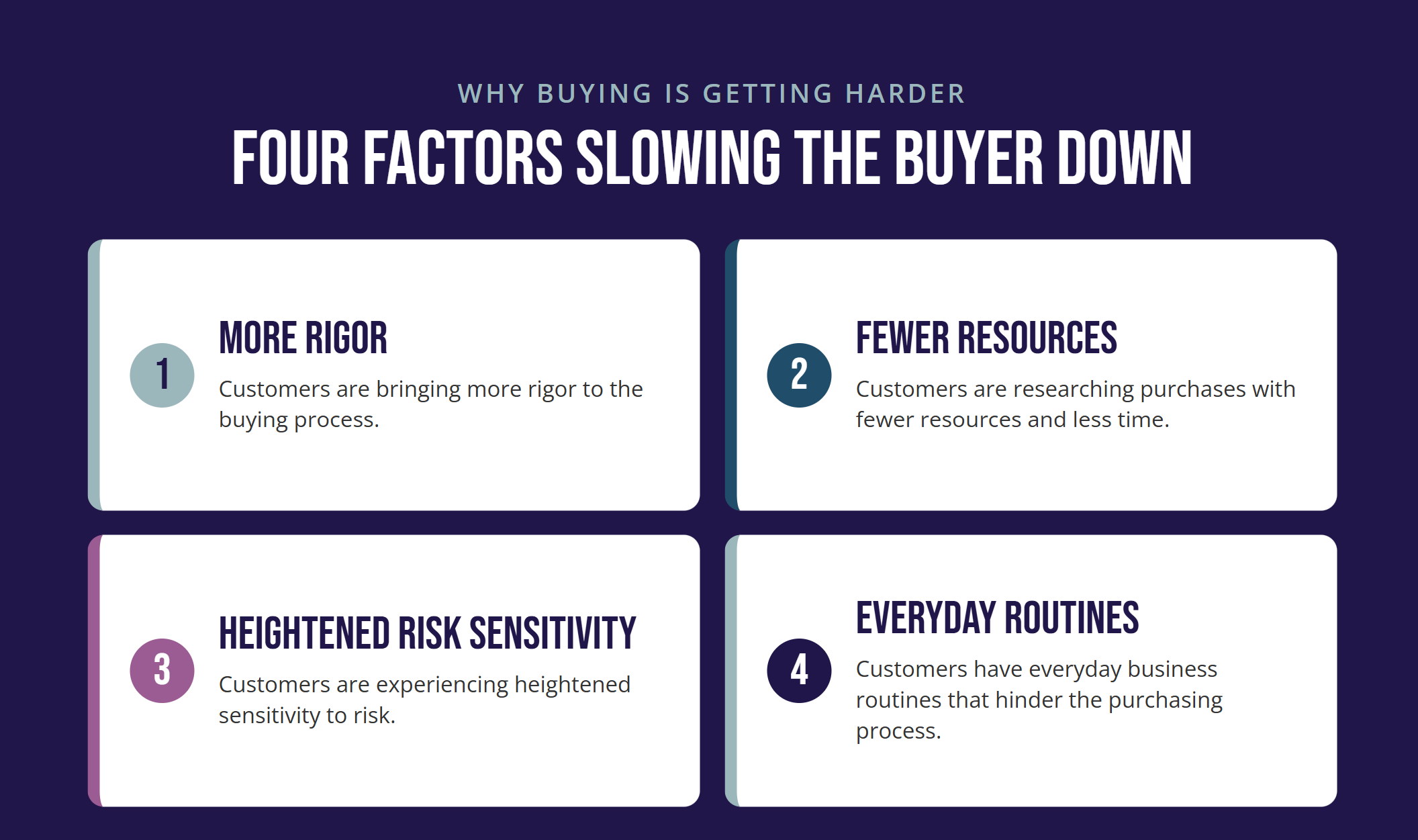
Richardson sees four factors driving these changes:
- Customers are bringing more rigour to the buying process.
- Customers are researching purchases with fewer resources and less time.
- Customers are experiencing heightened sensitivity to risk.
- Customers have everyday business routines that hinder the purchasing process.
How does sales enablement keep pace with a buyer's journey that keeps changing?
Sales enablement professionals must be able to track and predict these changes so they can map their material to the turns in the road. By doing so, they can provide marketing collateral, data, and insights that are salient not only to the customer's end goal, but also to top-of-mind issues at that particular stage of the buyer's journey.
The first step is to identify which factor the customer is facing. Then sales enablement professionals can equip the seller to respond appropriately. For example:
- To meet a customer's increased rigour, give sellers clear, relevant data supporting the effectiveness and ROI of the solution.
- To ease a customer's sensitivity to risk, give sellers concise case studies that illustrate the solution's real-world outcomes.
One capability underpins both examples: speed. With a faster response time, enablement professionals help sellers keep customer concerns from languishing. Sellers must address these hesitations in the moment, before they solidify.
Richardson's work with LexisNexis Risk Solutions shows what aligning a sales approach to the buyer's journey can look like.
What are the three principles for simplifying the buyer's decision?
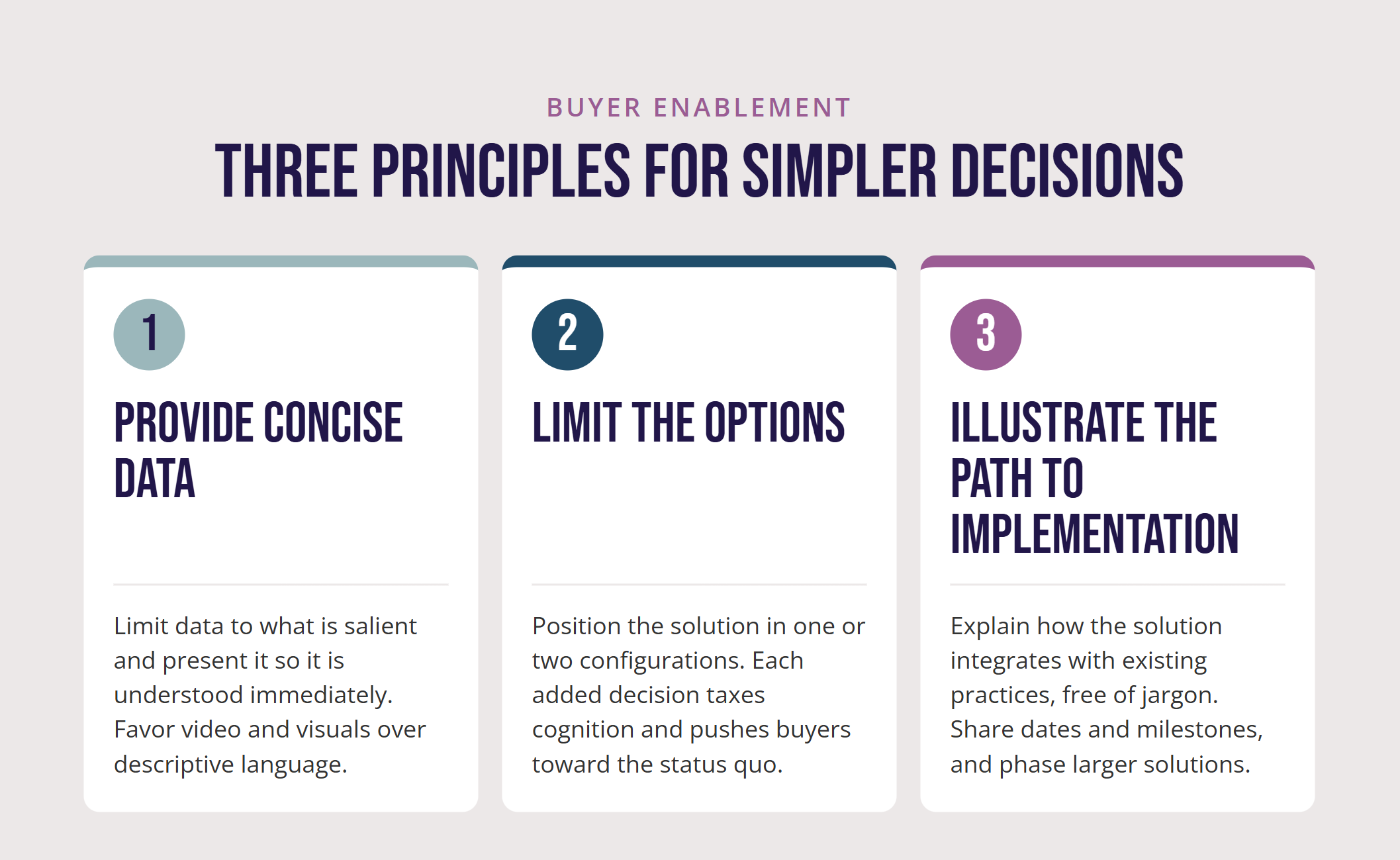
Strong buyer enablement means carefully selecting which material to give sellers to help them pave the way to a purchase. It is akin to choosing the right tool at the right time for the specific part of the job at hand. Sales enablement professionals can do so by following three principles.
1. Provide concise data to support the solution
Understanding data should not be burdensome for the customer. Limit the data to only what is salient, and present it in a way that can be understood immediately. That means considering the cognitive load of the information.
Doing so means providing clear and simple supporting data, and using video and visuals over descriptive language. As business challenges and their solutions become more sophisticated, it is more important than ever to distill complex messaging into small, digestible content.
2. Limit the available options
Equip the seller to position the solution in one or two configurations. Presenting the customer with a long list of options only complicates the issue. Research suggests that each additional decision a person makes can tax their cognition and encourage them to resort to the default choice: the status quo.
When presenting the short list, help the seller create clear messaging that links the solution to the customer's challenges. The key is to make the solution salient to the stakeholders.
3. Illustrate the path to implementation
Business solutions are more complex than ever, so implementation is a critical focus for customers. Stakeholders need to know how the solution will integrate with their existing practices. Enablement professionals must help sellers articulate how implementation will work, free of technical language and jargon. The customer also needs to know how the seller's role will evolve from problem solver to implementation resource over the long term.
Specifics help. Enablement professionals can give sellers dates and milestones to share with the customer. For larger, more sophisticated solutions, divide implementation into phases with clear delineations.
What does this mean for enablement teams?
Good sales enablement practices demand strong buyer enablement practices. As stakeholders face a sprawling maze of decisions, it is critical for enablement professionals to map their material to each iteration of the buyer's journey and help simplify the decision-making process for the buyer.