What Is an Effective Sales Coaching Framework for Sales Managers?
Sales performance improvement

Written by: Claire Imber, Director of Content Strategy & Thought Leadership
Published: November 23, 2026
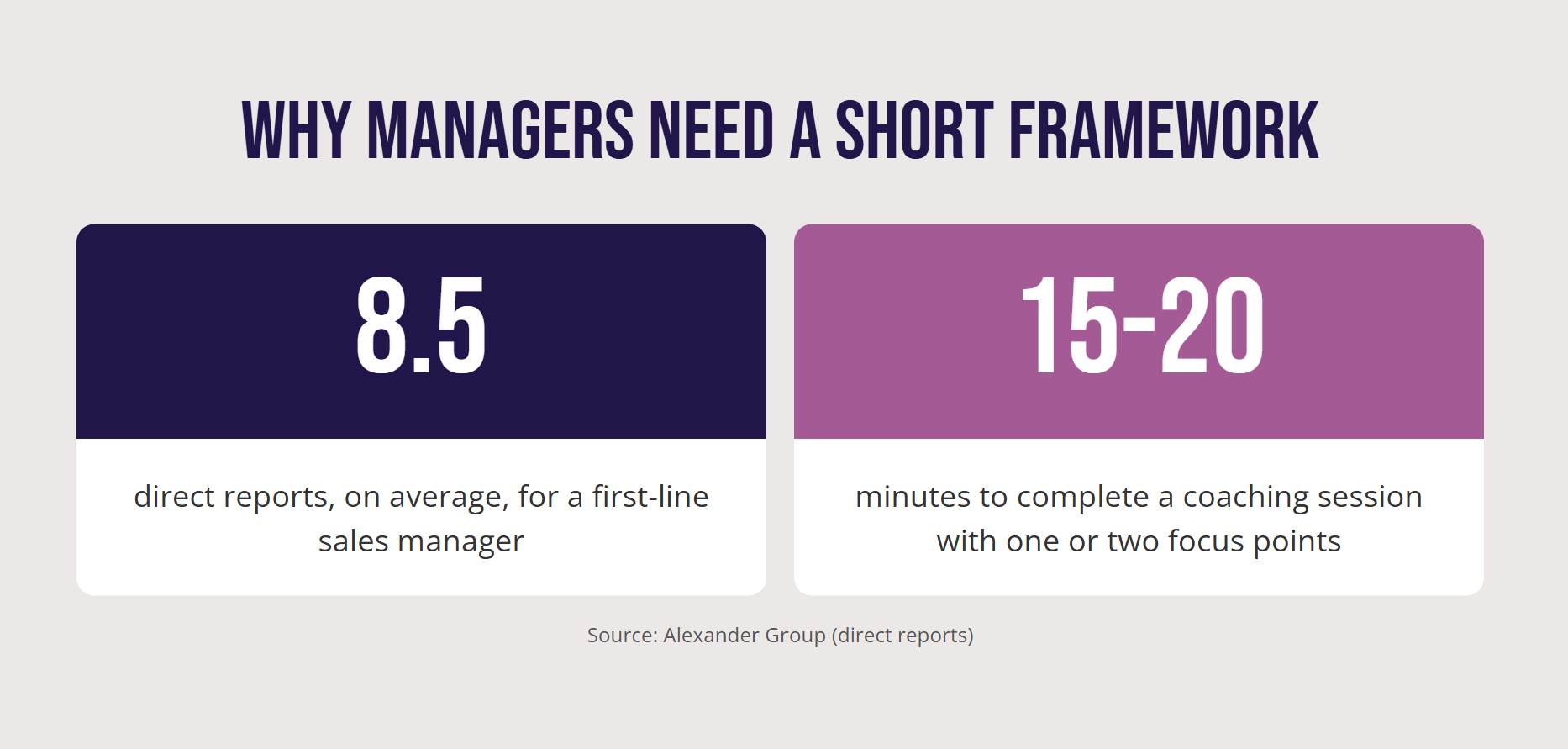
Change is the one constant in selling, and agility is the skill that helps sales managers meet it. A manager who adapts to change leads any team through any market, and does it efficiently. Efficiency matters because first-line sales managers have an average of about eight and a half direct reports, according to the Alexander Group. Every added direct report brings more information to interpret from enablement platforms, knowledge management systems, business development applications, conversational intelligence, data analytics, and artificial intelligence.
Key Takeaways
- An effective sales coaching framework gives managers one simple, repeatable cycle: Prepare – Engage – Advance.
- Each coaching session stays short, with one or two priority focus points.
- Sellers find the underlying issue themselves and commit to their own next steps.
Why do sales managers need an efficient coaching framework?
Managers with larger teams can't coach every seller on every issue. They need a coaching methodology that is dynamic and relevant to what's happening in the field at any time. It also needs to rest on behavioural psychology principles, so it works with a range of personalities.
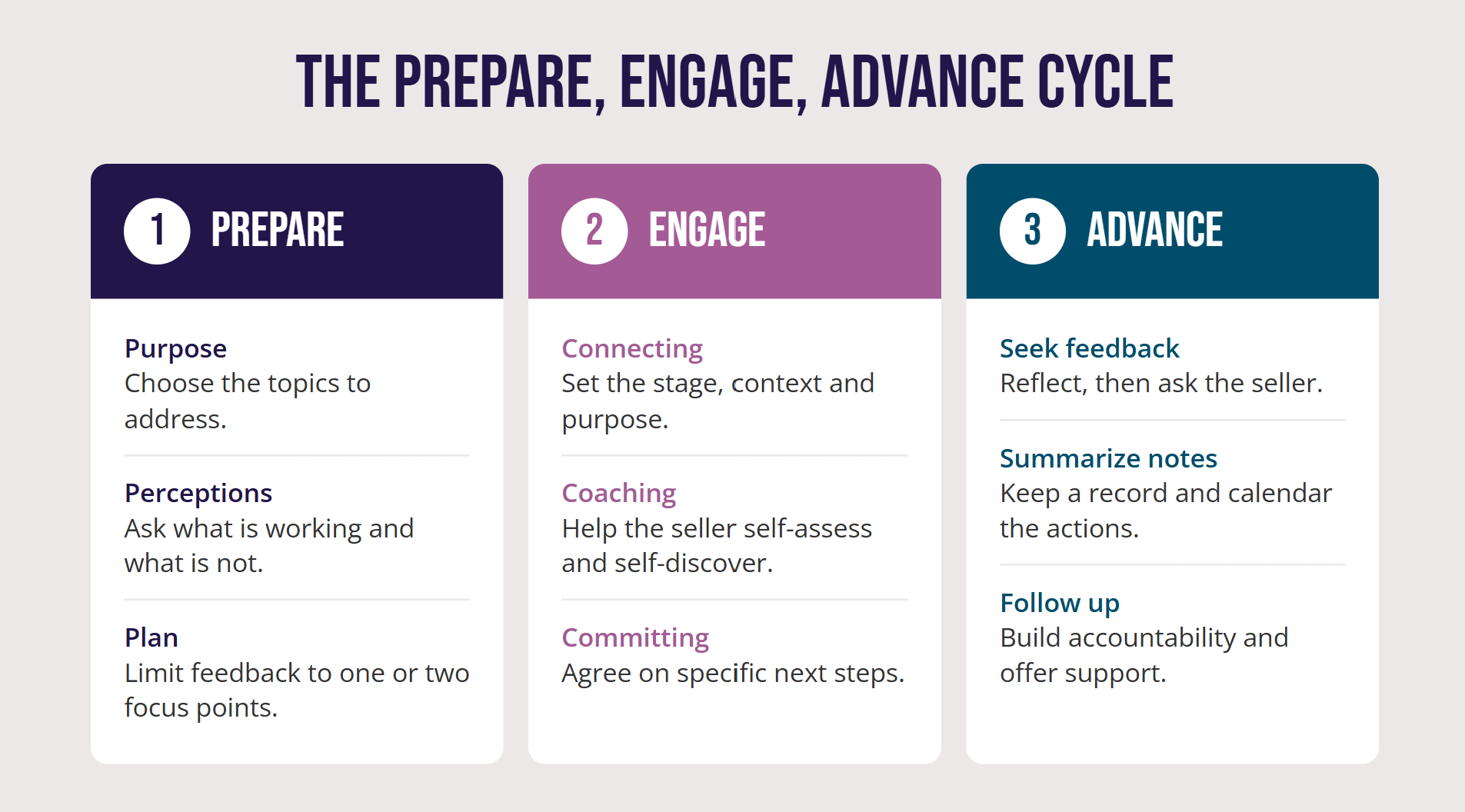
Richardson teaches this as a cycle of Prepare – Engage – Advance. Here is how each part works and why it matters.
How do sales managers prepare for a coaching conversation?
Preparation is both an act and a mindset. It happens in three parts: purpose, perceptions, and plan.
Know your purpose
Start by identifying the topics the conversation should address. Review notes from prior meetings with the seller and look at all relevant data. If possible, observe the seller's customer conversations, which reveal further opportunities for coaching and development.
Know your perceptions
Ask yourself four questions about the seller:
- What's working, and what isn't?
- What is the desired outcome?
- What is preventing this outcome?
- What needs to be done?
Sellers should prepare their own answers to the same questions.
Know your plan
Think through the questions you will ask and anticipate the seller's assessment and reactions. This forethought keeps the conversation focused and concise. Limit feedback to one or two priority focus points so you can complete a coaching session within 15 to 20 minutes.
How should a sales coaching conversation run?
Engagement is where a manager creates real change in the seller, and where agility comes into play. It has three parts: connecting, coaching, and committing.
Connecting
Connecting sets the stage, the context, and the purpose of the conversation.
- Stage: Establish a safe, collaborative setting. Build rapport and state your intention to support.
- Context: Summarise what led to the discussion and recap prior conversations and commitments, which reinforces accountability.
- Purpose: Review the agenda and check for feedback.
The best coaches use neutral language to manage emotions and show that they intend to support, not judge.
Coaching
Coaching is a collaborative process that helps sellers self-assess and self-discover ways to improve. It happens across three steps:
- The seller discusses how they're progressing against their goals and where challenges remain.
- The manager and seller work together to uncover the underlying issue affecting performance.
- The two list a few ideas for addressing the issue, then choose the best one.
Richardson's Consultative Sales Coaching Model follows the same logic: Assess – Analyse – Address.
Committing
Committing means agreeing on specific behaviours and actions that will strengthen the seller's performance. It works best when the seller names the next steps. That also gives the seller a greater sense of self-efficacy, and research on self-efficacy shows that people with high self-efficacy tend to recover more quickly from setbacks and stay committed to their goals. Finish by scheduling a follow-up and reinforcing your support.
"When you put those behaviors into practice — questioning and listening, having facilitated sessions with coaches that actually get in there and can coach them along the way — our teams are better able to actually apply some of those behaviors in the moment with their customers." — Amber Boll, Director, Sales Global Process Owner, Rich Products Corporation
How do sales managers keep coaching moving forward?
Advancing is a set of best practices that keeps managers and sellers learning as performance improves. It means seeking feedback, summarising notes, and following up.
Seek feedback
Start with your own reflection: what did you do well, and where could you do things differently? Then ask sellers for their feedback. Any overlap between your self-reflection and their comments marks an important area of focus.
Summarise notes
Keep a record of each discussion for continuity, and put agreed-upon action steps in your calendar. Effective coaching is a long game. Other internal initiatives, market trends, and quarterly goals pull attention away, and a written record keeps you and the seller anchored to a plan.
Follow up
Follow-up builds accountability. When sellers know you will follow up, they follow through. It also lets you reinforce your commitment and offer praise and support. The goal is for the seller to see you as a constant, supportive presence rather than a manager looking for faults.
This fits with Social Interdependence Theory, which holds that positive interdependence exists when people see their own goals as linked to others' success.
"I'm a team of one, so I'm not everywhere. Our managers may not have the capacity to do a lot of that coaching. I think with this system, it now allows us to be places that we can't be." — Darnetta Daire, Sales Enablement Manager, Hollister Incorporated