What Should Be on an Opportunity Review Checklist for a B2B Sales Deal?
Sales performance improvement

Written by: Claire Imber, Director of Content Strategy & Thought Leadership
Published: November 13, 2026
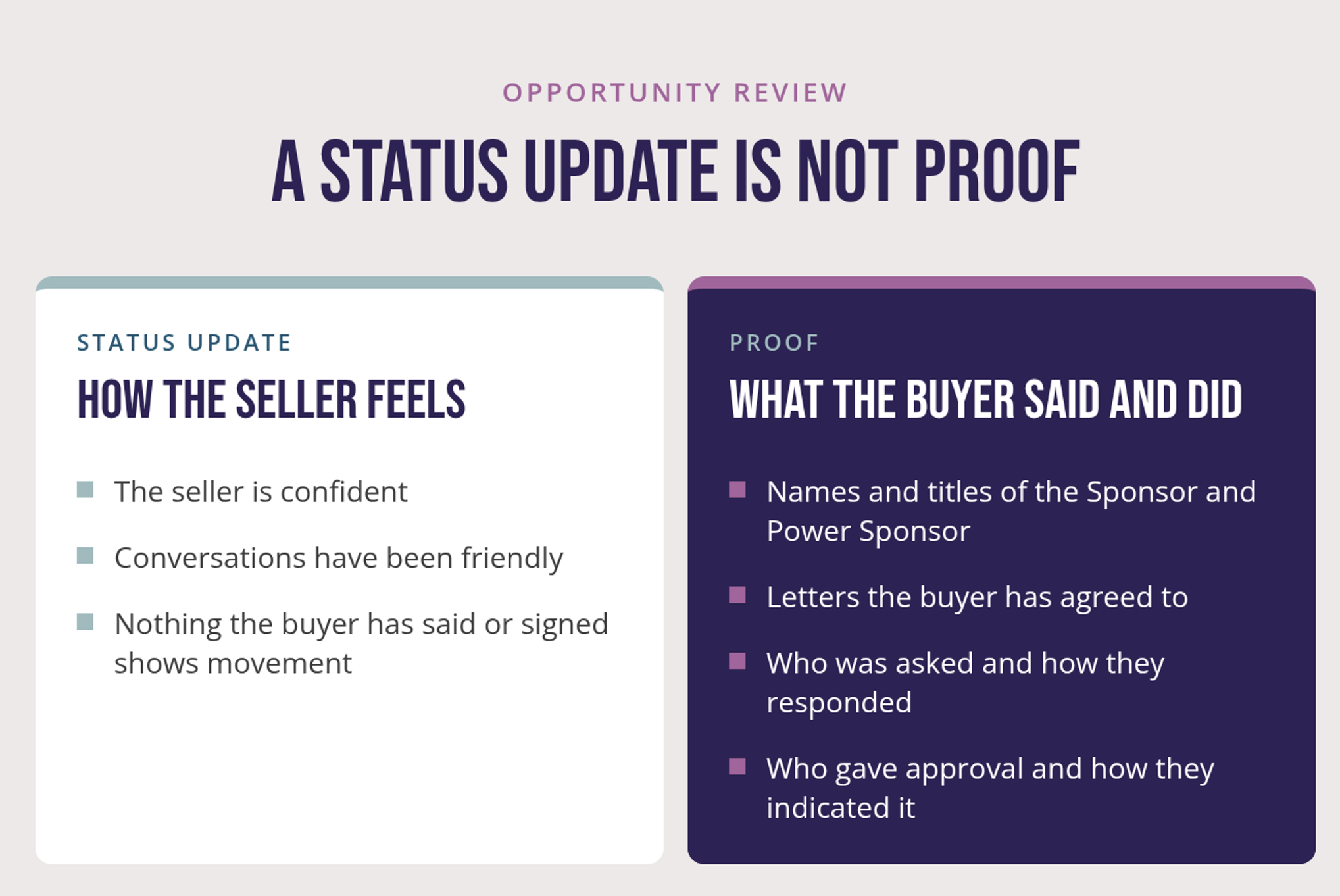
Every pipeline has a deal that feels certain. The seller is confident and the conversations have been friendly, but nothing the buyer has said or signed shows the deal is moving. A good opportunity review replaces that feeling with evidence. The checklist below shows what to look for at each stage, from the first plan to the signed agreement.
Key Takeaways
- A strong opportunity review checklist ties each sales stage to specific seller actions.
- Each stage also names a proof point you can verify, such as a named sponsor, an agreed Collaboration Plan, verbal approval, or agreed terms.
- The review then rests on evidence, not on a seller's opinion of the deal.
What does an opportunity review checklist cover?
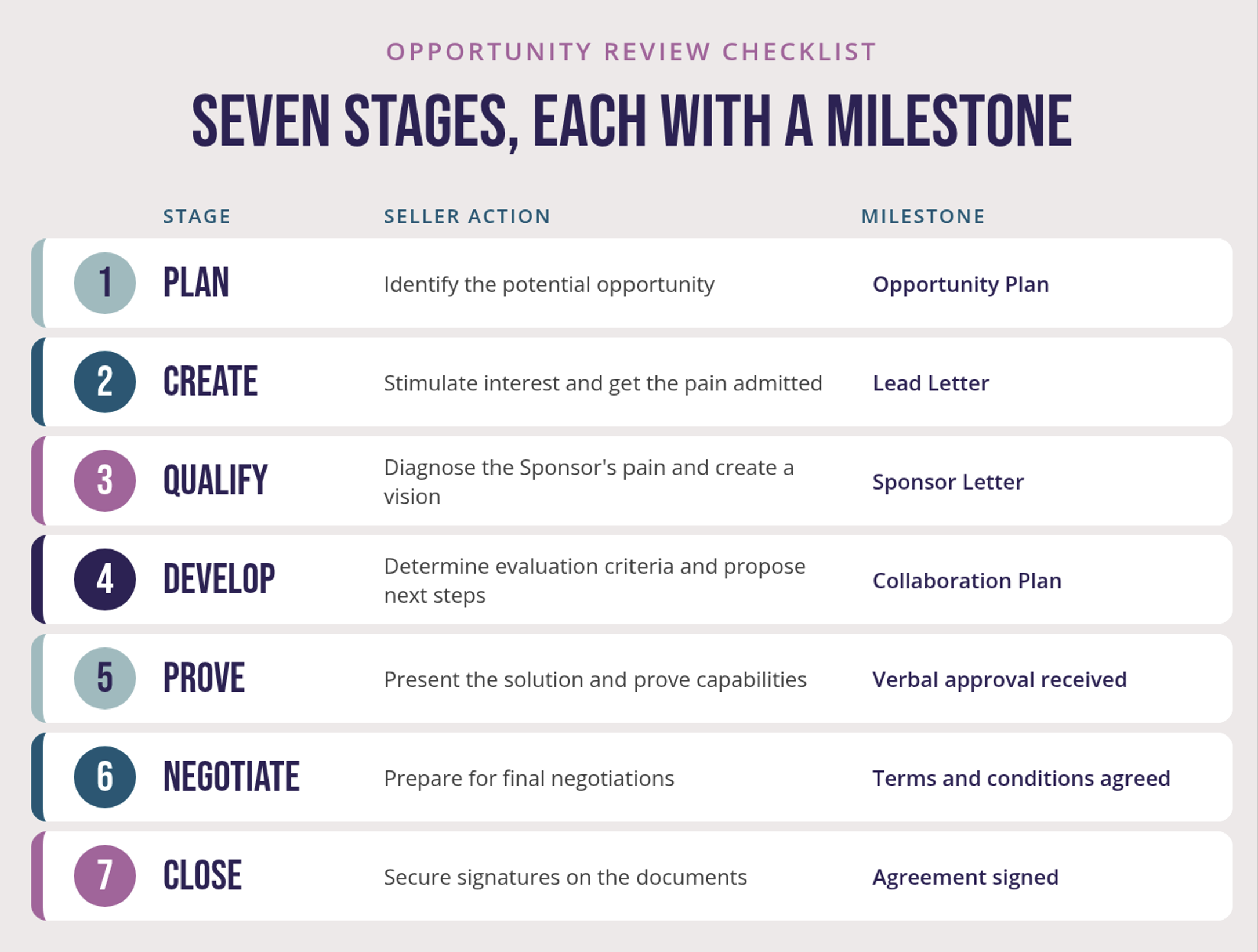
It covers the full path from first idea to signed agreement. The version below follows seven stages: Plan, Create, Qualify, Develop, Prove, Negotiate, and Close. Each stage lists what the seller does, the proof to confirm, and the milestone that marks the stage complete.
What should you check at each stage?
Plan
Seller action: Identify the potential opportunity.
Proof to confirm: The completed Opportunity Assessment supports the competitive strategy.
Milestone: Opportunity Plan.
Create
Seller actions: Identify the potential beneficiary, stimulate interest, get the pain or problem admitted, and confirm the dialogue and agree upon next steps.
Proof to confirm:
- The name and title of the potential beneficiary.
- The business development approach, determined and executed.
- Pain articulated by the beneficiary.
- A Lead Letter sent, with its content agreed upon.
Milestone: Lead Letter — a recap of initial interest and issues.
Qualify
Seller actions: Diagnose the admitted pain or problem of the Sponsor. Create, enhance, or reengineer the vision with the Sponsor. Gain agreement to explore further. Negotiate access to Power, if required. Confirm the dialogue and agree upon next steps.
Proof to confirm:
- Pain or problem articulated by the potential Sponsor.
- A differentiated vision and value, articulated by the Sponsor.
- The Power Sponsor's name and title.
- A Sponsor Letter sent, with its content agreed upon.
Milestone: Sponsor Letter — a recap of the problem, the solution, and the next steps.
Develop
Seller actions: Diagnose the admitted pain or problem of the Power Sponsor. Create, enhance, or reengineer the vision for the Power Sponsor. Gain agreement to explore further. Determine the evaluation criteria. Propose a plan of next steps. Confirm the dialogue and agree upon the plan of next steps.
Proof to confirm:
- Pain or problem articulated by the potential Power Sponsor.
- A differentiated vision and value, articulated by the Power Sponsor.
- A Power Sponsor Letter and draft Collaboration Plan sent.
- The Collaboration Plan modified or agreed upon.
Milestone: Collaboration Plan — the agreed upon steps to realise the solution.
Prove
Seller actions: Begin execution of the Collaboration Plan. Present the potential solution and value. Prove capabilities (operational, technical, and financial). Conduct a review of the proposal. Ask for the business. Issue a proposal, if required. Receive verbal approval.
Proof to confirm:
- Each step accomplished (a Go/No Go Step Letter).
- The value proposition agreed upon.
- The audience, date, and time of the pre-proposal review.
- Who was asked, and what their response was.
- Who gave approval, and what their indication was.
Milestone: Verbal approval received.
Negotiate
Seller actions: Prepare for final negotiations and reach final agreement.
Proof to confirm:
- A Negotiating Worksheet and Get-Give List.
- Who agreed, and what was agreed upon.
Milestone: Terms and conditions agreed upon.
Close
Seller action: Secure signatures on the necessary documents.
Milestone: Agreement signed.
Why does the checklist ask for proof instead of a status update?
A status update tells you how the seller feels about the deal. Proof tells you what the buyer has said and done. That is why the checklist asks who was asked, what they said in response, and who gave approval and how they indicated it. It also asks for names and titles, and for letters the buyer has agreed to. Those answers show whether a deal has earned the next stage.
Richardson's Opportunity Vitals — Pain, Power, Vision, Value, and Consensus — take the same approach. They are an objective set of criteria that anchors selling activity to facts, not assumptions.
Does every sales process look like this?
No. This checklist reflects a generalised sales process, and your own process steps will differ. The approach still applies. Name the actions for each stage, name the proof that confirms them, and review the deal against both.
How do you use the checklist in a deal review?
Work through the deal stage by stage and ask for the proof behind each item. Wherever the proof is missing, that gap becomes the seller's next step. A deal with a named Power Sponsor, an agreed Collaboration Plan, and a clear record of who approved what is ready for the next stage. A deal without them still has work to do, and the checklist shows exactly where.
Richardson's Sprint Selling methodology pairs the Opportunity Vitals with Opportunity Health, a way to measure the strength of each vital.