How to Become a Trusted Advisor to B2B Buyers
Sales performance improvement

Written by: Ben Taylor, MBA, Content Marketing Manager, Richardson
Published: November 11, 2026
“The hardest thing about B2B selling today is that customers don’t need you the way they used to.”
That is the first sentence of “The End of Solution Sales,” an article about the changing environment in business-to-business (B2B) sales that appeared in the July 2012 issue of Harvard Business Review. Today, well over a decade later, those words still ring true.
Key Takeaways
- You earn trusted advisor status, and only the buyer decides whether you have it.
- You earn it by bringing buyers new insights, shaping opportunities, and looking out for their best interests.
- Preparation around the buyer’s business goals and personal needs gives you something worth saying.
- Buyers who ask for your advice and opinions are confirming your status.
Why don’t buyers need sellers the way they used to?
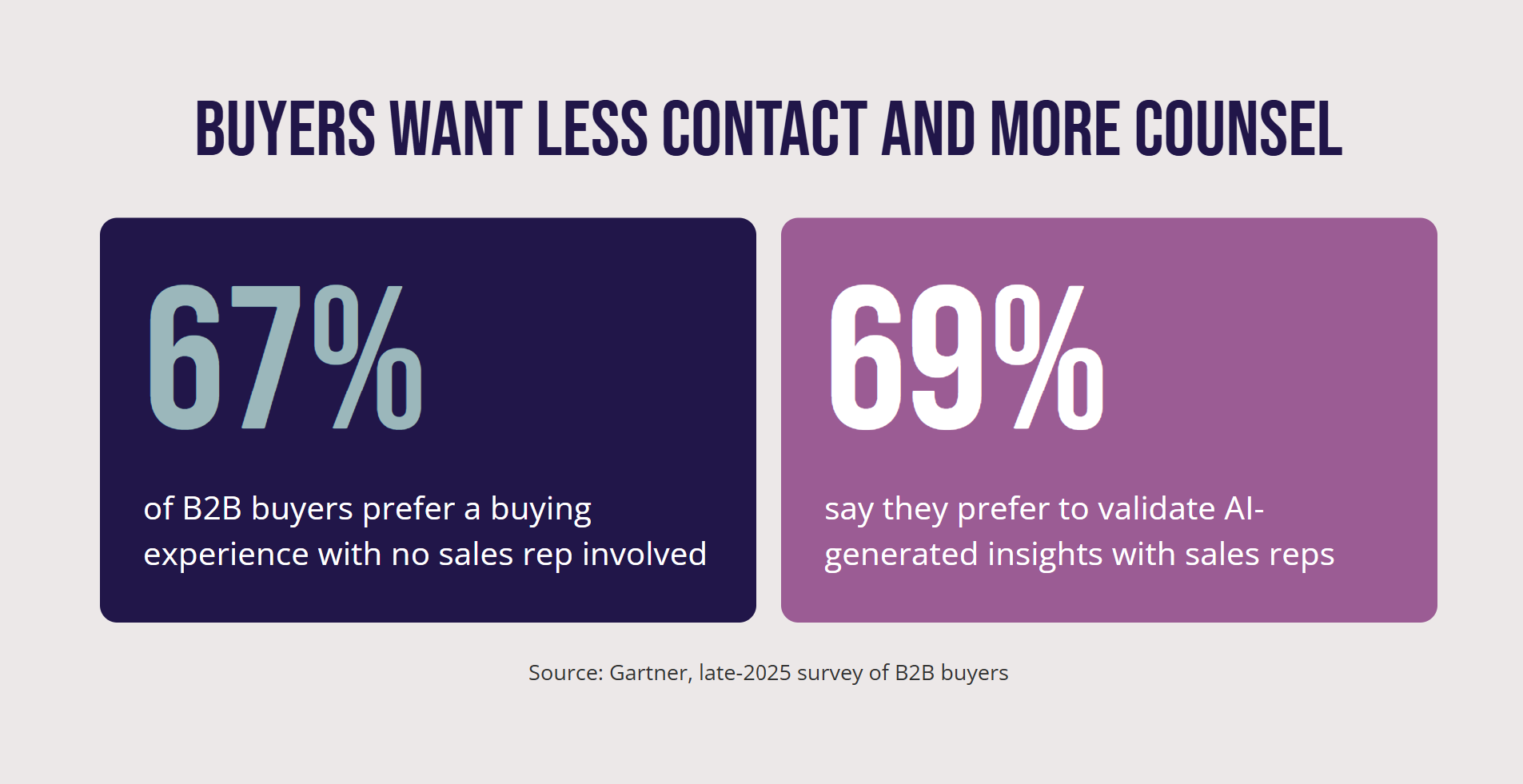
The internet has radically altered buyer behaviour, and the shift continues. In a late-2025 survey, Gartner found that 67% of B2B buyers prefer a buying experience with no sales rep involved. Yet 69% say they prefer to validate AI-generated insights with sales reps. Buyers do less of their research with sellers, and they still look for someone they trust to make sense of it.
The buying process itself also now typically has more decision makers, often a committee that must reach consensus, instead of a single contact. That adds delays, which means slower pipeline velocity, more stalled deals, and even the dreaded “no decision.” Only transactional sellers in a transactional business, and sellers who become trusted advisors, have the ear of the right buyers and can move deals through the pipeline effectively.
The same flood of information also creates an opportunity. There is so much information out there that buyers sorely need someone to provide perspective and guidance at critical points in the business cycle.
How do you earn a seat at the table?
Trusted advisor status can’t be claimed. You have to earn it — and the only opinion that matters is the buyer’s. Five behaviours help sellers differentiate themselves and earn a seat where decisions are made:
- Be proactive. Don’t just react to RFPs. Bring buyers new insights and good ideas.
- Shape opportunities. Don’t wait for buyers to hand you specs.
- Look out for the buyer’s best interests. Build a reputation for knowledgeable, workable solutions that add value.
- Be more consultative than transactional. This helps even in a transactional environment.
- Balance the pendulum swing in the sales process. Know when to ask questions and when to provide insights.
Buyers notice. In a recent meeting, one buyer told us: “You seem to really understand what I’m trying to accomplish. I’m taking a risk in doing training because we’re not really buying training, we’re trying to buy results. We want to move our business forward, and I see that you get that.”
Veolia Watertech’s Nick Hine, Global Commercial Learning Director, describes the same priority from the buyer’s side: the goal was to “go above excellent training and actually deliver measurable and defined commercial results.”
Questions are another signal. Buyers bounce ideas off us. They ask for our views on industry matters and about our competitors. They ask whether their competitors are experiencing similar issues and how we’re solving them. They see us as a credible resource — a kind of clearinghouse for best-practice information.
Emerson’s Stacy Keeling, Director, Commercial Excellence and Lifecycle Services, puts it this way: “We chose to partner with Richardson because they take the time to understand our business, navigate the complexities of a global organisation, and consistently deliver best-in-class support.”
When buyers turn to you for advice and counsel, it confirms your status as a trusted advisor. From there, you soon find yourself at the table as part of the buying process, shaping opportunities instead of reacting to them alongside a crowd of competitors.
How should you prepare to meet a buyer?
Few things are more important than preparation. How well you prepare can immediately differentiate you from the competition. Focus on three areas:
- Strategic impact: What business goals and objectives is the buyer supporting with this purchase?
- Buyer needs: What’s important to the buyer on both a business and personal level?
- Technical preparation: Do you have a thorough knowledge of the product or service you’re selling?
Preparing in these ways earns you that elusive second meeting, especially at the executive level. If you don’t ask the right questions, and if you can’t tell executives something they don’t already know, why should they buy from you?
Focus, too, on leading indicators of success, not lagging ones. Doing so adds relevancy to the conversation. At Richardson Sales Performance, we talk about four value lenses for presenting those leading indicators — and yourself — to buyers:
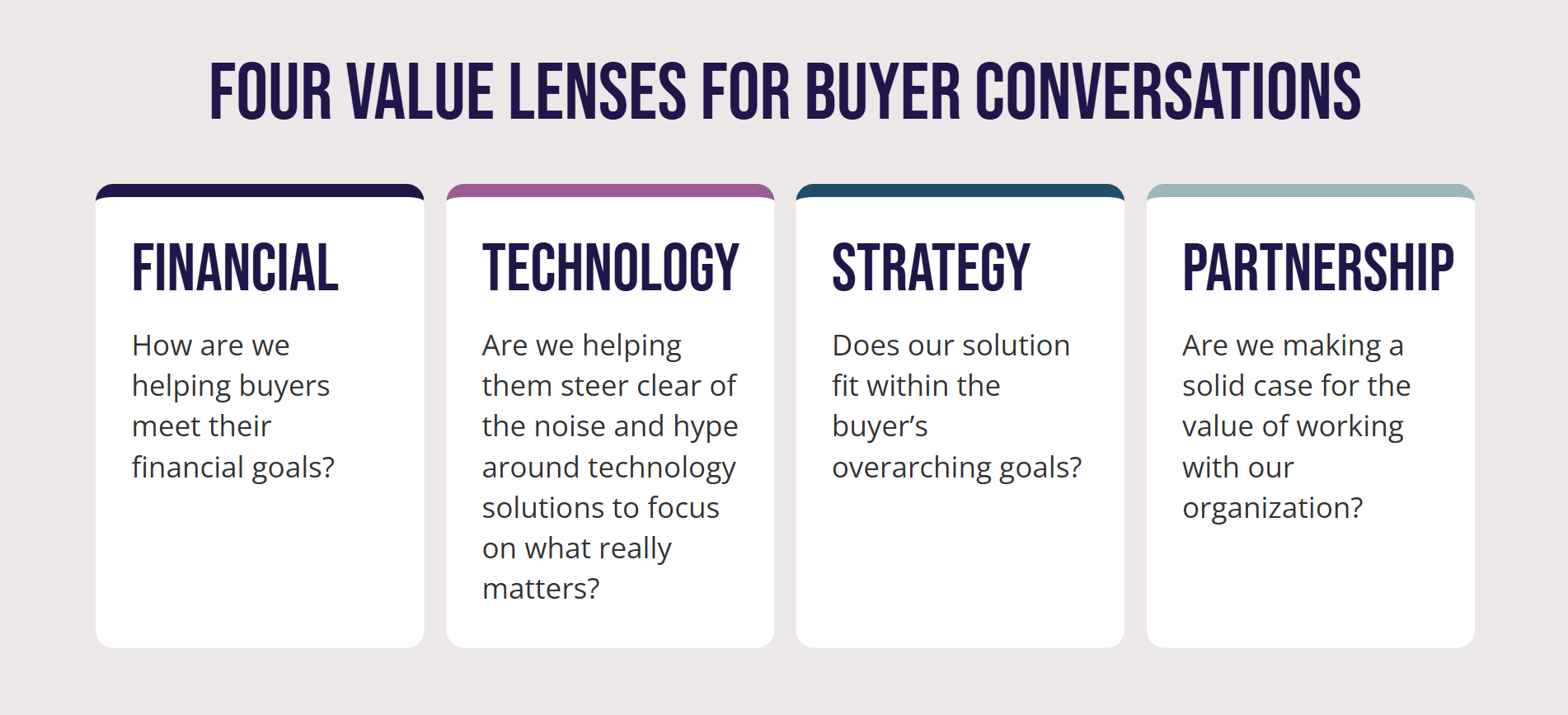
| Value lens | The question to ask |
|---|---|
| Financial | How are we helping buyers meet their financial goals? |
| Technology | Are we helping them steer clear of the noise and hype around technology solutions to focus on what really matters? |
| Strategy | Does our solution fit within the buyer’s overarching goals? |
| Partnership | Are we making a solid case for the value of working with our organisation? |
In our sales training programme, we address these value lenses by giving sales professionals a practical framework and the tools to think in depth about the behaviours needed to become a trusted advisor. Leading indicators are also the measure of how likely you are to close a deal instead of watching it stall in the pipeline.
How can you tell if you’re a trusted advisor — or not?
Earning the trust of B2B buyers has become increasingly hard in today’s information-rich, instant-search culture, and many sellers haven’t yet reached trusted advisor status. Here is how to tell where you stand.
You’re likely a trusted advisor if:
- Your clients continually ask your opinion on industry matters, not just the product or service you’re selling.
- You’re brought into the decision-making process in advance of an RFP.
- Your contact introduces you to the boss and to the project committee.
You’re likely not yet a trusted advisor if:
- The buyer introduces you as “just the sales guy.”
- Initial discussions with the buyer focus on price.
- The extras you bring your clients are donuts instead of market insights.
What should you keep in mind as you build your advisor role?
Being a trusted advisor begins with integrity, and it also requires skill and strategy, which can be learned and practised.
Buyers who are looking for additional insights and a consultative approach will find them somewhere. When they find them in you, you’re at the table, shaping the opportunity. When they don’t, you’re soon on the outside looking in as others rush in with their insights and consultation.
The most important thing to remember is to focus on the end game for the business you’re trying to win. Always keep in mind what is important to the buyer, not what is important to you, the seller.