Customized Sales Training: Why Relevance Drives Seller Performance
Sales enablement

Published: May 11, 2026
What is Customized Sales Training?
Customized sales training is a learning approach that adapts sales skills, messaging, examples, role plays, and reinforcement to the seller’s real-world environment. Rather than relying on generic scenarios, customized training reflects the organization’s products, customer challenges, industry language, deal dynamics, and buyer expectations so sellers can apply new behaviors in live opportunities.
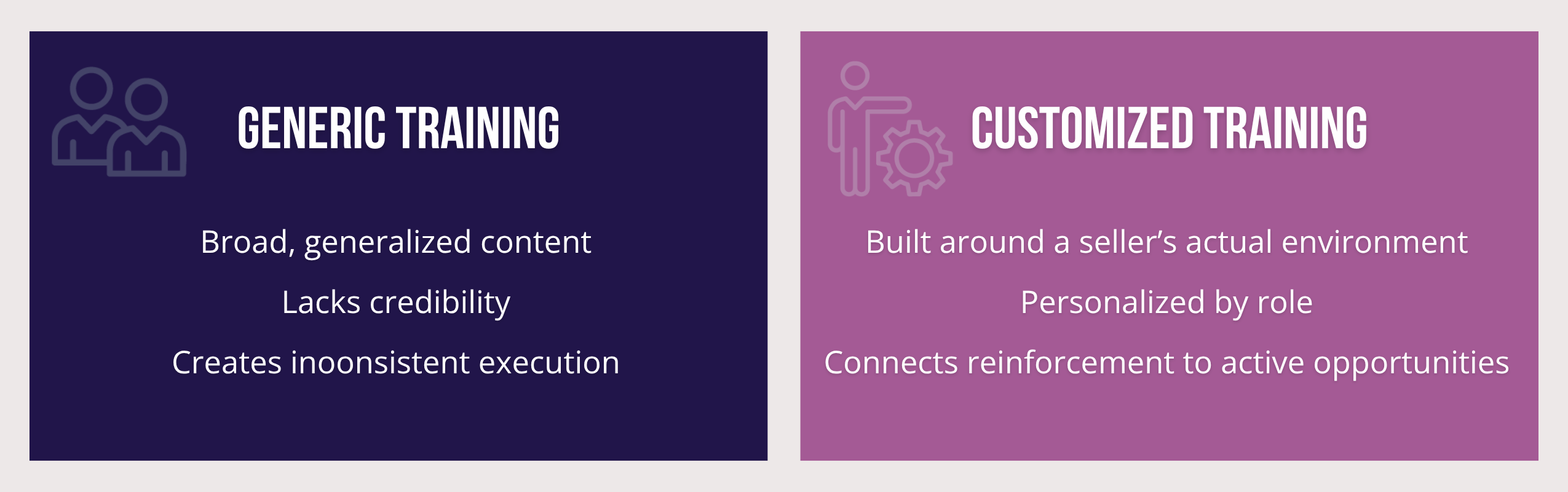
Generic sales training often fails because sellers struggle to connect broad concepts to the specific customers, conversations, and business problems they face every day. When training feels disconnected from reality, sellers disengage, behavior change stalls, and buyers lose confidence in the seller’s ability to create relevant value.
Keep reading to learn how customization improves seller adoption and what sales leaders can do to build training that translates into measurable performance.
Complete the form below to download the brief, "The Power of Customization in Sales Training" to see how customized sales training helps sellers apply skills faster, build buyer confidence, and drive stronger results.
Why Generic Sales Training Fails
Many sales training programmes are designed to reach the largest possible audience. The content is broad, the examples are generalised, and the scenarios are built to apply across industries, roles, and customer types. But when training applies to everyone, it often feels relevant to no one.
Sellers need to see themselves, their customers, and their real sales challenges reflected in the learning experience. If they do not, engagement drops. More importantly, application drops. Sellers may understand the framework in theory, but they struggle to use it when the conversation becomes complex, the buyer’s needs are specific, or the stakes are high.
This is why customisation matters. Sales training must connect directly to the realities sellers face in the field, including the language their customers use, the business problems buyers are trying to solve, and the value messages that differentiate the seller’s solution. Training becomes effective when it mirrors the seller’s real environment, including their products, services, messaging, and selling scenarios.
Generic training lacks credibility
Sellers instinctively evaluate whether training will work in their world. If the examples feel too generic, if the language does not match how customers speak, or if the scenarios fail to reflect the complexity of real opportunities, the training loses credibility.
When learning lacks credibility, sellers are less likely to use it. They may complete the training, participate in the activities, and understand the concepts, but the behaviors do not transfer into customer conversations.
This creates a common problem for sales leaders: strong participation in training, but limited behavior change.
Generic training creates inconsistent execution
When training is not customised, sellers are left to do the translation work themselves. More experienced sellers may adapt the content on their own, applying the concepts to their market, customers, and opportunities. Newer sellers may struggle to make that leap.
The result is uneven execution across teams, regions, and roles. Some sellers apply the training effectively. Others default to old habits. Ramp time slows, coaching becomes harder, and the organisation sees less return from its training investment.
Why Customisation Matters More in Today’s Buying Environment
Today’s buyers expect sellers to understand their industry, speak their language, and connect solutions to measurable business outcomes. They are not looking for product information alone. They are looking for perspective, relevance, and confidence.
That expectation is rising as buying groups become more cautious, complex, and self-directed. Buyers have more access to information than ever before, and many are willing to move forward without engaging a seller if the seller does not create value in the conversation.
This makes relevance a competitive advantage. A seller who can connect their solution to the buyer’s specific challenges is more likely to earn trust, create urgency, and move the opportunity forward. A seller who relies on generic messaging risks sounding interchangeable.
Customised sales training helps close this gap by preparing sellers for the actual conversations they need to have. It gives them the language, practice, and confidence to connect skills to real buyer needs.

How Customised Sales Training Improves Performance
Organisations that generate meaningful results from sales training do not start with content. They start with context.
Customised sales training is built around the seller’s actual environment. It reflects the industries they sell into, the customer types they engage, the solutions they represent, and the deal dynamics they navigate. This makes the training more relevant, more credible, and easier to apply.
Effective customisation often includes:
- Aligning training to specific industries and customer segments
- Using real-world messaging and positioning
- Creating practice scenarios that reflect actual deal dynamics
- Connecting reinforcement to active opportunities
- Equipping managers to coach against real selling situations
- Adapting examples to the seller’s products, services, and buyer personas
When learning feels familiar, sellers can apply it faster. They do not have to spend time translating abstract concepts into practical actions. Instead, they practice the conversations, questions, objections, and value messages they will use with customers.
Key takeaway: Sellers are more likely to invest in training when they see that the training has been built for them.
Example: Where Generic Sales Training Breaks Down
Consider a medical device seller preparing for a high-value conversation with a physician. The seller recently completed training. They understand the framework, remember the key concepts, and know the steps they are supposed to follow.
But as they prepare for the meeting, hesitation sets in.
The examples they practiced do not quite match the customer. The terminology feels slightly off. The stakes feel higher than anything they simulated. The skills they learned seem useful in theory, but broad and unfocused in the moment.
Instead of applying the new approach, the seller defaults to what they already know. They talk about product features and clinical benefits, but they miss the opportunity to connect the solution to the physician’s specific challenges, patient scenarios, and operating environment.
The problem is not that the seller lacks effort. The problem is that the training did not prepare them for the reality of the conversation.
With a customised approach, sellers receive practice with physician-specific scenarios, relevant terminology, common objections, clinical priorities, and business outcomes. It helps the seller move from product explanation to meaningful customer relevance.
That shift matters because buyers are looking for trusted advisors, not just solution providers.
What Should Be Customised in a Sales Training Programme?
Customisation does not mean rebuilding every element of training from scratch. It means adapting the right elements so the learning experience reflects the seller’s world.
Sales leaders should consider customising the following areas:
Industry context
Training should reflect the industries sellers serve, including market pressures, business trends, regulatory considerations, and common customer priorities.
Buyer personas
Different stakeholders care about different outcomes. Customised training should help sellers understand the needs, concerns, and decision criteria of each buyer role.
Customer challenges
Sellers need to practice connecting their solution to the problems buyers are actually trying to solve. This requires training scenarios that reflect current customer needs.
Product and solution messaging
Sales training should include the organisation’s real messaging, value proposition, differentiators, and proof points so sellers can use them naturally in conversation.
Sales process and methodology
Customisation should connect skills to the organisation’s sales process, opportunity stages, qualification criteria, and internal language.
Role-play and practice scenarios
Practice should mirror actual deal dynamics. This includes realistic buyer objections, competitive pressures, stakeholder complexity, and urgency gaps.
Coaching and reinforcement
Managers need tools that help them reinforce the same customised behaviors in the field. Coaching guides, opportunity reviews, and reinforcement exercises should all connect to real selling situations.
Active opportunities
The strongest training helps sellers apply new skills to deals they are currently pursuing. This closes the gap between learning and execution.

How Sales Leaders Can Build More Relevant Training
Sales leaders who want better results from training should treat customisation as a performance lever, not a cosmetic enhancement. The goal is not simply to make training feel more familiar. The goal is to help sellers apply new skills in the moments that matter most.
Design for relevance, not just reach
Training should reflect the specific realities of different roles, industries, and customer segments. Broad training may be efficient to deliver, but relevance determines whether sellers use it.
Sales leaders should ask:
- Does this training reflect the customers our sellers actually engage?
- Does it use the language our buyers use?
- Does it address the business challenges our sellers need to solve?
- Does it help sellers apply skills to current opportunities?
Build credibility through context
Sellers respect training that respects their reality. When examples, scenarios, and practice exercises feel authentic, sellers are more likely to engage.
Credibility comes from specificity. A generic objection-handling exercise is useful. An objection-handling exercise based on a real buyer concern in the seller’s industry is better.
Close the gap between learning and execution
The closer training is to real-world application, the faster behavior change occurs. Sellers should not have to figure out how to apply the training after the session ends. Application should be built into the experience.
This can include live opportunity planning, customer conversation simulations, manager-led coaching, and post-training reinforcement tied to actual deals.
Treat customisation as a performance lever
Customisation is not a nice-to-have. It is what helps training translate into measurable outcomes.
When training reflects the seller’s real world, it becomes easier to build confidence, improve consistency, accelerate ramp time, and strengthen buyer engagement. It also gives sellers the ability to demonstrate a more granular understanding of the customer’s challenges.
That is where differentiation happens.
How to Measure Customised Sales Training Effectiveness
Sales leaders should measure customised sales training by looking beyond attendance and completion rates. Participation matters, but it does not prove behavior change.
More meaningful measures include:
- Seller adoption of new skills
- Manager observations during coaching
- Improved opportunity progression
- Higher-quality discovery conversations
- Stronger value articulation
- Faster ramp time for new sellers
- More consistent execution across teams
- Increased buyer engagement
- Improved win rates or deal quality
- Better alignment between training and active pipeline needs
The most important question is whether the training shows up in the next customer conversation. If sellers can apply the skills quickly, confidently, and consistently, the training is doing its job.
Key Takeaways
Customised sales training improves relevance by aligning learning to the seller’s real customers, products, and sales conversations.
Generic sales training often fails because sellers do not see their day-to-day challenges reflected in the content.
The most effective programmes customise industry context, buyer scenarios, messaging, role plays, coaching, and reinforcement.
Sales leaders should treat customisation as a performance lever because it helps close the gap between learning and execution.
Customised Sales Training Turns Learning into Field Performance
Effective sales training is not defined only by how efficiently it is delivered. It is defined by how easily it shows up in the next customer conversation.
When training is generic, sellers are left to make the connection on their own. When training is customised, sellers can see exactly how new skills apply to their buyers, opportunities, and business challenges.
That relevance drives confidence. Confidence drives action. And action is what turns learning into performance.
Ready to make sales training more relevant, credible, and actionable? Contact us today to learn how we can customise a programme that helps your team apply new skills where they matter most: in the field.
Frequently Asked Questions About Customised Sales Training
Q: What is customised sales training?
A: Customised sales training adapts sales skills, examples, messaging, role plays, and reinforcement to the seller’s specific industry, customer base, solution, sales process, and real-world selling environment.
Q: Why does generic sales training fail?
A: Generic sales training fails when sellers cannot connect the content to their real customer conversations. If the scenarios, language, and examples do not reflect their world, sellers are less likely to apply the training.
Q: How does customised sales training improve seller performance?
A: Customised sales training improves performance by making learning more relevant, credible, and immediately applicable. Sellers can practice the conversations they actually need to have, which helps improve confidence, adoption, and behavior change.
Q: What parts of sales training should be customised?
A: Sales training can be customised by industry, buyer role, sales process, product messaging, customer challenges, deal stage, role-play scenarios, coaching guides, and reinforcement activities.
Q: Is customised sales training only for large sales organisations?
A: No. Customised sales training can benefit any organisation that needs sellers to connect solutions to specific customer challenges, especially in complex B2B selling environments.
Q: How do you measure customised sales training effectiveness?
A: Common measures include seller adoption, manager coaching observations, improved opportunity progression, faster ramp time, higher win rates, stronger buyer engagement, and more consistent execution across teams.
Q: What is the difference between personalised and customised sales training?
A: Personalised sales training often adapts learning to an individual seller’s needs, while customised sales training adapts the broader programme to the organisation’s market, customers, solutions, and selling environment.