How to Bring a Subject Matter Expert into a Sales Meeting
Sales performance improvement

Written by: Ben Taylor, MBA, Content Marketing Manager, Richardson
Published: November 11, 2026
In a time of war, which would you choose: a soldier or a mathematician?
This question is not a riddle. It’s a reminder that sometimes complex problems require a different type of expert. That was the thinking behind the decision to form the Statistical Research Group during World War II. The group attempted to solve wartime challenges using statistical skills. One member, Abraham Wald, set out to keep more bomber planes safe from enemy destruction.
As the story is usually told, technicians would examine the exterior of bomber planes, taking note of where the bullets hit. Their solution: add armor to those areas. Wald’s approach, brilliant in its simplicity, was the entire opposite. The insight credited to Wald: put armor on the areas that didn’t have bullet holes. The reason: if planes returned safely with bullet holes in the fuselage, for example, then they could withstand damage in those areas. Analysts never took note of the bullet hole locations in downed aircraft because those planes never returned. Soon, more armor went to the non-bullet hole parts of the bomber planes. More pilots lived. Historians note that much of the detail is reconstruction, but the lesson holds.
Apparently, winning a war takes more than soldiers. Sometimes you need a mathematician on your side. Sellers, take note: occasionally you need someone on your team who isn’t in sales. Sometimes you need a subject matter expert (SME) to help push the deal through. Below, we look at how to bring SMEs into a selling team.
Key Takeaways
- Choose an SME who can communicate with customers and has the time to prepare.
- Give the SME extra practice, and let the seller lead the meeting while the SME supports.
- Debrief after every customer-facing meeting.
Why do sales teams bring SMEs into customer meetings?
Buyers do much of their research on their own, and they turn to sellers at critical moments in the journey. In a 2025 Gartner survey of 645 B2B buyers, 69% preferred to validate AI-generated insights with sales reps. Those moments often involve problems that grow in scale and complexity with each passing day, which is why an SME is integral to success.
How do you choose the right SME for the job?
Expertise alone is not enough. Though sellers need an SME for their in-depth knowledge, they must also consider how effectively the SME will communicate with the customer. The SME has a different skill set that rarely involves customer-facing activities.
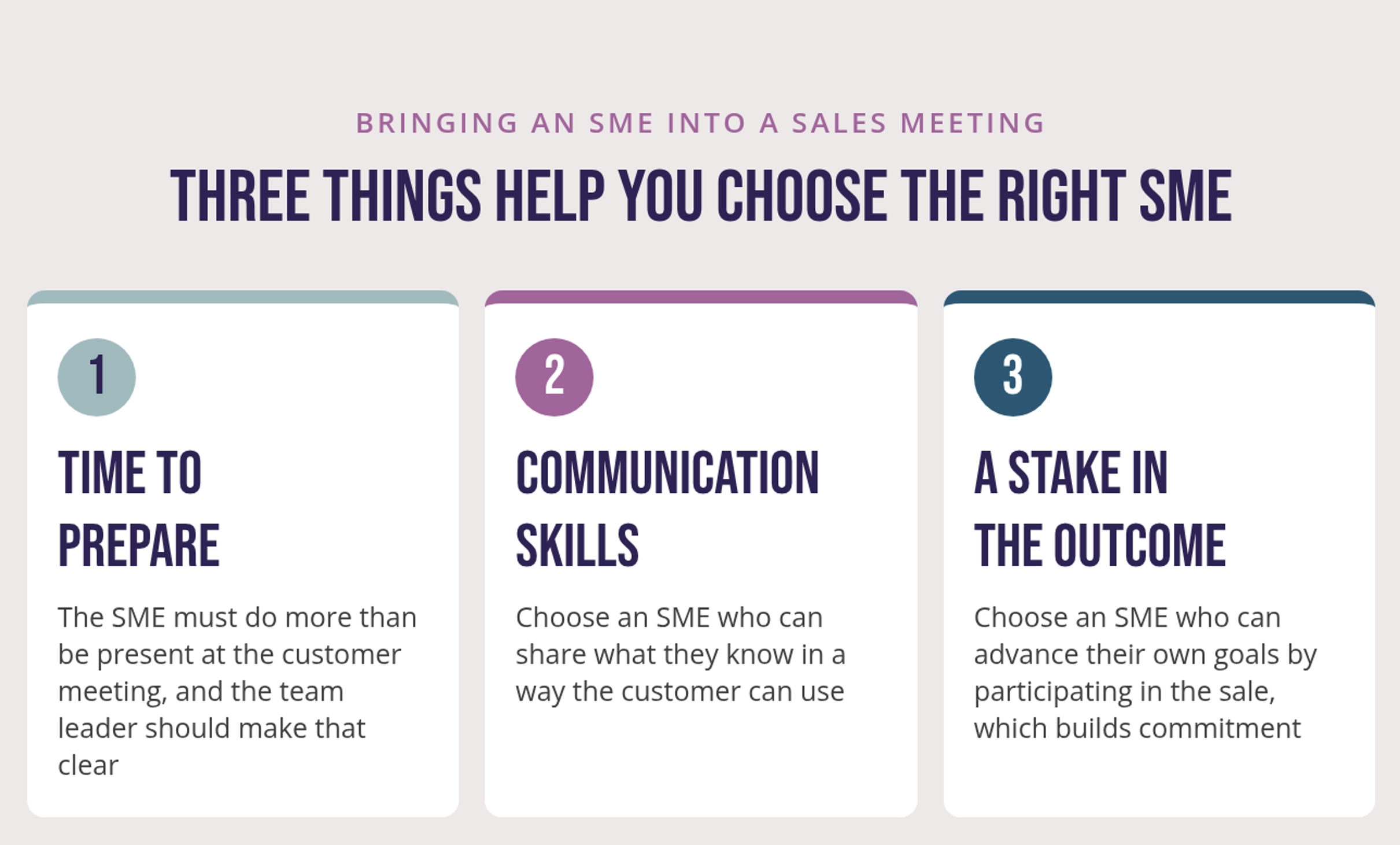
Three things help:
- Time and willingness to prepare. This preparation drives success. The sales team leader must make it clear that if the SME agrees to help, they’ll need to do more than be present at the customer meeting.
- Communication skills. Choose an SME who can share what they know in a way the customer can use.
- A stake in the outcome. Choose an SME who can advance their goals by participating in the sale. That stake builds their commitment.
How much extra prep time does an SME need?
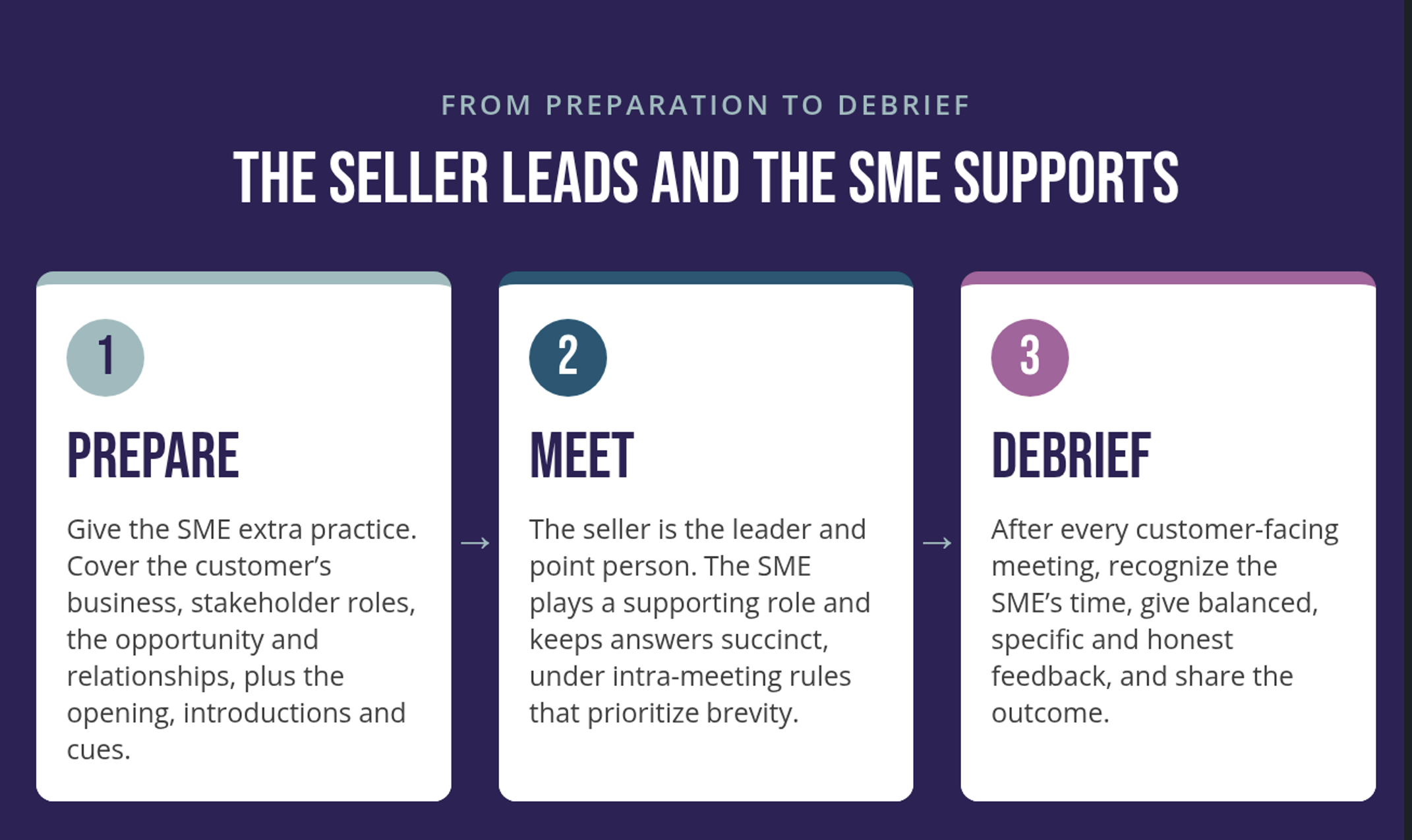
An SME’s involvement will change the preparation timeline. That is, SMEs will need more practice. They need to understand the customer’s business, the stakeholder roles, the opportunity, and the relationships.
Practice the opening and introductions so that the SME understands their cues and where they’ll fit into the story on the day of the presentation. This is also an opportunity for the SME to practice sharing complex information in a concise way that blends with the surrounding content provided by the other sales professionals. The goal is to tie the SME’s knowledge to the customer’s business challenges in a clear and compelling way.
Who leads the meeting, and what does the SME do?
In a sales meeting, the seller is the leader and point person, with the SME acting in a supporting role. This dynamic reverses the organisational chart. Ordinarily, the SME is the centre of attention and wellspring of insight. In a selling meeting, that flips.
Sellers need to discuss when and how the SME will contribute to the meeting. Customer questions require succinct, direct responses. However, SMEs with a wealth of knowledge feel the pull to unleash volumes of information and insights. The seller should set intra-meeting rules that prioritise brevity.
Richardson’s Team Selling Training programme is based on the book Sell Like a Team by Richardson facilitator Michael Dalis. It teaches sellers to use SMEs to build and organise selling teams that deliver more compelling presentations.
What should you expect from an SME?
An SME can be an asset to a selling team, but they’re still part of a team. The strongest SME cannot compensate for an otherwise unprepared selling team. An SME offers a specialised and focused set of skills, but winning the sale requires the team to fire on all cylinders. Too much focus on the SME will pull time away from other important parts of preparation.
It’s also important to remember that the SME rarely shares the seller’s urge to win the sale. In most cases, the reward of closing is more substantial for the seller than it is for the SME.
Why should you debrief after every meeting with an SME?
As business challenges and the solutions that they require become increasingly complex, SMEs will join more sales meetings in the future. Sellers should make a regular habit of debriefing after each customer-facing meeting.
Debriefing is a good opportunity to recognise the time that the SME has devoted to the process. It’s also the appropriate time to offer balanced, specific, and honest feedback. Even when the meeting has ended, the SME will appreciate updates on the outcome. Keep communication open.
Sellers who help focus the SME’s effectiveness outpace the competition.