What Should an Account Planning Tool Include?
Sales performance improvement

Written by: Ben Taylor, MBA, Content Marketing Manager, Richardson
Published: November 13, 2026
Focusing on existing accounts means capturing critical information, aligning with customer priorities, and delivering consistent value. To make that strategy work, sellers must first select the right customers, analyse their needs, draft an action plan, collaborate with the customer, and rise to the level of a trusted advisor.
With so many elements in play, sellers need a way to bring structure to the process. For this reason, sales teams need a strong planning tool.
Key Takeaways
- An effective account planning tool includes eight components: industry analysis, customer relationship analysis, a customer strategy map, stakeholder assessment, competitive assessment, a running question list, strategy development, and an action plan.
- Together, these components bring structure to analysing a customer's needs and turning that analysis into a strategy.
What are the eight components of an effective account planning tool?
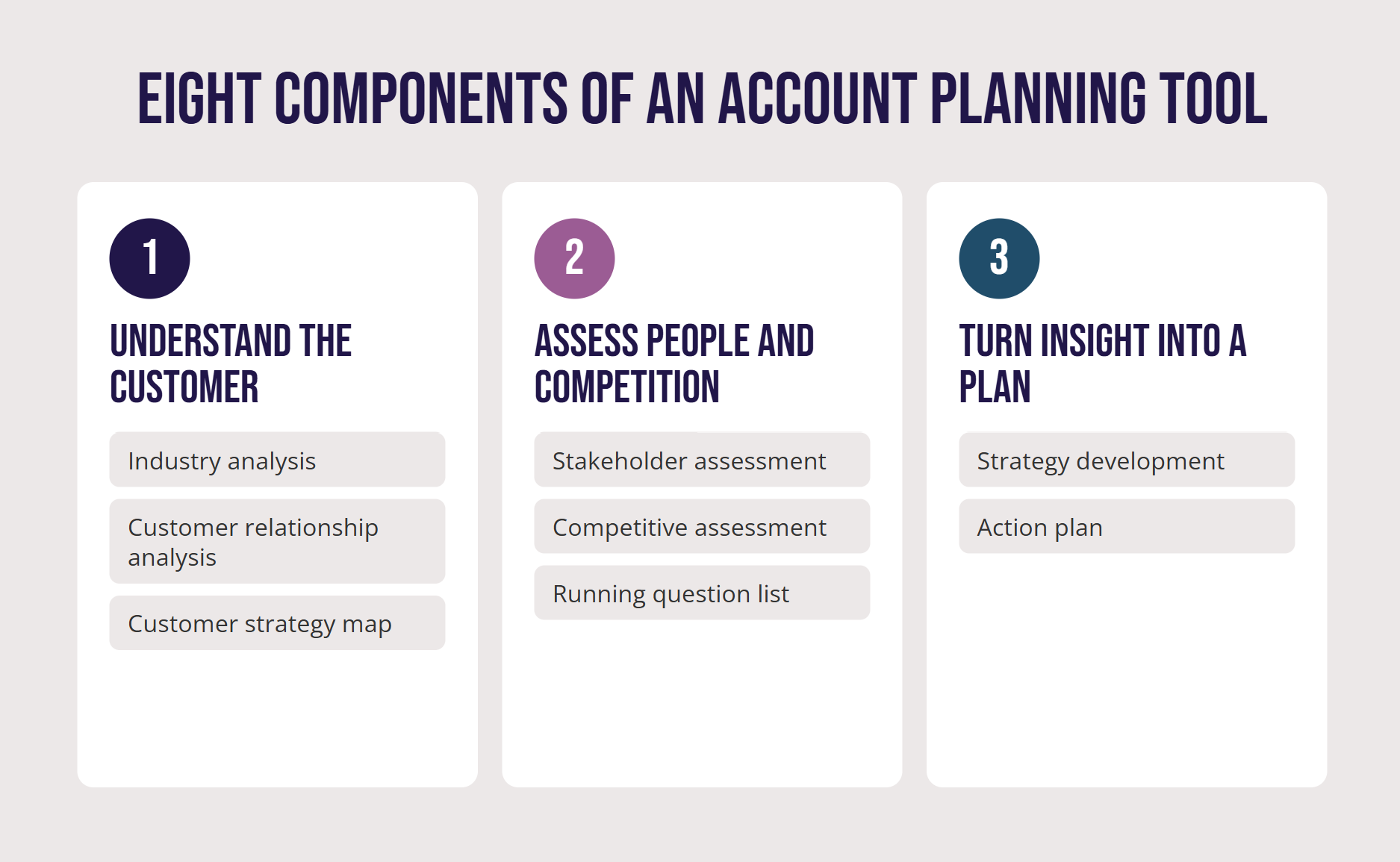
The eight components fall into three groups: understanding the customer, assessing the people and the competition, and turning what you learn into a plan.
| Group | Components |
|---|---|
| Understand the customer | Industry analysis, customer relationship analysis, customer strategy map |
| Assess people and competition | Stakeholder assessment, competitive assessment, running question list |
| Turn insight into a plan | Strategy development, action plan |
How does a planning tool help you understand the customer?
Industry analysis
Examine external industry issues that affect the customer. Industry trends reveal the customer's motivation for change, whether it's market changes, resource issues, competitive forces, or the regulatory environment. Isolate which of these areas is most pressing for the customer.
Customer relationship analysis
Document your history with the customer and avenues for expansion like untapped business units and new divisions. This assessment should include a review of customer revenues and a summary of the "white space" identified in the account so you can see where you can add value.
Customer strategy map
Review the customer's strategy to determine which of their objectives and initiatives connect with the solution's capabilities. List the customer's goals, challenges, and culture. Determine where you can provide the most value within the context of the customer's plans.
How does a planning tool help you assess stakeholders and competition?
Stakeholder assessment
Categorise the stakeholders by their role, level of influence, and alignment with the solution. Take an inventory of your strengths and vulnerabilities. Clarify your key objective, whether it's to strengthen the relationship, neutralise the competition, or increase the solution's perceived value.
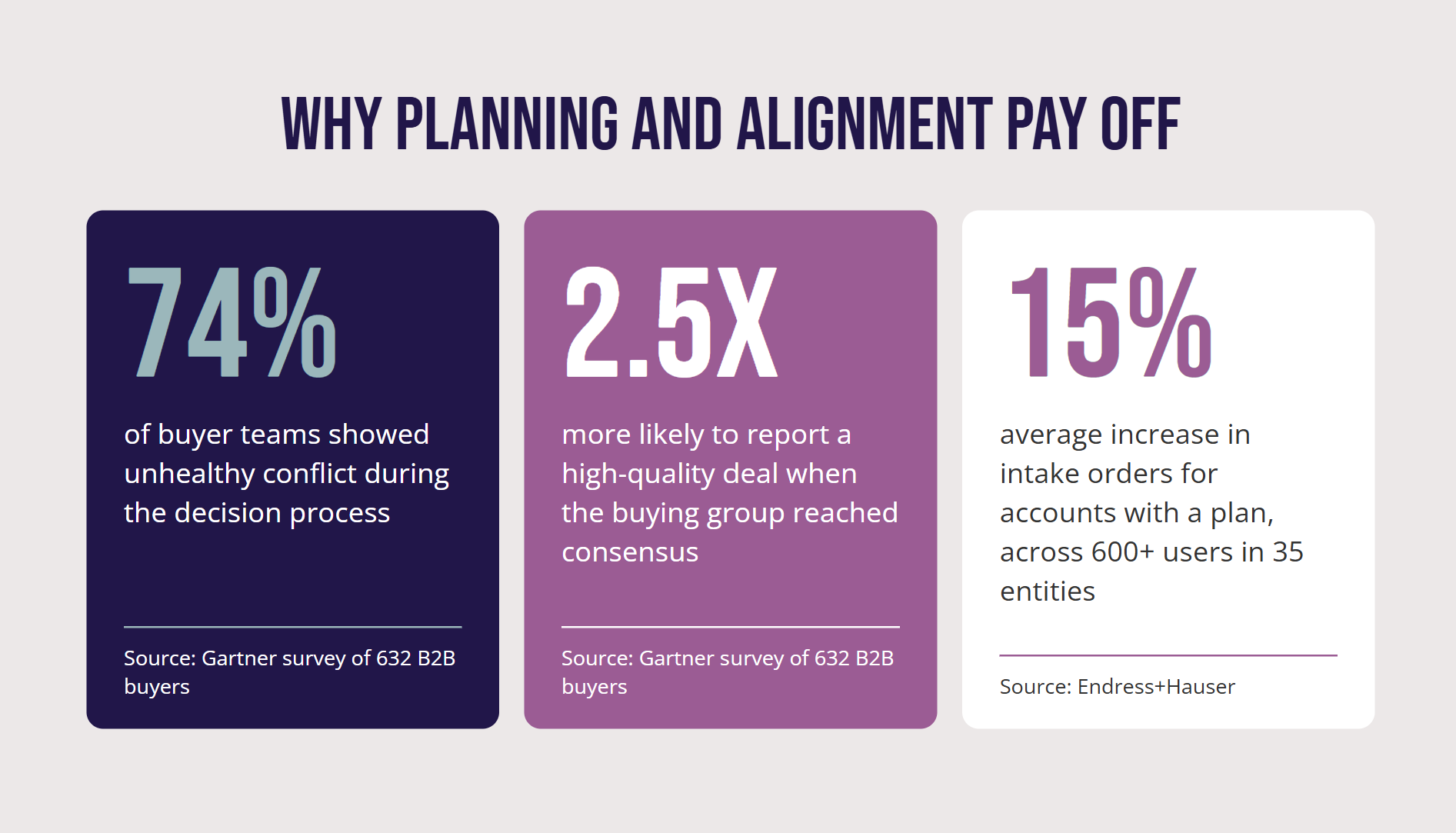
Alignment matters: in a Gartner survey of 632 B2B buyers, 74% of buyer teams showed unhealthy conflict during the decision process, and buying groups that reached consensus were 2.5 times more likely to report a high-quality deal.
Competitive assessment
Review your competitive position from the customer's perspective. Develop ways to articulate your unique value. Determine how you will align with the customer to meet their needs in a way that outperforms the competition.
Running question list
Questions will emerge throughout the planning process. Keep an ongoing list of these inquiries and the steps needed to answer them. One important question reveals information that drives the sale to closing.
How do you turn account research into a plan?
Strategy development
The information from the steps above must coalesce into a strategy. To do so, create a detailed list of specific goals and objectives that account for your solution's capabilities. The drafted strategy must include potential opportunities, stakeholder relationships, and service needs.
Action plan
Identify actions to reduce uncertainty, build on strengths, facilitate consensus, remove or reduce vulnerabilities, and drive momentum to the sale. Determine which team members will take ownership in executing these steps. List potential obstacles and how to respond.
Why does account planning matter?
If sellers are going to guide customers to the sale, they must know every turn along the way. Planning helps anticipate those turns. The key is to become intentional with every step of the process.
Strategic account planning works best when customer changes become part of the process. Richardson's Prosperous Account Strategy programme teaches sellers to build these plans, and its Salesforce-native tool supports all phases of the account planning process.
At Endress+Hauser, accounts with a Prosperous Account Strategy plan saw a 15% average increase in intake orders, with 600+ active users across 35 entities. Patrick Klein, sales enablement manager at Endress+Hauser, says Richardson's "...planning tools have contributed to both capability development and long-term behavior change."