What Are the Biggest Sales Challenges B2B Sellers Face? Findings from the 2025 Selling Challenges Research Study
Sales performance improvement

Written by: Ben Taylor, MBA, Content Marketing Manager, Richardson
Published: November 24, 2026
Buying — and selling — is in a chaos spiral. In early 2025, Challenger and Richardson surveyed 418 sales professionals about their biggest sales challenges for the 2025 Selling Challenges Research Study. Across every concern — prospecting, closing and negotiation, account growth — one key theme emerged.
Buyers, in an era marked by uncertainty and rapid technological change, increasingly hesitate to fulfil commitments throughout the sales cycle. Then, they complicate the process: adding additional stakeholders in each stage, inventing new objections, asking for surprise price concessions, and ultimately choosing to do nothing rather than make a purchase.
Overwhelmed and unsure, the buying team acts like a school of fish, their movements unpredictable. It's difficult to determine which stakeholders influence a decision. They sometimes divide or hide when approached. When change intensifies, the status quo quickly appears to become the safest choice.
Looking for the latest data? Richardson's 2026 Selling Challenges findings build on this 2025 baseline.
Key Takeaways
- Buyer hesitation is the challenge that runs through every stage of the sale.
- Sellers say the hardest parts are getting buyers to commit to specific actions on specific dates (60%) and tailoring messaging to varied stakeholders (57%).
- The top threat when closing is customers who don't take agreed-upon actions (68%).
What Is the Biggest Challenge at Each Stage of the Sale?
Respondents chose their top three challenges for each stage. The most-cited challenge at each stage:
| Stage | Most-cited challenge | Share of respondents |
|---|---|---|
| Prospecting | Tailoring messaging to meet varied stakeholder priorities | 57% |
| Winning active opportunities | Mitigating buyer hesitation and indecision | 48% |
| Account growth | Defending against competitors | 40% |
| Negotiation | Gaining the buyer's commitment to specific actions on specific dates | 60% |
| Closing | Customer not committing to actions or failing to take agreed-upon actions | 68% |
What Makes Prospecting So Hard Right Now?
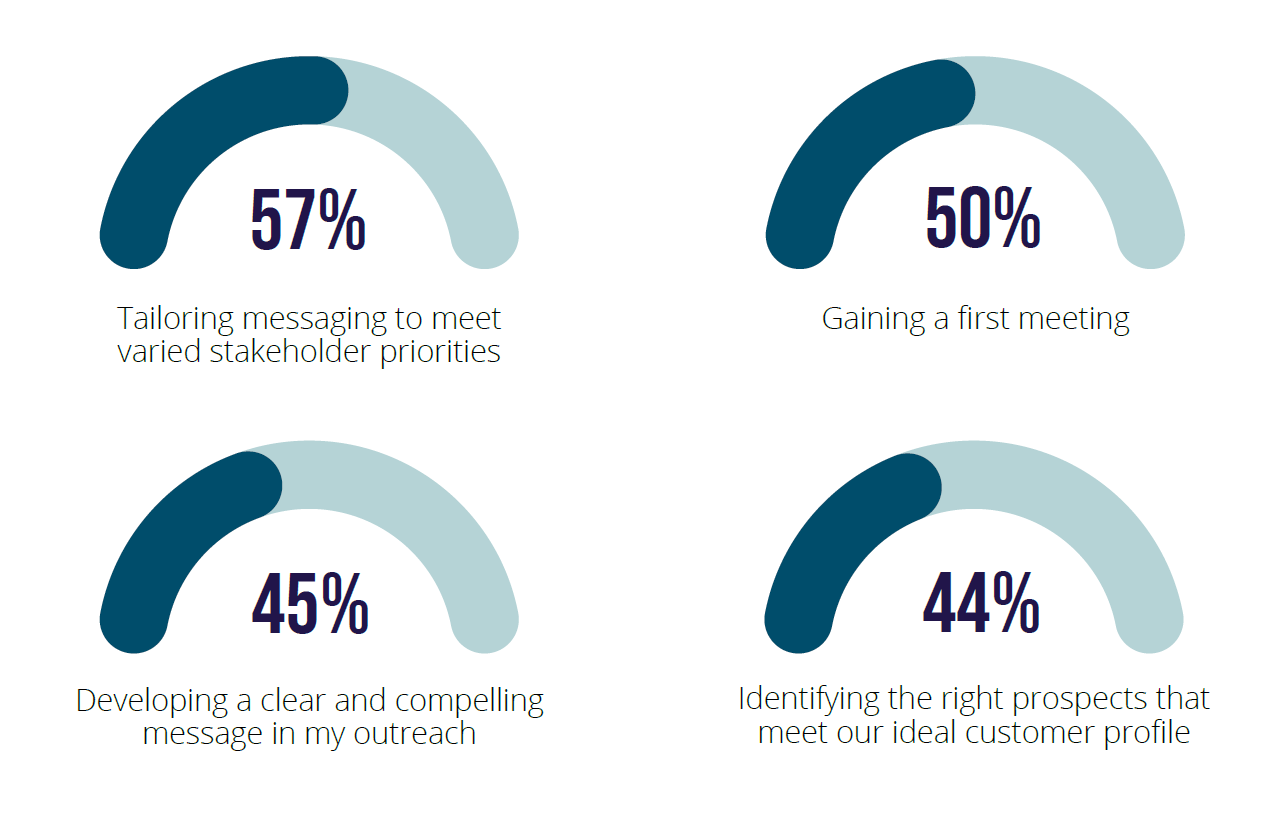
Breaking through the noise to engage a prospect in an initial conversation has always been a challenge — and it remains one. Respondents named three building blocks as their toughest prospecting challenges:
- Tailoring messaging to varied stakeholder priorities (57%)
- Getting a first meeting (50%)
- Developing a clear and compelling message (45%)
Competing priorities and limitless sources of information fracture buyers' attention. Most sellers recognise the need to tailor their messaging but struggle to do it effectively and at scale. Social selling, which many sellers embraced in recent years, ranked lower this year. Just 23% of respondents chose "leveraging social media to get the prospect's attention" as a key challenge.
Buyers' preference for self-service adds to the challenge. Gartner's 2026 sales survey found that 67% of B2B buyers prefer a rep-free buying experience.
What helps
- Prioritise. Pursue organisations and individuals that fit entirely within your ideal customer profile. Develop industry expertise so you understand their concerns and can speak to stakeholders in a language they understand.
- Focus on your prospect's pain. Customer pain has three parts. It is personal, meaning job-specific. It can be quantified. And it's negatively stated.
- Deliver commercial insights tailored to the customer. Teach each buyer something new or unique about their business or industry. Customise it to the role and personality of the individual stakeholder, and offer additional insights as new stakeholders enter the picture.
Why Do Deals Stall Before They're Won?
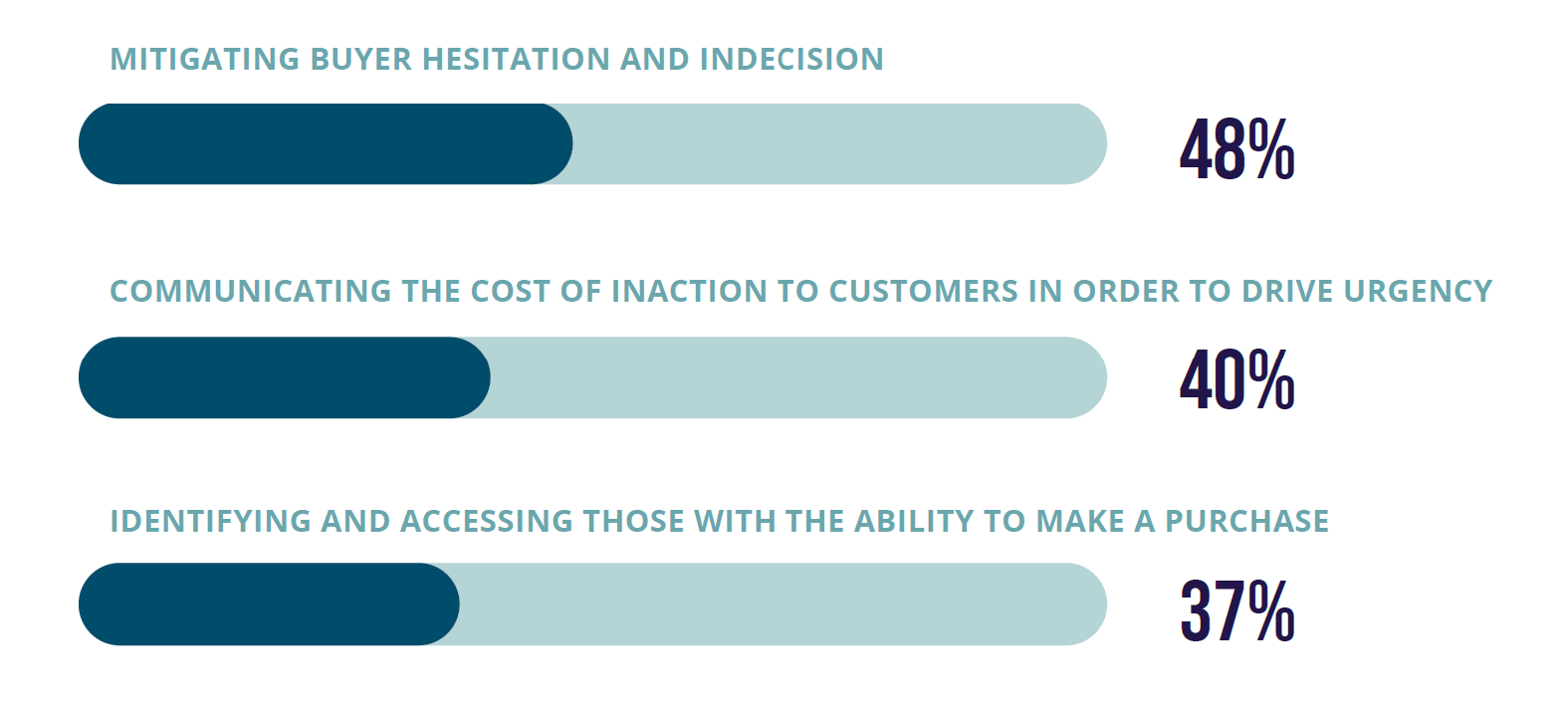
The top three challenges in winning active opportunities were buyer indecision (48%), articulating the cost of inaction (40%), and identifying the stakeholder with buying authority (37%).
As the outlook keeps changing at the company and industry level, any decision feels like a commitment that may soon be outdated. Buyers become stuck in a perpetual cycle of reevaluation. Customers think of themselves as actively participating in the purchase cycle, but they're really just stuck in one place. Challenger research from 2020 found that as much as 40–60% of lost deals end in no decision.
Choosing a new solution carries three risks for a buyer: reputational risk (making the wrong choice), financial risk (the solution failing), and organisational risk (ineffective implementation). Against those risks, committing to no change can look like the safer option.
What helps
- Understand and guide buyers through indecision. First uncover why a buyer hesitates. Then offer your recommendation (even when it won't benefit you), limit the illusion of choice by reducing the need for more discovery, or mitigate the buyer's sense of risk.
- Show the cost of inaction. Quantify the risk by identifying what matters to the buyer, then putting real numbers behind it. Show what's missing from the customer's logic, illustrate the impact, and reveal the value of a different approach.
- Identify the power. You can't sell to someone who can't buy. Ask about the customer's process for buying, the role and influence of each stakeholder, the personal and business drivers that motivate them, and who the final decision maker is. Your primary contact can become an internal advocate who clears the path to power.
Richardson clients have seen results from building these skills. One client in the computer programming industry reduced its "went dark" rate by 46% (it was previously 28%). An enterprise software client raised its win rate from 48% to 69% in the first year, which added more than $8 million in revenue.
What Are the Biggest Challenges in Growing Existing Accounts?
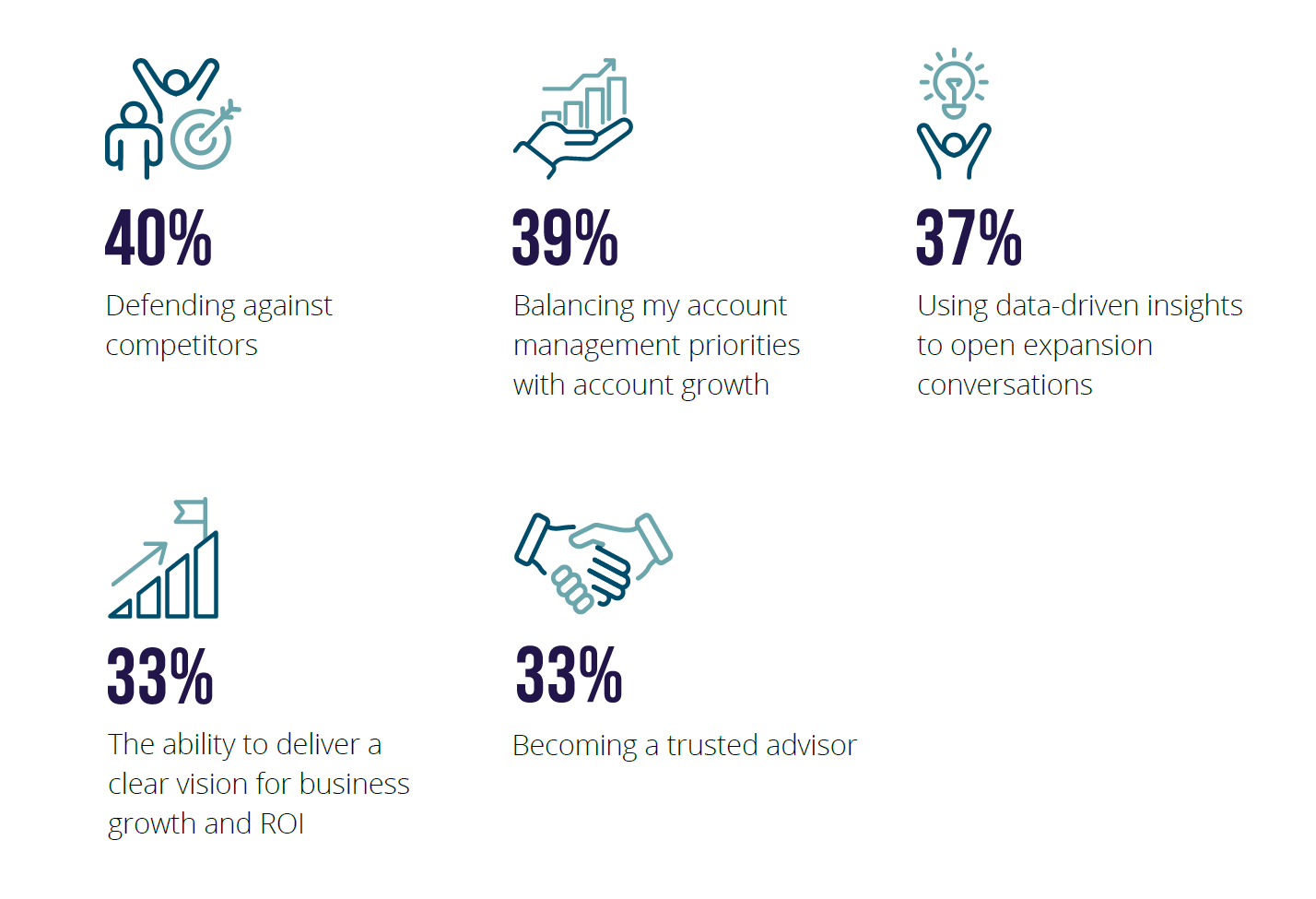
Account growth was the one area where respondents didn't agree on a single top challenge. Of the 10 challenges cited, four fell within a few percentage points of each other:
- Defending against competitors (40%)
- Balancing account management with account growth (39%)
- Using data-driven insights to open expansion conversations (37%)
- Delivering a clear vision for business growth and ROI, and becoming a trusted advisor (both 33%)
A seller can focus on only so many challenges at once. When everything is a priority, nothing becomes a priority. As businesses grow more complex, it's also harder to articulate the value of a solution in the buyer's setting, and attributing measurable ROI to a product or service adds to the difficulty.
What helps
- Make yourself indispensable. Shift the key question from "How do I sell more of this product or service?" to "What problems can my company uniquely solve within this organization?"
- Prioritise the right opportunities. Look beyond the accounts with the highest potential revenue. Consider which accounts align most closely with your solution, so you can offer the most meaningful value.
- Pursue account expansion like new business. Partner with existing contacts and ask for warm introductions to new business units. Read 10-K reports or listen in on earnings calls, then reach out with resources tied to those stakeholders' interests rather than to your product. That approach shows clients the usefulness of a trusted advisor.
What Are the Biggest Negotiation Challenges?
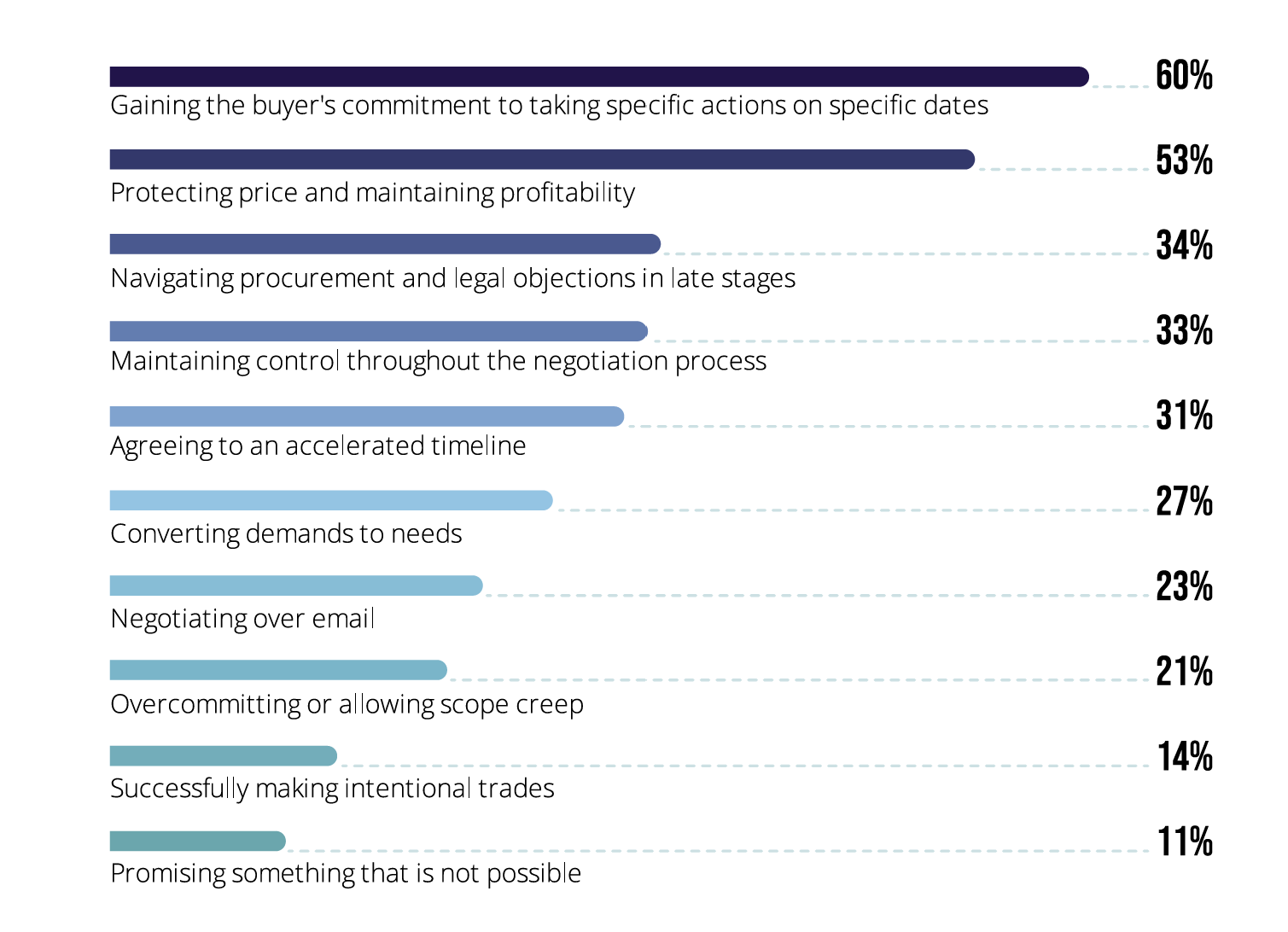
Sellers often point to legal and procurement when negotiations break down. But navigating procurement and legal objections ranked third, at 34%. Two other challenges ranked well above it:
- Gaining the buyer's commitment to taking specific action on specific dates (60%)
- Protecting price and maintaining profitability (53%)
Last year's leader, protecting price, fell to second place. Buyers increasingly feel insecure in making decisions, and that grows more acute in late stages of the sales cycle. They drag their feet, miss deadlines, or respond weeks later asking for a discount. Sometimes they bring in another stakeholder or three.
What helps
- Introduce the buyer to the buyer. Even a seller's key contact often doesn't understand the buying process, and several people in the same buying organisation may meet for the first time during it. Ask your contact, "Have you bought something like this before?" Some of the most successful sellers build an organisational chart that maps the key stakeholders' connections and hierarchy, which helps build stakeholder agreement.
- Develop a collaboration plan. A collaboration plan outlines the steps that those with buying power agree to take with you. It identifies specific actions on specific dates, along with responsibilities and resources. That gives both sides a sense of cooperative ownership and helps the buyer feel comfortable making a decision.
- Consider negotiation at the start, not the end. Selling and negotiation are two parts of one interactive process. Early misses cause late-stage pains: ineffective identification of customer problems, an inability to articulate the cost of inaction, and no plan to use true negotiables, the aspects of a sale that let you deliver value without resorting to price concessions.
What Are the Biggest Threats When Closing?
As the sale moves closer to a finish, the customer becomes more likely to stall or disappear. Respondents' top three closing threats:
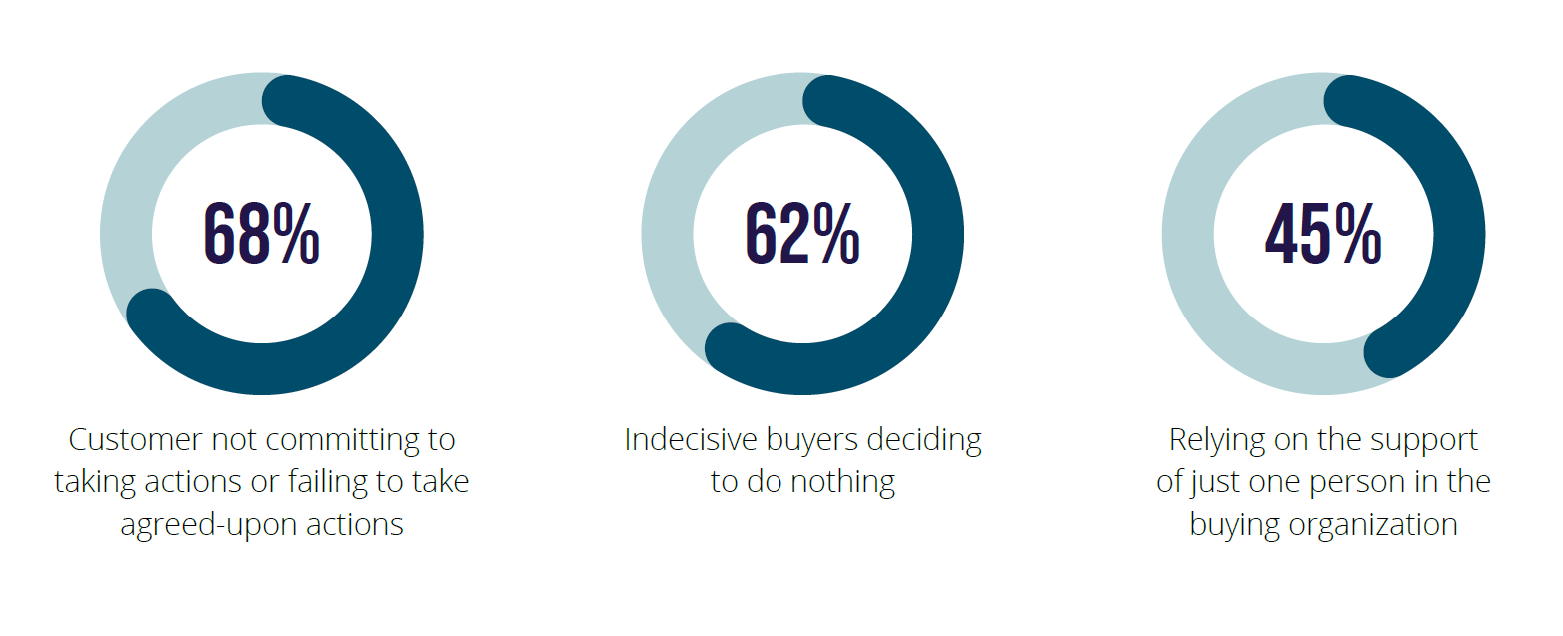
- Customer not committing to taking actions or failing to take agreed-upon actions (68%)
- Indecisive buyers deciding to do nothing (62%)
- Relying on the support of just one person in the buying organisation (45%)
Dramatic change to a customer's business, industry, or the broader environment can occur even within the short period between qualification and discovery. Sellers need to embrace agility, even in a single sales cycle. Each stakeholder has a unique definition of value, a different sensitivity to risk, and a vision of what lies ahead. When a seller fails to multi-thread, they risk not just losing their champion but the ability to speak to the overall needs of the buyer's business.
What helps
- Use the power of Prospect Theory. Kahneman and Tversky's Prospect Theory (work for which Kahneman received the 2002 Nobel Prize in Economic Sciences) shows that the pain of losing is roughly twice as powerful as the pleasure of gaining. Include the negative consequences of sticking to the status quo when talking to the customer.
- Tailor ROI conversations to different stakeholders. A CEO wants ROI in the context of high-level goals. A CFO focuses on measurability and the effect on profitability. The head of legal wants to be sure the organisation complies with regulatory requirements or mitigates exposure.
- Find the Mobilizer. Challenger research identified a customer type, the Mobilizer, who can drive change across an organisation and build consensus among colleagues. Mobilizers are vendor-neutral, curious, and sometimes even sceptical. They work hard to pressure test what sellers tell them, their coworkers respect them, and they speak in terms of "we," not "I."
"High performers focus less on 'maximum impact' – that is, what is theoretically possible – and more on setting realistic, 'believable impact' expectations early on." — Lauren Graves, senior director, learning design, Challenger and Richardson
What Do Sellers Say They Need Most to Be More Effective?
Respondents' top needs mirror the challenges above:
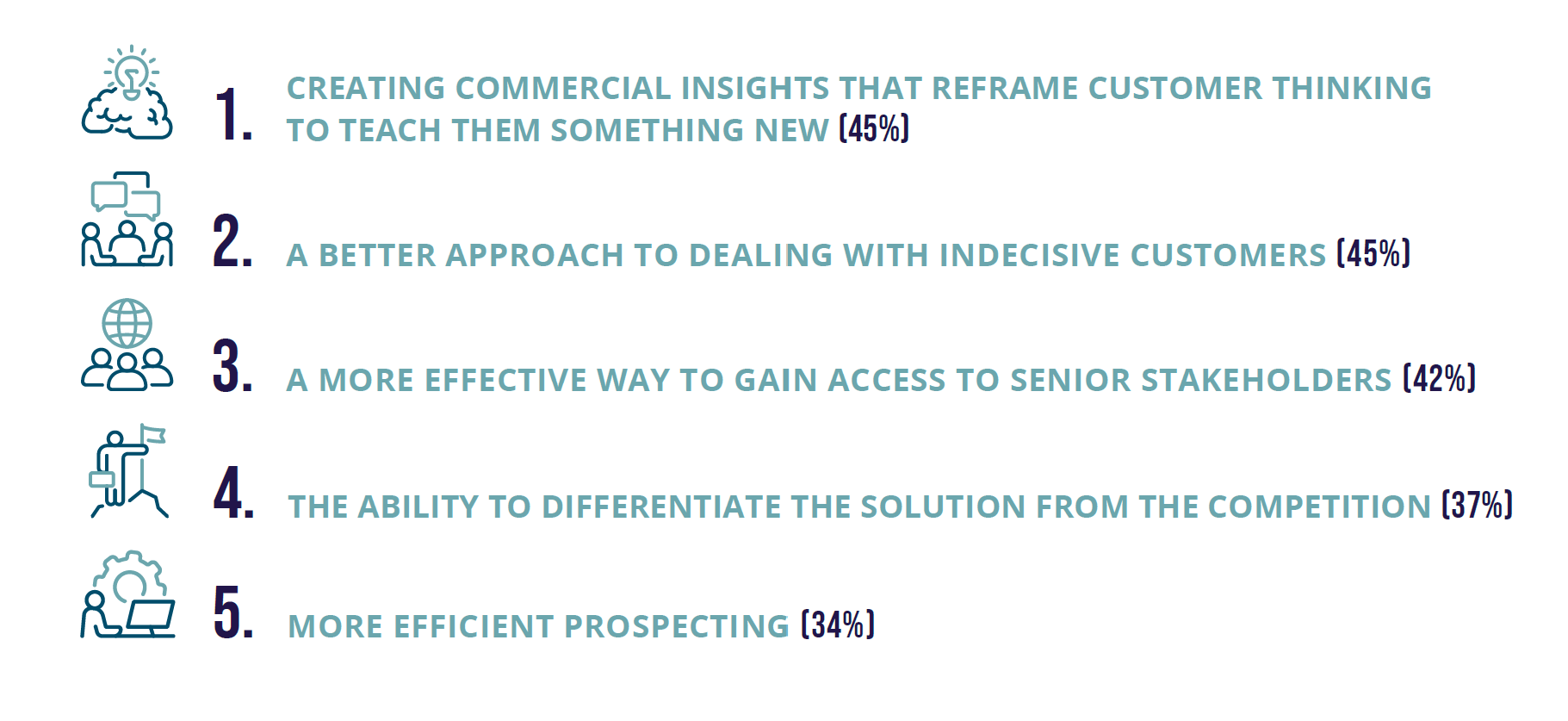
- Creating commercial insights that reframe customer thinking to teach buyers something new (45%)
- A better approach to dealing with indecisive customers (45%)
- A more effective way to gain access to senior stakeholders (42%)
- The ability to differentiate the solution from the competition (37%)
- More efficient prospecting (34%)
The top two needs are two sides of the same coin. To break through to hesitant buyers, teach them something new or change their perspective. Show them the cost of the status quo and mitigate their fear of risk.
Two skills help make that repeatable:
- Constructive tension. Constructive tension isn't about creating tension between the seller and the customer. It's about creating tension between the buyer and the status quo. Ask questions that help the buyer learn something new or think differently: "How is this regulation change affecting your business right now?" or "What would happen if your biggest competitor doubled their speed — how would you respond?" Use silence strategically, and use respectful disagreement to help reframe the customer's thinking. Shawn Dooley, senior customer success enablement manager at Iterable, describes the mindset this way: "How do you teach them something new? How do you switch their status quo? It's not about us."
- Selling sprints. Buyers enter and exit the conversation, needs change, perceptions of risk evolve, and the criteria for value shift. Selling in sprints makes tracking those changes repeatable. Each sprint has three actions: prepare, engage, and advance. Together they produce a burst of activity that ends in a mini-close that guides buyers to the next step.
How Do Sellers Prefer to Learn New Skills?
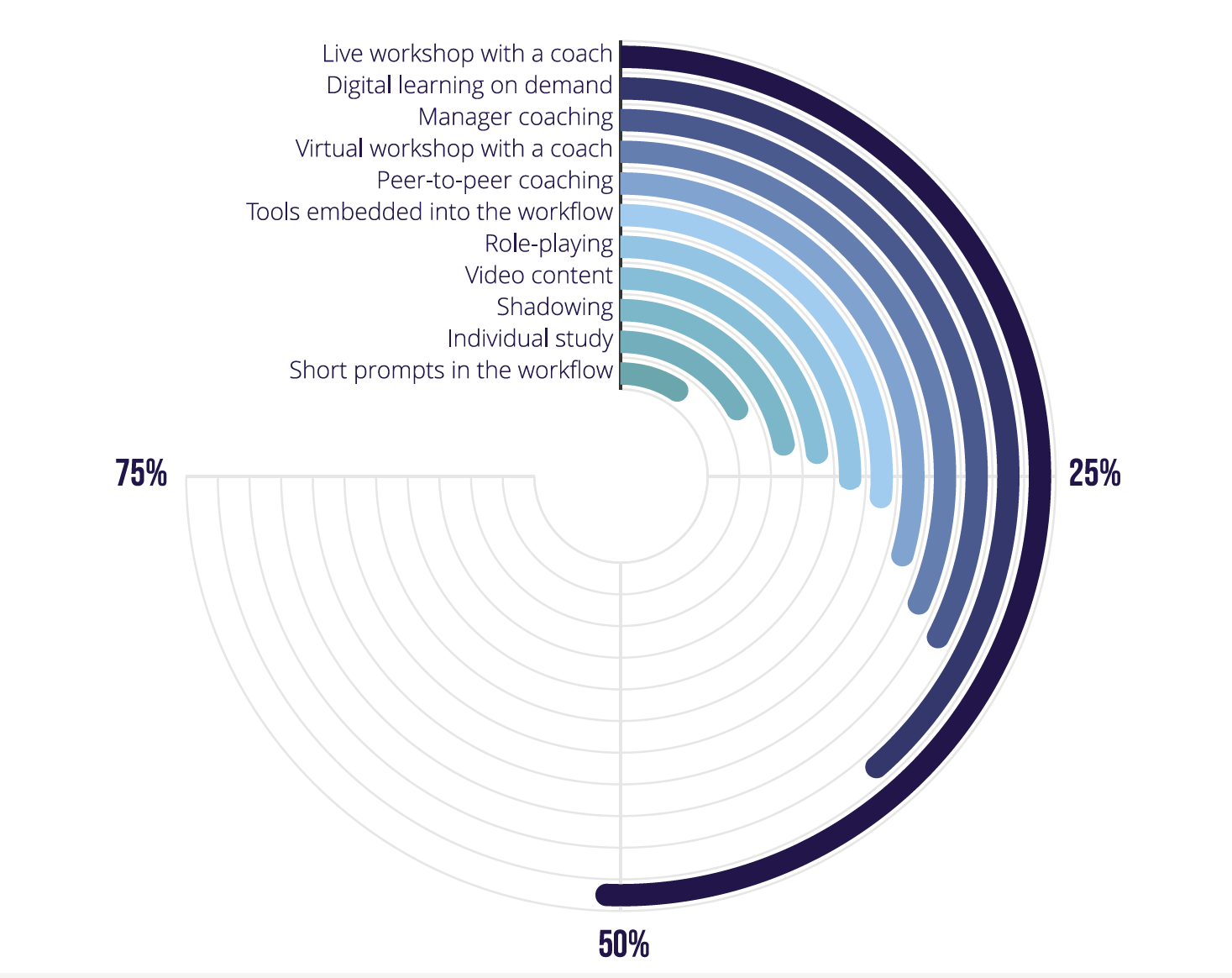
When asked how they prefer to learn and adopt new skills and behaviours, 51% of respondents chose live workshops with a coach, the top response. Digital learning on demand followed at 39%, then manager coaching (33%), virtual workshops with a coach (32%), and peer-to-peer coaching (30%).
Live learning lets sellers practise in role-play exercises that replicate the tension of a real sales conversation without the risk of hurting a real customer. Live feedback helps them adjust in the moment.
Consistency matters as much as format. Darnetta Daire, sales enablement manager at Hollister Incorporated, puts it this way: "It's a behavior change, right? So you can't expect results right away. But the more consistent you are with training and bringing people along with you, the more it becomes part of that normal language."
The Way Forward
Buyers have grown elusive and noncommittal, and the study also revealed what sellers need to inspire customers to act. Many sellers have the resources they need to succeed. The key is to think differently about how to use them.