Why Personalized Learning Works for Sales Teams
Sales performance improvement

Written by: Ben Taylor, MBA, Content Marketing Manager, Richardson
Published: November 13, 2026
Sales capability development is fast, effective, and lasting when the experience is adaptive and personalized to the seller.
Too often, training forgets one thing: the uniqueness of the learner. A seller's training needs depend on their role, skill gaps, and the nature of their current opportunities. Sales and enablement leaders are well aware of this problem but have been unable to address it because doing so is complicated and resource-intensive — until now. Technology is equipping leaders to deliver adaptive, personalized learning to sellers, and the timing couldn't be better.
Key Takeaways
- Personalized learning works because it builds on what each seller already knows.
- It focuses on the skills a seller needs to win the deals in front of them, so sellers pay closer attention and engage more.
- It delivers those skills when sellers need them, in short bursts they can put to work right away.
Why does one-size-fits-all sales training fall short?
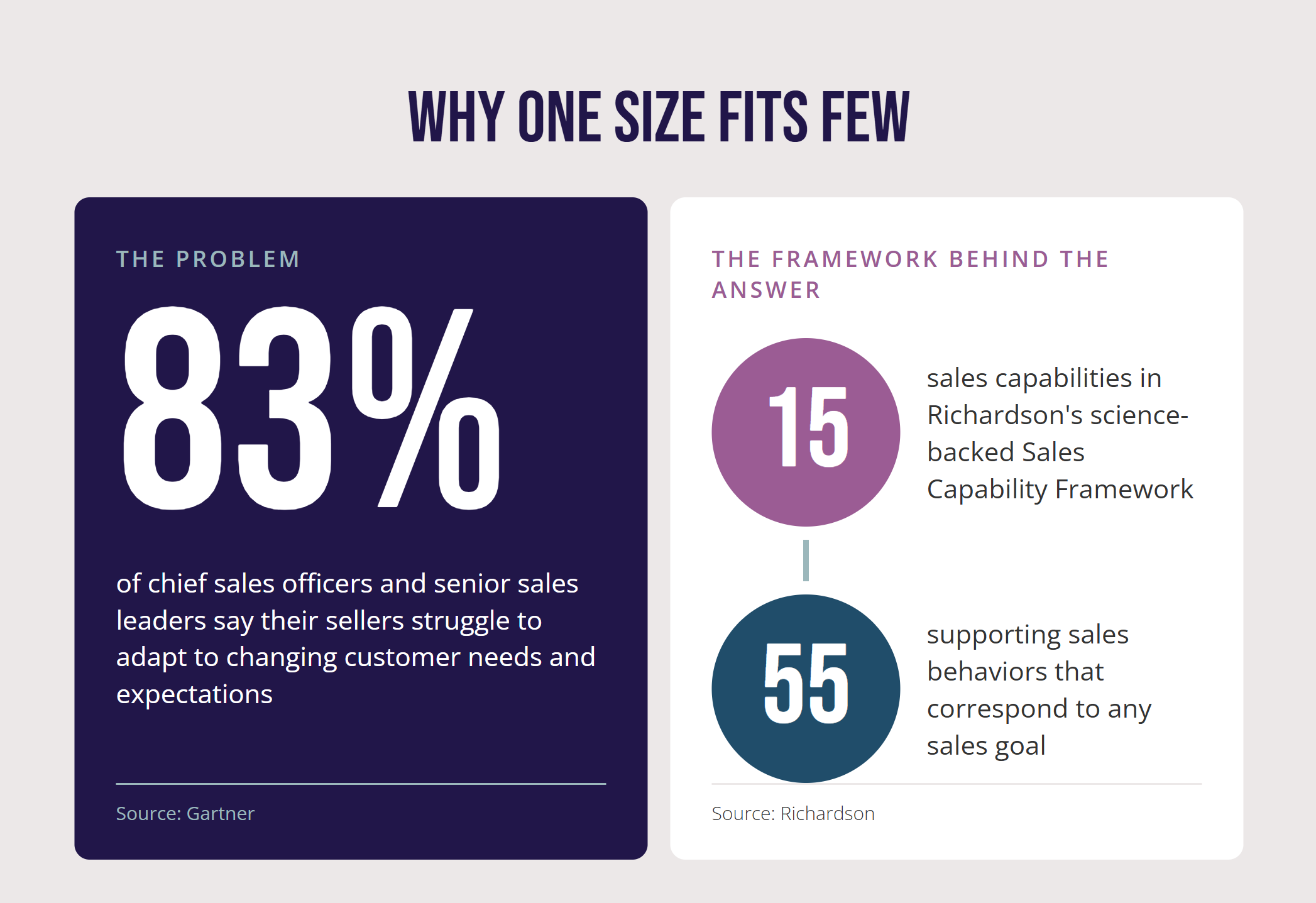
Traditional approaches deliver a full suite of content and ask the seller to isolate what's relevant from what is not. That work adds to the already considerable challenge of building new skills. A growing supply of content and tools only complicates the path forward.
Personalization changes that. Sellers can focus on what matters without getting lost in volumes of material, which makes it more than a way to catch up to the reality of selling today. It gives sellers a serious competitive advantage.
How does personalized learning build on what sellers already know?
Personalized learning recognizes the seller's existing capabilities. The training focuses on the seller's specific knowledge and skill gaps and leaves out material already within their range of competency.
It's also additive, because a new skill makes the current ones more effective. Consider two examples:
- Access and consensus. A seller may already know how to access power in the buying organization but lack the capability to drive consensus. Without consensus, the ability to access power is of little use. Developing the second skill lets the seller get more out of the first.
- Opening terms and trading. A seller may be proficient at proactively asserting opening terms in a negotiation but unable to trade with purpose later in the process. Developing that second skill makes the first more effective, because the two are complementary. The whole becomes greater than the sum of its parts.
Learning scientists call this concept consolidation. The authors of Make It Stick explain that learning sticks when it's tied to what a person already knows, and that existing knowledge is what lets new learning make sense. Personalized learning puts this principle to work.
Why do sellers engage more with learning tied to their own deals?
Sellers are more receptive to learning that addresses the specific skills they need to win. Earning their buy-in to ongoing training means showing them that what they'll learn will have a direct impact on the outcome of the opportunities they're pursuing. That's an improvement over the more common method of deploying a broad set of selling skills across a team of different roles, needs, and pursuits.
Researchers in the Journal of Educational Psychology call the attention and engagement that relevant learning triggers situational interest. In a 2018 study of 150 high school algebra students, personalizing problems to students' out-of-school interests raised their situational interest, and that interest predicted better accuracy and learning efficiency. A 2024 meta-analysis of 34 publications found that personalizing learning around learners' interests had a medium-to-large effect on interest and a medium effect on retention.
Cori Hartje, Director of Global Sales Enablement at Mitel Networks, describes what that relevance looks like in practice:
"Our Mitel sellers have consistently said that the customised Richardson content is some of the best sales training they've experienced, and the concepts learned can be immediately applied to their daily work."
Research by Walkington and Bernacki describes three levels at which personalized learning can work:
- Depth. Depth refers to how deeply the content connects to the learner's real experiences, rather than making only shallow connections. For any seller, the deeper interest is winning a pursuit. The capabilities needed to win differ for each person, so deep personalization means delivering content that addresses their specific skill gaps.
- Grain size. Grain size refers to how well the learning is customized to the unique experiences of the learner. Content designed with an awareness of the seller's role has a finer "grain" and is more effective. Content suited to a broad group has a coarser grain and is less impactful. A 2024 meta-analysis found that grain size influenced how strongly personalization affected interest.
- Ownership. Ownership refers to the learner's role in connecting the content to their goals. Personalized learning gives sellers more of it, because they can see the impact of applying newly acquired capabilities to their current pursuits.
Why does learning delivered in the moment work better?
Personalized learning is immediate because it serves the seller where they are, delivering the capabilities they need when they need them. That's possible when the experience is built around the seller's individual performance metrics, which reveal the specific skills they need.
Immediacy makes skill development more effective because the seller can put a new skill to work as soon as they learn it. It's also more engaging than an intermittent approach, in which sellers as a group occasionally step away from selling to train. In that setting, the connection between the skill and the sale is lacking. Personalized learning is context-aware, so it addresses the competency most relevant to the moment. Sellers are motivated to keep learning because they know it will serve their interests.
Learning that is immediate also allows shorter periods of instruction, because each session addresses a specific need. At Richardson, we see this short-form style as part of what makes the capabilities last.
How do you deliver personalized learning to every seller?
What is less clear than whether personalized learning works is how to make it work at scale. At Richardson, we've approached the challenge by thinking strategically about the steps needed to make it a reality. Hollister's Darnetta Daire, Sales Enablement Manager, puts the scale challenge this way:
"I'm a team of one, so I'm not everywhere. Our managers may not have the capacity to do a lot of that coaching. I think with this system, it now allows us to be places that we can't be."
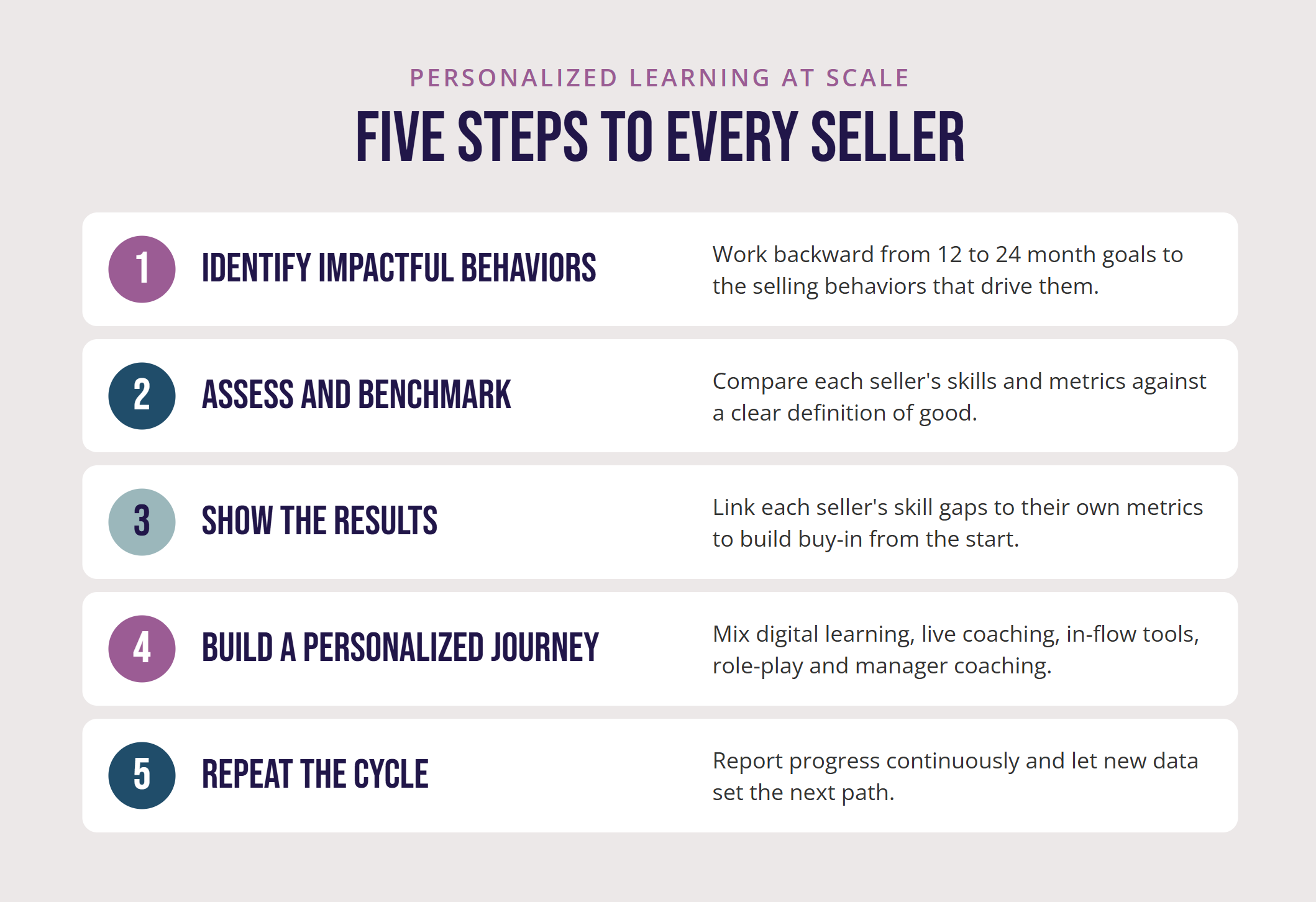
- Identify the behaviors most impactful to success. Start with the lagging indicators you want to reach in the next 12 to 24 months. Work backward to the leading indicators that show you're progressing toward them. Then identify the selling behaviors most influential to those indicators. These behaviors come from Richardson's science-backed Sales Capability Framework.
- Assess and benchmark sellers to determine skill gaps. Each seller undergoes a capability assessment that benchmarks their current skills and behaviors against a clear definition of "good." The assessment should combine behavioral questions and the seller's performance metrics, so real-world results inform the picture. Personalized performance dashboards show sellers their skill gaps and how they benchmark against their peers.
- Show the results. The most important step is to start the seller's learning journey by showing them how they did, which behaviors and skill gaps they have, and how those skills link to their metrics. This is how you build engagement and buy-in from the start. When sellers see an individual picture of improvement needs tied to their own targets, they can easily see what's in it for them.
- Develop a personalized learning journey. Personalized learning works best when the recommendations are clearly linked to a seller's individual metrics and the path mixes intentional modalities:
- Digital, self-paced learning that targets a specific skill gap. It must be video-based, modular, and full of interactivity to be effective.
- Live coaching and feedback sessions focused on skill development with an expert.
- Live pursuit coaching, so sellers can see how skills apply to real deals, plus knowledge retention activities.
- Tools in the seller's existing technology that help them apply the learning to real pursuits and in the flow of work.
- Digital sustainment assets that are interactive, surfaced in the flow of work, easy to use, and require minimal effort from the seller — more than just PDFs.
- Video role-play and feedback sessions to reinforce and sustain new behaviors.
- Manager coaching sessions that use performance and skill data for hyper-focused feedback.
5. Show the results, again and again. Learning should always be on, and visibility into improvement should be continuous. After a seller completes a path, show them the results in both learning and their own performance metrics. That provides the incentive to keep improving. Your data then reveals the next set of prioritized behaviors and the next personalized path for each seller. This progression is how you build a culture of continuous improvement.
What does this look like across a whole sales team?
Personalized learning works because it builds on the seller's base of knowledge while delivering relevant skills that can be applied to current opportunities.
For far too long, companies have had to deal with a big disconnect between their training and their real results in the field. At Richardson, we've developed a system for delivering personalized learning at scale across a sales team of different skill levels, experience, and roles. We connect metrics to behaviors, training to outcomes, and sellers to their best performance. As a result, sellers become part of a culture of continuous improvement with outcomes that can be seen.