Scaling Behavior Change in Sales Just Became a Reality
Published: June 23, 2026 | By Kate Lewis, Chief Product Officer
How Can Generative AI Be Used in Sales Training and Sales Enablement?
Generative AI can be used in sales training and sales enablement to personalize learning, create realistic practice scenarios, reinforce sales methodology, support manager coaching, recommend next actions, and deliver relevant guidance in the flow of work. For enterprise sales organizations, the greatest opportunity is not simply using AI to create more enablement content. It is using AI to help sellers build the right skills, apply them in live selling situations, and sustain behavior change over time.
Sales teams already have more content, tools, and data than ever. Yet many organizations still struggle to turn training into consistent field execution. Generative AI offers a way to make enablement more adaptive, contextual, and scalable. But AI only creates measurable value when it is connected to a clear sales methodology, manager coaching rhythms, seller workflows, and performance outcomes.
What Is Generative AI in Sales Enablement?
Generative AI in sales training and enablement refers to AI tools that can create, summarize, adapt, and recommend sales-related content, coaching guidance, learning reinforcement, and seller support. In sales training, generative AI can help create role plays, practice scenarios, coaching prompts, and individualized learning paths. In sales enablement, it can help sellers prepare for meetings, access relevant content, summarize buyer interactions, and receive guidance tied to specific selling moments.
How Can Generative AI Be Used in Sales Training?
Traditional sales training often struggles because it is delivered at a single point in time, while sellers need ongoing reinforcement in real selling situations. Enablement teams also face pressure to support larger teams, more complex offerings, more stakeholders, and changing buyer expectations. This creates a gap between what sellers learn and what they consistently do in the field.
Generative AI matters because it can help close that gap. Gartner has predicted that by 2029, sales organizations with AI-driven enablement functions will achieve 40% faster sales stage velocity than those using traditional enablement approaches.
AI can make training more relevant to individual sellers, make coaching more focused for managers, and make enablement more responsive to live opportunities.
But AI alone can’t solve everything. To turn sales enablement into long-term behavior change, it needs to be grounded in proven methodology, business goals, seller workflows, and measurable behavior change.
Why Scaling Behavior Change Has Been So Difficult
Behavior change is hard for one person.
Across a large sales organization, it becomes a coordination challenge.
Every seller is on a different journey. A tenured enterprise seller may need help defending value in late-stage negotiations. An inside seller may need to apply the same methodology through email and virtual engagement. A field seller may need to improve discovery depth. A manager may need to coach the behavior rather than simply inspect the deal.
This is why generic reinforcement breaks down. When every seller receives the same follow-up content, practice assignment, and reminder, the experience quickly becomes irrelevant.
Relevance is what makes development stick.
To scale behavior change, leaders need to move from one-size-fits-all enablement to role-specific, behavior-specific, and context-specific reinforcement. Sellers need to know which behavior matters most for them, why it matters now, and how applying it will help them win.
.png?quality=50)
That level of personalization has always been valuable. Until now, it has been difficult to deliver consistently across large sales organizations.
AI Makes Behavior Change More Operational
AI can make behavior change scalable only when there is a clear architecture underneath it.
Without that architecture, AI can simply accelerate confusion. If leaders have not defined the behaviors that matter, the coaching standards managers should reinforce, or the outcomes the organization wants to influence, AI has no clear destination.
The organizations that benefit most from AI-enabled enablement start with clear answers to foundational questions:
- What selling behaviors need to change?
- Which behaviors matter most to business performance?
- What should sellers do differently in specific customer moments?
- How should managers coach and reinforce those behaviors?
- What signals will show whether adoption is happening?
- How will learning, practice, workflow, coaching, and measurement connect?
Once that architecture exists, AI becomes a powerful orchestration layer. It can help the organization continuously guide focus, relevance, practice, reinforcement, and next action.
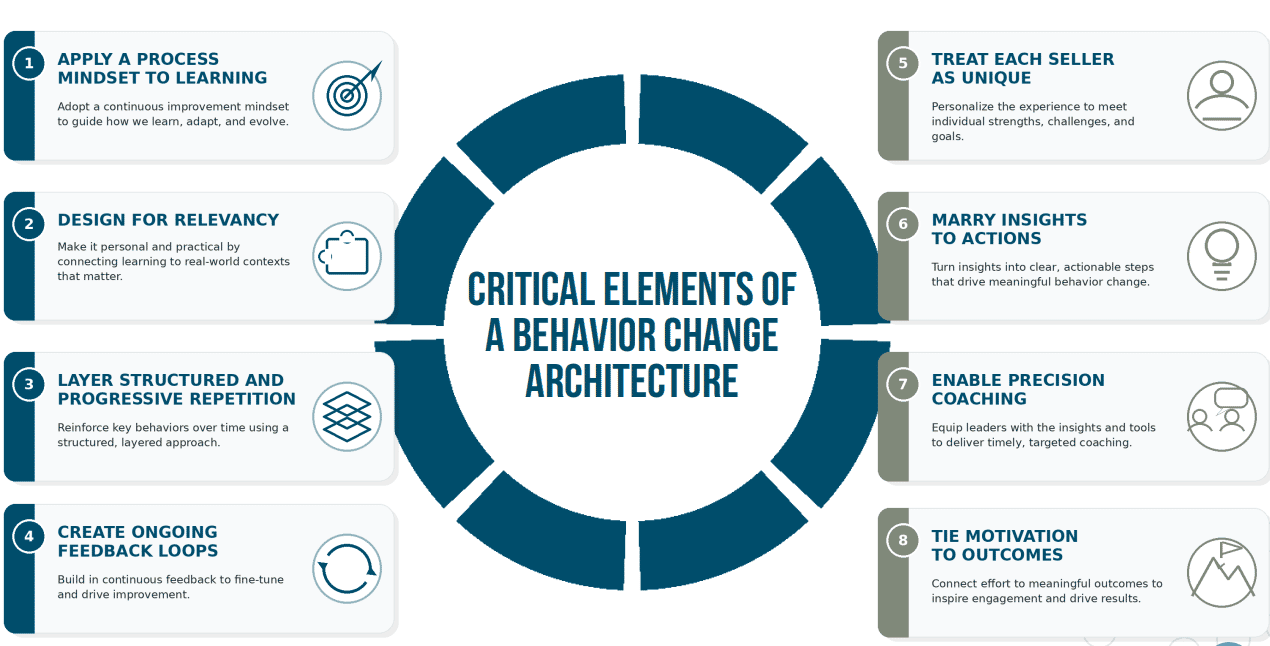

Orchestrating Sustained Behavior Change At Scale
A Practical Framework for Scaling Sales Behavior Change
Organizations that make sales training stick build a behavior change system. That system includes five connected capabilities: Assess, Activate, Reinforce, Sustain, and Signal.
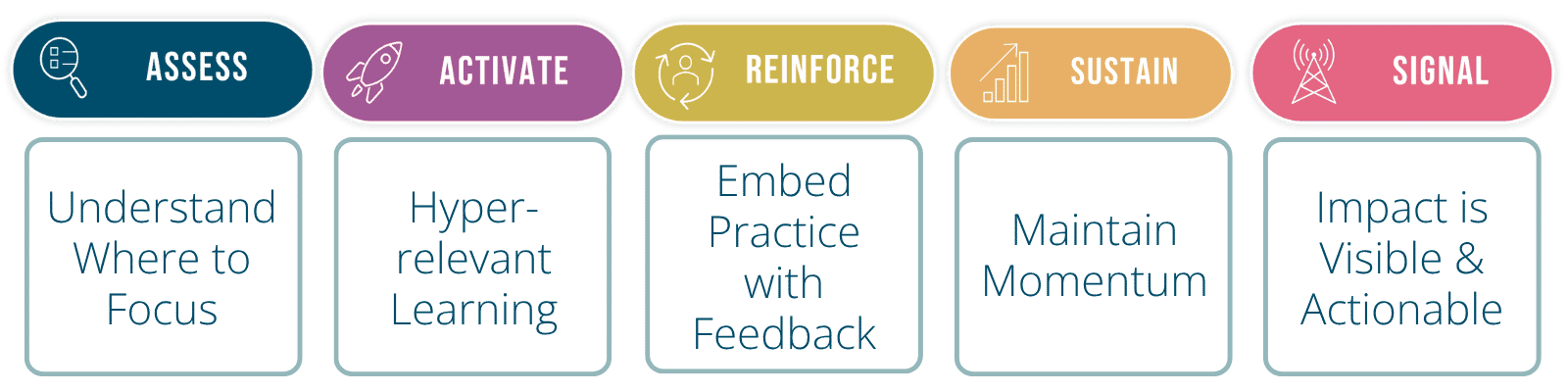
Assess: Identify the Behaviors That Matter Most
Behavior change starts with focus.
Leaders need to define the specific behaviors that will have the greatest impact on sales performance. “Improve negotiation” is too broad. “Proactively assert opening terms in late-stage commercial conversations” is more actionable.
The more precise the behavior, the easier it becomes to diagnose gaps, assign support, coach effectively, and measure progress.
Activate: Make Learning Relevant to Each Seller
Once the priority behavior is clear, sellers need targeted learning that helps them apply it in their actual selling environment.
This is where customization matters. Relevance does not happen by simply changing a few examples or adding a company logo to a training module. It comes from understanding the organization’s sales strategy, buyer dynamics, messaging, competitive environment, and role-specific challenges — then translating those realities into learning experiences sellers recognize as their own.
That work often starts in the workshop experience. By bringing together sales, marketing, enablement, and leadership stakeholders, organizations can define what “good” looks like in the field: the value story sellers need to tell, the buyer problems they need to address, the objections they need to handle, and the behaviors managers need to reinforce.
From there, activation becomes much more precise. A field seller may need better discovery practice. An inside seller may need help translating the methodology into customer emails. A strategic account executive may need support orchestrating stakeholders. A manager may need coaching prompts tied to the same behavior.
Activation is not about giving sellers more content. It is about giving them the right content, grounded in their business reality, at the right time, in a form they can use.
AI-enabled systems can then help scale that relevance by recommending targeted modules, surfacing role-specific examples, and connecting each seller’s development path to the behaviors and scenarios that matter most.
Reinforce: Build Practice and Feedback Into the Flow
Adults do not change behavior through exposure alone. They change through practice, feedback, reflection, and repetition.
A seller may understand how to defend value but still discount too quickly when a buyer challenges price. A seller may know how to create urgency but fail to reframe the cost of inaction in a real conversation.
Practice closes the gap between knowing and doing. AI-enabled role plays, targeted scenarios, guided feedback, and behavior-specific coaching can help sellers build capability before applying the skill in live opportunities.
Sustain: Keep Momentum After Training
One of the biggest risks in any sales training investment is drop-off after launch.
Sustainment needs to be built into the seller’s flow of work, in the tools they use every day, like Slack or Teams, and Salesforce, in the form of prompts or reminders that bring best practices to life in real selling situations.
The behavior also needs to show up in the operating rhythm of the business: call planning, deal reviews, manager one-on-ones, team meetings, onboarding, coaching conversations, pipeline inspection, and performance reviews.
When new behaviors are reinforced where selling decisions are made, they stop feeling like something sellers learned in training and start becoming part of how the organization sells.
Signal: Make Behavior Change Visible
Leaders cannot scale what they cannot see.
Traditional training measurement often focuses on attendance, completion, assessment scores, and satisfaction. These measures have value, but they do not show whether behavior is changing.
A scalable behavior change system needs leading indicators:
- Are sellers applying the target behaviors?
- Are managers coaching to the same standards?
- Are certain teams adopting faster than others?
- Are behavior changes connected to pipeline quality, deal velocity, win rate, forecast confidence, or price discipline?
The purpose of measurement is not only to prove value after the fact. It is to help leaders adjust while there is still time to improve results.
Signals turn behavior change into something leaders can manage.
Traditional Sales Training vs. Scalable Behavior Change
Traditional Sales Training
One-time events
Generic learning paths
Limited reinforcement
Activity-focused measurement
Training completion as the primary signal
Manager follow-up depends on bandwidth
Difficult to connect to outcomes
Scalable Behavior Change
Continuous development
Personalized learning journeys
Ongoing nudges, practice and coaching
Behavior-focused measurement
Skill application and adoption as leading indicators
Manager coaching is guided by behavior signals
Connected to business priorities and performance trends
The Role of Accelerate Prism
Scaling behavior change requires infrastructure. Sales organizations need a way to connect methodology, personalized learning, practice, reinforcement, manager coaching, workflow prompts, behavioral signals, and performance data.
That is the role Accelerate Prism is designed to support.
Prism helps organizations connect defined sales behaviors to reinforcement cycles, personalized user journeys, AI orchestration, real-world customization, manager prompts, behavioral signals, and organizational visibility.
The value is not that Prism replaces the strategy behind sales training. The value is that it helps operationalize the strategy so behavior change can be reinforced, measured, and sustained at scale.
For organizations investing in sales training, that distinction matters. The question is no longer whether sellers can be trained. The question is whether the organization can make the desired behaviors show up consistently after training ends.
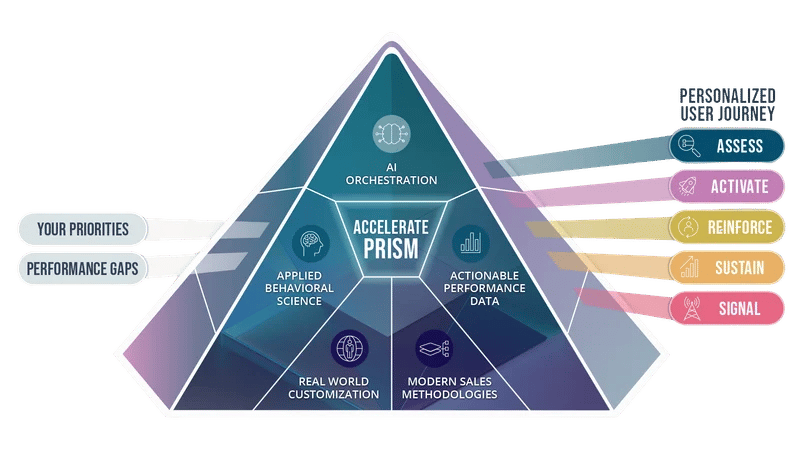
Take A Guided Tour of Richardson’s AI-orchestrated Sales Excellence System

FAQ: Scaling Behavior Change in Sales Organizations
What is sales behavior change?
Sales behavior change is the process of helping sellers consistently apply new skills, methods, and decision patterns in real selling situations. It goes beyond knowledge transfer by focusing on what sellers actually do before, during, and after customer interactions.
How can sales leaders scale behavior change after sales training?
Sales leaders can scale behavior change by defining the behaviors that matter, personalizing reinforcement, embedding practice and feedback, equipping managers to coach, and using leading indicators to monitor adoption.
What role does AI play in sales behavior change?
AI can help identify priority behavior gaps, personalize learning, recommend next best actions, support practice and feedback, sustain engagement, and surface performance signals. AI is most effective when it amplifies a clear behavior change architecture.
How should sales organizations measure training impact?
Sales organizations should measure both leading and lagging indicators. Leading indicators show whether sellers are applying target behaviors. Lagging indicators show business results such as revenue, win rate, deal velocity, forecast accuracy, or price discipline.
From Training Investment To Behavior Change Infrastructure
For years, sales leaders faced a difficult tradeoff.
They could deliver training broadly and risk making reinforcement too generic to change behavior. Or they could personalize development and make the effort too resource-intensive to sustain across the organization.
AI-enabled orchestration changes that equation.
The future of sales training is not more content. It is a more precise, personalized, measurable behavior change.
Behavior change is hard. But for the first time, sales organizations have a realistic way to operationalize it at scale.
And that changes what leaders should expect from their next sales training investment.