Why Doesn’t Your Sales Data Tell You How to Improve Seller Performance?
Sales performance improvement

Written by: Ben Taylor, MBA, Content Marketing Manager, Richardson
Published: November 13, 2026
Data can tell sales and enablement leaders what is happening, but rarely can it tell them why something is happening. To address performance gaps, drive improvement, and succeed, sales organizations need the “what” and the “why.”
Knowing the “why” means understanding what selling behaviors drive the metrics. By seeing the link between metrics and behavior, leaders can identify and prioritize the behaviors that have the greatest impact on the organization’s strategy.
Making this link has never been more important, given that 83% of chief sales officers say their sellers struggle to adapt to changing buyer expectations.
Key Takeaways
- Sales data shows what happened, not the selling behaviors that led to it.
- Metrics like win rate and pipeline velocity can’t capture soft factors such as access to decision makers or the strength of a value proposition.
- Linking each metric to the behaviors that drive it turns data into a clear picture of what to develop.
Why Has More Sales Technology Led to More Data, but Not More Answers?
Tech innovation continues to reshape customer needs and perceptions of value. Its influence has also extended into the selling organization. As leaders strive to track and understand the customer’s changes, they have built their tech stack higher and higher.
The intent of these ever-growing tech stacks has been to empower the seller with greater resources and, therefore, more ways to win the sale. However, the outcome has not reflected the intent. More tech has led to more data, not more answers.
What Are the Three Problems With Sales Performance Data?
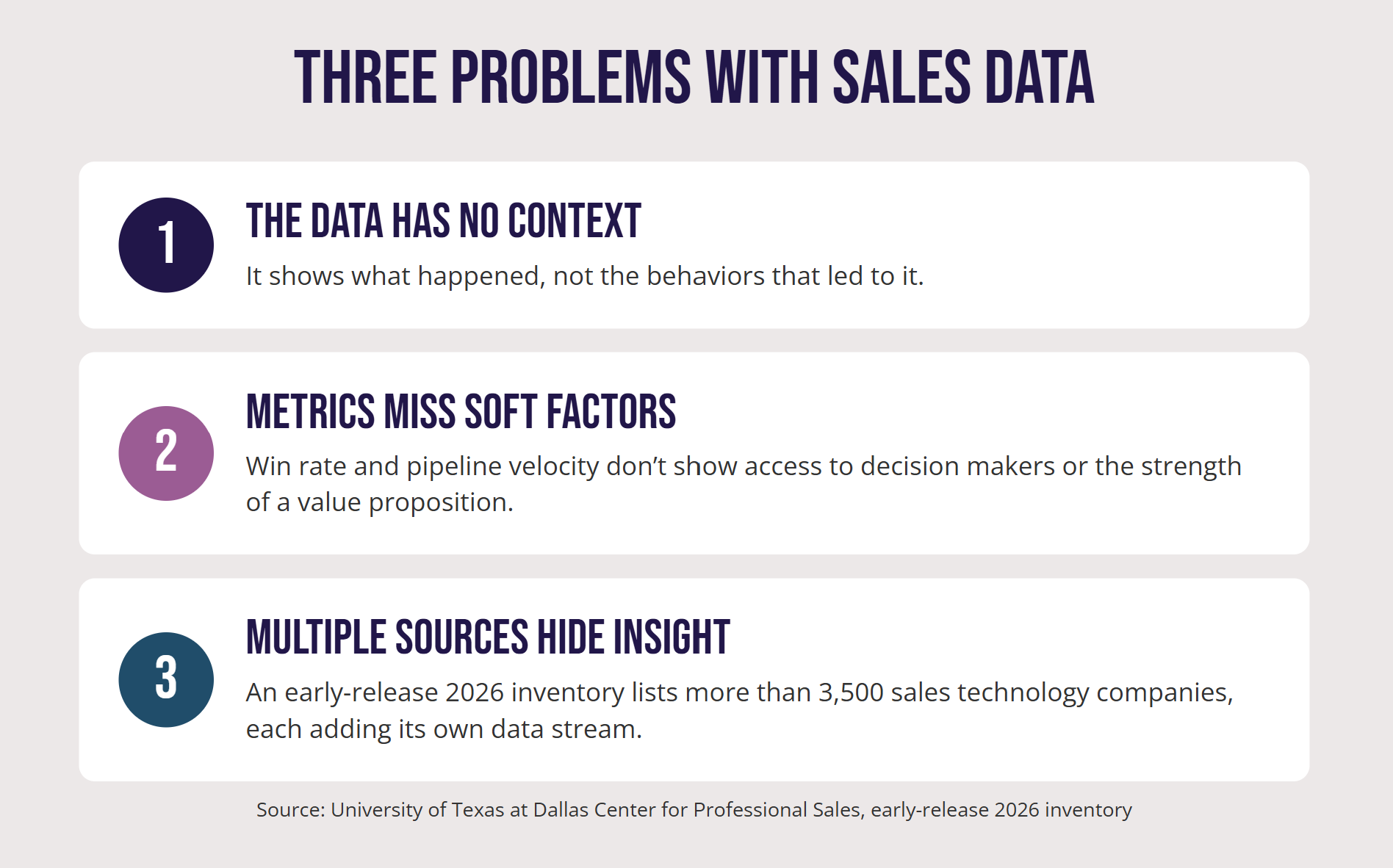
1. The data is without context
It represents what happened, but not the behaviors that led to that end.
2. Metrics reflect hard data, not soft factors
Win rate and pipeline velocity are valuable, but they don’t show soft factors like the ability to access decision makers or create a compelling value proposition. Effective selling requires an understanding of both.
3. Multiple data sources make insights hard to find
The sales technology landscape is vast. An early-release 2026 inventory from the University of Texas at Dallas Center for Professional Sales includes more than 3,500 companies. Managing multiple sources of data, and the inconsistencies within those streams, has made it difficult to distill insights from volumes of information.
What Does This Mean for Sales Enablement Teams?
This abundance of data has left enablement leaders overwhelmed with last-minute, ad-hoc requests, prioritizing urgency over strategy. The three problems above make it difficult for enablement leaders to partner strategically with the business to drive long-term performance that aligns with the organization’s sales imperatives. Instead, they find themselves in a reactive, task-oriented mode.
That prevents enablement professionals from delivering the kind of value they’re capable of. Enablement leaders can proactively develop the most critical selling behaviors within the sales team. Torrents of data, like rising flood water, leave them struggling to keep their heads above the surface.
How Do You Connect Performance Metrics to Selling Behaviors?
When leaders identify which selling behaviors drive key metrics, they can prioritize those most critical to the organization’s objectives. That gives sales and enablement leaders powerful control over the success of their sales strategy and enablement outcomes.
The current enablement approach, focused on training and communication, is effective at skill development and change awareness. Yet it often fails to drive execution, action, and, by extension, sales results. Enablement must expand beyond training and communication. Gartner research points the same way: align enablement with the behaviors the sales strategy needs, and measure whether those behaviors change. That means identifying the behaviors correlated with commercial success, scaling them across the sales force, and measuring their impact.
Start by defining what good looks like
Leaders need the list of selling behaviors required to succeed at any point in the sale. Building this list takes months or even years, because so many stakeholders in the selling organization have unique opinions on what capabilities and behaviors constitute “good.”
There is a way to jump to the end of this process. Richardson has spent more than 45 years training some of the largest sales organizations, and in doing so, has honed its understanding of what belongs in this framework.
Richardson’s framework is segmented into meetings, motions, and methods. Together, these represent the macro organizational view. Each area is further segmented into a set of capabilities and behaviors that underpin any effective sales strategy. This segmentation lets leaders carefully select the behavior or combination of behaviors relevant to a given seller. That role-based personalization earns the seller’s commitment to the process, because they know they will receive training on key revenue-relevant behaviors.
Shared definitions also give teams a common way to measure. Phil Peabody, Chief Lending Officer at Capital Farm Credit, says Richardson “gave us a common language and a common vocabulary and allowed us to start to centralize some of those different metrics.”
How Do You Find the Behavior Gaps Sellers Have?
The role-based framework gives leaders the full scope of capabilities and behaviors needed to win. Putting it to use means knowing the gaps sellers have relative to the framework. Leaders need a subjective and objective approach based on observable and metric-measured behaviors.
Making this process work means learning which behaviors in the framework drive the different business performance metrics. The result is a clear picture of where to focus interventions and a way to measure outcomes.
That specificity changes how coaching works. Darnetta Daire, Sales Enablement Manager at Hollister Incorporated, says: “We’re able to coach specifically to, hey, how are reps doing with understanding needs? How are reps doing with connection? How are reps doing with recommending our products?”
Richardson’s Accelerate Prism visualizes these connections by pulling together the selling organization’s data from multiple platforms in one place. The result is a clear, real-time representation of the behaviors an individual seller needs to develop to drive results.
How Do You Keep This Approach Working Over the Long Term?
Linking business metrics to in-field performance gaps must be operationally efficient to last. If it’s not easy, it won’t last. Leaders cannot rely on spreadsheets to manage and track metrics and correlated behaviors. There are hundreds of sellers across an increasingly complex revenue tech stack, and recording and distributing this information by hand is impractical and lacks the speed needed to act on insights quickly. Richardson’s guide to keeping a capability framework working over the long term covers the practical steps.
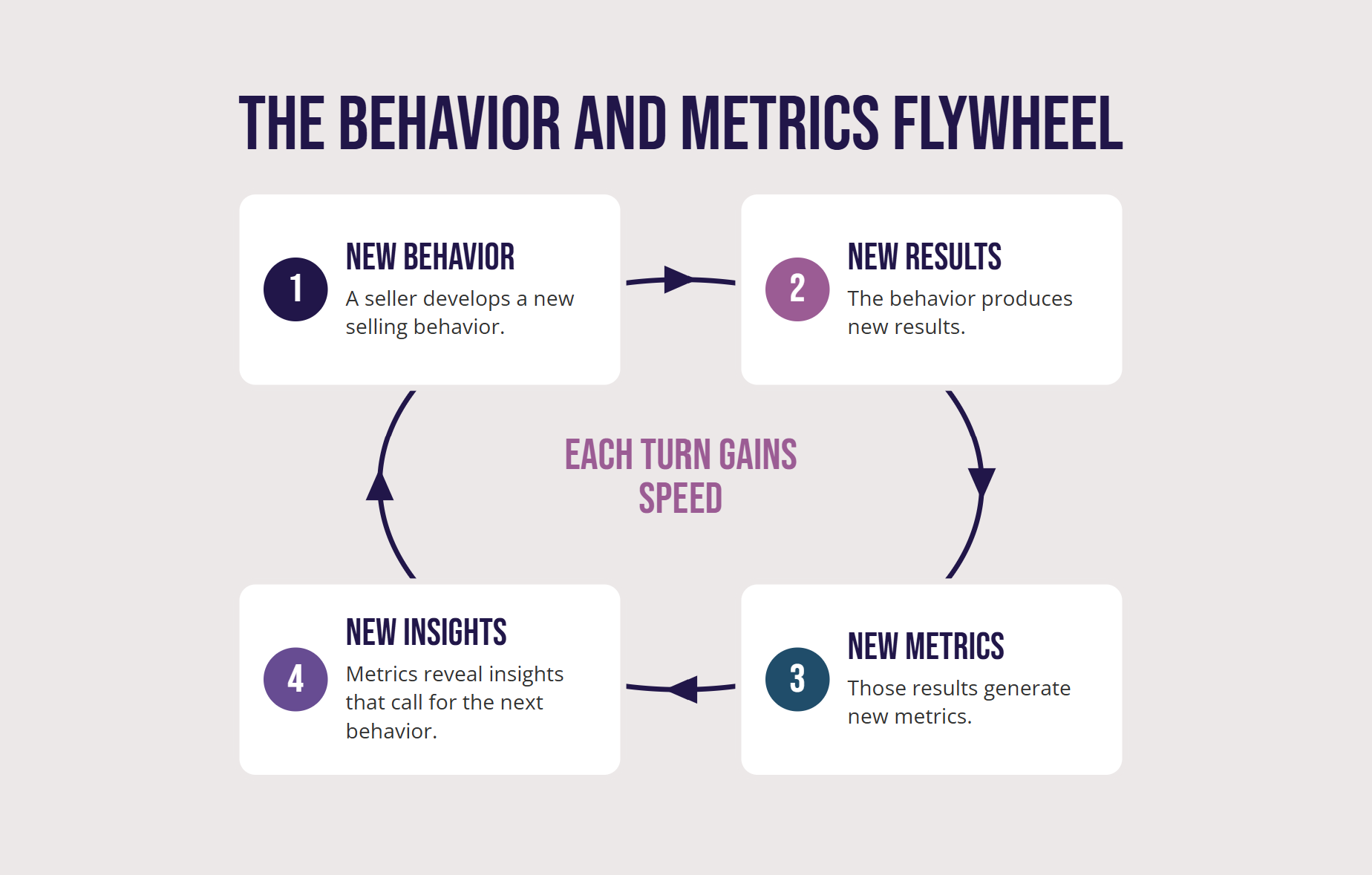
The process must also continue in perpetuity, because skill gaps change. Once a seller develops a new selling behavior, they see new results. These new results generate new metrics. New metrics reveal new insights, which, in turn, call for the development of new behaviors. The flywheel gains speed, and enablement leaders increasingly refine their strategy, which leads to closer alignment with revenue teams.
This process also makes it easy to trace a clear and direct line from metrics to behaviors to improvement and results. That throughline shows leaders and sellers that the approach works, which quickly builds their commitment to it. Individual sellers get a personalized learning plan that continuously drives skill improvement, and sales and revenue leaders get data-driven insights into how their team’s development is affecting revenue and where to go next.