How Can Sales Enablement Prove the Impact of Sales Training?
Sales performance improvement

Written by: Ben Taylor, MBA, Content Marketing Manager, Richardson
Published: November 9, 2026
How long would it take to calculate the GDP of a country home to millions of people?
It could take weeks or even months to source and compile the necessary data. Moreover, while you gather the numbers, the picture could change. Spending might increase, or investments could fall. Some of the numbers may not even be available.
A few economists faced this problem when calculating the GDP of several countries, so they developed a new approach.
They measured GDP by studying satellite photos showing the amount of nighttime light emitted. As it turns out, rising and falling light output closely track changes in GDP. In fact, this kind of analysis is so effective that it can even be used to estimate economic growth at the city level.
The work of these economists tells us that knowing what to look at and where to look is more effective than attempting to assess volumes of data. This idea has powerful implications for sales organizations today, in which data is vast in quantity but limited in its ability to shed light.
Key Takeaways
- Tie training to the selling behaviors that drive the metrics leaders already track, such as win rate.
- Personalize development for each seller, then track whether those metrics move as behaviors improve.
- Repeat the cycle, because the results show what to continue and what to adjust.
Why has it been so hard to prove the impact of sales training?
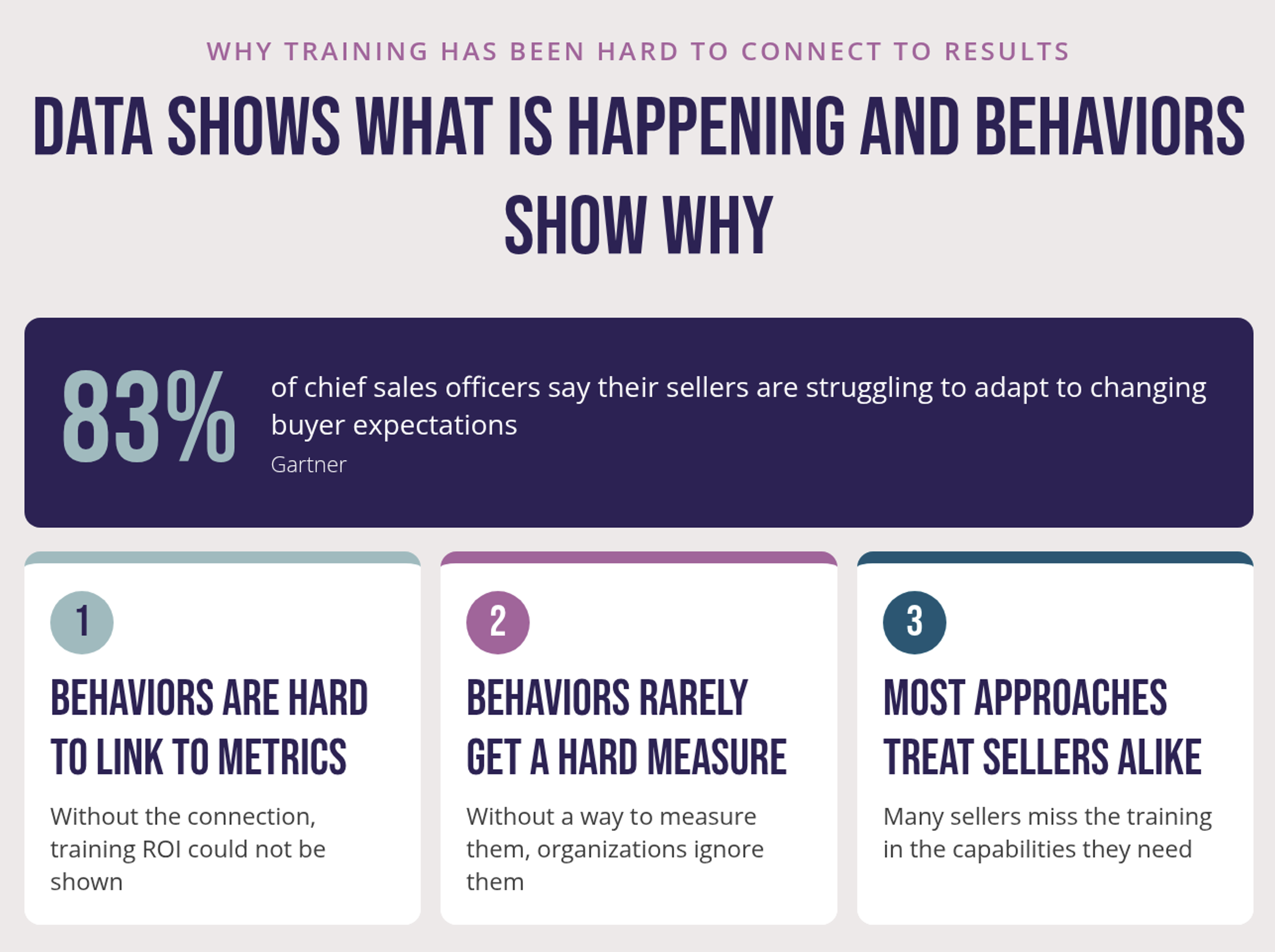
Enablement efforts increasingly struggle to impact the sales team's performance. A Gartner survey found that 83% of chief sales officers say their sellers are struggling to adapt to changing buyer expectations. This challenge comes at a time when sales and performance data is more abundant than ever. More data should equip enablement teams with more insights and, in turn, more revenue. It hasn't.
Data offers only part of the picture. Data tells you what is happening but not why. Three reasons explain why training has been hard to connect to results:
- Behaviors have been hard to link to metrics. It has been difficult to identify the specific selling behaviors correlated to performance metrics. Without this connection, there was no way to demonstrate the impact or ROI of training, so training has always faced skepticism.
- Behaviors rarely get a "hard" measure. Sales organizations have many hard measures — win rate, pipeline velocity, and time to productivity. Most don't put hard measures on behaviors, so behaviors seem "soft." The adage "What gets measured gets managed" is all too true. Without a way to measure behaviors, organizations ignore them.
- Most approaches treat all sellers the same. Changing seller behavior is difficult because many sellers do not receive the specific training in the individual capabilities they need to succeed.
Enablement leaders also operate in react mode, handling the latest request to solve some pain point. These tasks rarely add up to a single, cohesive plan for meaningful performance improvement.
What does it mean to connect selling behaviors to sales metrics?
Data is critical, but context is paramount. If the data tells you what is happening, you need context for why, and selling behaviors give you that context. They show what is happening in the field with customers.
Consider a declining win rate. The data might tell leaders that the sales team is losing more opportunities to new, low-cost competitors. However, this information falls short of identifying ways to correct the problem. By correlating the falling win rate to a selling behavior, like an inability to properly articulate the value of the solution, leaders can begin to resolve it.
Changing selling behaviors also shows results sooner than levers that take longer to move, like product innovation, pricing strategies, and portfolio changes.
How do you prove the link between training and results?
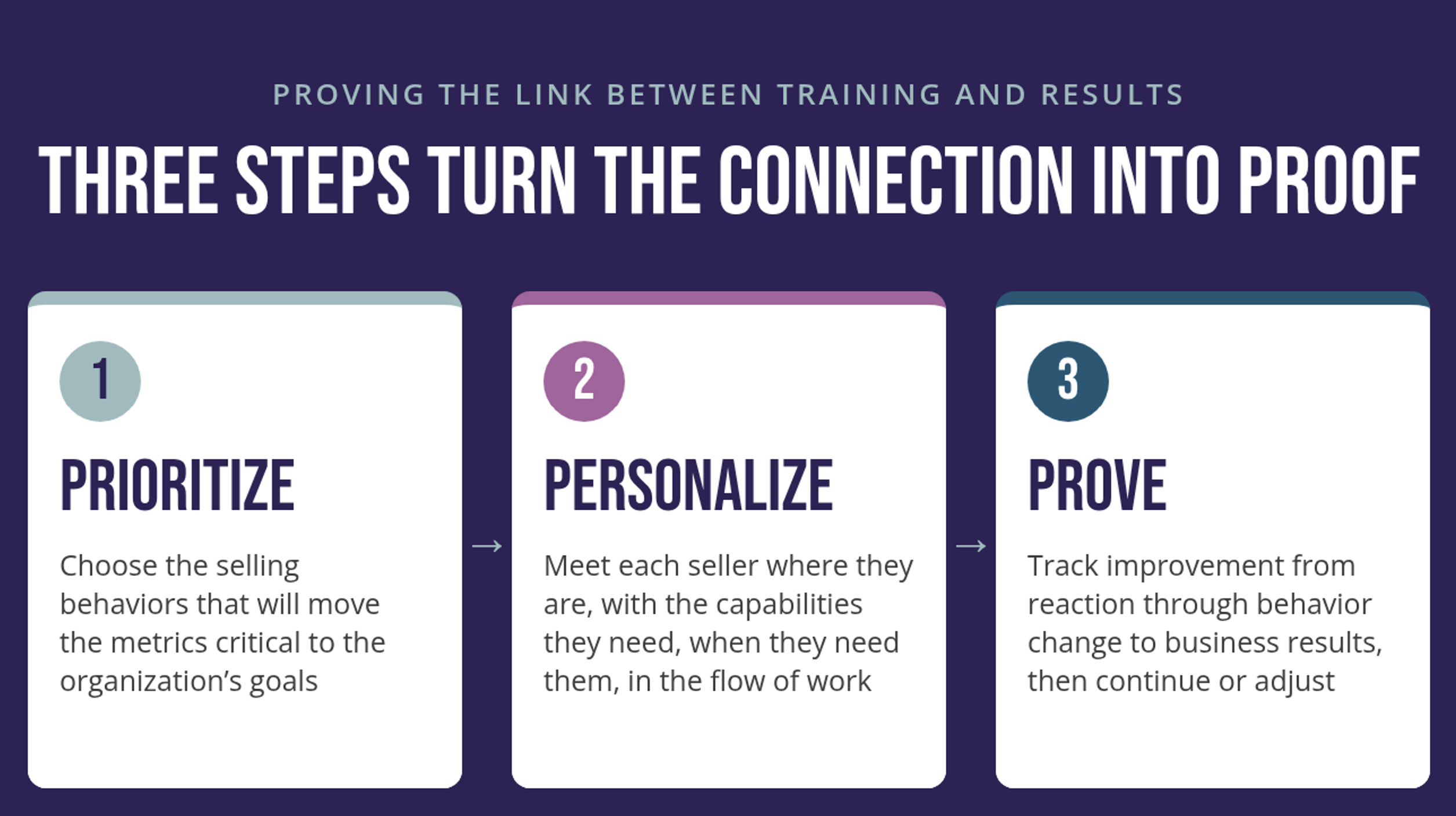
Three steps turn the connection into proof: prioritize, personalize, and prove.
1. Prioritize the behaviors that matter most
Leaders first need to understand which selling behaviors will be most impactful in reaching their sales goals. Doing so means connecting behaviors to leading and lagging metrics to visualize how specific behaviors move the metrics critical to the organization's goals. This converts the broad language of strategy into precise, individual capabilities.
The idea behind this process is that performance data no longer represents an advantage. Everyone has it. Success will flow to those who use it more effectively.
Richardson helps leaders connect metrics to behaviors using a group of behavioral science-backed critical selling skills curated over more than 40 years. These skills enable sellers to succeed across three key areas: sales meetings, motions, and methods.
| Area | Capabilities | Example behaviors |
|---|---|---|
| Motions — Create | Market Knowledge, Prospecting Efficiency, Prospecting Effectiveness | Know the Market, Target Ideal Prospects, Ask for Referrals |
| Motions — Capture | Discovery, Value Differentiation, Solution Creation, Solution Positioning, Win-Win Negotiations | Diagnose and Quantify Pain, Position Quantifiable Value, Control the Negotiation |
| Motions — Grow | Strategic Account Growth | Identify White Space, Cross Sell and Upsell |
| Meetings | Sales Meeting Execution, Conversational Agility, Difficult Buyer Conversations, Stakeholder Management | Actively Listen, Check for Feedback, Resolve Objections, Analyze Stakeholders |
| Methods | Selling Standards, Agile Opportunity Pursuit Management | Qualify Opportunities, Forecast Accurately, Manage a Pipeline |
2. Personalize the skill development process
Once leaders know which behaviors are the priority based on their metrics, they need to think about how to change them and make them last. The best approach is to personalize learning because different combinations of selling behaviors are necessary for different sales roles. Even sellers within the same role have different needs based on their natural abilities, the specific opportunities they're pursuing, and the stage of the sale.
A seller focused on strategic account growth needs to target specific behaviors like identifying white space, cross-selling, and upselling. In contrast, a seller focused on business development needs to develop specific capabilities in creating compelling prospecting messages and asking for referrals.
Personalized learning meets the seller where they are. It offers them the exact capabilities where and when they need them. This practicality and immediacy make sellers highly receptive to training because it is revenue-relevant and tailored to them.
It is very powerful to show sellers how a particular behavior will help them improve their win rate. And when they have improved that behavior and their metrics begin to shift, their appetite for development will only increase.
Critically, a personalized approach allows new behaviors to develop in the flow of work. Sellers can apply the new behaviors as they learn them. These new behaviors then impact outcomes and metrics, which feed back into the system and refine the insights that follow. Learning techniques like spaced repetition, short-burst content, and nudges all allow learning to happen without having to step off the field.
3. Prove the link between efforts and outcomes
With this approach, leaders can prove to themselves, their sellers, and the organization that the link between metrics and behaviors has a measurable impact on success. Citing this link helps everyone see that adaptive advantage — the ability to respond to circumstances quickly and effectively for ongoing development — is real.
Gartner's research on sales enablement points the same way. It advises sales leaders to require measurement that attributes specific behavior changes to enablement initiatives and ties them back to sales goals and KPIs. Richardson's approach to measurement follows the same logic, tracking improvement at every stage of the learning journey, from initial reaction through behavior change to business results.
Proving the link between efforts and outcomes also shows how well the sales and enablement leaders' strategy translates into forward movement. A process like this always yields value, because the feedback either tells leaders that what they're doing is effective or that it's not. In both cases, the data provides actionable, directional cues on what to do next: either continue with the selling behaviors or adjust those that aren't working. The result is meaningful, continuous change at scale.
OB Hospitalist Group offers one example of measured results. After working with Richardson on agile selling training, they achieved a 7-percentage-point increase in closed win rates compared to the previous year. Additionally, new hospital commitments are projected to rise by 28% year over year.
Richardson's Accelerate Prism connects behavior and performance data to show what's working, where support is needed, and how development is impacting results.
Why does this approach get stronger over time?
- Existing resources yield new value. Most selling organizations already have the data that fuels this approach, so it's relatively easy to implement. That data will likely represent several years of sales performance, giving leaders a running start as they seek to understand the behavior-metric connection. As they gain more utility from their sales tech stack, the costs of those investments fall, and the ROI rises.
- The network effect emerges. As more sellers record their capabilities — both where they're strong and where they're lacking — leaders can more clearly see the broad directional cues that inform their long-term strategy for driving sales performance at scale. Managers also gain visibility into behavior-level gaps across individuals and teams, which shows where coaching will help most.
- Sellers overcome path dependence. Path dependence is the idea that past designs — like a fixed railway — tend to constrain future options. A metric-based capability development process encourages leaders and sellers to constantly check their assumptions and verify that their actions generate the intended outcomes. That makes it more adaptable than a fixed process, and changes can happen throughout the pursuit, so sellers can develop even when they're in the field.
Richardson helps sales organizations link the performance metrics that matter to the specific selling behaviors that move them. As a result, leaders more effectively convert their sales strategy to in-field selling behaviors. Data becomes useful. Progress becomes visible. Skepticism becomes certainty.