How Insurance Carriers Become Strategic Partners to Brokers
Sales performance improvement

Written by: Claire Imber, Director of Content Strategy & Thought Leadership
Published: October 16, 2026
Insurance carriers have invested heavily in digital transformation over the last decade. Across underwriting, claims, and distribution, leaders have deployed new tools designed to increase efficiency, improve broker engagement, and accelerate growth.
Yet while technology investments continue to rise, many carriers tell Richardson that sales productivity and broker relationship growth have not kept pace. The wider market shows a related pattern: McKinsey's Global Insurance Report 2025 found that while personal lines property and casualty premiums grew 9.5% in 2022–23, premiums as a share of nominal GDP stayed under prepandemic levels.
In those conversations with insurance executives, a common theme emerges: digital initiatives generate incremental improvements but rarely translate into stronger strategic relationships with brokers and distribution partners. The challenge is not a lack of digital innovation. It is the difficulty of converting small operational wins into sustained commercial growth.
Key Takeaways
- Carriers become strategic partners when sellers use data and digital insights to help brokers grow their business, not just process submissions faster.
- Digital tools that streamline transactions make a carrier easier to work with, but on their own they rarely change the sales conversation.
- Broker relationships that stay tactical leave account penetration stalled and growth dependent on market cycles.
- Carriers that invest in how sellers engage brokers, alongside the technology, turn small operational wins into larger, more strategic accounts.
What Does a Strategic Partner Do Differently?
Imagine a regional broker who has worked with a carrier for years. They know the underwriting team, they submit business regularly, and they value the relationship. But from the broker's perspective, every interaction still feels transactional. They log into the portal, submit the risk, and wait for the quote. Even when the process is efficient, the relationship remains purely operational.
Now imagine a competitor that uses data and digital insights to approach that same broker differently. They identify growth opportunities in the broker's portfolio, share insights about emerging risks, and proactively help the broker develop new client strategies. This is where the conversation changes. The competitor is no longer just a carrier. Instead, they become a partner in the broker's growth. Over time, those conversations turn small operational wins into deep strategic relationships.
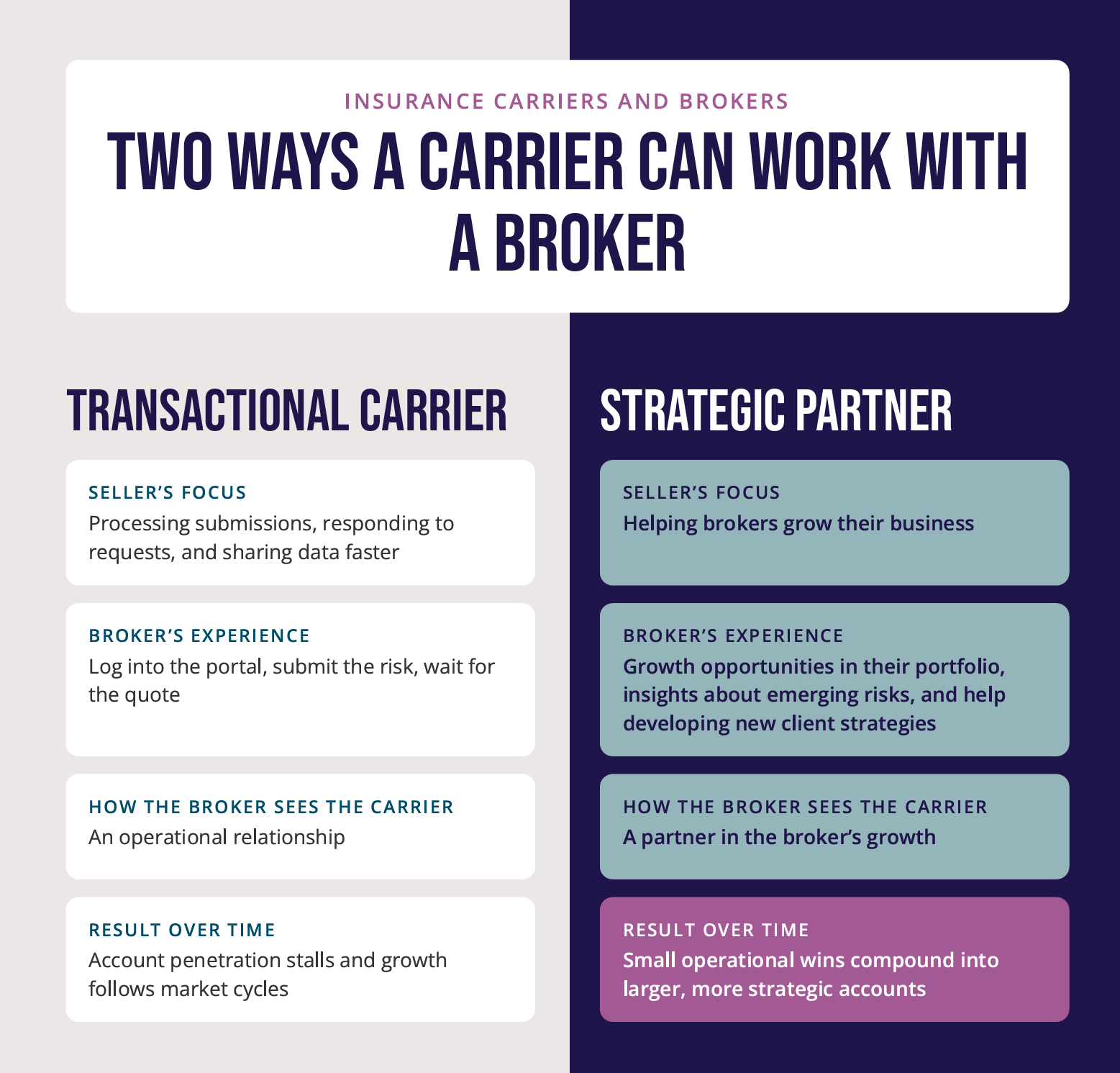
| Transactional Carrier | Strategic Partner | |
|---|---|---|
| Seller's focus | Processing submissions, responding to requests, and sharing data faster | Helping brokers grow their business |
| Broker's experience | Log into the portal, submit the risk, wait for the quote | Growth opportunities in their portfolio, insights about emerging risks, and help developing new client strategies |
| How the broker sees the carrier | An operational relationship | A partner in the broker's growth |
| Result over time | Account penetration stalls and growth follows market cycles | Small operational wins compound into larger, more strategic accounts |
Richardson customers have made this kind of shift. Kristin Krawczyk, senior sales director at Cencora, describes a team that moved from a very transactional approach to a much more consultative one, and says a common methodology and shared vocabulary have been most important to her as a leader of leaders.
Why Doesn't Efficiency Alone Make a Carrier a Strategic Partner?
Most carriers approach digital transformation as a technology modernization effort, deploying tools like broker portals, CRM systems, digital quoting platforms, and data and analytics dashboards. The assumption is straightforward: If technology improves efficiency, sales teams will naturally build stronger relationships, resulting in account growth. But efficiency improvements alone rarely change how sales teams engage brokers. Digital tools make existing activities faster, but they do not fundamentally change the sales conversation.
The real barrier to growth is not technology adoption. It is the gap between operational improvements and relationship expansion. When digital initiatives focus primarily on process improvement, sales teams often use them to support transactional interactions: processing submissions faster, responding to requests more quickly, and sharing data more efficiently.
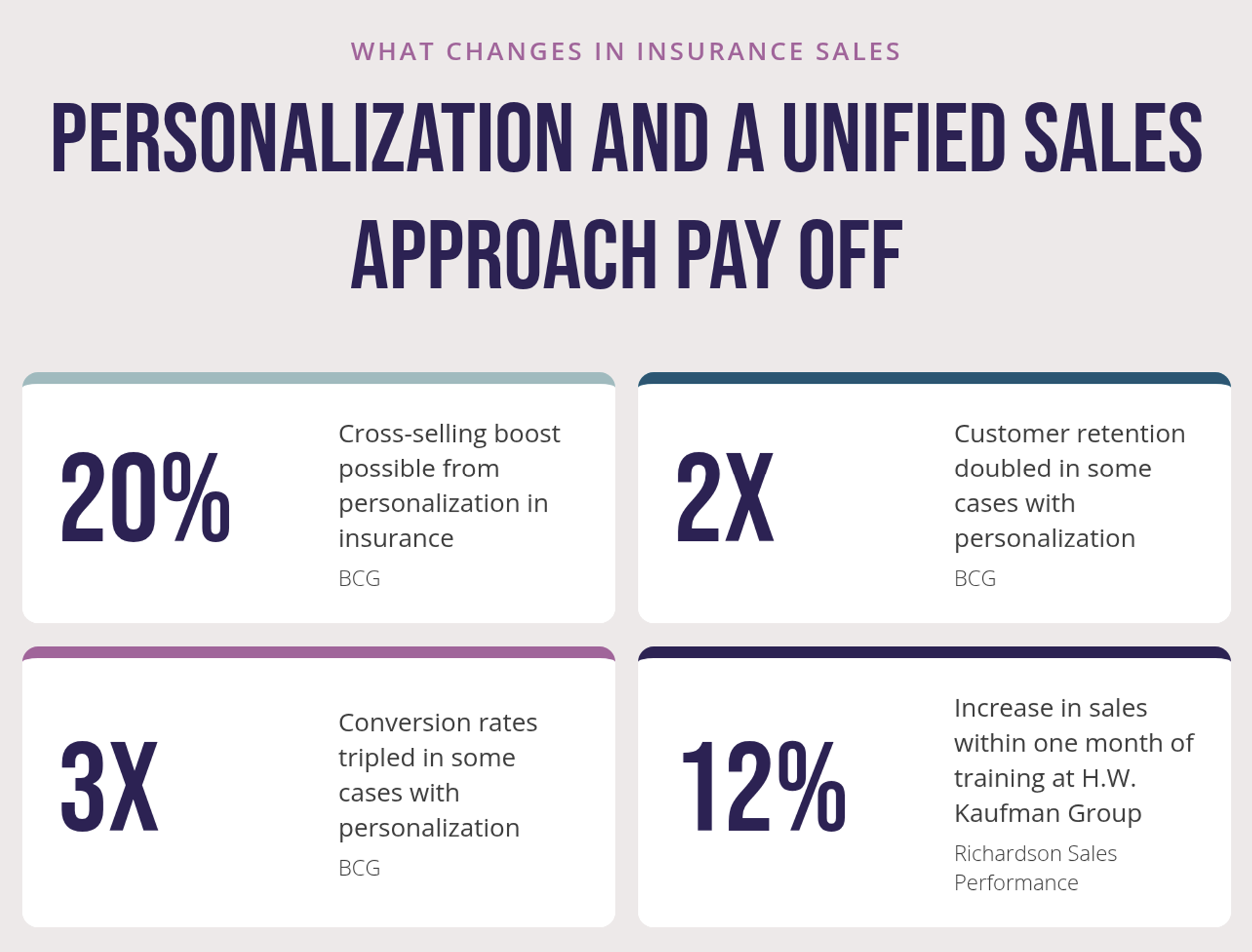
While valuable, these improvements primarily help carriers win individual deals, not deepen broker partnerships. Without a shift in how sellers engage brokers, digital investments risk reinforcing the status quo rather than transforming relationships. Consider research from BCG, which found that personalization in insurance can boost cross-selling by as much as 20% and in some cases has helped double customer retention and triple conversion rates.
What Does Staying Transactional Cost Carriers?
The cost shows up in distribution economics. Bain and Company's 2024 insurance loyalty research found that insurance consumers still rely heavily on people to supplement digital channels, especially for complex issues such as claims.
Some insurers now go beyond transactional efficiency and add value-added services that meet customers' wider needs; Bain describes risk-prevention services as still more promise than reality, but a significant opportunity.
Insurance sellers who don't learn about the customer's broader needs find themselves most vulnerable to technology that merely guides a single transaction. In this setting, broker relationships remain tactical, account penetration stalls, and growth becomes increasingly dependent on market cycles rather than relationship expansion. In other words, digital efficiency unintentionally reinforces activity without impact.
How Can Digital Tools Help Carriers Become Partners?
In Richardson's view, the carriers that get the most from digital transformation are those that use technology to elevate sales conversations. Instead of focusing solely on process automation, they use digital capabilities to help sellers identify high-value broker opportunities, uncover emerging client risks, provide proactive insights to brokers, and position themselves as strategic partners.
Digital tools do not replace relationships. They strengthen the seller's ability to create value in every interaction. The goal shifts from simply processing transactions faster to helping brokers grow their business. When that shift occurs, small operational wins begin to compound into stronger partnerships, and ultimately into larger, more strategic accounts.
What Should Insurance Leaders Prioritize?
For insurance leaders investing in digital transformation, the key lesson is clear: Technology alone does not create stronger relationships. To realize the full value of digital transformation, organizations must also invest in how their sellers engage brokers and clients. That means focusing on three priorities:
- Elevate the sales conversation. Equip sellers with insights that help brokers grow their business, not just select and execute policies.
- Focus on relationship expansion. Use digital data to identify the brokers and opportunities with the greatest strategic potential.
- Align technology with human expertise. Ensure digital tools empower sellers to deliver more value in every conversation.
When organizations combine digital capabilities with stronger commercial engagement, they unlock the true promise of transformation: turning small operational wins into big, lasting relationships.
Helping One of the World's Largest Commercial Insurers Deepen Broker Relationships
As one of the world's largest commercial insurers, the company operates an extensive broker distribution network. Maintaining strong broker engagement while scaling globally is critical to sustaining growth.
To support this objective, the insurer partnered with Richardson to strengthen the consultative capabilities of its sales and distribution teams. The focus was not simply on improving sales activity, but on helping teams deepen broker conversations, better understand client business challenges, and position their expertise as a strategic advantage.
By strengthening the quality of sales conversations and reinforcing a consultative engagement model, the insurer empowered its teams to convert everyday interactions with brokers into opportunities to build deeper relationships. The result was stronger broker engagement and a greater ability to turn operational interactions into long-term partnerships.
Richardson's work with insurance teams extends beyond this example. H.W. Kaufman Group, a global insurance network with 300 products and more than 1,200 associates, partnered with Richardson to unify its sales approach and saw a 12% increase in sales within one month of training.