How Sales Leaders Can Adopt AI Without Hurting Seller Performance
Sales performance improvement

Written by: Ben Taylor, MBA, Content Marketing Manager, Richardson
Published: October 16, 2026
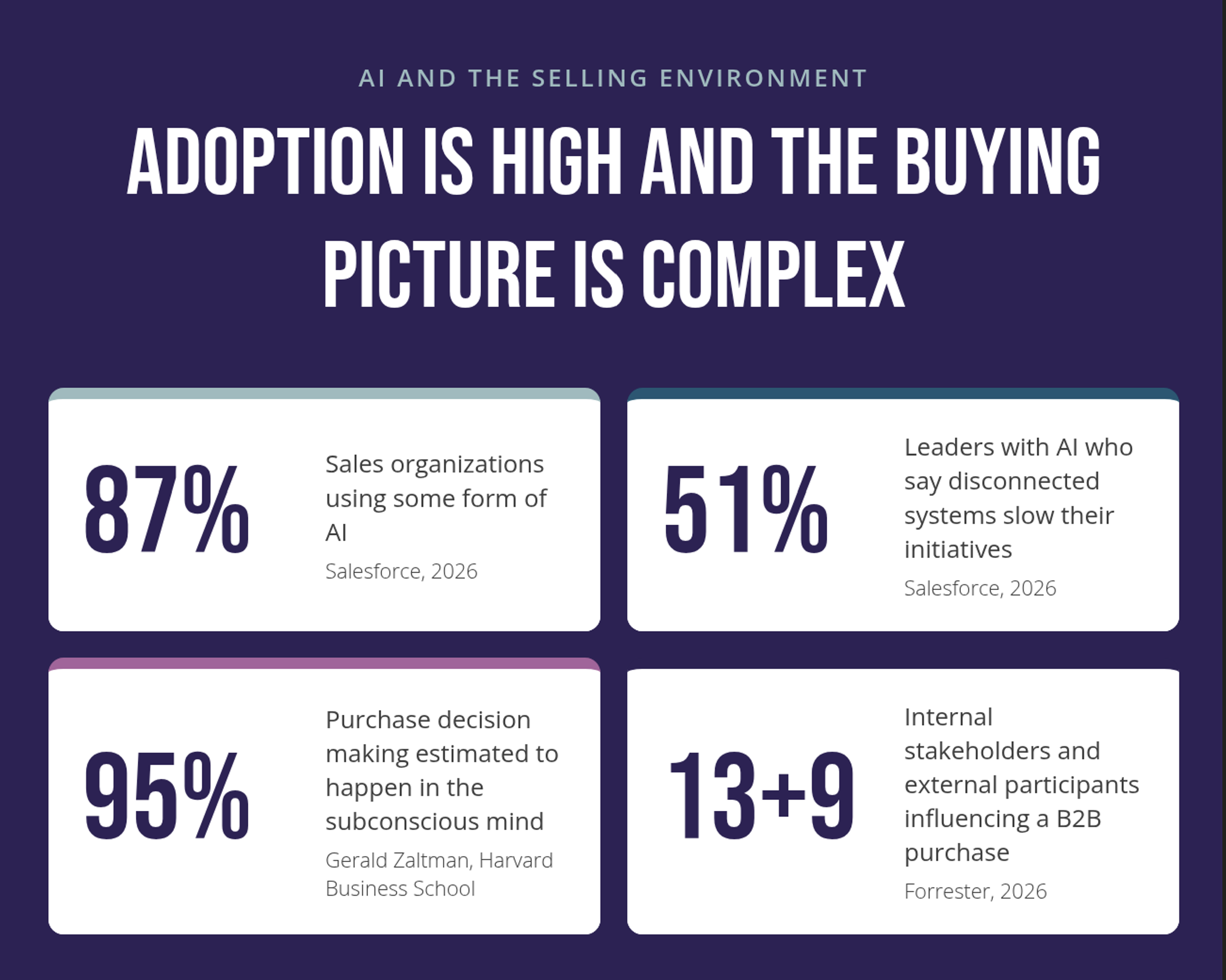
AI has arrived in sales fast. New tools promise efficiency and efficacy through machine learning. Salesforce’s 2026 State of Sales report found that 87% of sales organizations now use some form of AI for tasks like prospecting, forecasting, lead scoring, and drafting emails.
As businesses rush ahead, some are asking whether AI can deliver. Richardson Sales Performance’s view: AI is a useful sales tool, and it works best when leaders account for its limitations. We see those limitations as three key challenges.
Key Takeaways
- Make the technology part of your sales methodology instead of the entire approach.
- AI is only as strong as the underlying data.
- Leaving critical thinking to AI means technology, not the person, benefits from experience.
- AI systems cannot properly estimate the influence or direction a customer’s emotion has on a decision.
- Proceed with caution, use AI as a supplement, question the data, and train teams to use AI wisely.
Why Does the Quality of Data Limit What AI Can Do?
In the late 1700s, people became fascinated with a lifelike robot called the Mechanical Turk. The machine could engage players in a game of chess. The robot’s arms moved pieces across the board and amazed players. The inventor toured the machine around Europe, thrilling visitors. In time, observers exposed the “automaton” as a hoax. A man, hidden within, used a system of levers and pulleys to move the “robot.” Like the Mechanical Turk, AI is only as strong as what resides within.
Existing Data Has Inaccuracies
The underlying data informs all of AI’s outputs. The problem: data is often flawed, incomplete, or irrelevant. Consider the finding from Salesforce’s 2026 State of Sales report: 51% of sales leaders with AI said disconnected systems are slowing their AI initiatives.
Poor data management matters because this same data forms the basis for AI-generated recommendations. Manual processes invite inaccuracies. Administrative activities increasingly burden sales professionals. They must enter data and record activities at the expense of time with the customer. AI could make that worse as the technology grows and demands even more data.
Some Data Cannot Be Quantified
Even accurate data limits AI functionality because the existing data only reflects information that can be expressed as a data point. Harvard Business School professor Gerald Zaltman has estimated that 95% of purchase decision making happens in the subconscious mind. Sales professionals cannot log these subconscious processes into a system. This problem grows as the number of decision makers grows. Each stakeholder has unique biases. These important cues unfold in real time. The sales professional doesn’t have time to refer to AI tools when the customer’s needs change within the course of the conversation. These rapid changes show the shift between “System 1” and “System 2” thinking.
System 1 is fast and emotional, while System 2 is slow and analytical. In Thinking, Fast and Slow, Nobel Prize–winning psychologist Daniel Kahneman explains that when all goes smoothly, System 2 adopts the suggestions of System 1 “with little or no modification.” This finding highlights the role of emotion in buying decisions because fast, emotional thinking informs so much of the analytical thought occurring in System 2 thinking.
Confirmation Bias Skews Data
Machine learning is the function behind most AI solutions. However, learning cannot occur without all of the relevant information. Often, the person inputting information determines what is relevant. That dynamic is a problem because confirmation bias reveals how often we dismiss relevant information. Confirmation bias occurs when we choose to focus only on information that confirms our existing beliefs while ignoring contradictory data.
All people are subject to this inherent bias. The problem occurs when confirmation bias influences what data the user chooses to input into the system and what they leave out. While AI might claim to take an unbiased approach, in truth, bias shapes the data powering AI.
When AI Became a Four-Letter Word
More than a decade ago, the developers behind IBM’s AI program called Watson decided they needed a way to equip the computer with natural language capabilities. They needed Watson to understand human speech, even when the speech is slang. The developers turned to the Urban Dictionary, an online repository of slang. They fed the complete database of informal language into Watson’s system. Soon after, the developers noticed a problem. “Watson couldn’t distinguish between polite language and profanity,” according to reporter Michal Lev-Ram with Fortune. The 35-person team developed a filter and removed the Urban Dictionary from Watson’s memory.
The lesson for sales data is the same: what goes in determines what comes out.
How Can AI Affect Seller Judgment?
The customer’s buying journey is more complex than it has ever been, because customers are learning as they move through the process. Their assumptions and needs change amid competing internal priorities. Tracking this iterative, dynamic process requires critical thinking.
The Continued Need for Original Thinking
Sales professionals face varying perceptions of risk, ROI demands, and negotiations. The more a sales professional engages this rigorous process, the more they develop their critical thinking abilities. Leaving this cycle of refinement to AI means that the program, not the person, benefits from experience.
As uncertainty reenters the C-suite, stakeholders have differing outlooks on the future. Some are bullish and supportive of new solutions. Others are hesitant to engage a new solution. The best tool for reconciling these differences is the sales professional’s critical thinking. A 2025 Microsoft Research and Carnegie Mellon survey of 319 knowledge workers points the same way: higher confidence in generative AI was associated with less critical thinking, while higher self-confidence was associated with more.
AI Is Often Anchored to a Fixed Pool of Strategies
Many AI selling tools ship with a preset library of selling skills, so their recommendations pull from established strategies and practices. This system can leave sales professionals anchored to a limited number of paths forward. It lets them forget that the available approaches to selling are unlimited. In some scenarios, the best way forward will not be one of these skills. Instead, an unconventional sale will require an unconventional approach.
The Empathy Gap
The empathy gap is a cognitive bias in which people have difficulty taking the emotional perspective of another person. Too often, we assume others will respond to a situation as we would. Or we imagine we would prevail when others falter. Effective sellers are aware of this gap, and they succeed when they overcome it.
AI risks widening this gap. Empathy is critical in selling because buying decisions are emotional. AI is not prepared to meet this challenge because AI systems cannot properly estimate the influence or direction the customer’s emotion has on a buying decision.
How Does AI Change Business Relationships?
Solutions are increasingly complex. The sales professional plays an important role here. They can articulate solution benefits in a way that connects to the customer’s world. Doing so, however, requires a relationship. Fostering such a relationship becomes difficult when AI occupies the space between the buyer and the sales professional.
Diffusion of Responsibility
Diffusion of responsibility occurs when a person becomes less likely to take responsibility due to the presence of others. This phenomenon may translate to sales professionals working with AI tools. With AI present, the sense of responsibility may be diluted, and one can attribute lost opportunities to AI rather than taking ownership. This result may intensify when the sales professional learns that leaders have staked the success of the selling organization, in part, on machine learning.
Selling Is Increasingly a Team Effort
As a greater number of decision makers enters the buying process, sales professionals are finding it necessary to sell as a team. Forrester’s 2026 research found that, on average, 13 internal stakeholders and nine external participants influence a B2B purchase decision, and the number rises for more complex or strategic purchases. Selling gets harder with multiple people on both sides of the table. Numerous decision makers mean navigating different needs and perceptions of value. For the lead sales professional, a selling team means extra work: building cohesion and supporting non-selling teammates like subject matter experts.
How Should Sales Leaders Adopt AI?
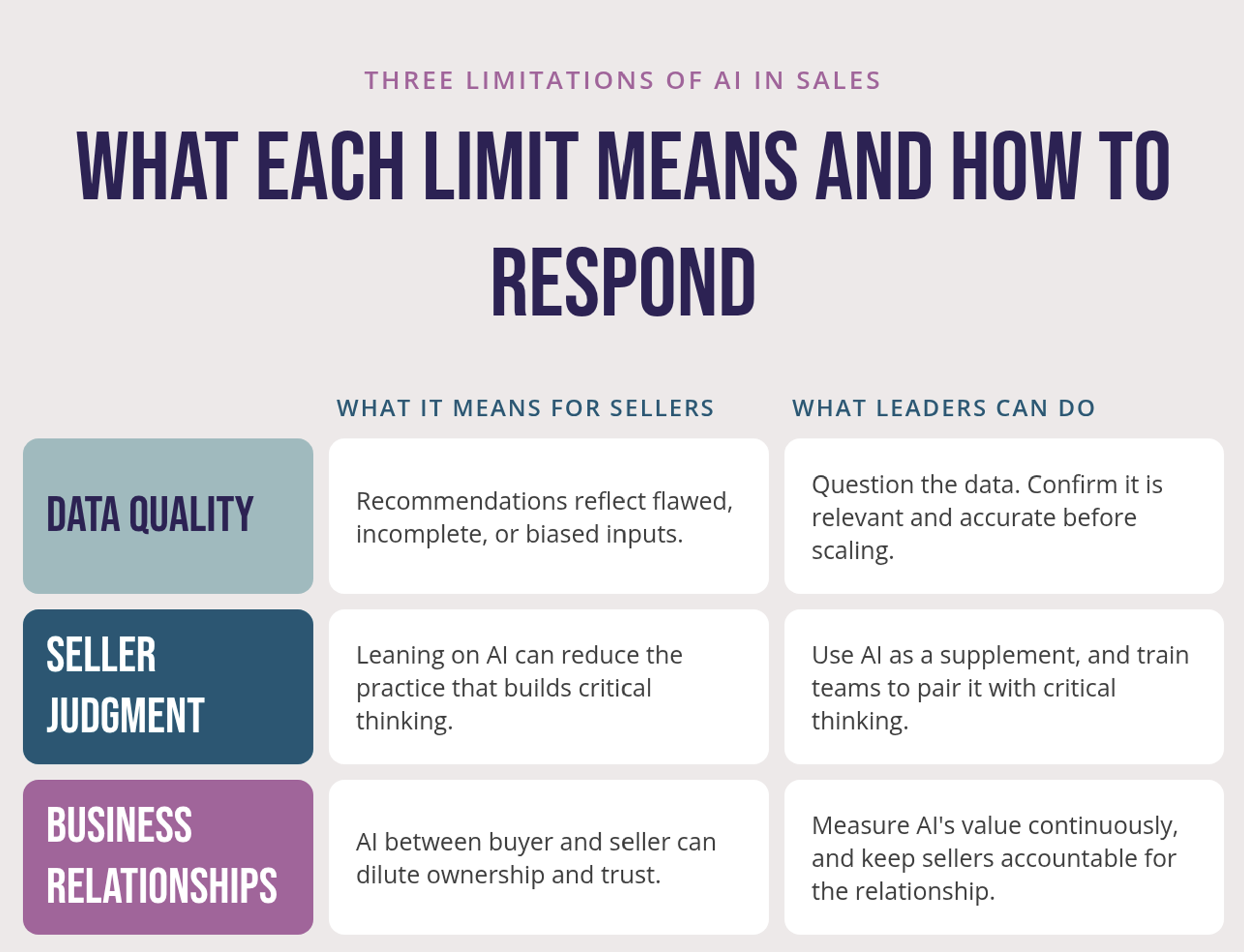
Sales leaders can capture AI’s value and protect seller performance by taking four steps.
Proceed with Caution
Recognize that AI offers value you must measure constantly. Gartner predicts that by 2028, AI agents will outnumber human sellers tenfold, yet fewer than 40% of sellers will report that AI improved their productivity. Just as sellers should use critical thinking when selling, sales leaders should apply it when they assess AI.
Use AI as a Supplemental Resource
AI is not a replacement for thinking — it is a way to augment it. Make the technology part of a methodology, not the entire approach.
Accelerate Prism, Richardson Sales Performance’s sales excellence system, follows this principle: it is built on Richardson’s Consultative and Challenger methodologies and uses AI to amplify human expertise.
“One of the things that has been most important to me is having a common methodology and even a common vocabulary that we can use to describe where we are in terms of stages in the sales process with all of our team members.” — Kristin Krawczyk, senior sales director, Cencora
Question the Data
AI is only as strong as the underlying data. Ensure that the data is relevant and accurate. Aim for the Oxford English Dictionary, not the Urban Dictionary. Gartner advises leaders to confirm that foundational data is accurate before scaling AI.
Train Teams to Use AI Wisely
Make it clear to selling teams that AI is another tool in their arsenal. Help them understand how to use it alongside their critical thinking and communication skills. Encourage them to consider AI’s output as a fresh perspective on the selling scenario. Gartner also recommends ongoing training to help sellers work with AI tools.
Who Makes the Final Call: The Seller or the Technology?
AI has potential, but it pays off only as one link in a chain of capabilities. Treat it as another data point that offers a sharper perspective. This perspective, much like the literal perspective that sports replay technology provides, does not produce the final call. The referee checks the replay for a new vantage point, then uses it to make the right call on the field. The referee makes the final call, not the technology.
AI should work the same way so that sales professionals use the data before the data uses them.