How SaaS Companies Defend Margin as AI Makes Software Easier to Replicate
Sales performance improvement

Written by: Claire Imber, Director of Content Strategy & Thought Leadership
Published: November 9, 2026
The race to embed AI faster, better, and at scale is consuming SaaS. Buyers want copilots, autonomous workflows, and coordinated agents running across their systems, yesterday. They're tasking teams with building their own apps and agents, “vibe coding” their way toward solutions as fast as they can imagine them.
In the face of all that demand, a SaaS leader's strategy feels obvious: innovate faster than competitors.
For two decades, that innovation drove differentiation — and supported premium pricing. But while AI news drives the loudest headlines, it's also forcing a quieter change in the way customers experience software.
Commercial teams selling innovation alone must adapt, fast.
Key Takeaways
- SaaS companies defend margin in the AI era by selling expertise alongside innovation, because product features alone no longer set them apart.
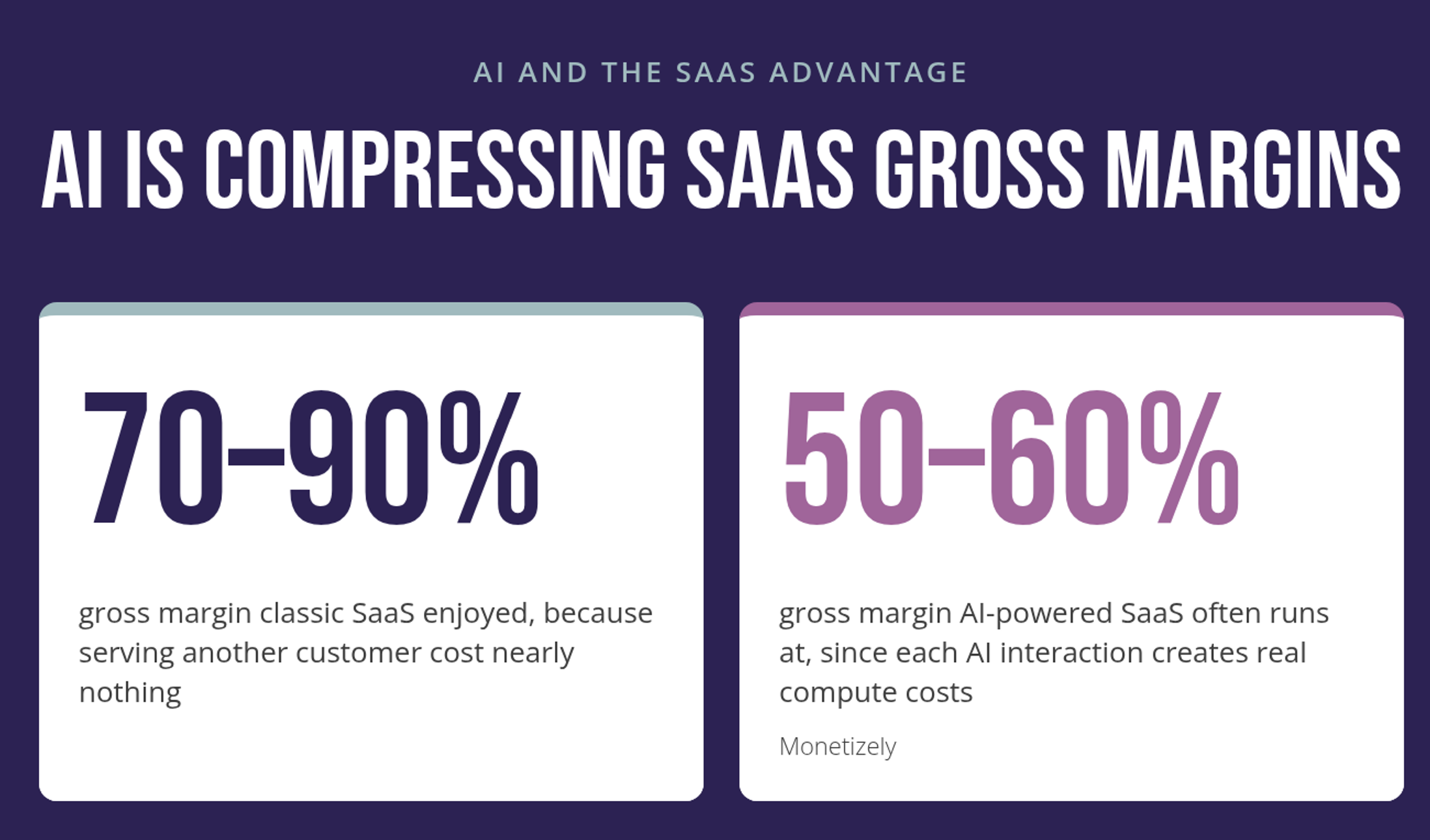
- AI also pressures margin directly, as AI-powered SaaS often runs closer to 50–60% gross margins than the 70–90% classic SaaS enjoyed.
- Sellers who can't guide buyers through AI decisions get stuck in the Confidence Chasm, where deals stall and pricing power disappears.
Why Does AI Make SaaS Products Harder to Tell Apart?
Historically, differentiation in SaaS lived inside the product. Companies staked their claim around the interface, the workflow, or the proprietary functionality that made one platform feel fundamentally different from another. Those innovations bolstered commercial teams and made renewals a solid bet.
When AI agents begin executing work across systems — searching data, generating outputs, orchestrating tasks — the user interacts less with the underlying software interface and more with the AI layer sitting above it.
That means the perceived difference between applications begins to shrink.
AI does more than add capabilities to software. It abstracts the software itself. And when the interface disappears, the value of any single SaaS product becomes harder for customers to distinguish. The product becomes the infrastructure behind the outcome.
What Is the New Differentiator for SaaS?
As agentic AI shifts the way buyers experience software, the new limiting factor won't be product capability, but product conversations. AI introduces new questions for buyers:
- Where does it create real value?
- How should it be applied in our workflows?
- What risks come with adoption?
To navigate those changes, buyers need more than a demo. Gartner's survey of 645 B2B buyers found that 69% prefer to validate AI-generated insights with sales reps. Sales leaders who want to differentiate for the next era of SaaS sales will focus on building teams capable of translating innovation into expertise.
Is AI Already Squeezing SaaS Margins?
Early signals across the software industry show this shift is already compressing the traditional SaaS advantage.
The economics of AI software fundamentally differ from traditional SaaS. Classic SaaS businesses historically enjoyed 70–90% gross margins because the marginal cost of serving an additional customer was nearly zero. AI-powered SaaS products often operate closer to 50–60% gross margins because each AI interaction creates real compute costs, according to Monetizely. That means the capabilities companies are racing to ship are eroding the margin cushion SaaS once relied on.
| Classic SaaS | AI-Powered SaaS | |
|---|---|---|
| Typical gross margin | 70–90% | Often closer to 50–60% |
| Cost of serving an additional customer | Nearly zero | Real compute costs with each AI interaction |
| Where differentiation lives | The interface, workflow, and proprietary functionality | The expertise that surrounds the software |
| How fast competitors replicate features | Traditional software cycles | Far faster |
Differentiation cycles now accelerate dramatically. MIT researchers found that the price of reaching a given level of AI benchmark performance has fallen five to 10 times per year. When capabilities become cheaper and widely available that quickly, competitors can replicate features far faster than in traditional software cycles.
Market pressure is already emerging. A March 2025 AlixPartners analysis of 122 publicly traded enterprise software companies found AI is squeezing them, as they sit between AI-native startups with lower cost structures and tech giants embedding AI into existing platforms. As a result:
- The share of high-growth companies fell from 57% in 2023 to 39% in 2024, with analysts expecting just 27% in 2025.
- Median net dollar retention dropped from 120% in 2021 to 108% in Q3 2024, suggesting customer stickiness has declined.
The pattern is consistent: AI lowers differentiation, speeds up competition, and cuts into SaaS margins. Companies still running the old SaaS playbook of more features at higher prices will find that innovation alone no longer defends value.
Why Do SaaS Deals Stall Even When the Product Is Strong?
Inside SaaS organizations, this pressure shows up in a familiar pattern. Product teams ship powerful AI capabilities, but when those capabilities reach the market, the conversation stalls.
Buyers struggle to evaluate the opportunity amid a sea of familiar claims. Sellers struggle to guide the decision, coordinate growing buying groups, and navigate new procurement hurdles.
When confidence disappears, so does pricing power. Buying groups delay, value conversations shrink, and deals stall. Sellers get stuck in the Confidence Chasm, and no amount of product knowledge will pull them out.
How Can SaaS Sellers Build the Expertise That Defends Margin?
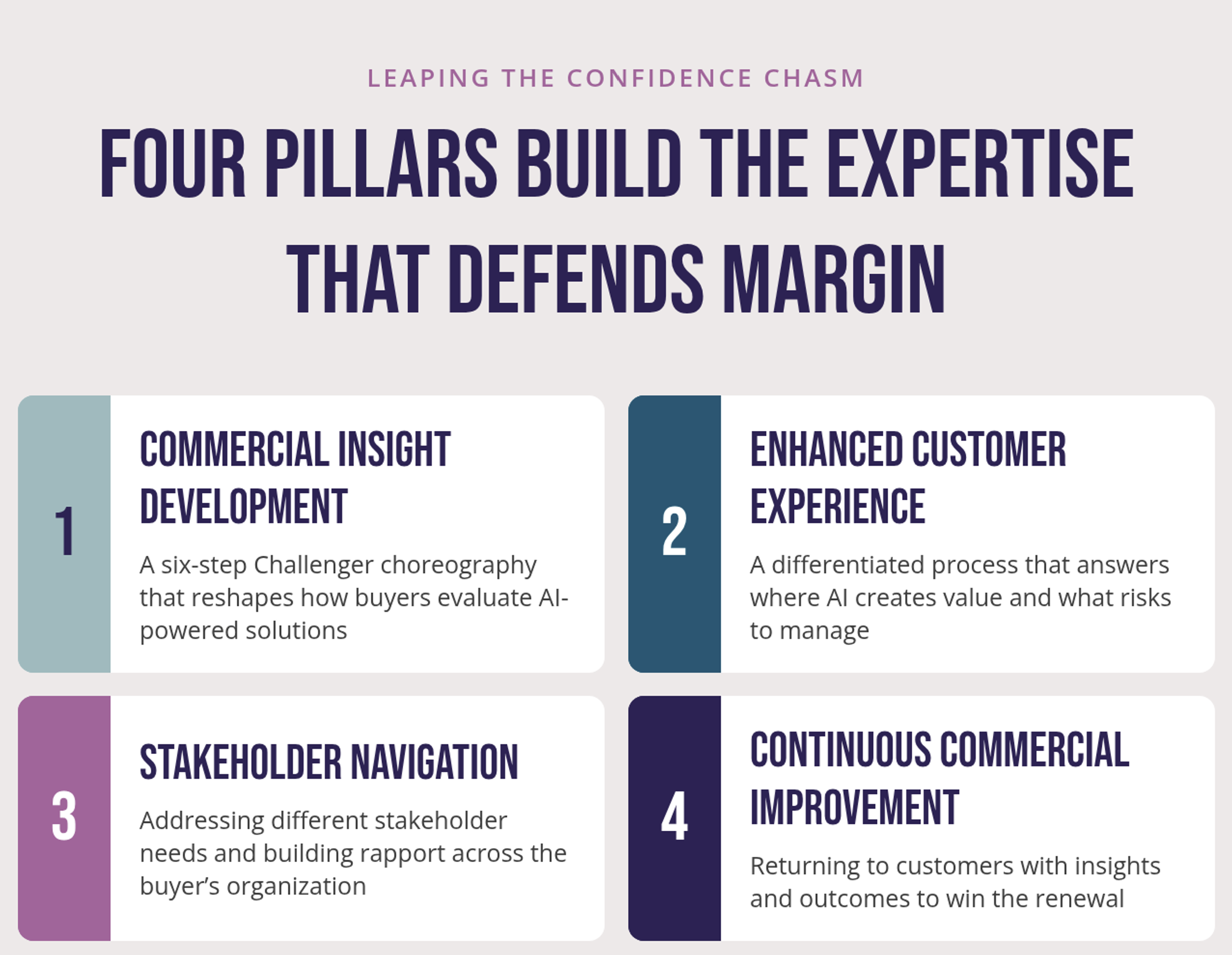
The SaaS companies that defend margins in an agentic AI market will compete on something harder to replicate than product features: commercial expertise. The differentiator shifts from software capability to the expertise that surrounds it. Developing that expertise around four pillars pulls sellers out of the Confidence Chasm.
Commercial Insight Development
To win the right to sell, your sellers can't focus on features and benefits. They also can't assume that buyers know what they want. That's why the most successful sellers will deliver a story that deconstructs a buyer's thinking, dismantles their underlying beliefs and assumptions, and then leads toward a new solution. This six-step Challenger choreography, called Commercial Insight, equips sellers to introduce insights that reshape how buyers evaluate AI-powered solutions.
Enhanced Customer Experience
These sellers guide buyers through a differentiated, elevated process, and partner with them to answer key concerns. Where does AI create measurable business value? What risks must be managed? Challenger research has found that the sales experience is the biggest driver of B2B customer loyalty, a finding it validated again in 2019. With rapid AI expansion and a flooded market, sellers who deliver an elevated experience stand to gain the most.
Stakeholder Navigation
The sellers buyers trust most with their time help them understand and address different stakeholder needs, build rapport across their organizations, and make it easy to purchase. As buying groups expand and procurement processes change, sellers with these skills pull ahead of AI-only counterparts and begin building relationships that turn into long-term contracts ripe for renewal.
Continuous Commercial Improvement
As sellers reframe their value around expertise and establish themselves as consultative partners, they can reframe their right to renew and expand, as well. The strongest, stickiest software companies will build their relationships around continuous commercial improvement by tying their solutions to real, previously unseen problems. Rather than assuming existing customers will renew, they'll return to conversations with insights and outcomes, expecting to win the renewal with the same consultative approach that won them the business in the first place.
Proof in practice: After working with Richardson, an enterprise software company raised its win rate from 48% to 69% in the first year, which produced more than $8 million in added revenue.
Where Does Differentiation Live Now?
AI is reshaping SaaS's competitive landscape, but the most important shift is not happening in the product roadmap. It's happening in sales conversations.
When software capabilities become easier to replicate, the companies that defend margin will be those that help customers navigate complexity and act with confidence.
Because in an agentic AI market, the real differentiator is no longer the product. It's the expertise used to sell it.