How Can a CRO Build a Competitive Advantage in an Uncertain Market?
Sales performance improvement

Written by: Ben Taylor, MBA, Content Marketing Manager, Richardson
Published: November 9, 2026
Waiting out a complex market only prolongs challenges. The most effective CROs know this and invest in building capabilities when others hesitate. The status quo isn't holding steady — it's a choice to defer growth.
Key Takeaways
- CROs build a competitive advantage in an uncertain market by training sellers while competitors hesitate.
- The most effective training targets observable selling behaviors, reinforces them in live deals through frontline managers, and measures the change.
- Sellers gain the skills they need to win now, and their lead over teams that wait grows as the market rebounds.
Why does an uncertain market reward the CRO who invests first?
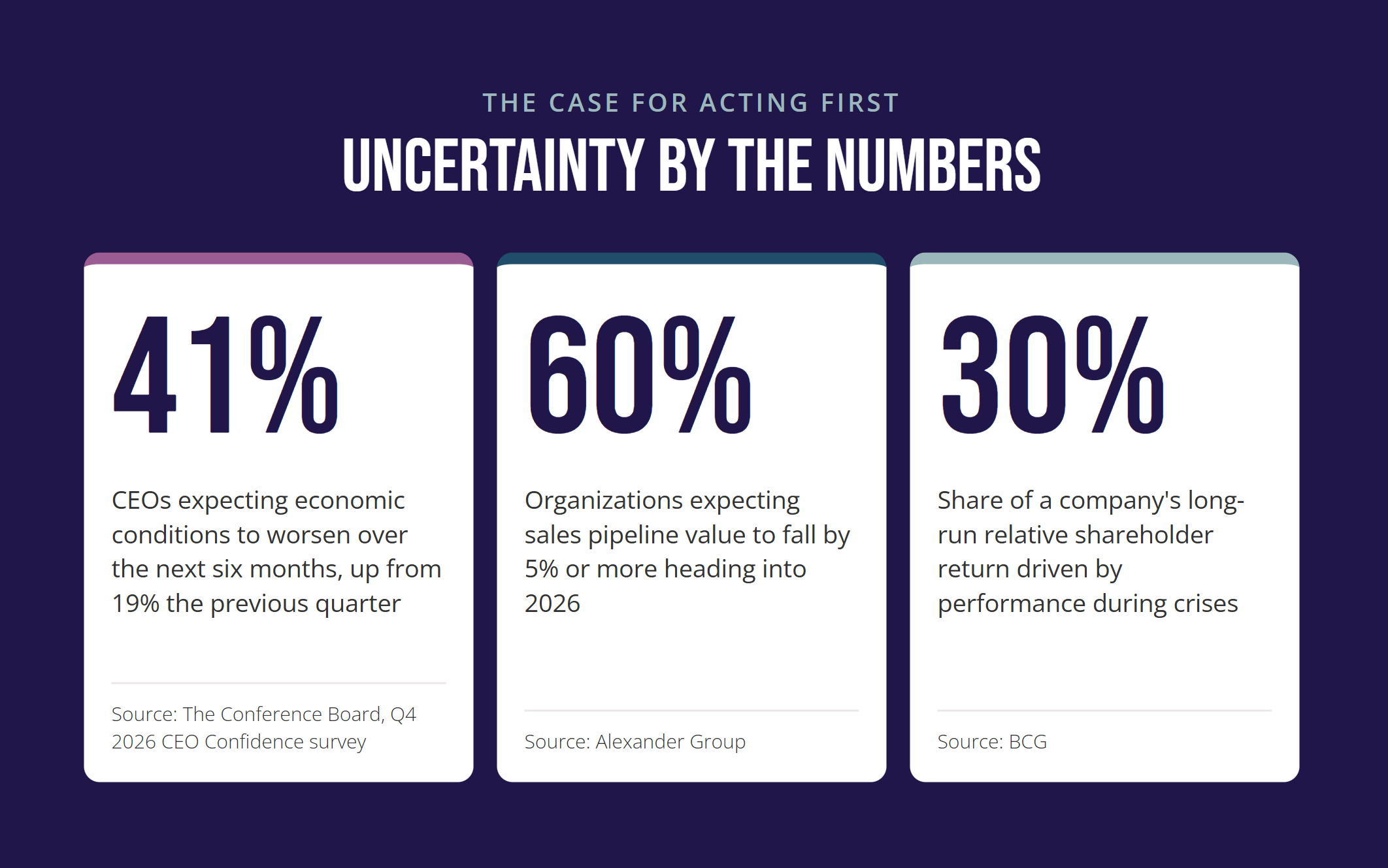
Hesitation is due, in part, to concerns about the macroeconomic setting. In The Conference Board's Q4 2026 CEO Confidence survey, 41% of CEOs expected economic conditions to worsen over the next six months, up from 19% the previous quarter. Sales organizations feel it too: Alexander Group research found that 60% of organizations expected sales pipeline value to fall by 5% or more heading into 2026. Investments look daunting and even risky in this environment. But not making them presents an even greater risk.
This setting is also an opportunity for CROs ready to develop their teams' skills, because it offers two benefits:
- Sellers gain the critical capabilities needed to win now.
- Their margin of competitive outperformance compounds. Leaders who wait and see regress, giving those who act an even greater lead.
Performance during disruption carries outsized weight over the long run. BCG research found that about 30% of a company's long-run relative shareholder return is driven by how it performs during crises.
What does standing still cost a sales organization?
A complex market exposes skill gaps; it doesn't pause selling. When CROs wait to train, rather than take action, they leave sellers unequipped to perform in a market that demands sharper value messaging, more effective deal qualification, and better conversation skills.
These high-level skills are what make the difference — it's not enough to be motivated. Sellers need to know what good looks like. That's why leaders need to identify the observable behaviors that create impact, isolating the capabilities that directly influence the leading and lagging metrics that are critical to the organization's goals.
The costs of standing still are not just explicit ones, such as lost deals. There are also implicit costs, or opportunity costs. Sellers lose morale as lost deals accumulate, and they become less engaged. Trust between leadership and the sales team weakens when sellers believe that the executive team has not recognized the importance and value of investing in them.
These costs aren't always clear. When CROs and sellers face a rapidly changing market, they lose confidence in their ability to drive revenue. In response, it's easy in the short term to cut costs, because CROs can quantify savings. Yet without training, sellers spend more time chasing deals that could be won with modern selling approaches.
What selling skills give a team an edge when buyers hesitate?
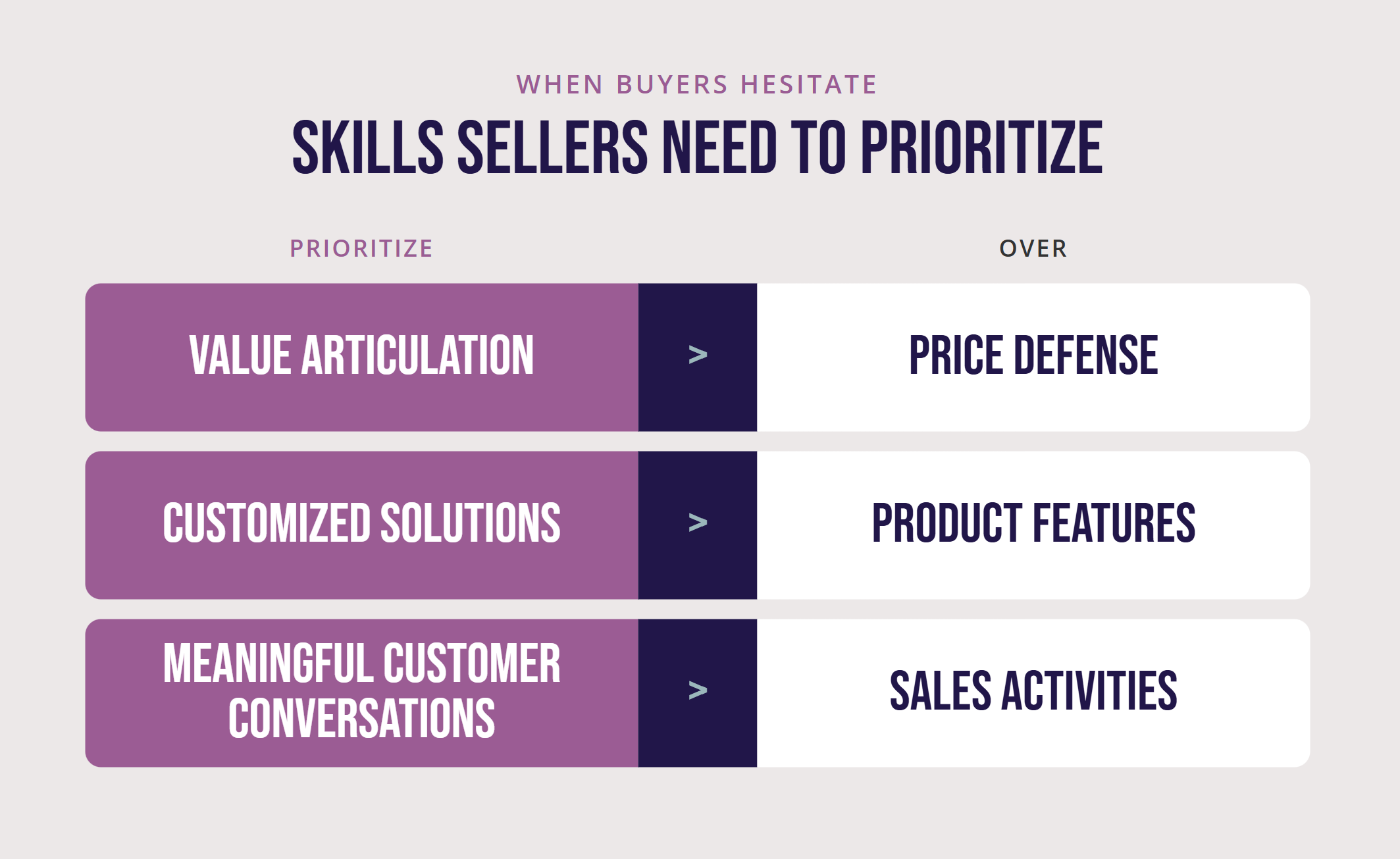
As stakeholders become more hesitant, sellers need new skills to win. CROs who invest in training build teams that can meet these new needs:
| Sellers need to prioritize… | …over |
|---|---|
| Value articulation | Price defense |
| Customized solutions | Product features |
| Meaningful customer conversations | Sales activities |
Without training, leaders bet that what worked before will work again. The problem: the future looks dramatically different, and businesses need solutions to challenges they've never seen.
Richardson's 2026 Selling Challenges Research Study, a survey of more than 300 sales professionals, shows where sellers feel the gap. Stakeholder indecision or resistance was the top pipeline challenge (28%), followed by building consensus and urgency across a complex buying group (27%) and quantifying value (21%). Asking purpose-driven questions that surface needs was the hardest skill to apply in conversations (33%).
In this setting, sellers need to be able to diagnose customer pain, clarify root causes, and quantify it with an attentive yet thought-provoking questioning strategy. This approach equips sellers to help buyers quantify and define their problems. Sellers must also highlight the cost of inaction and use commercial insights to reframe thinking, revealing hidden risks, opportunity loss, competitive threats, and downstream consequences. The market demands these skills in a way it didn't before. Without sharpening them, sales teams default to legacy behaviors that won't work.
Sellers must also be ready to engage customers with complex challenges. They need higher-level skills to define problems, unite stakeholders, and inspire action. Helping customers act means building stronger executive-level credibility with stakeholders, as buyers increasingly compare experiences rather than just solutions. Challenger research shows that the sales experience — rather than product, price, or brand — is the single most significant driver of customer loyalty. Success requires more than a high-quality solution. It requires a great buying experience, and sellers provide one by helping stakeholders conceptualize and clarify their core challenges.
Organizations that train their sellers to diagnose customer problems, challenge assumptions, and articulate impact stand apart in crowded markets. Better skills pay off now, and they pay off more when demand rebounds.
What do effective CROs do differently?
Effective CROs don't wait to return to normal. They see this stalled period as the start of a new environment with new challenges. Sellers win by helping buyers navigate these challenges, but that requires new skills.
1. Capitalize on decisiveness
To maintain a durable lead in the market, CROs need to train today to improve pipeline quality, achieve higher win rates without eroding margins, and drive faster growth when the market regains momentum. Opportunities to move ahead of competitors are rare, but today represents one such chance. While other sales organizations wait for market signals, the most effective CROs are already training.
Richardson clients typically see a 20% improvement in close rate, a 1.5% uplift in margin, and a 25% increase in sales productivity. OUTFRONT Media is one example. After a blended learning program built on Richardson's Consultative Selling framework, the company saw a 20% increase in close rate, 2x growth compared with competitors over three quarters, and 10% revenue growth.
Training in this setting equips sellers with revenue-relevant skills that address the buyer's hesitation and widens their lead over competitors who regress to outdated sales approaches.
2. Draw a clear connection between behavior and performance
Success motivates. CROs must help sellers link skills to results and connect learning, behavior, and performance. This real-time approach lets sellers adjust as they sell. Traditional dashboards reflect data, not meaning.
Proving the link between efforts and outcomes also indicates how well the sales and enablement leaders' strategy translates into forward movement. A process like this always yields value, because the feedback either tells leaders that what they're doing is effective or that it's not. In both cases, the data provides actionable, directional cues on what to do next: either continue with the selling behaviors or adjust those that aren't working. The result is meaningful, continuous change at scale.
We chose to extend our partnership and work with Richardson for a second three-year term. This was, in no small part, due to the superb support from the customer success team. They have worked closely with us over the past 3 years to go above excellent training and actually deliver measurable and defined commercial results that supports meeting our sales goals. — Nick Hine, Global Commercial Learning Director, Veolia Watertech
3. Make behavior change scalable
To drive performance improvement across the organization, managers and coaches need to be part of the process. By partnering with enablement, they can address the individual skill gaps in each seller.
Previously, this approach was nearly impossible. Identifying and addressing the unique needs of a distributed sales organization requires too many resources. Today it is possible with AI that can unify live training, digital learning, and coaching guidance. CROs can also use AI to see what drives performance. With this insight, they can equip sellers to take the right actions at the right moments, so improvement is consistent, scalable, and sustained.
With Richardson, what I love about it is we were able to scale the entire framework throughout our organization globally. So you're getting that same language, that same framework with consistency, which keeps that brand. — Darnetta Daire, Sales Enablement Manager, Hollister Incorporated
4. Create cohesion across systems
Data is vast and accessible. Insights are not. That's why leaders need the tools to interpret sales data and understand which selling behaviors are most associated with winning. This approach identifies what's working and what isn't, and it lets CROs and other leaders measure behavior change, improve forecasting, allocate resources, and drive predictable growth.
How should a CRO put this into practice?
- Align training to the client's new context, not a generic sales approach. AI has ushered buyers into a new setting, demanding more sophisticated capabilities for sellers.
- Personalize learning so new skills stick. No seller learns the same way. Personalized learning paths prevent atrophy as sellers navigate new skills.
- Build confidence through structured practice, not one-time events. Sellers need training and reinforcement that occur in the flow of work, with customized content relevant to the current pursuit.
- Tie learning to earning. Align training to observable behaviors that drive performance, rather than relying on a seller's intrinsic motivation.
- Connect training to in-flight pursuits for maximum efficacy. Connect training to real deals, reinforce it with frontline leadership, and measure improvement by performance.
- Develop both sellers and frontline managers to sustain change. By deploying training across the sales organization, leaders create change that lasts while deploying a methodology that can be adjusted at scale.
When you put those behaviors into practice — questioning and listening, having facilitated sessions with coaches that actually get in there and can coach them along the way — our teams are better able to actually apply some of those behaviors in the moment with their customers. — Amber Boll, Director, Sales Global Process Owner, Rich Products Corporation
Why choose momentum over caution?
Periods of uncertainty reward leaders who act with intent rather than restraint. For CROs, standing still is a competitive concession, not a defensive posture. While others delay investment and hope for clearer signals, the most effective revenue leaders are using this moment to sharpen capabilities that directly influence performance.
Training isn't a discretionary expense for stable markets. It decides who wins share, who protects margins, and who is prepared when demand accelerates. By investing now, CROs equip their teams to meet buyers where they are today — hesitant, complex, and value-driven — while simultaneously widening the gap against competitors relying on outdated approaches.
The advantage compounds. Sellers build confidence as their behavior changes, managers reinforce the right skills at the right moments, and leaders see what actually drives results. When the market rebounds, these organizations won't be scrambling to catch up — they'll already be operating at a higher level.
CROs who treat this moment as a rare chance to build a durable advantage will come out ahead of competitors. The decision isn't whether to invest. It's whether to lead or follow.