What Are the Benefits of a Consistent Sales Methodology?
Sales performance improvement

Written by: Ben Taylor, MBA, Content Marketing Manager, Richardson
Published: October 14, 2026
Expanding departments, merging divisions, and growing teams lead to inconsistent selling approaches. Sales professionals with a long tenure have an established approach, while those who are new have a different style. As these disparate groups come together, an unevenness sets in.
This challenge intensifies as the organization's solutions grow and change. As products and services become more holistic and sophisticated, they require new selling skills to fully articulate the breadth of their capabilities. The selling organization becomes a patchwork of inherited practices and bold new initiatives.
The solution: adopting a consistent sales methodology and a common sales language across the organization.
Key Takeaways
- A consistent sales methodology and common sales language make performance measurement more accurate, because every seller is measured against the same framework.
- Sales enablement becomes more efficient, and refocuses on sustainment, when it supports one methodology instead of a disjointed array.
- Team selling runs more smoothly when experts, executives, and implementation professionals learn one framework once and coordinate around the same playbook.
- Coaching and debriefing get more effective, and new hires reach productivity faster.
Why Does a Consistent Sales Methodology Make Performance Measurement More Accurate?
Consistency drives accuracy because all sales professionals are measured against the same framework. Metrics like win rate, quota attainment, and contract value are general enough to capture the overall performance of differing styles. But if any of those figures reflect poor performance, leaders can't uncover the underlying reasons.
Some leaders respond by adopting a multitude of measurements to cover a diverse range of selling techniques. That approach taxes internal systems that lack the capacity to generate so many metrics. Leaders become burdened with time-consuming measurement and focus only on the measurements that reflect a favorable picture. What follows is a culture of "managing to the metric" rather than focusing on revenue-generating activities like prospecting and expanding existing accounts.
A consistent selling approach solves this problem by putting selling behaviors ahead of measurement. Leaders first choose the optimal selling behaviors, then support those behaviors with a right-sized set of measurements.
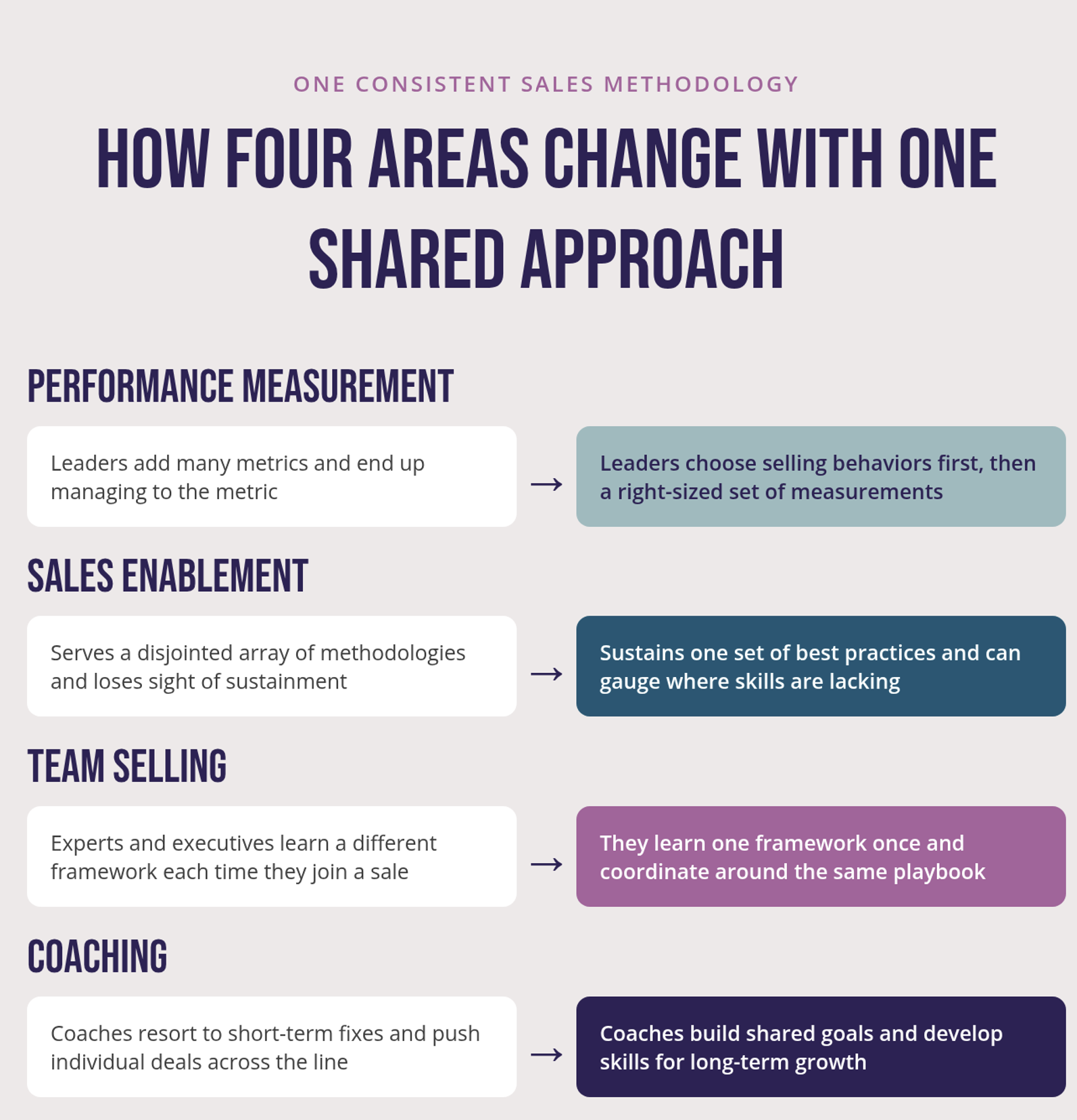
| Area | Without one methodology | With a consistent methodology |
|---|---|---|
| Performance measurement | Leaders add many metrics and end up managing to the metric | Leaders choose selling behaviors first, then a right-sized set of measurements |
| Sales enablement | Serves a disjointed array of methodologies and loses sight of sustainment | Sustains one set of best practices and can gauge where skills are lacking |
| Team selling | Experts and executives learn a different framework each time they join a sale | They learn one framework once and coordinate around the same playbook |
| Coaching | Coaches resort to short-term fixes and push individual deals across the line | Coaches build shared goals and develop skills for long-term growth |
How Does a Consistent Sales Methodology Make Sales Enablement More Efficient?
Sales enablement is the function and discipline that equips sales professionals with the content, coaching, training, and analytics they need to improve their selling capabilities. Enablement professionals help sellers apply the right tools at the right time to advance the sale, and they are responsible for driving sales efficiency and effectiveness.
That work gets harder when enablement must serve a disjointed array of selling methodologies. The distraction pulls teams away from one of their core functions: sustainment. Enablement must sustain a set of best practices that coalesce into a repeatable sales process. Without sustainment, the function can't gauge where skills are lacking or how to serve emerging customer needs.
Accommodating different selling styles also risks pulling enablement away from the customer. Teams that work within a uniform methodology develop more resonance with the touchpoints in the buyer's journey and a sense of what will motivate the customer at each stage. That matters because enablement does more than dispatch materials, tools, and marketing collateral. It also judges which of those tools best fits the customer, their need, and their progress in the buying process.
Consistency also helps enablement meet needs faster, because teams learn what works and what doesn't.
How Does a Consistent Sales Methodology Strengthen Team Selling and Coaching?
Selling is becoming a team effort. Increasingly sophisticated and complex products call for subject matter experts, executives, and implementation professionals, and these team members are not trained sales professionals.
Team Selling
Bringing these colleagues into a sale requires careful planning, rehearsals, and communication. With a single, shared sales methodology, those who aren't sales professionals learn the framework once. Without one, they must learn a different framework each time they join a presentation. Success and speed come from coordinating around the same playbook.
Customers notice the difference. They see incongruent selling as a sign of disorganization and imbalance. An effective team selling engagement requires seamless transitions, concise messaging, and a consistent narrative flow — all of which depend on a single core selling practice.
Coaching and Debriefing
Consistency also matters after the team sale, because debriefing is where progress occurs. It is difficult to assess effectiveness when different styles are in play. As a result, the team coach resorts to short-term fixes, such as telling a sales professional what went wrong and how to fix it. That practice undermines the development of critical selling skills and inhibits long-term growth.
Effective coaching comes from instilling a sense of shared goals within the team. When the approach to selling is inconsistent, those goals are dispersed. Coaches then work frantically to push individual deals across the line rather than empowering sales professionals to nurture the sale on their own.
New-Hire Ramp
A consistent selling process also helps new hires reach productivity faster by giving them clarity of purpose that drives engagement. Engagement matters: Gallup's latest meta-analysis of 736 studies across 347 organizations found that employee engagement is related to each of 11 business outcomes it examined.
How Does a Consistent Sales Methodology Improve the Customer Experience?
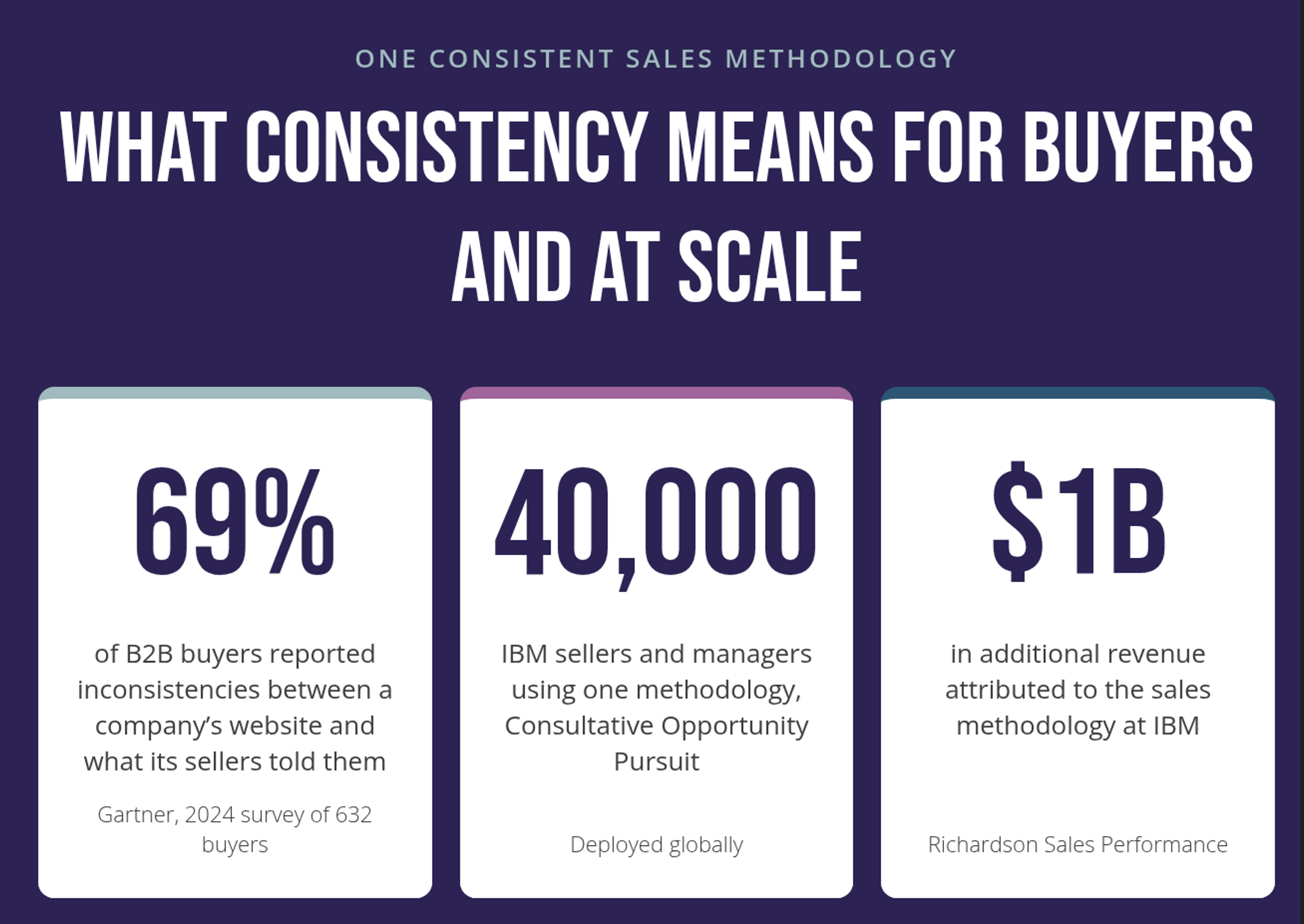
Customers need a consistent experience. It allows them to develop confidence in the sales professional and their solutions. Consistency is also a trust issue. In a 2024 survey of 632 B2B buyers, Gartner found that 69 percent reported inconsistencies between a company's website and what its sellers told them, which Gartner says can create mistrust and put the transaction at risk. A shared methodology and common sales language give every seller one consistent way to frame value.
Consistency also drives efficiency. Today's customers need effective solutions fast. Competing priorities and limited time mean that sales professionals must get to the root of the challenge earlier. A universal selling methodology uncovers the customer's needs without wasting valuable time. A stronger customer experience also supports customer retention.
How Can Large Sales Organizations Build Consistency at Scale?
The need for a consistent sales methodology is most apparent in large organizations, where sales professionals are distributed across divisions, departments, and demographics. Reaching a dispersed group at that scale requires a digitally deployed solution.
"One of the things that has been most important to me is having a common methodology and even a common vocabulary that we can use to describe where we are in terms of stages in the sales process with all of our team members." — Kristin Krawczyk, Senior Sales Director, Cencora
The same principle holds at the largest scale. At IBM, Richardson's Consultative Opportunity Pursuit™ methodology was deployed to 40,000 sellers and managers globally, and $1B in additional revenue has been attributed to the sales methodology.
Richardson Sales Performance has helped dozens of Fortune 500 companies build consistent selling practices that yield results.