How Should Sales Organizations Adapt Their Strategy in an Uncertain Economy?
Sales performance improvement

Written by: Claire Imber, Director of Content Strategy & Thought Leadership
Published: November 9, 2026
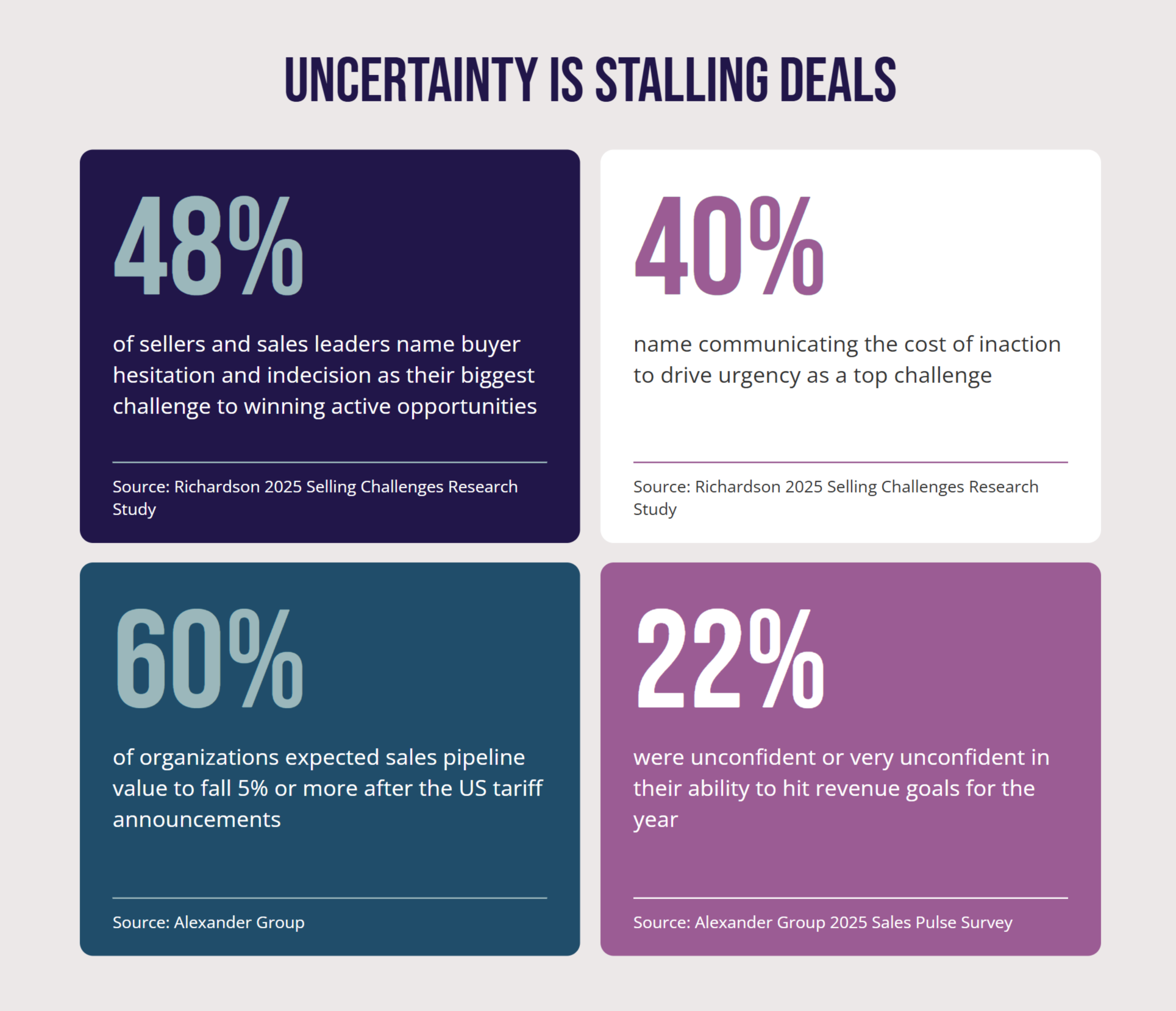
Capital constraints, policy uncertainty, and volatile economic conditions have halted most buying decisions. To thrive, selling organizations need to adapt.
Buyers are facing high levels of uncertainty driven by a volatile economy, and they are increasingly wary. Richardson's 2025 Selling Challenges Research Study found that nearly half of the sellers and sales leaders surveyed (48%) named mitigating buyer hesitation and indecision as their biggest challenge to winning active opportunities.
Alexander Group data shows how much that uncertainty grew throughout 2025. At the start of the year, commercial organizations expected revenue growth to match 2024's roughly 14%. Following the tariff announcements in the US, Alexander Group data showed 60% of organizations expecting a decrease of 5% or more in sales pipeline value, and more than half considering a reduction to their commercial budget.
“Right now, there’s a lot of noise,” said Taylor Mullen of the Alexander Group. “Leading organizations that are agile and constantly adapting their strategies and operations to what’s changing around them are the ones that will succeed.”
Here’s how those leading organizations prepare for what’s to come — and how you can join them.
Key Takeaways
- Organizations that adapt well retain and expand existing accounts instead of relying on new business alone.
- They engage the CFO early and help hesitant buyers move forward with a clear recommendation.
- They focus on their highest-value accounts and build agile, AI-ready teams.
Why should retention and expansion come first?
Alexander Group found that leading organizations put a higher emphasis on retaining existing customers. Retention is critical in disrupted markets such as manufacturing, biotech and life sciences, and transportation.
To build a strong retention engine, companies should start by:
- Deploying lifecycle marketing programs (onboarding, adoption, renewal) to reduce churn
- Launching customer advocacy programs to surface and amplify loyal accounts, particularly those affected less by tariff fluctuations
- Updating current customer engagement models
- Adjusting coverage strategy and roles
“The companies that position themselves as trusted advisors will experience greater retention and greater expansion down the road,” Mullen said.
How do you pursue account expansion like new business?
With retention in focus, sellers and customer success teams should prepare to pursue expansion within existing accounts. More respondents (68%) cited cross-selling and upselling as a growth strategy for 2025 than any other, according to Alexander Group’s 2025 Sales Pulse Survey.
This puts particular pressure on customer success teams. Despite being hired for their relationship and problem-solving skills, they may be uncomfortable shifting from providing service to upselling and cross-selling. These teams require training to align strategy with execution in value-led conversations that drive account growth.
It isn’t enough to focus on relationships that represent the highest potential revenue. Sales leaders also need to identify the accounts with needs aligned with their solution — and emphasize adaptability and flexibility for the road ahead.
How do you sell to the CFO when every purchase draws scrutiny?
Nearly one-quarter (22%) of respondents told Alexander Group they were “unconfident” or “very unconfident” in their ability to hit revenue goals for the year in the 2025 Sales Pulse Survey. “Customers are putting in measures to reduce expenses,” said Mullen. “Nearly half of organizations are limiting non-essential travel and freezing new hiring plans.”
Against this backdrop, the CFO is an increasingly important voice, assessing the numbers and vetting ROI figures as purchases draw greater scrutiny from procurement. The CFO understands how shifting economic factors affect the business and casts the deciding vote on whether to invest.
Addressing their needs directly sets organizations apart. Richardson recommends sellers use three tactics:
- Engage the right power early in the sales process. The seller needs critical financial details early to make a compelling case that speaks to the CFO’s needs. By understanding a customer’s financial goals and margins, they can create resonant messaging that addresses the CFO’s concerns from the start. That prevents the all-too-common scenario where finance or procurement abandons a deal at the final mile.
- Contextualize the ROI within a range of reasonability. Sellers need to help stakeholders understand that ROI comes through a range of values, and build credibility by sharing successes that land in the middle of that range. This way, sellers can demonstrate a rate of return within a reasonable confidence level and even overperform projections.
- Provide clear and plausible explanations for the ROI range. Case studies that show ROI need to come not only from similar industries, but also from customers facing similar challenges, with at least two or three significant parallels. The seller’s objective is not to prove that they’re right or that their projections are certain. The aim is to provide a sufficiently credible argument that keeps the customer engaged.
Richardson’s own results follow the same logic. On average, Richardson training grows client revenue by 5% to 12%, depending on the industry — a range, not a single promise.
How do you help buyers who can’t decide?
Under volatile conditions, such as when a recession looms, any purchase feels like a commitment that may soon be outdated. It’s no surprise that the two most cited challenges associated with winning active opportunities are “mitigating buyer hesitation and indecision” (48%) and “communicating the cost of inaction to customers to drive urgency” (40%), according to Richardson’s research.
Research published in The JOLT Effect shows customers grow overwhelmed by choice, information, and expectations. They need a solution, but their fear of messing up, particularly in volatile periods, outweighs their fear of missing out on success. That leaves buyers firmly planted in the status quo.
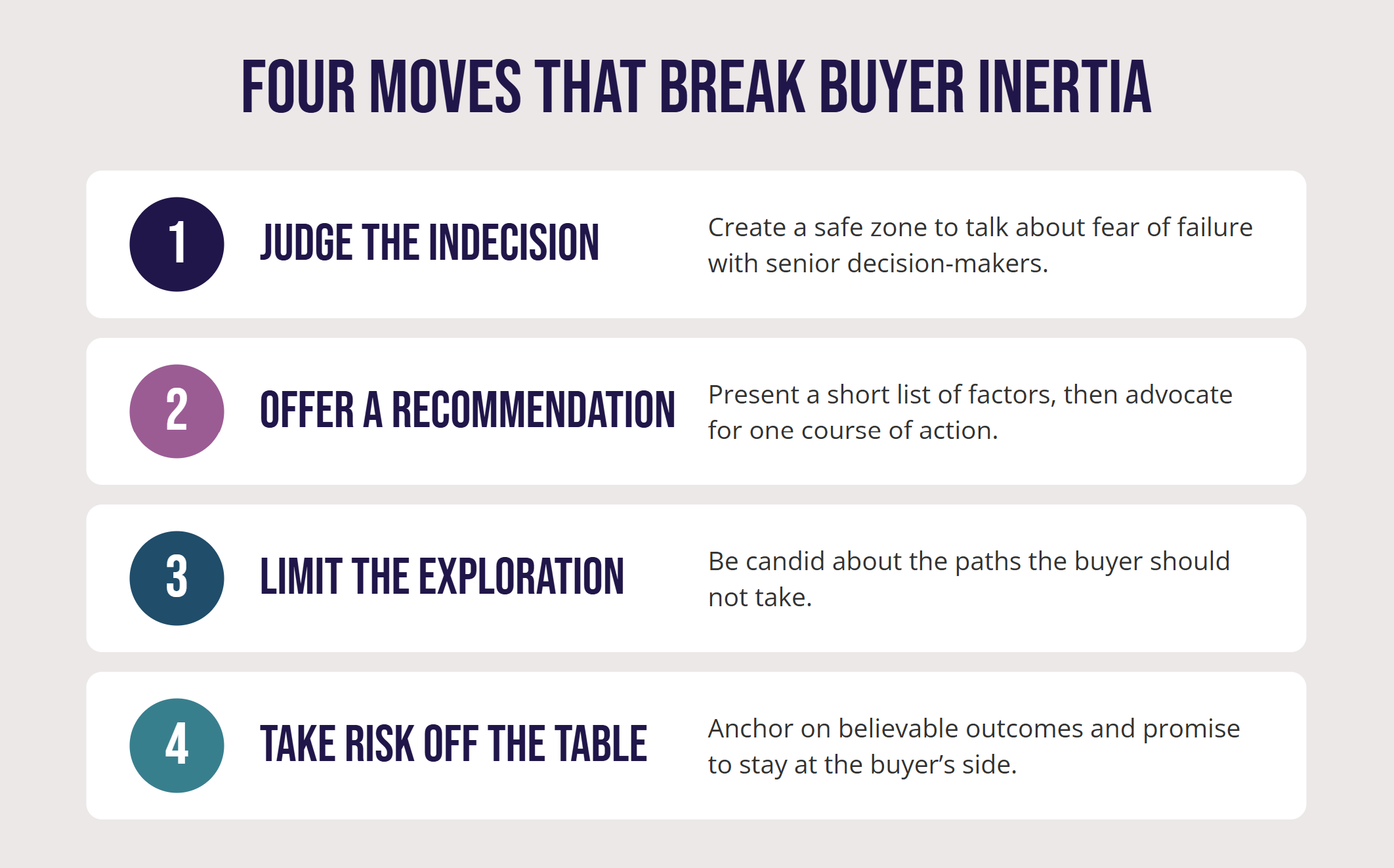
To overcome the customer’s indecision, sellers need to break through the buyer’s inertia:
- Judge the level of indecision. Talking about the fear of failure is uncomfortable for senior decision-makers who want to feel decisive. The most effective sellers can ease that fear and develop a safe zone for these conversations.
- Offer your recommendation. Sellers must present a small list of factors to consider, then advocate for one specific course of action. This step involves transitioning from asking customers what they want to buy to advising them on what they should purchase. If the seller has built trust, the buyer will prefer this recommendation over going it alone.
- Limit the exploration. Sellers become reliable when they are candid about the path they believe the buyer shouldn’t take. Sometimes, the wrong path can even be a solution within the seller’s profile of products and services. The seller must demonstrate that they aren’t trying to sell the world — they’re trying to solve the customer’s problem.
- Take risk off the table. The most effective sellers get the customer anchored to outcomes that are believable, practical, and doable. They don’t overpromise. They also create a safety net by reassuring the buyer that they will be by their side to ensure success.
How should you update your value positioning?
Companies must be ready to reevaluate how they’re speaking to customers at any given moment. Risk-averse customers won’t resonate with old messaging that doesn’t acknowledge volatility. In addition to adopting tailored commercial insights, leading companies should invest in:
- Conducting fresh Voice-of-Customer interviews to uncover new pain points, such as supply chain risks and cost pressures
- Creating compelling stories around ROI
- Recrafting their value proposition around cost efficiency, risk mitigation, and resilience
How do you tighten your pipeline?
When the going gets tough, sellers often find themselves tempted to cast a wide net, reasoning that expanding their pool gives them more swings and at least a couple will be home runs. But not every swing is equal, and sellers without focus find themselves more likely to strike out.
Organizations that instead focus on their Ideal Customer Profile (ICP) and intensify their prioritization efforts are the ones that come out ahead. Sales leaders must invest in:
- Concentrating efforts on customers that will move the needle the most
- Providing explicit guidance to sellers on where to allocate their time
- Reevaluating customer segmentation strategy
- Validating and ranking high-impact accounts
- Carefully assessing and rebalancing marketing channel mixes
What kind of workforce does an uncertain market require?
AI is not going to take a seller’s job. The true threat to a seller is a competitor who can use technology more effectively. For this reason, sellers and sales leaders need a focused approach for using AI to develop the new skills required for the year ahead.
According to Alexander Group’s 2025 Sales Pulse Survey, 41% of companies used AI and 38% planned to, compared with just 20% of companies surveyed in 2024. Alexander Group’s 2026 research points the same direction: 78% of commercial executives said AI is driving revenue growth. In a complex selling environment, the difference between adoption and “wait and see” is immense. Sales leaders who aren’t using AI to its fullest are already behind.
Amber Boll, director, sales global process owner at Rich Products, put it this way: “I don’t think any of us are going to be able to do this successfully at scale long term without really, really embracing AI.”
Sales leaders must also focus on hiring and developing talent ready for the road ahead. Cutting personnel in sales or marketing may seem like an easy way to offset rising costs, but it sets teams up for long-term failure when uncertainty passes.
“Having the right talent, in this case, means having talent with flexible skill sets who can quickly change their approach, whether that means pivoting to new accounts and customers, new pricing schemes, new products, etc.,” said Mullen. “Sales teams need agility to follow through on strategy.”
Not all sellers are comfortable with these changes, but the most successful teams will adapt, fast.
Why choose growth over safety?
As companies struggle against uncontrollable headwinds, hunkering down — or even cutting back — might seem wise. But that approach prioritizes short-term safety over growth. Top-performing companies succeed by retaining and growing existing accounts through updated and targeted messaging, breaking through uncertainty to grow their book of business, and building agile, flexible teams ready to leverage new technology. Uncertainty lies ahead, and successful businesses will be ready to stand and meet it.