Why Sales Technology Isn’t Enough to Improve Sales Execution
Sales enablement

Written by: Amy Smalfus, VP Content & Learning Strategies
Published: April 27, 2026
Why Isn’t Sales Technology Enough to Improve Sales Performance?
Sales technology is not enough to improve sales performance because data, analytics, and AI tools can show what happened, but they cannot define how sellers should execute. Without a consistent sales methodology, every seller may interpret insights differently, managers may coach inconsistently, and leaders may struggle to identify which behaviors are actually driving results. A sales methodology gives organizations a shared behavioral standard for customer conversations, opportunity progression, coaching, and measurement.
Modern sales organizations have invested heavily in CRM systems, enablement platforms, conversational intelligence, sales analytics, and AI-powered tools. These technologies can improve visibility and help leaders identify patterns, but they cannot replace the foundation required for consistent execution. This article explains why sales technology often produces more data without producing more consistency and how a proven sales methodology helps teams turn insight into repeatable revenue performance.
Keep reading to learn how a consistent methodology helps sales leaders turn technology and data into scalable sales execution.
Complete the form below to download the brief, "What's Missing From Today's Sales Technology," to explore how to create a foundation for consistent execution in your sales tech stack to drive real deal confidence.
What Sales Technology Can and Cannot Do
Sales technology plays an important role in today’s selling environment. It can help organisations capture activity, inspect pipeline movement, analyse conversations, automate workflows, and surface trends that may otherwise go unnoticed.
These capabilities are valuable. Sales leaders need visibility into what sellers are doing, where opportunities are stalling, and how buyer behaviour is changing. Technology can make these dynamics easier to see. However, sales technology has limits:
- Technology can show that a seller had a discovery call. It cannot, by itself, define what a strong discovery conversation should include.
- Technology can indicate that an opportunity has advanced. It cannot, on its own, determine whether the seller created enough value to justify that progression.
- Technology can identify patterns in win rates, sales cycles, or buyer engagement. It cannot automatically establish the behavioural standard every seller should follow to improve those outcomes.
That is the gap many organisations experience. They have more visibility than ever before, but visibility alone does not create alignment. Without a consistent sales methodology, sales technology can produce more information without improving execution.
What’s Missing from Most Sales Technology Stacks?
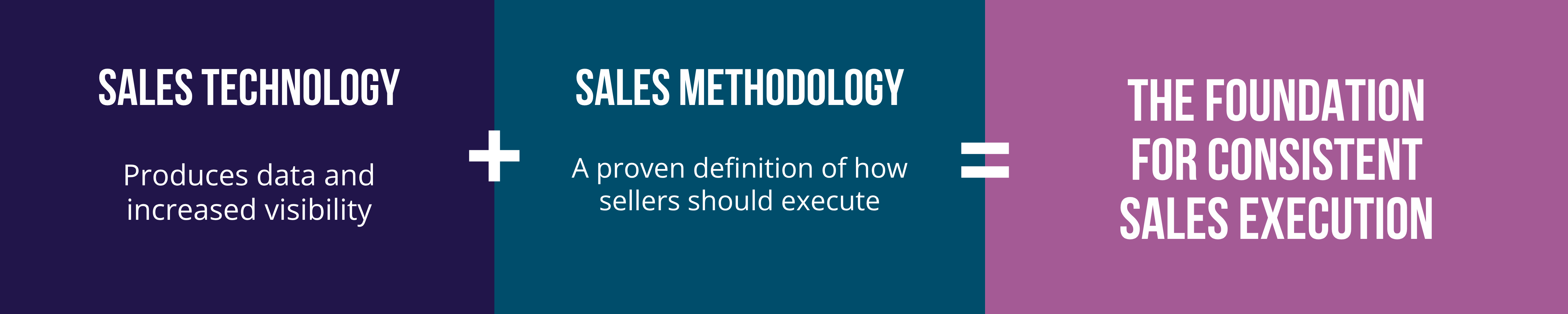
What is missing from many sales technology stacks is a research-backed sales methodology that defines how sellers should execute.
A sales methodology gives sellers, managers, and leaders a common framework for approaching the sales process. It defines the behaviours that matter most, including how sellers prepare for customer conversations, diagnose buyer needs, engage stakeholders, communicate value, and advance decisions.
This shared standard is what allows organisations to scale performance. When every seller operates from a different interpretation of what “good selling” looks like, leaders are left managing individual approaches. When every seller follows a consistent methodology, leaders can coach, measure, and improve execution across the entire team.
A strong sales methodology helps answer questions such as:
- How should sellers prepare for high-value customer conversations?
- What information should sellers uncover during discovery?
- How should sellers diagnose customer challenges?
- How should sellers engage buying groups?
- What criteria should determine whether an opportunity is qualified?
- How should managers coach sellers against observable behaviours?
- Which behaviours should leaders measure and reinforce?
Without answers to these questions, sales technology may increase visibility into seller activity but fail to improve seller effectiveness.
Why More Data Can Make Sales Execution Less Consistent
Many sales leaders respond to performance challenges by looking for more data. This response is understandable. Modern sales platforms produce large volumes of information, and leaders are under pressure to make sense of what is happening across teams, territories, and opportunities.
The problem is that more data does not always create better decisions.
Without a consistent behavioural standard, data can become noisy. Metrics may be interpreted differently by different managers. Forecasts may become unreliable because sellers apply inconsistent qualification criteria. Coaching may lack direction because leaders do not have a shared definition of what they are coaching toward.
This creates a common problem: leaders begin managing the metrics rather than improving the behaviours behind the metrics.
For example, a sales leader may see that conversion rates are declining. But without a consistent methodology, it can be difficult to know why. Are sellers failing to reach the right stakeholders? Are they asking weak discovery questions? Are they moving opportunities forward before confirming buyer commitment? Are they struggling to connect solutions to business outcomes?
The data shows the issue, but the methodology helps reveal the cause.
This is why sales analytics must be connected to a defined standard of execution. Metrics become more meaningful when they measure whether sellers are applying the right behaviours at the right moments in the sales process.
Sales Technology vs. Sales Methodology
Sales technology and sales methodology serve different but complementary roles. The strongest sales organisations do not choose one over the other. They align both.
| Sales technology provides | Sales methodology provides |
| Data and visibility | A standard for execution |
| Activity tracking | Behavioural expectations |
| Analytics and insights | Coaching criteria |
| Automation | Consistent opportunity progression |
| AI-generated recommendations | A proven framework for seller action |
| Pipeline visibility | Shared definition of opportunity quality |
| Conversation intelligence | Guidance on what strong conversations require |
Sales technology helps leaders see what is happening. Sales methodology helps sellers understand what should happen next.
When these two elements are aligned, technology becomes more useful. Instead of tracking disconnected activity, leaders can use technology to inspect whether sellers are applying the behaviours that drive performance.
How a Consistent Sales Methodology Improves Coaching and Measurement
Sales coaching becomes more effective when managers have a clear framework for what they are coaching.
Without a shared methodology, coaching often depends on each manager’s personal experience or preferences. One manager may focus heavily on activity. Another may focus on messaging. Another may emphasise negotiation or qualification. While each of these areas may matter, inconsistency across managers can create confusion for sellers.
A consistent sales methodology gives managers a shared language and a shared set of behaviours to reinforce. Instead of coaching only to outcomes, managers can coach to the actions that produce those outcomes.
For example, rather than telling a seller to “build more confidence in the deal,” a manager can coach the seller to:
- Clarify the customer’s business challenge
- Identify all relevant stakeholders
- Confirm the decision process
- Connect the solution to measurable business impact
- Create mutual commitment around next steps
These behaviours are observable. They can be practiced, coached, inspected, and improved.
This is where sales technology becomes especially powerful. When tools are aligned to the methodology, managers can use data to identify where sellers need support and then coach against a consistent standard.
How a Consistent Methodology Improves Measurement
A consistent methodology also improves performance measurement.
Many sales organisations rely heavily on lagging indicators such as quota attainment, revenue, win rate, average contract value, and pipeline coverage. These metrics are important, but they do not always explain why performance is improving or declining.
If quota attainment is down, leaders need to understand the behaviours behind the result. Are sellers qualifying poorly? Are they failing to create urgency? Are they losing access to senior decision-makers? Are they struggling to differentiate value?
A consistent methodology gives leaders a way to connect performance outcomes to seller behaviours. This makes measurement more actionable.
Instead of asking only, “Did the seller hit the number?” leaders can ask:
- Did the seller follow the qualification standard?
- Did the seller uncover the customer’s decision criteria?
- Did the seller engage the right stakeholders?
- Did the seller communicate value in terms of customer outcomes?
- Did the seller advance the opportunity with clear mutual commitment?
These questions help leaders move from measuring activity to improving execution.

The Benefits of Aligning Sales Technology to a Sales Methodology
When sales technology is aligned to a consistent sales methodology, organisations create a stronger foundation for scalable performance.
A consistent methodology can help sales organisations:
Establish shared terminology
Sellers, managers, and leaders need a common language. Shared terminology makes deal reviews, coaching conversations, pipeline discussions, and performance analysis more productive.
When everyone uses the same definitions, leaders can compare opportunities and behaviours more accurately across the organisation.
Reduce variability in sales execution
Inconsistent execution makes performance difficult to scale. If each seller qualifies opportunities differently, engages stakeholders differently, or advances deals differently, leaders cannot easily identify what is working.
A methodology reduces that variability by defining the behaviours sellers should apply across customer interactions and opportunity stages.
Improve manager coaching
Managers need a clear framework for coaching. A methodology gives them observable behaviours to inspect and reinforce, making coaching more practical and consistent.
This helps managers move beyond subjective feedback and focus on specific skills sellers can improve.
Support faster onboarding
New sellers ramp faster when they are given a proven structure from day one. A methodology helps new hires understand how to prepare, engage customers, diagnose needs, and progress opportunities.
Instead of learning only by observing others, sellers gain a clear model for effective execution.
Enable peer learning
Consistency makes peer learning easier. When sellers use the same framework, they can compare approaches, share best practices, and learn from successful behaviours across the team.
Improve adaptability
Selling conditions change. Buyer expectations evolve. New tools emerge. Messaging shifts. A consistent methodology gives organisations a stable foundation they can adapt over time.
When everyone is aligned to the same framework, leaders can introduce changes more quickly and consistently.
Make sales technology more effective
Technology works best when it supports a clear sales strategy. When tools are configured around a methodology, they can reinforce the right behaviours, guide sellers in the flow of work, and help leaders measure execution more accurately.
How to Build a Culture of Consistent Sales Execution
Creating consistency requires more than introducing a methodology once. Sales leaders need to embed the methodology into the way sellers work, managers coach, and leaders measure performance.
Here are three ways to build a culture of consistent sales execution.
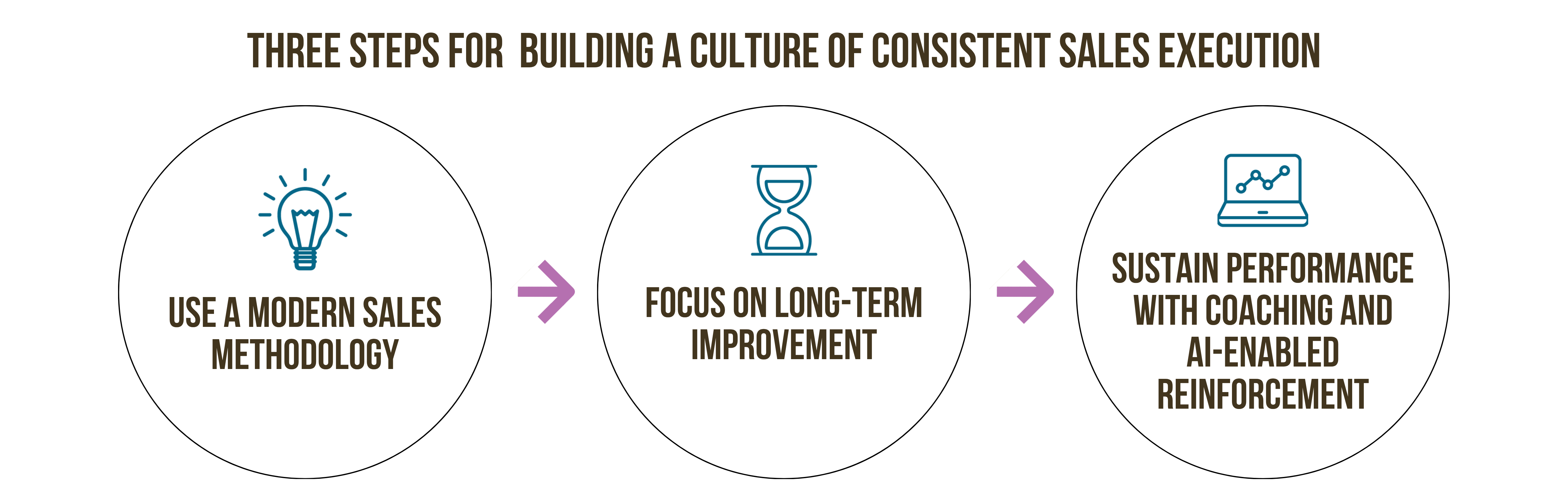
1. Use a modern sales methodology
A modern sales methodology should be practical, research-backed, and grounded in how buyers make decisions. It should define the specific behaviours sellers need to execute in real selling situations.
An effective methodology should clarify how sellers:
- Prepare for customer conversations
- Diagnose business challenges
- Engage multiple stakeholders
- Communicate differentiated value
- Create urgency around change
- Advance decisions
- Manage complex opportunities
The methodology should also be observable. Leaders and managers need to see whether sellers are applying the behaviours consistently. If the standard is vague, it will be difficult to coach. If it is observable, it can be reinforced and measured.
2. Focus on long-term improvement
A sales methodology cannot become part of the culture through a single training event. Sellers need structured learning, practice, manager coaching, and ongoing reinforcement.
This is especially important because consistent execution develops over time. Sellers need to move from awareness to application to sustained behaviour change.
Workflow tools can help by embedding methodology into daily selling activities. For example, tools integrated into CRM can prompt sellers to prepare for meetings, identify stakeholders, document buyer needs, and plan next steps using the organisation’s defined methodology.
This helps sellers apply the right behaviours in the right moments rather than treating methodology as something separate from their daily work.
3. Sustain performance with coaching and AI-enabled reinforcement
AI can play an important role in sustaining sales performance, but it should reinforce the methodology rather than replace it.
AI can identify patterns, surface risks, recommend next steps, and provide guidance in the flow of work. However, AI still needs a standard to reinforce. Without a methodology, AI may generate insights without ensuring that sellers are applying the behaviours that matter most.
High-performing sales organisations use technology to support a proven approach. They align AI, analytics, coaching, and workflow tools around the same behavioural standard.
This creates a reinforcement loop. Sellers receive guidance while they work. Managers coach against the same expectations. Leaders measure execution against consistent criteria. Over time, the methodology becomes embedded in how the organisation sells.

Turning Sales Methodology into Lasting Performance
Sales technology can help organisations see more, analyse more, and automate more. But technology alone does not create consistent sales execution.
To improve performance at scale, sales organisations need a shared methodology that defines what strong execution looks like. This methodology gives sellers a clear path to follow, gives managers a framework for coaching, and gives leaders a standard for measuring performance.
When methodology and technology are aligned, sales leaders can move beyond data collection and begin building a system for repeatable revenue performance.
The goal is not to add more tools or more metrics. The goal is to ensure that every part of the sales organisation—people, coaching, technology, and measurement—supports the same standard of execution.
In a complex selling environment, consistency is not just a best practice. It is the foundation for scalable sales performance.
Key Takeaway:
Sales technology improves visibility, but sales methodology improves consistency. The strongest sales organisations align their tools, coaching, workflows, and metrics to a shared behavioural standard so sellers can execute more effectively across every customer conversation and every opportunity.
Frequently Asked Questions: Sales Technology and Sales Methodology
What is missing from most sales technology stacks?
Most sales technology stacks are missing a consistent sales methodology. While tools can capture data, analyse activity, and surface insights, they do not define how sellers should execute. A methodology gives sellers, managers, and leaders a shared standard for conversations, opportunity progression, coaching, and measurement.
Q: Why isn’t more sales data enough to improve performance?
A: More sales data is not enough because data only shows what happened. Without a shared methodology, sellers and managers may interpret the data differently. This creates inconsistent coaching, unreliable forecasts, and difficulty identifying which behaviours actually improve sales outcomes.
Q: How does a sales methodology improve sales technology?
A: A sales methodology makes sales technology more useful by giving leaders a standard to measure against. Instead of tracking disconnected metrics, organisations can use technology to inspect whether sellers are applying the right behaviours throughout customer conversations, deal qualification, and opportunity progression.
Q: What is the difference between sales technology and sales methodology?
A: Sales technology provides tools, data, automation, and visibility. Sales methodology defines the behaviours sellers should use to engage buyers, diagnose needs, create value, and advance opportunities. Technology supports execution, but methodology defines what strong execution looks like.
Q: How can sales leaders create consistent sales execution?
A: Sales leaders can create consistent execution by defining a shared methodology, training sellers on observable behaviours, coaching managers to reinforce those behaviours, and aligning sales technology to measure and sustain the methodology in daily workflows.
Q: Can AI improve sales execution?
A: AI can improve sales execution when it reinforces a proven methodology. AI can identify patterns, surface insights, and provide guidance in the flow of work, but it should not replace the behavioural standard that defines how sellers should execute.