Strategic Account Management Best Practices: How to Retain and Grow Your Most Important Clients
Sales performance improvement

Written by: Claire Imber, Director of Content Strategy & Thought Leadership
Published: November 24, 2026
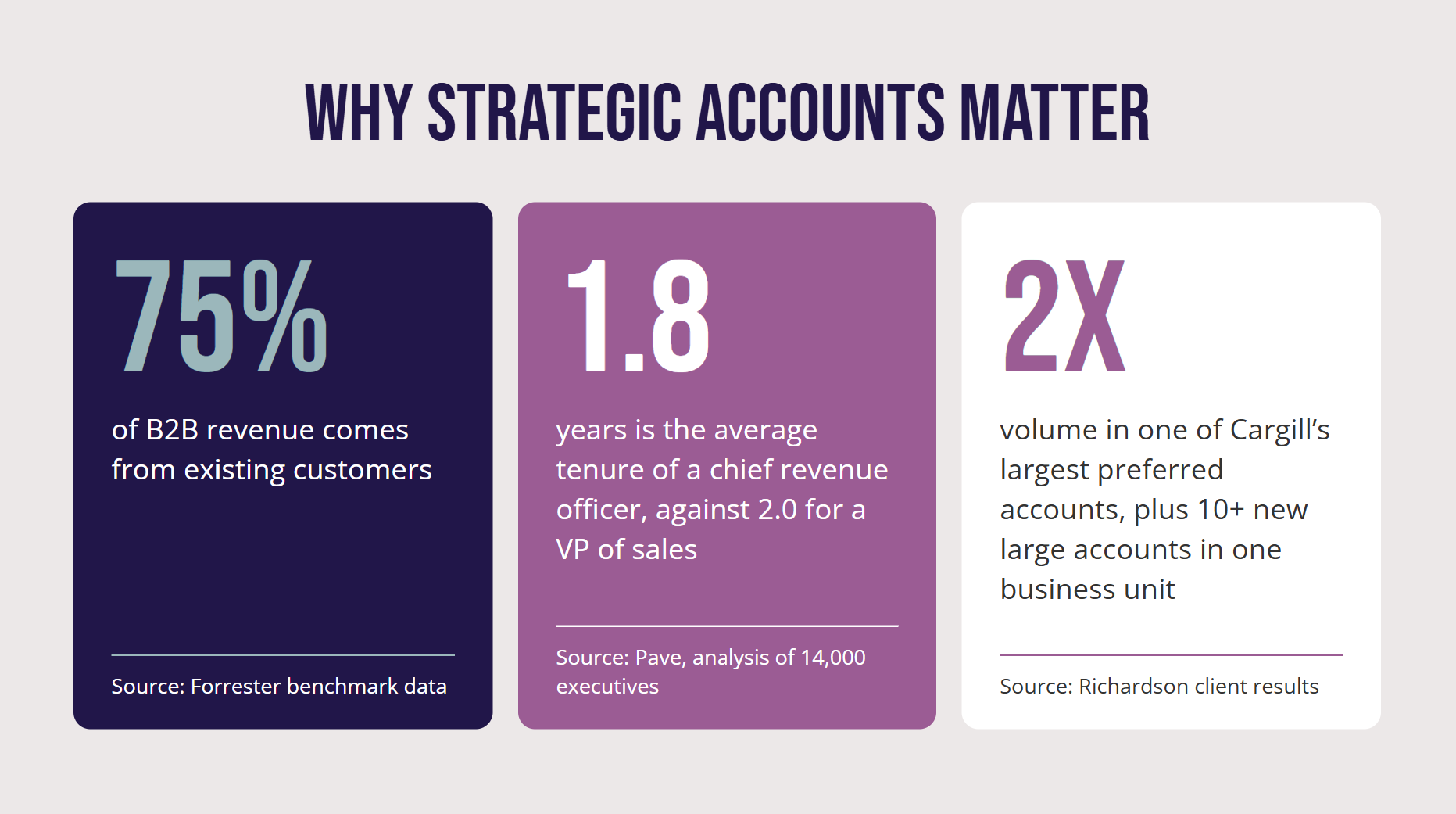
Successful sales leaders build their reputations and careers on the ability to consistently meet or exceed their target revenue goals each year. Many, however, fall short of their annual “number,” which is one of the driving forces behind the high level of turnover among sales leaders. Pave’s analysis of 14,000 executives puts the average tenure of a chief revenue officer at 1.8 years and a VP of sales at 2.0 years.
More often than not, the defining difference between sales leaders who succeed and those who don’t is not their ability to create the right sales strategy, but their ability to execute it. Strategic accounts are where that execution pays off most.
Key Takeaways
- Strategic accounts grow when you choose the right clients, put the right person in charge, and build relationships across the whole account.
- Make your company hard to replace, and bring the client insight that creates new value.
- Hold your team accountable for executing an account plan the client has seen and agreed to.
Why do strategic accounts matter to your sales strategy?
Selling to an existing account is much more profitable and predictable than trying to win new business with a new organisation. Forrester benchmark data shows that existing customers represent about 75% of B2B revenue.
Customers with strategic account status are also typically more receptive to exploring proposals for product enhancements, new products, and new services and solutions. That gives sales leaders a chance to deepen the relationship and become an integral part of the customer’s business.
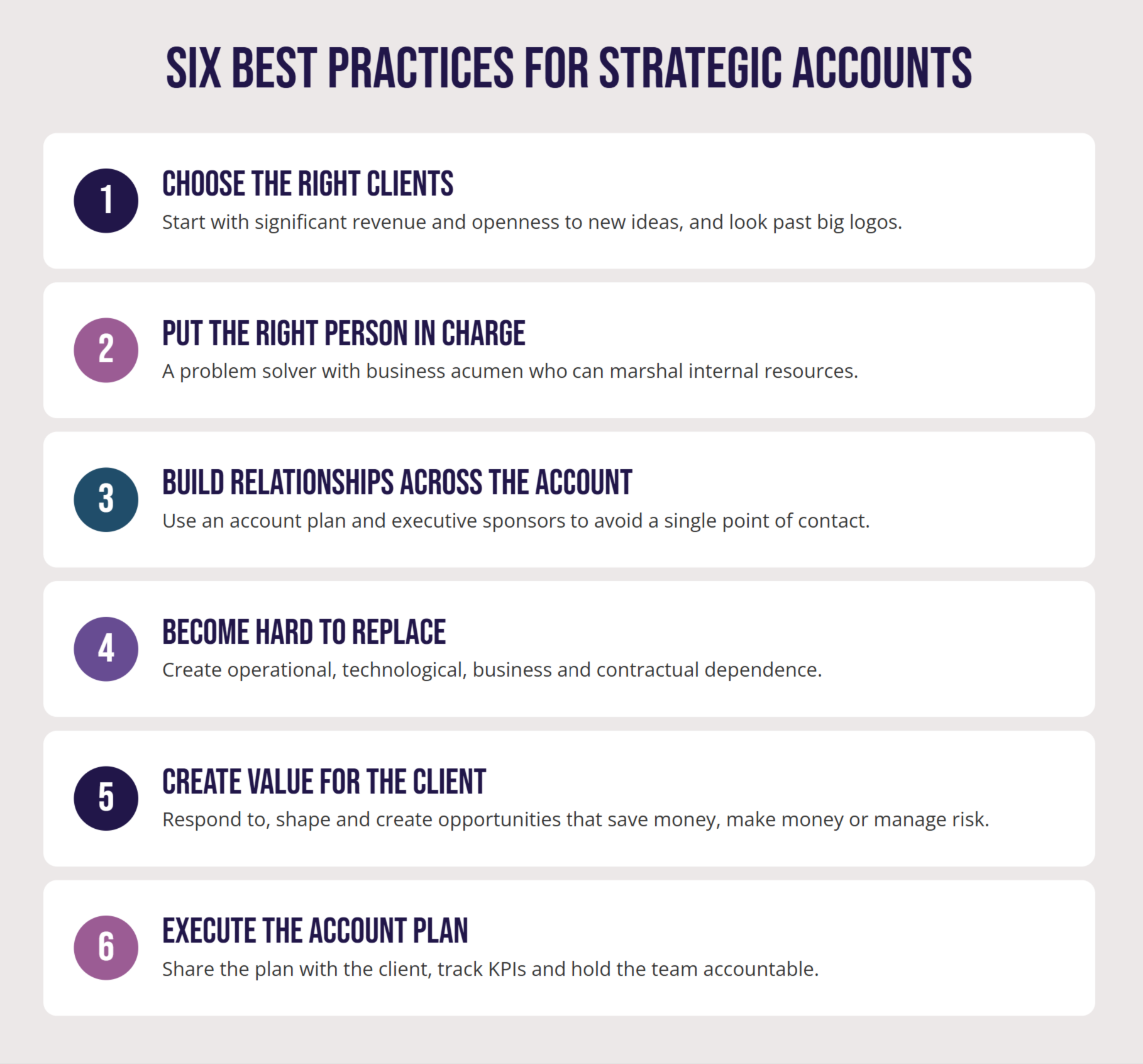
A customer that plays an integral role in the current and long-term success of your company is an invaluable asset, and it needs to be managed that way. These six best practices help you protect and grow strategic accounts.
1. How do you decide which clients should be strategic accounts?
Start with the clients that contribute a significant amount of revenue. Ask yourself, “If we lost this account, how much would we worry about filling the revenue gap?”
Then look for clients that are open to experimenting with innovative ideas and new solutions. Early adopters, and companies in highly competitive industries that require constant innovation, are ripe for strategic account alignments. That gives you a chance to develop best practices and case studies while you deepen the relationship.
Don’t be too enamoured of “big logos,” such as Fortune 500 companies or a buzzy new startup. Working with them bolsters your credibility, but many are difficult to work with and very cost conscious. These accounts are hard to make profitable enough to merit the resources a true strategic account needs. Challenger brands may be more open to your ideas and thus a better fit.
One more filter: Take your CEO’s opinion into consideration. Which clients would they hate to lose? Which clients do they brag about often?
2. Who should manage your strategic accounts?
Trying to get a farmer to hunt is futile. Some people are cut out for new business development, and others aren’t. The opposite also holds true. You don’t want a strategic account manager (SAM) who is so aggressive that they pester the client or propose new ideas that aren’t in the client’s best interest.
The ideal SAM is a problem solver who is sensitive to the client’s needs. They must be willing and able to become an expert in the account’s business and connect the client’s needs to your company’s ability to help. Educating the customer about insights relevant to their business is a major focus of the role.
A SAM also needs credibility and the ability to marshal internal resources. Extensive technical expertise isn’t necessary, but an aptitude for calling in the right people at the right time is critical to seizing opportunities that further the relationship. The most successful SAMs relate to the needs of a wide range of people in the account and build consensus among them. Hunters, by contrast, focus on winning the next deal on their own.
Study your best SAMs to understand what makes them successful. Valid, reliable psychographic assessments and time and activity studies help, and so does joining some of their client calls to hear the style and substance of their conversations.
The role asks for more than a farmer’s skills. A great SAM is a consultant, an educator, an advisor, and — above all — a person with strong business acumen. These skills can be developed, but many require specialised training and coaching to become authentic, confident, and effective.
3. How do you protect an account from the risk of a single contact?
Nothing puts a strategic account at greater risk than having only a single point of contact, or having a SAM own all of the relationships in the account.
An account plan helps you identify all of the key players who influence the need or preference for your solution. LinkedIn is a useful tool for this work. If you’re linked to your SAM and your SAM is linked to contacts in the account, you have visibility into those contacts and the ability to connect with them. When people change jobs, they often update their profiles quickly, so you and your SAM can manage the change proactively.
Identify potential buyers and strong influencers early. One way is to establish executive sponsorship programmes, in which your senior executives build peer-to-peer relationships with executives in your strategic accounts. These relationships fortify the account, speed up decision making, and protect you from changes in executive leadership or company strategy.
4. How do you become hard to replace?
Ideally, you become part of the fabric of your strategic account’s organisation, so the client depends on you. That dependence can take four forms:
- Operational dependence, such as channel partnerships
- Technological dependence
- Business dependence, such as providing special terms or financing
- Contractual dependence, such as asking for multiyear or automatically renewing contracts
Sometimes clients won’t be 100% satisfied, or they’ll hire new, key personnel who introduce new biases and preferences. If they depend on you for their business, it’s difficult for them to sever ties without giving you a chance to make things right.
5. How does a SAM create value for the client’s business?
This is where you look beyond the obvious and seek new win-win opportunities in your client’s business. A SAM typically provides value by helping clients save money, make more money, or manage their risk. Those opportunities arrive in one of three ways:
- Respond. The opportunity comes directly from the client, usually as a proposal request. To act quickly, your strategic accounts team must already be set up to respond.
- Shape. A solution is on, or close to, the client’s radar, but executive leadership hasn’t had time to develop an initiative around it. For example, a client learns it is breaking into a new market and must hire 100 sellers in 10 different countries. That’s a chance to partner with the client and offer solutions to support the effort.
- Create. The account is too busy or overwhelmed by challenges to give innovation and strategic planning proper attention. Here, the client values a partner that brings ideas, helps them understand their challenges, and shapes solutions that help them reach their goals.
Clients notice the difference. Jeanne Delancey, Director, Commercial Learning and Development at Cencora, describes the kind of partner they value: “Richardson’s been a great consultative partner. All of the approaches that we’ve been bringing to our sales organization to make them more effective in their customer interactions — you guys walk the walk and talk the talk.”
SAMs who shape and create opportunities benefit by mitigating competition, reducing price sensitivity, and building deeper, higher-level relationships in the account. After a sales effectiveness programme with Richardson, Cargill reported 2x volume in one of its largest preferred accounts and 10+ new large accounts in one business unit.
6. How do you make sure the account plan gets executed?
Managing a strategic account takes rigour and discipline. Think of it as running a business within your business. Account planning helps identify the resources you need to reach your growth objectives, and it’s a collaborative process. It requires the client’s involvement to be valid.
Too often, account plans are more fantasy than reality. Many organisations go through an annual account-planning exercise and then forget to execute the plan. Your SAMs need valid account plans, and you need to hold people accountable for executing their account strategies. Identify the objectives, goals, and key performance indicators to track progress, just as you would manage your sales pipeline. Make sure your SAMs have what they need to meet their goals, and coach their strategic account teams to success.
Don’t consider a strategic account plan final until your client has seen it and agrees to it.
Where should you start?
It’s easy to get distracted from the fundamentals of executing your sales strategy. There are countless initiatives around people, process, and technology that can help you reach your goals, but few will be as impactful as establishing key clients as strategic accounts and managing them well. Before your next strategic initiative or brainstorming session, ask yourself how much potential exists within your strategic accounts and what you need to do to protect and grow them. Strategic account programmes provide consistent, stable revenue that helps sustain long-term growth.