What Soft Skills Do Salespeople Need?
Sales performance improvement

Written by: Ben Taylor, MBA, Content Marketing Manager, Richardson
Published: November 13, 2026
Businesses are increasingly attuned to the importance of soft skills as the knowledge economy continues to grow. In a knowledge economy, production and services are based on knowledge-intensive activities, and soft skills are the core of the intellectual capabilities behind them. Put simply: soft skills are the engine of the knowledge economy.
Key Takeaways
- Salespeople need six core soft skills: Presence, Relating, Questioning, Listening, Positioning, and Checking.
- The six are interconnected, so a seller gets the full value of one only by demonstrating the others.
What are the six soft skills salespeople need?
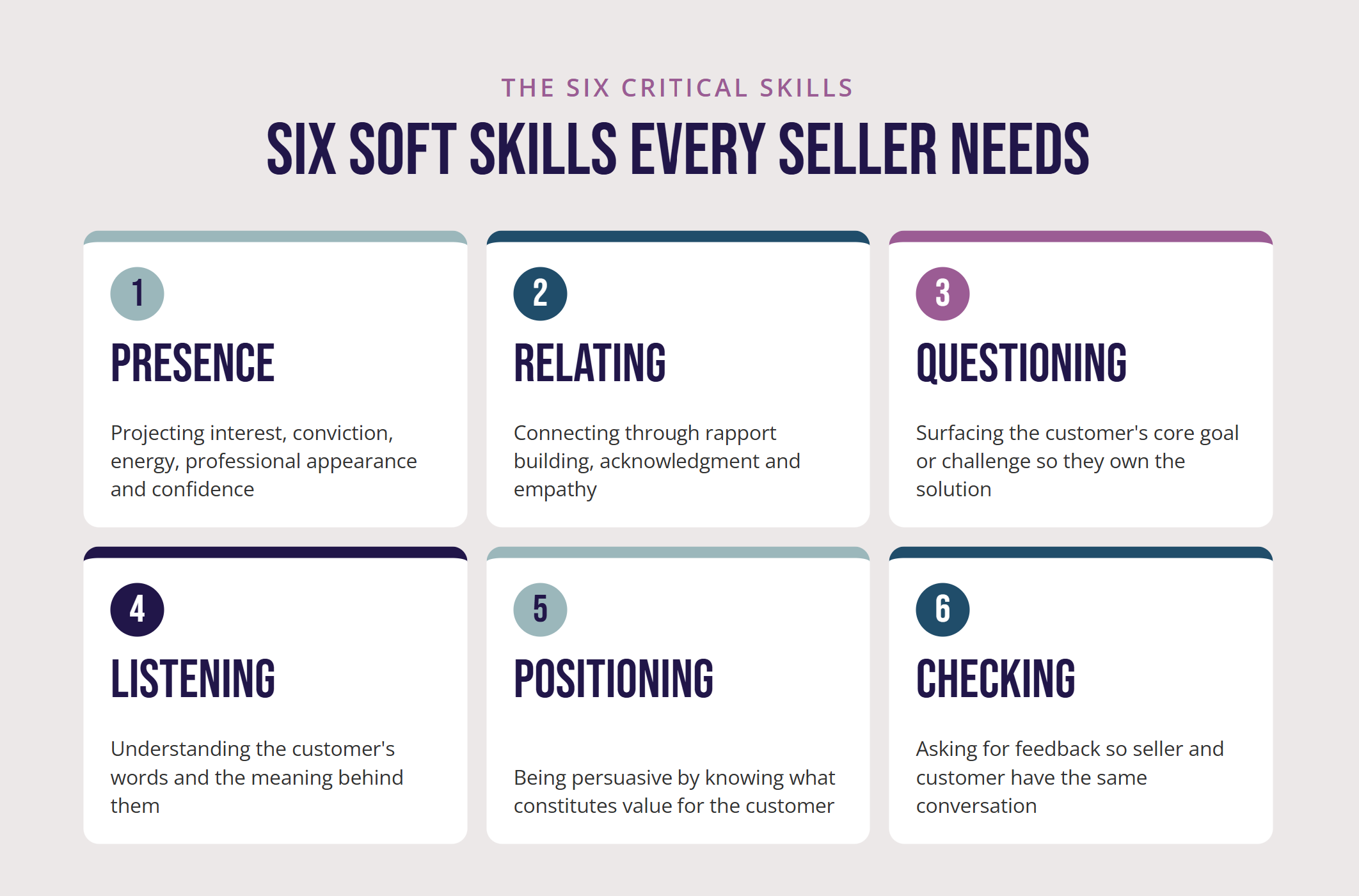
Richardson Sales Performance believes there are six core soft skills. We call them the Six Critical Skills. Each is important, and to truly possess the soft skill advantage, a seller must master all six. They are interconnected; to benefit from the value of one, the sales professional must be able to demonstrate the others.
Presence
Presence is the way a sales professional demonstrates their professionalism. It is the skill of projecting interest, conviction, energy, professional appearance, and confidence.
Relating
Relating is the way that one makes a meaningful connection with customers. Building the relationship takes three levels of connection: rapport building, acknowledgement, and empathy.
Questioning
A key part of the sales conversation is asking questions that surface the customer's core goal or challenge. When customers provide answers to these questions, they feel a sense of ownership of the solution.
Listening
The ability to truly hear and understand the customer's needs requires active listening, which is the process of understanding the other person's words and the meaning behind them.
Positioning
Positioning is the act of being persuasive rather than just exchanging information. To position a product or service effectively, the sales professional must know what constitutes value for the customer.
Checking
Ensuring that the sales professional and the client are having the same conversation requires constant checking. Asking for feedback is critical.
Why do soft skills matter in sales?
Demand for soft skills keeps growing
These skills are increasingly in demand. LinkedIn's 2026 Skills on the Rise research finds that employers are prioritising skills over degrees, job titles, and linear career paths, and LinkedIn News editor Andrew Seaman says companies are also searching for innately human skills, such as cross-team collaboration and client relations. The appeal makes intuitive sense because soft skills are broadly applicable to a range of challenges. They are always relevant.
However, many leaders remain unclear on how to bring those capabilities into their businesses. SHRM's 2023 Talent Trends research found that about one in four organisations that struggled to recruit cited candidates' lack of the right soft skills. In our experience working with leading businesses, that gap prevents people from fully realising the value of their role-specific skills.
How do soft skills unlock role-specific skills?
In our experience, competitive advantages are eroding in today's setting of widely available technology. As a result, soft skills are a way to elevate the value of the business and the quality of interactions with customers.
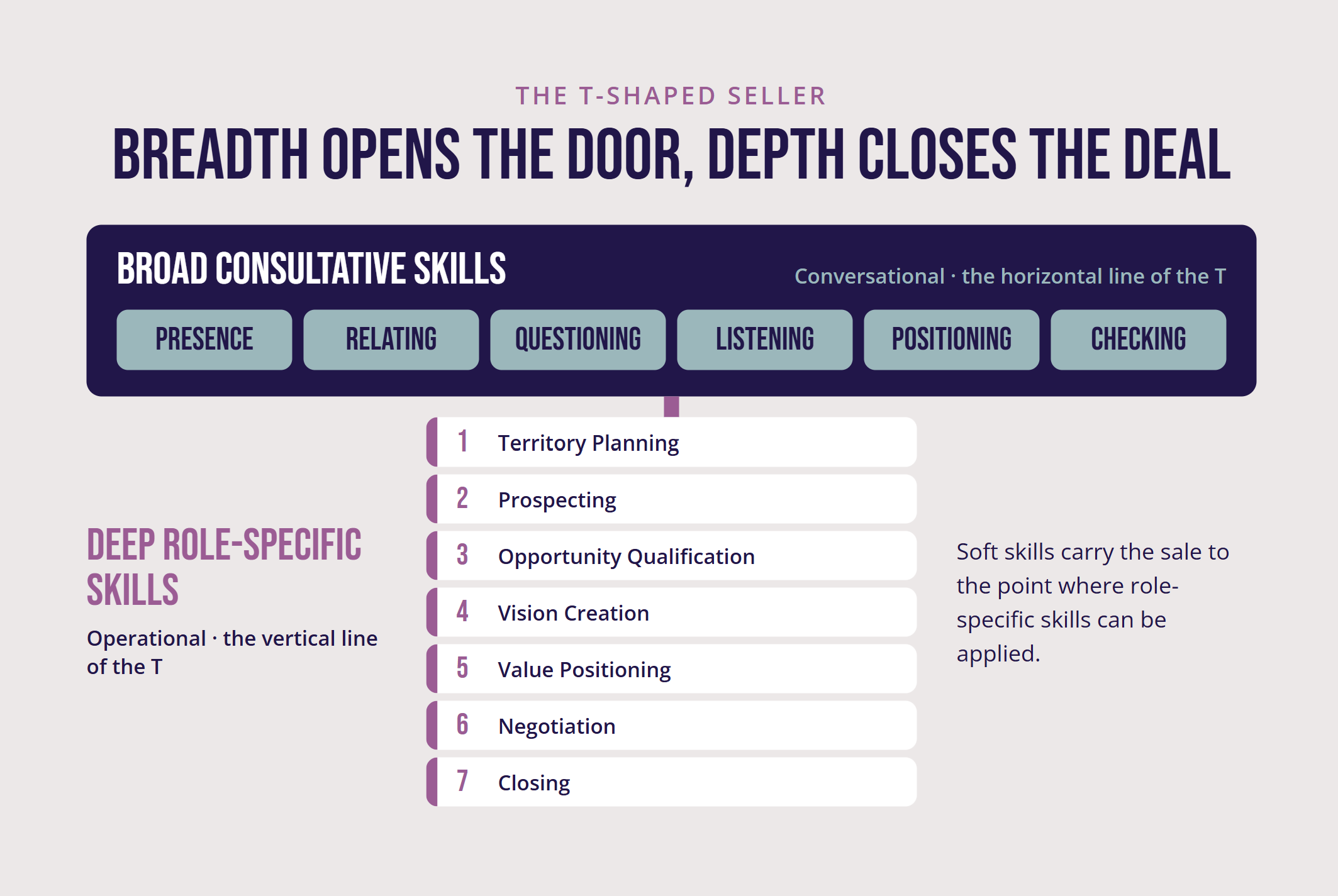
The value of soft skills has also renewed interest in the idea of "T-shaped" skills, a model McKinsey reportedly used internally in the 1980s and that IDEO's Tim Brown later popularised. This idea suggests that the most effective individuals possess cross-discipline soft skills balanced with deeper role-specific competencies. The horizontal line of the T represents soft skills, and the vertical line represents the depth of expertise in a single area.
| Skills | |
|---|---|
| Broad consultative skills (conversational) — the horizontal line of the T | Presence, Relating, Questioning, Listening, Positioning, and Checking |
| Deep role-specific skills (operational) — the vertical line of the T | Territory Planning, Prospecting, Opportunity Qualification, Vision Creation, Value Positioning, Negotiation, and Closing |
In selling, this model represents a simple but unseen truth: the soft skills in the horizontal are what allow a sales opportunity to reach a point where the role-specific skills can be applied. Without conversational, adaptable, and critical thinking skills, few sellers will advance the sale to the stage where specialised skills like negotiation, positioning, and virtual selling emerge.
This connection is critical because role-specific skills emerge from years of experience. They influence the customer to move through the buying journey. Without soft skills, the deeper role-specific skills that are years in the making offer little advantage.
Consider how active listening affects the sale. A sales professional who does not understand the importance of active listening will miss critical details that would enable them to position the solution properly later. They might have a deep reservoir of knowledge about a product or service, but without capturing the details underpinning the customer's needs, they will not know which aspects of the solution to highlight.
"When you put those behaviors into practice — questioning and listening, having facilitated sessions with coaches that actually get in there and can coach them along the way — our teams are better able to actually apply some of those behaviors in the moment with their customers."
— Amber Boll, Director, Sales Global Process Owner, Rich Products Corporation
How can sales leaders put the Six Critical Skills to work?
To benefit from the Six Critical Skills, leaders need to ensure the skills are applied to the operational, conversational, and analytic selling factors. That is, these soft skills must be apparent across all facets of the business. The strongest benefit of this approach is that it simplifies the sales growth equation.
When sales professionals fold these skills into their interactions and approach to work, they never risk losing sight of the essential factors that drive the sale. That risk is ever-present and growing as selling tools and methodologies become increasingly complex. By building the core of the selling methodology around the Six Critical Skills, leaders can bring scalable change to an organisation. Doing so means using the skills in three ways that adapt to the modern sale.
Embrace change
A key strength of the Six Critical Skills is that they work in a changing environment. Questioning, listening, and checking all aim to understand the dynamics of the customer's situation. These skills are a reminder that the path to the sale is in the customer's words. Sales professionals who focus on learning from the customer avoid the common mistake of positioning a solution too early.
Differentiate strengths
CRM and workflow tools offer considerable benefits to the selling organisation. However, most sales professionals enjoy those same benefits, so the competitive advantages of technology are limited. What brings renewed power to these tools are the people behind them. When sales professionals combine the emotional intelligence of soft skills with hard skills, a sales organisation becomes better able to use technology selectively, when and where it matters most: in front of the customer.
Unite capabilities
As selling organisations grow and change, they often shed characteristics and acquire new ones. While this is a natural part of development, it can lead to a lack of uniformity across the organisation. With a focus on the Six Critical Skills, the organisation can orient itself around a "true north" that remains unchanged. When a team sees that every initiative ties to a clear and immovable centre, they are better able to understand the intent of the plan and why it matters. The result is sustained behaviour change.
"With Richardson, what I love about it is we were able to scale the entire framework throughout our organization globally. So you're getting that same language, that same framework with consistency, which keeps that brand."
— Darnetta Daire, Sales Enablement Manager, Hollister Incorporated
Complexity pervades the business landscape. Too often, the response is to adopt an equally complex solution. At Richardson Sales Performance, we have learned that the better and more effective response is to re-centre around timeless soft skills that serve the sales professional in any setting. The Six Critical Skills provide capabilities that work within a changing environment while fostering skills across the organisation that are unseen among competitors.