How Long Does It Take to Implement a Sales Training Programme?
Sales performance improvement

Written by: Claire Imber, Director of Content Strategy & Thought Leadership
Published: November 9, 2026
At a certain point, sales leaders must convert the concept of sales training into concrete steps to implement and ingrain it in their organisation. Doing so is challenging. Leaders must engage the broad experience levels and training needs of the sales team. Training encompasses several components, requiring a diverse set of skills for learning and development and enablement teams, and it must be an ongoing process.
These factors make it challenging to translate the goal of sales training into a step-by-step process — but with the right guidance, it is achievable.
Richardson Sales Performance has spent decades training enterprise sales teams worldwide, and that experience has shaped a linear process and timeline for taking sales organisations to peak performance. The steps below are a general guideline. The specifics will vary from one organisation to another.
Key Takeaways
- A structured approach to preparation readies a sales team in 4–8 weeks.
- Implementation takes another 4–8 weeks.
- Sustainment is ongoing, because learning should always be on.
What does the timeline look like from start to finish?
Richardson's approach moves through three phases.
| Phase | Timing | What happens |
|---|---|---|
| Preparation | 4–8 weeks | Leaders identify the behaviours that drive wins, benchmark each seller, show sellers their results, and build personalised learning journeys. |
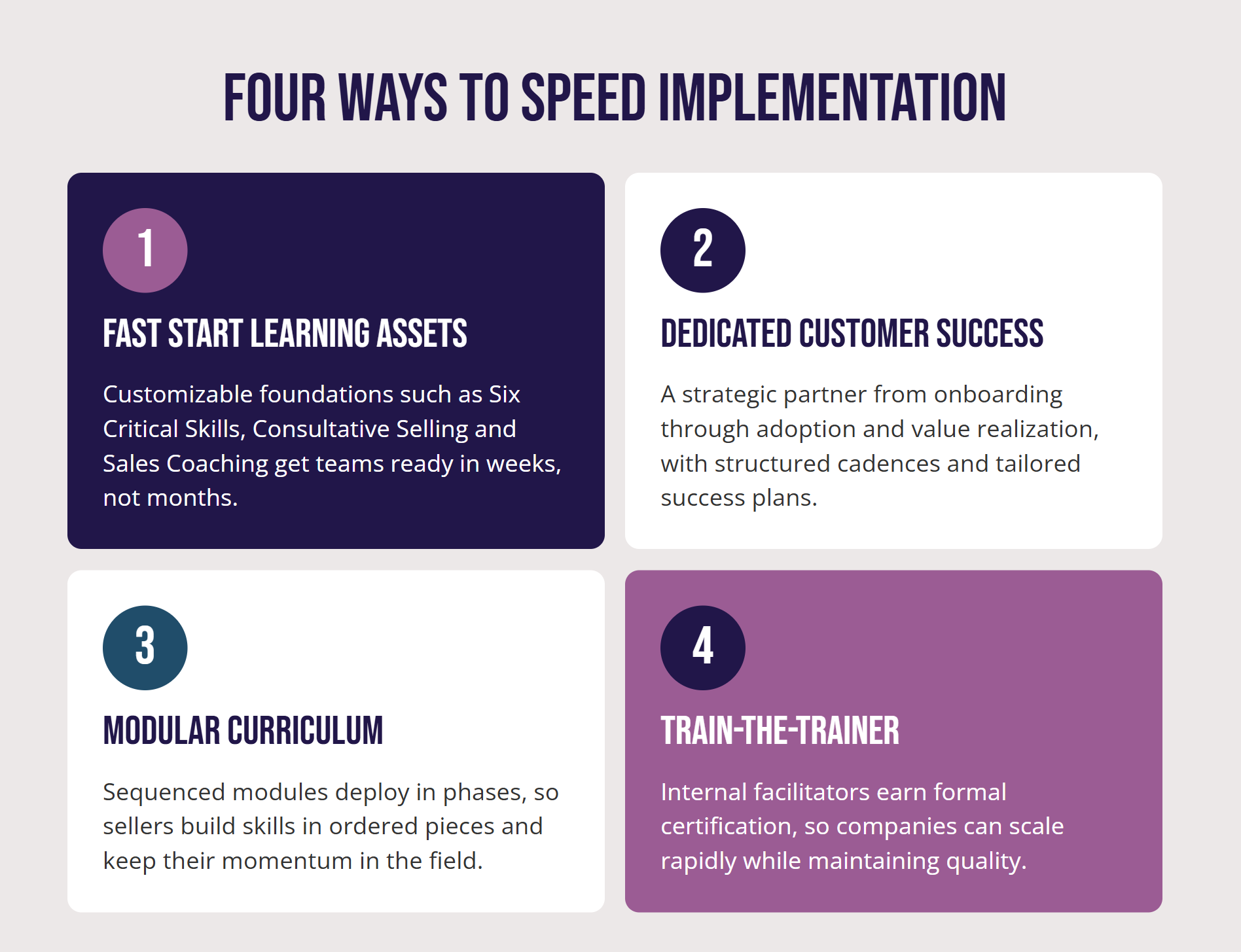
| Implementation | 4–8 weeks | Sellers start with fast start learning assets, work with a dedicated customer success team, move through a modular curriculum, and gain internal trainers through Train-the-Trainer. |
| Sustainment | Ongoing | Managers coach to the strategy, leaders track long-term measures, and sellers build self-efficacy. |
What happens during the 4–8 weeks of preparation?
A structured approach to preparation readies the sales team in 4–8 weeks. Richardson accomplishes this with a phase-based launch model that sets clear milestones for content finalisation, trainer preparation, and rollout. The work happens across four parts.
“Having a clear plan and a clear strategy for what you want to implement and how you want to roll it out in advance is really helpful — because of the breadth of capabilities that there are.” — Amber Boll, Director, Sales Global Process Owner, Rich Products Corporation
1. Identify the behaviours most impactful to success
Before personalising the skill development process, leaders need to isolate the specific capabilities that drive wins. The work moves in three steps:
- Clarify the lagging indicators. These are the metrics leaders want to examine over the next 12 to 24 months to determine success.
- Identify the leading indicators. These show progress toward the lagging indicators. The approach involves starting at the end and working backward to understand how to reach that point.
- Identify the selling behaviours most influential to those indicators. This converts the strategy into precise, individual capabilities.
Here's an example. An organisation sets a goal of generating more growth from net-new clients. Its lagging indicators might be pipeline growth from net-new accounts and an increase in average opportunity value. A leading indicator that points toward both is successful meeting outcomes in net-new accounts. From there, leaders identify the behaviours that influence those outcomes. Sellers would first develop better prospecting skills to get the right people in the meeting. Then they would engage stakeholders across the account, asking insightful discovery questions about the cost and risks of the current situation.
Put simply, leaders first identify their destination, then they determine the path they'll take to reach it.
2. Assess and benchmark sellers to determine skill gaps
Once leaders know which metrics and behaviours matter most, it's time to assess each seller against them. Each seller undergoes a capability assessment that benchmarks current skills and behaviours. The assessment should combine behavioural assessment questions with the seller's performance metrics, so that real-world results inform the picture. It's best to have both the seller and the manager complete the review, which creates a more objective and balanced view.
3. Show sellers their results
The most crucial step is to start the seller's learning journey by clearly presenting their assessment, identifying the behaviour and skill gaps to improve, and linking those skills to their relevant metrics. When sellers see an individual picture of improvement tied to their own targets, they see what is in it for them to invest time in building skills.
4. Develop a personalised learning journey
The results then inform a personalised learning path for each seller. Personalised learning works best when recommendations link directly to a seller's individual metrics and when the path includes a mix of modalities:
- Digital, self-paced learning that targets a specific skill gap
- Live coaching and feedback sessions with an expert
- Tools in the revenue technology stack that help sellers apply the learning while they work
- Interactive digital sustainment learning assets
What happens during the 4–8 weeks of implementation?
Sales capability development is fast, effective, and lasting when the experience is adaptive and personalised to the seller. A seller's training needs depend on their role, skill gaps, and the nature of their current opportunities. With personalisation, sellers can focus on what matters without getting lost in volumes of material.
1. Fast start learning assets
Richardson begins by aligning sellers on foundational capabilities, such as the Six Critical Skills, Consultative Selling, and Sales Coaching. Each is customisable and gets sales teams ready in weeks, not months.
These capabilities are instrumental to all sales pursuits. The Six Critical Skills, for example, give sellers the flexibility to connect with customers in a meaningful way during conversations. They enable sellers to pivot and adjust in the moment as they listen to and interpret the information. The degree to which a seller masters these skills is what separates the best from the average.
2. A dedicated customer success team
Every client pairs with a dedicated customer success team that serves as a strategic partner throughout the transformation journey. From onboarding through adoption and value realisation, the team ensures alignment, removes roadblocks, and helps connect business goals to measurable outcomes. With structured cadences, tailored success plans, and proactive insights, the customer success team is a valuable resource for sustaining progress.
“They have worked closely with us over the past 3 years to go above excellent training and actually deliver measurable and defined commercial results that supports meeting our sales goals.” — Nick Hine, Global Commercial Learning Director, Veolia Watertech
3. A modular curriculum that flexes with your needs and priorities
Richardson organises training content into sequenced modules. An organisation can engage in the entire Consultative Selling programme, for example, or choose just one part of that curriculum, like Resolving Objections. Richardson deploys the parts in phases to make the skills more digestible. Change is jarring and fatiguing, and introducing learning content in ordered pieces lets sellers develop a skill set that builds on itself.
The modular approach also encourages adoption. For many sellers, training can seem like a distraction from their important pursuits. A modular curriculum lets sellers keep their momentum in the field while acquiring skills relevant to their current opportunities and addressing their existing skill gaps. Sales leaders need to communicate the rationale behind this approach to their sellers, because it shows the training was designed with their interests in mind. Managers must reinforce the skills during team meetings and one-on-one meetings. Earning sellers' commitment requires training that is personalised, outcome-driven, and strengthened as adoption grows. Richardson's brief on earning seller buy-in for sales training goes deeper.
4. Train-the-Trainer for scale
One of the most complicated challenges for sales and enablement leaders is deploying training at scale, which is why Richardson equips internal facilitators early in the process. The Train-the-Trainer process culminates in sales trainers obtaining formal certification to administer Richardson Sales Performance course content. This approach allows companies to scale rapidly while maintaining quality. By modelling Richardson's approach and best practices, trainers meet their specific timelines in coordination with both Richardson-led and internal-led sessions.
How do you sustain a sales training programme after launch?
Learning should always be on, and the visibility of improvement efforts should be continuous. The sales team's data should reveal the next set of behaviours and skills to prioritise, as well as the next personalised learning path for each seller.
“It's a behaviour change, right? So you can't expect results right away. But the more consistent you are with training and bringing people along with you, the more it becomes part of that normal language.” — Darnetta Daire, Sales Enablement Manager, Hollister Incorporated
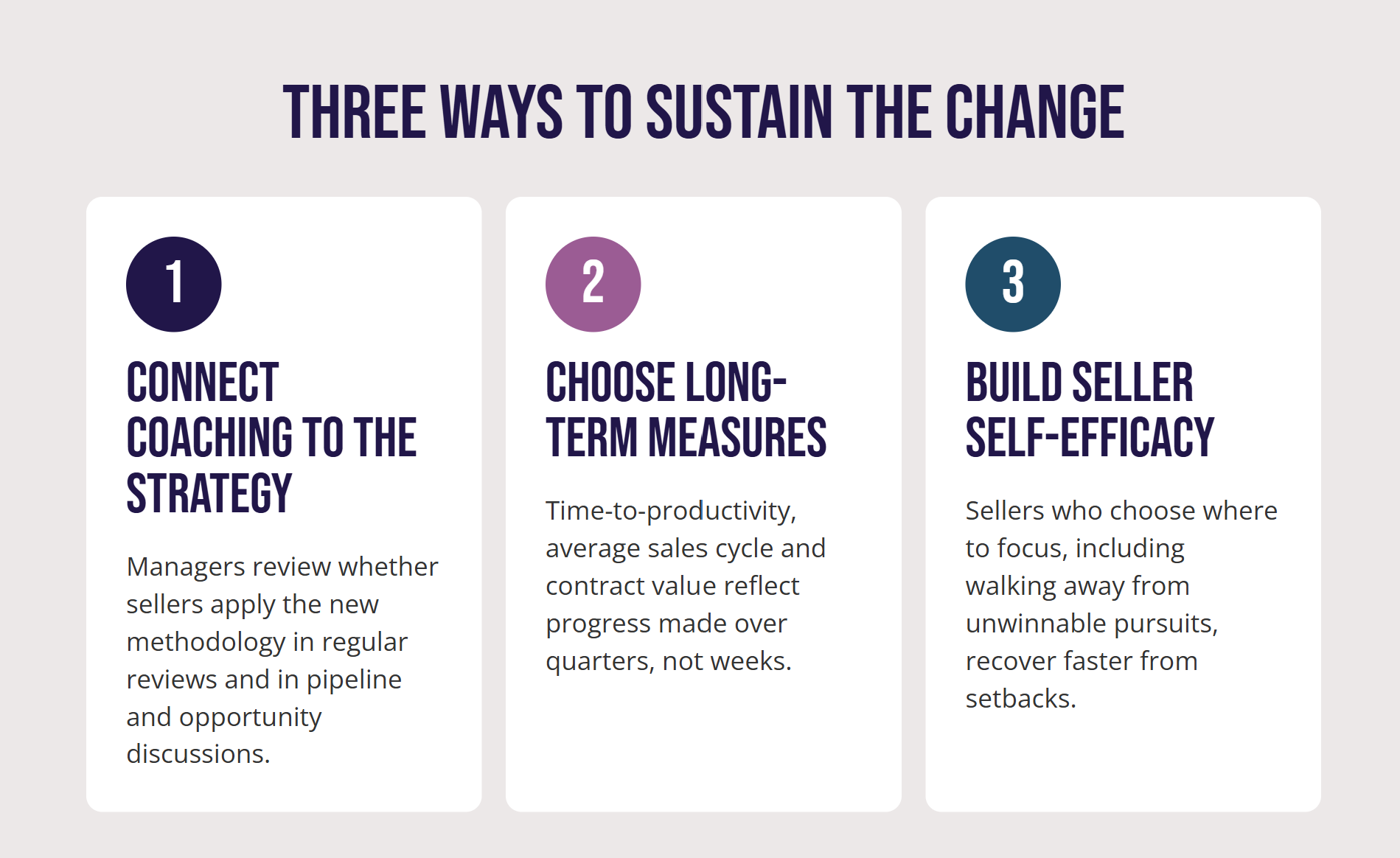
1. Connect coaching to the strategy
A new sales methodology can be intimidating for sellers because it is a departure from comfort. That's why the sales manager's role as a coach is so critical to making a new methodology work in the long term. During regular reviews, sales leaders can assess whether sellers consistently apply the new methodology by reviewing how well they apply the selling behaviours previously identified as leading indicators of success.
Sustainment also happens at the macro level. Sales leaders review pipeline and individual opportunities through the lens of the new methodology. Sellers see that the new approach is a team-wide effort when managers are in tune with it. And when leaders bring the methodology into coaching conversations, it becomes clear that leadership has a personal stake in its success.
2. Choose long-term performance measurements
Sales leaders who want to drive consistency must commit to long-term performance measurements. Time-to-productivity and average sales cycle are two examples. Improving these metrics takes considerable time, so they reflect progress made over quarters, not weeks. Contract value is another good long-term measure, because it reveals the sales team's ability to create strategic, long-term relationships.
3. Empower sellers with self-efficacy
A seller possesses self-efficacy when they believe that their capabilities are more influential in winning than their previous successes.
Research on self-efficacy finds that people with high self-efficacy recover more quickly from setbacks and stay committed to their goals. What makes this skill so powerful is that it instills a sense of confidence that lasts beyond coaching conversations.
Coaches foster this trait by encouraging sellers to be selective in how they spend their time, including the freedom to walk away from pursuits that are not winnable. Sellers who choose where to focus develop better shot selection skills. As a result, they position the product or service to the right prospects.
Why does a structured approach matter?
A structured approach drives effectiveness and efficiency in a sales training programme. The value of a partnership with Richardson extends beyond sales results. It's also in the guidance Richardson offers when preparing, implementing, and sustaining a programme. The more efficiently a sales organisation can initiate a sales training programme, the sooner it can achieve results.