How Sales Enablement Leaders Can Scale Behavior Change with AI
Sales enablement

Written by: Andrea Grodnitzky, Chief Marketing Officer
Published: May 7, 2026
How Can Sales Enablement Leaders Scale Behaviour Change?
Sales enablement leaders can scale behaviour change by connecting seller performance signals to targeted development, coaching, and reinforcement in the flow of work. Rather than relying on broad training programmes alone, organisations need a system that identifies individual skill gaps, delivers relevant guidance at the right moment, and helps managers coach based on real behavioural and performance data.
This article explains why traditional enablement often struggles to create consistent seller behaviour change, how AI can make development more relevant and scalable, and what sales leaders can do to build a more precise, data-driven approach to seller performance.
Keep reading to learn how sales organisations can move from episodic training to continuous, signal-driven seller development.
Complete the form below to download the brief, "The Problem Enablement Leaders Couldn't Solve. Until Now," to explore how to use agentic AI to connect connect performance signals to targeted development—and deliver that guidance continuously, at scale, in the flow of work.
Why Sales Enablement Struggles to Change Seller Behaviour
Sales organisations have more enablement resources than ever. Sellers have access to more content, tools, training, and data. Leaders have greater visibility into activity and performance. Technology continues to advance.
Yet one challenge remains difficult to solve: organisations still struggle to consistently connect seller behaviour to performance outcomes at scale.
The assumption behind many enablement efforts is straightforward. If sellers are exposed to the right content, taught the right frameworks, and supported with consistent coaching, behaviour change should follow. But in practice, these efforts often fall short because they are not coordinated into a continuous system that connects insight, learning, coaching, and action.
Traditional sales enablement programmes are often too broad to address each seller’s unique development needs. One seller may need help improving discovery. Another may struggle to lead consultative conversations. Another may need support in the final stages of closing. When training is delivered uniformly, sellers may learn useful skills, but those skills may not be the ones most relevant to their current performance gaps or live opportunities.
That lack of relevance limits impact. Development is often disconnected from the individual signals that show where each seller needs support. As a result, skill gaps accumulate, coaching becomes inconsistent, and training investments do not always translate into measurable performance improvement.
Why Relevance Is Essential to Seller Development
Relevant sales training is more effective because sellers are more likely to engage with development that connects directly to their deals, skill gaps, and performance goals. When learning is tied to real opportunities, sellers can apply new behaviours immediately, making training more practical and more likely to influence outcomes.
Relevance does not come from content alone. It comes from context.
Sellers need to understand how a skill will help them improve a real sales conversation, advance a current opportunity, or strengthen a specific stage of the sales process. When that connection is clear, learning becomes more meaningful. Sellers see how the training applies to their work, and they are more likely to use new behaviours when it matters.
For enablement leaders, this creates a scale challenge. Personalised development is clearly valuable, but it is difficult to deliver manually across a large team. Identifying each seller’s skill gaps, matching those gaps to relevant training, and reinforcing new behaviours over time requires more time and infrastructure than many enablement teams have.
That is why relevance has historically been hard to scale. Enablement teams understand the need for seller-specific development, but they often lack the resources, systems, and data connections required to operationalise it across the organisation.
How AI Helps Sales Enablement Scale Personalised Development
AI can help sales enablement teams scale personalised development by analysing seller activity, identifying individual skill gaps, recommending targeted learning, and delivering guidance in the flow of work.
This creates a new opportunity for enablement leaders. Instead of relying only on broad programmes or periodic training events, organisations can use AI to connect performance signals directly to the behaviours that need to change. This approach creates a more dynamic model of seller development, where learning and coaching are continuously informed by real performance context.
Yet, fewer than 10% of respondents in our Selling Challenges Research Study reported using AI "extensively" in their work. Most also acknowledged that AU use across the business is fragmented.
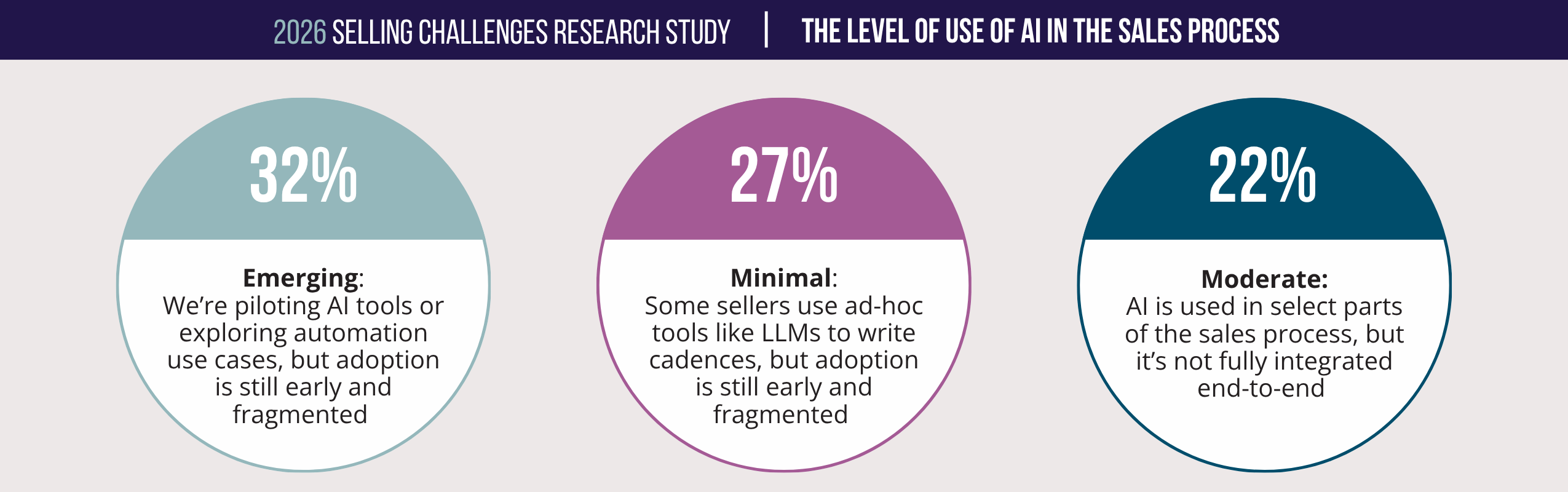
When organisations refocus and reevaluate their AI implementation efforts, it can support sales enablement by helping organisations:
- Analyse seller activity across calls, meetings, CRM data, and opportunities
- Identify skill gaps at the individual seller level
- Recommend targeted development based on actual performance signals
- Deliver guidance when sellers are preparing for or working on live opportunities
- Reinforce behaviours at the moment they can influence outcomes
- Help managers focus coaching on the skills and behaviours that matter most
This does not mean AI replaces enablement teams or sales managers. Instead, AI helps make personalised development more scalable. It can surface patterns that are difficult to identify manually, translate data into clearer coaching priorities, and support sellers with timely guidance tied to their real work.
For example, AI can help determine whether a seller needs support with discovery, stakeholder alignment, negotiation, objection handling, or advancing stalled opportunities. It can then connect that insight to the right learning path, scenario, role play, or coaching conversation.
The result is a shift from episodic training to continuous development. Instead of waiting for the next formal training session, sellers receive support as part of their daily selling activities. This helps organisations embed improvement into the way sellers prepare, execute, and learn over time.

Four Ways to Scale Behaviour Change Across the Sales Organisation
To build a more effective enablement model, sales organisations need to rethink how they develop sellers. The goal is not simply to deliver more training. The goal is to create a continuous system that connects insight to action.
1. Move from broad enablement to precision development
Organisations should shift from uniform training programmes to development that targets individual performance gaps. Broad enablement can help establish a common language, introduce new methodologies, or align teams around a shared approach. But broad enablement alone is not enough to address the specific behaviour changes each seller needs to make.
Precision development uses performance signals to identify where each seller needs support and then connects those signals to targeted learning, coaching, and reinforcement.
Those signals may come from CRM activity, pipeline movement, win-loss patterns, conversational intelligence, manager observations, learning activity, forecast accuracy, or sales call behaviour.
When these data sources are connected, leaders can better understand not only who is performing well or falling behind, but which behaviours are contributing to those outcomes.
2. Embed learning and guidance into the flow of work
In-the-flow learning means delivering guidance where sellers are already working, not after the selling moment has passed. It connects development to live opportunities, active deals, and real buyer conversations.
This is important because behaviour change happens through application. Sellers need opportunities to practice, use, and reinforce new skills in the context of their day-to-day work.
For example, a seller preparing for a discovery call may need guidance on asking deeper questions. A seller advancing a complex opportunity may need help identifying decision criteria or aligning stakeholders. A seller approaching a negotiation may need support in protecting value and avoiding unnecessary concessions.
In each case, the development need is tied to a specific selling moment. The more closely guidance is connected to that moment, the more useful it becomes.
3. Make sales coaching more targeted and data-driven
Sales coaching is one of the most important drivers of behaviour change, but it is often difficult to deliver consistently. Managers may not always know where to focus. Coaching conversations can become reactive, subjective, or centered on deal inspection rather than skill development.
Data-driven coaching helps solve this problem by giving managers clearer signals about which behaviours need attention.
Instead of relying only on intuition or anecdotal feedback, managers can use performance data, conversation insights, and learning signals to identify specific coaching opportunities. This helps coaching become more precise and actionable.
AI can support this process by highlighting patterns, recommending coaching topics, and helping managers prioritise where their time will have the greatest impact. But the manager still plays a critical role. AI may identify where coaching is needed, but managers create accountability, reinforce skills, and help sellers apply new behaviours in real customer conversations.
4. Accelerate core performers
Many sales organisations focus development resources on two groups: top performers and underperformers. Top performers receive attention because leaders want to replicate their success. Underperformers receive attention because leaders need to raise baseline performance.
But core performers often represent the largest opportunity for scalable growth.
Core performers make up the middle of the sales team. They are not the highest performers, but they are also not the lowest. They often have the capability to improve, but they need more targeted support to change the behaviours that limit their performance.
Because this group usually represents a large portion of the sales organisation, even small improvements can create meaningful business impact. Improving the middle can lead to stronger pipeline quality, better customer conversations, higher win rates, and more consistent execution across the team.
Precision development helps organisations unlock that opportunity by identifying the specific skills and behaviours each core performer needs to improve, then reinforcing those behaviours over time.
The Future of Sales Enablement Is Continuous, Personalised, and Data-Driven
Scaling behaviour change is no longer only a question of investment. Many organisations have already invested heavily in sales enablement, training, technology, and coaching. The real question is whether those investments are connected in a way that changes seller behaviour and improves performance.
AI gives sales organisations a new way to close that gap.
By connecting performance signals to targeted development, AI can help enablement teams deliver more relevant learning, help managers coach with greater precision, and help sellers apply new behaviours in the moments that matter most.
The organisations that make this shift will move beyond isolated training events. They will build a continuous development system that connects behaviour , guidance, coaching, and outcomes.
That is how sales enablement leaders can scale behaviour change — not by giving sellers more content, but by giving them the right development at the right time, based on the signals that matter most.
FAQ: Sales Enablement Behaviour Change and AI
Q: What is sales enablement behaviour change?
A: Sales enablement behaviour change is the process of helping sellers consistently apply new skills, methods, and behaviours in live selling situations. It requires more than training content. It depends on reinforcement, coaching, relevance, and a clear connection to real performance outcomes.
Q: Why is behaviour change difficult for sales enablement teams?
A: Behaviour change is difficult because sellers have different strengths, skill gaps, territories, opportunities, and buyer challenges. Broad training programmes may introduce useful concepts, but they often lack the personalisation and reinforcement needed to change seller behaviour consistently.
Q: How can AI improve sales enablement?
A: AI can improve sales enablement by analysing performance signals, identifying individual seller skill gaps, recommending targeted development, and delivering guidance in the flow of work. This helps enablement teams personalise support across large teams without manually diagnosing every seller’s needs.
Q: What is signal-driven seller development?
A: Signal-driven seller development uses data from CRM systems, sales conversations, learning activity, and performance outcomes to identify which seller behaviours need improvement. Those signals are then used to guide coaching, training, and reinforcement.
Q: Why should sales leaders focus on core performers?
A: Core performers often represent the largest portion of the sales team. Improving their execution even slightly can create meaningful gains across the organisation, especially when development is targeted to the specific behaviours that influence sales outcomes.
Q: Does AI replace sales coaching?
A: No. AI does not replace sales coaching. AI can help identify where coaching is needed and recommend development actions, but managers still play a critical role in reinforcing skills, creating accountability, and helping sellers apply new behaviours in real customer conversations.
Ready to move from broad enablement to precision seller development? Richardson helps sales organisations build the skills, coaching practices, and AI-enabled learning systems needed to drive lasting behaviour change at scale.