How Medical Device Sales Teams Earn Healthcare Buyers' Attention
Sales performance improvement

Written by: Ben Taylor, MBA, Content Marketing Manager, Richardson
Published: November 9, 2026
The rising costs and system-wide constraints in healthcare force this industry toward transformation.
By 2035, PwC predicts, as much as $1T in annual US healthcare spending will shift from old models to new ones enabled by AI, robots, and innovative delivery models.
But while healthcare innovations accelerate to meet this demand, the leaders evaluating them struggle. The burdens of the old system, from staffing shortages and burnout to lengthy intakes and wait times, remain. This latency means healthcare decision-makers face more choices than ever when they are least prepared to choose.
For sellers, the scarcity constraining sales isn't innovation — it's attention.
Key Takeaways
- Medical device sellers earn attention by connecting their innovation to the pressures buyers face every day, not by leading with specifications.
- Those pressures include procedural workflow efficiency, patient outcomes, clinician fatigue, and hospital operational constraints.
- Three capabilities make this repeatable: Commercial Insight development, human-centreed selling skills, and stakeholder navigation.
Why is attention, not access, now the scarcest resource in medical device sales?
The breakneck pace of healthcare innovation should leave buyers clamoring for the latest life-changing, life-saving technology. In the old world of medical device sales — the one driven by relationships — that technology would already be in their hands.
But we don't live in that world anymore.
The pace of discovery hides a break in the innovation chain: the healthcare professionals who could benefit most from innovative technologies don't have enough time to evaluate, let alone implement, them. Hospital closures and staffing shortages continue to shrink the time clinicians can spend evaluating innovation. Sellers scramble for the access they were once guaranteed. When they do gain access, their pitch doesn't land inside their narrow new window.
For decades, commercial teams in medical device manufacturing focused on competing for operating room access and physician relationships. Representatives could support procedures, train surgical teams, and build long-term relationships through repeated clinical engagement.
The post-pandemic playbook solved for limited access by digitising the same kind of relationship selling that drove the successes of the past. “If we could solve the problem of access,” the thinking went, “our product's innovations would win the day.” But the changes in healthcare go beyond the permanence of pandemic-era drop-in protocols.
At the same time, innovation in medical technology continues to accelerate — from robotic surgery systems to AI-assisted diagnostics and minimally invasive technologies. Healthcare professionals must now evaluate more innovation with less time to do so. As a result, the defining constraint in MedTech sales is no longer access, but attention.
What is making healthcare buyers so hard to reach?
It isn't in your head: setting a meeting in healthcare has never been this hard. Whether sellers need a few minutes with executives or a call with practice owners, they're constrained within narrow windows of access — and they're delivering to an audience with little real attention left to give. Five converging forces explain why:
- Physician burnout remains widespread. Nearly half of US physicians (45.2%) reported at least one symptom of burnout in 2023, according to a study published in Mayo Clinic Proceedings, and they remain at higher risk than other US workers. The best physicians focus their narrow resources on improving patient care, limiting the time available for vendor engagement.
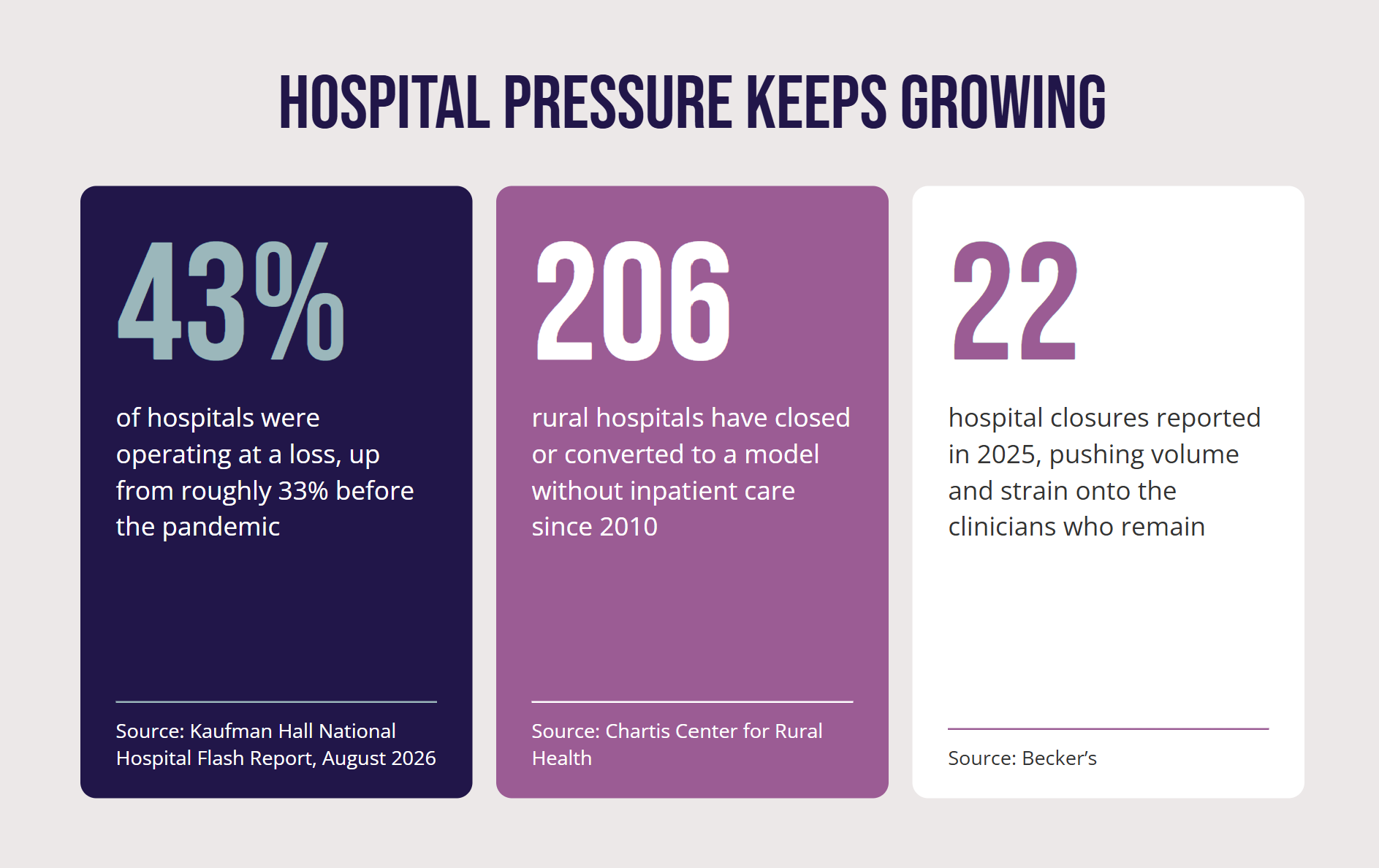
- Hospital margins remain extremely tight. Kaufman Hall's National Hospital Flash Report for August 2026 found that 43% of hospitals were operating at a loss, up from roughly 33% before the pandemic, forcing healthcare systems to scrutinise spending decisions closely.
- Hospitals and health systems are shuttering. Financial pressure and changing payer mixes lead to hospital closures and consolidation. The Chartis Centre for Rural Health reports that 206 rural hospitals have closed or converted to a model that excludes inpatient care since 2010, and Becker's reported on 22 hospital closures in 2025. Each closure pushes additional patient volume and operational strain onto the hospitals and clinicians that remain.
- Healthcare workforce shortages persist. Staff shortages across nursing and clinical roles increase workload and reduce the time available for evaluating new technologies.
- Healthcare buying decisions become more complex. Purchasing decisions increasingly involve clinicians, administrators, procurement leaders, finance executives, and compliance and IT stakeholders.
Heavy patient loads, documentation and compliance requirements, and constant clinical updates define the day-to-day realities of these buyers.
Together, these shifts create a new commercial equation: successful interactions require clear value, delivered to complex buying groups, within dramatically shorter timeframes.
Why are there no low-stakes interactions in healthcare sales anymore?
Selling into healthcare once was about building relationships through a series of low-pressure, low-stakes interactions. The realities of today's system make that approach impossible.
When hospitals close or consolidate, the clinicians and health systems that remain must absorb more patients, manage more complexity, and operate under tighter budgets. That means less time to evaluate new technologies. Historically, device representatives could rely on repeated engagement:
- Demonstrations
- Procedural support
- Training sessions
- Relationship building over time
Today that margin for error is shrinking. Physicians simply do not have time for a gradual approach, repeated engagements, and the slow rollout of a seller's innovations. If a conversation fails to deliver immediate relevance, the sales organisation does not simply lose the opportunity. It loses future access altogether.
Every interaction in an attention-constrained healthcare system either earns the buyer's trust or closes the door for good.
What do high-performing medical device sellers do differently?
Sellers who want to get their life-changing, life-saving innovations into the hands of physicians need to do more than sell their product, its features, or even the benefits of buying. They must earn a spot at the table through a focus on human-centreed transformation.
Instead of approaching healthcare professionals primarily as buyers of products, leading organisations engage them as people navigating enormous clinical, operational, and emotional pressures.
| Traditional sellers focus on | High-performing sellers focus on |
|---|---|
| Device specifications | Procedural workflow efficiency |
| Technical features | Patient outcomes |
| Incremental product improvements | Clinician fatigue and operational constraints within hospitals and health systems |
When sellers connect innovation to these pressures, they transform scarce attention into meaningful engagement.
This isn't just a mindset shift. The human-centreed transformation approach changes every aspect of the sales process. It affects how sellers prepare for conversations, the insights they deliver, and how they deliver them. It also future-proofs sales teams because it relies on deeply human skills — judgement, insight, and influence — that technology alone cannot replace.
“This isn't just a sales methodology. This is an organisational shift.”
— Hilary McConkey, VP, Global Commercial Solutions and Sales Excellence, Hu-Friedy Group (Straumann)
Which capabilities help sales teams earn attention in a high-stakes conversation?
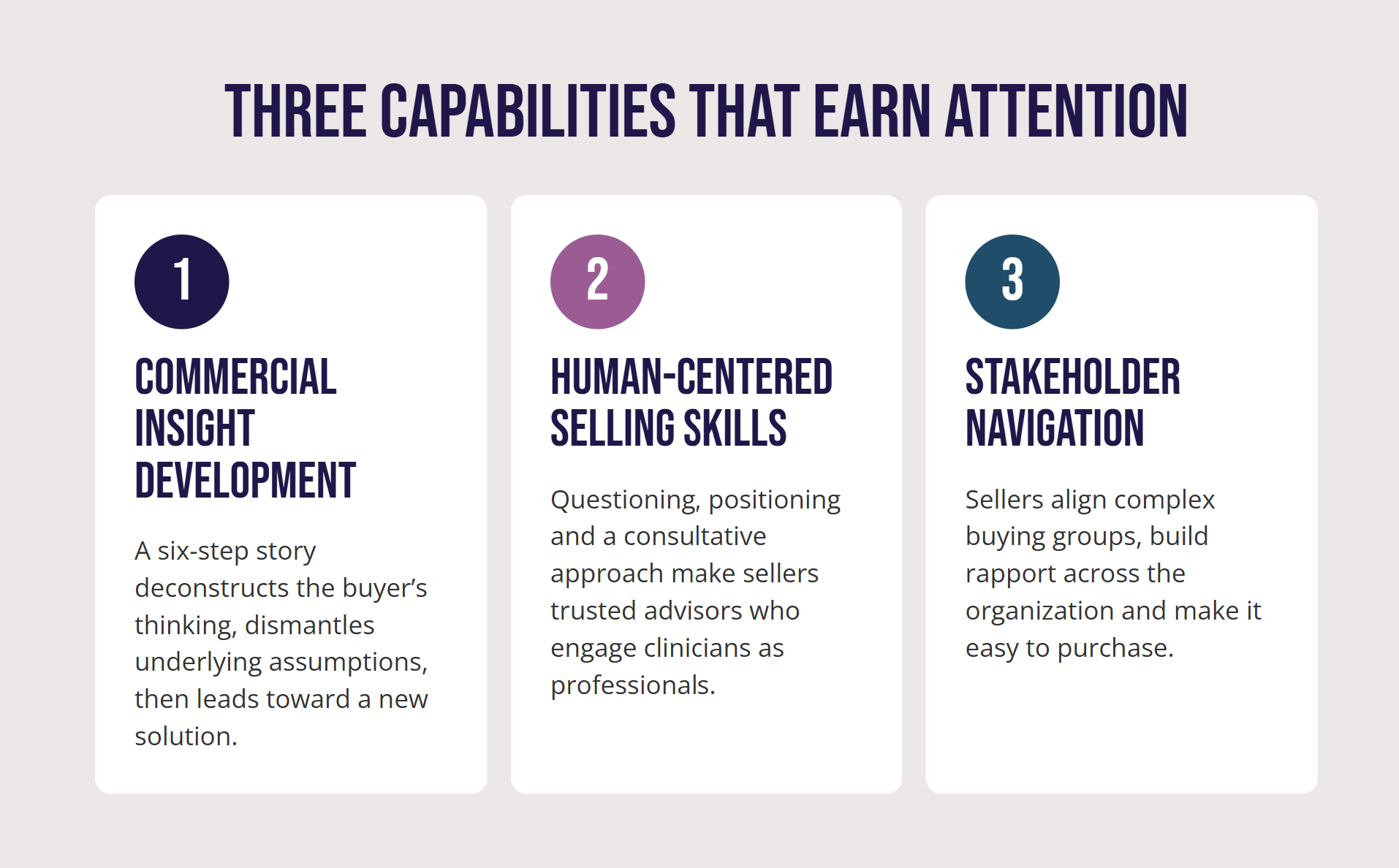
For CSOs and Heads of Sales, the critical question now is: Can your sales teams handle high-stakes conversations with zero margin for error? Three capabilities stand out among the most successful organisations.
Commercial Insight development
To win the right to sell, reps can't focus on the features and benefits of medical devices. They also can't assume that buyers want to act — or even understand why acting now is essential. That's why the most successful sellers deliver a story that deconstructs a buyer's thinking, dismantles their underlying beliefs and assumptions, and then leads toward a new solution. This six-step choreography, called a Commercial Insight, equips sellers to introduce insights that reshape how healthcare leaders evaluate solutions.
Human-centreed selling skills
As attention narrows and buying groups balloon, successful sellers don't just define a problem and present a solution. They use the respect earned by delivering a Commercial Insight to change the way buyers view them. They use questioning and positioning to dig into the real problems facing their buyers. They take a consultative approach and become trusted advisors who can help their buyers come to decisions.
Most importantly in a healthcare setting, sellers don't see their buyers as the door to a sale. They engage clinicians and administrators as professionals navigating intense operational pressure.
Stakeholder navigation
Buyers across industries consistently report that the sellers they trust most with their time help them understand and address different stakeholder needs, build rapport across their organisations, and make it easy for them to purchase.
Richardson's 2026 Selling Challenges Research Study, which surveyed more than 300 sales professionals, shows how hard this is. Sellers named identifying and reaching the right stakeholders as their hardest prospecting task (28%), and aligning stakeholder groups tied with slow decision speed as the top challenge in complex buying groups (24% each).
In healthcare, that means preparing to align complex buying groups around measurable clinical and operational outcomes. Sellers who address these fundamental elements of the buying experience will turn attention and adoption into impact that drives long-term relationships.
What does this look like in practice?
A manufacturing and industrial company in analytical and life sciences faced increasing product commoditisation and competitive pressure, making it harder for sellers to differentiate their solutions. They needed to shift from relying on product expansion to creating and shaping opportunities through insight-driven selling while retaining existing customers and expanding into new markets.
Richardson implemented an insight-based consultative selling strategy to transform how sellers engage customers. The initiative included:
- Training delivered across 120 global locations in nine languages
- Development of capabilities to differentiate value beyond product features
- Equipping sellers to introduce insights earlier in the buying cycle, gain access to decision-makers, and build trust with new stakeholders
The results:
- Consecutive quarters of growth
- Participants reported improved win rates
- Sales teams were better able to differentiate solutions and expand into new markets
Hollister Incorporated, a medical products company, describes the value of consistency across markets:
“With Richardson, what I love about it is we were able to scale the entire framework throughout our organisation globally. So you're getting that same language, that same framework with consistency, which keeps that brand.”
— Darnetta Daire, Sales Enablement Manager, Hollister Incorporated