What Are the Most Effective Learning Strategies for Professionals?
Sales performance improvement

Written by: Ben Taylor, MBA, Content Marketing Manager, Richardson
Published: November 24, 2026
An education professor at the University of Chicago once coined the term "hidden curriculum." Schools teach more than the material covered in class. They also teach unseen norms, and often those norms include approaches to learning based on an outdated understanding of the brain. As a result, many of us are anchored to routines that don't serve us as well as they should. We carry them into adulthood and professional training.
The good news: we can change the way we learn. Neuroplasticity — the remodelling of neural networks — means connections in the brain are constantly forming, so we can adopt new approaches supported by psychological research. In a world where information is limitless and accessible to all, effective and efficient learning is becoming a competitive advantage. Research points to a handful of strategies that work.
Key Takeaways
- Spaced practice and self-testing have the strongest research support.
- Mixing related topics, asking "why" questions, and writing a short reflection also help, especially for material that's easy to confuse.
- Matching training to a preferred learning style isn't supported by the evidence.
How does spacing out practice improve retention?
Distributed practice, sometimes called spaced practice, drives long-term retention by spreading out the learning process. It contrasts with massed learning, in which a learner crams information, retains it for a short period, then loses it. A 2021 meta-analysis of 10 learning techniques found distributed practice and practice testing the most effective.
How long should you wait between sessions?
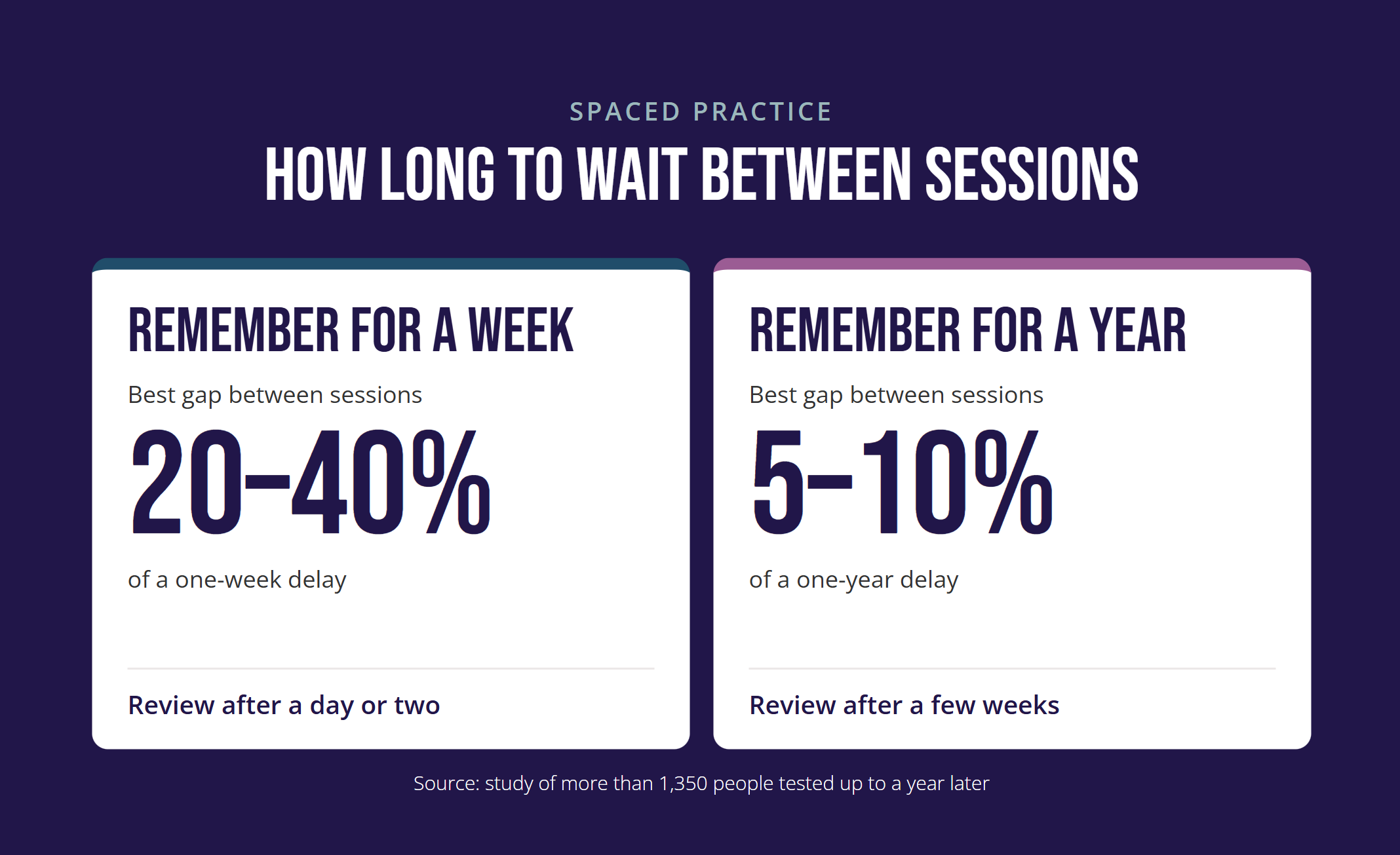
A study of more than 1,350 people taught a set of facts, reviewed after a gap of up to 3.5 months, and tested up to a year later found that the best gap grew with how long they needed to remember. The best gap was about 20 to 40% of a one-week delay and about 5 to 10% of a one-year delay. In practical terms, remembering something for a week calls for a review after a day or two, while remembering it for a year calls for a review after a few weeks.
Professionals can afford long lag times. Students preparing for a test have a limited period to use distributed practice, but professionals have their entire career. The simplest rule is to leave enough time for some forgetting to occur. Retrieving the information should be a challenge.
Learners rarely use distributed practice because traditional textbooks don't encourage it. Technology is changing that. Learning programmes now provide periodic refreshers by email or mobile device.
Why does spacing work?
Researchers offer several theories. When we spread sessions apart, we must work harder to retrieve memories of the previous session, which creates a more robust learning experience. Closer sessions can mislead learners into thinking they know the material because recall is easier, but the faster recall is likely due to recency, not proficiency. Others point to consolidation, the process of converting short-term memories into long-term memories.
Why does mixing topics beat studying one at a time?
Most textbooks and training programmes present information in a "blocked" format, separated by topic. A chemistry text discusses atoms first, then solution compositions, then chemical reactions. Interleaved study alternates between topics instead. The chemistry student learns about solution compositions while learning about atoms, instead of one before the other.
| Blocked study | Interleaved study |
|---|---|
| Topic A1, A2, A3 | Topic A1, B1, C1 |
| Topic B1, B2, B3 | Topic A2, B2, C2 |
| Topic C1, C2, C3 | Topic A3, B3, C3 |
Interleaving works for two reasons researchers point to. First, exposure to different concepts together brings out how they differ, which helps learners tell them apart and encode them individually. Blocked study puts a greater burden on the learner to identify contrasts. Second, interleaving builds a cadence in which learners return to the first topic after starting the second, and again after starting the third. That spaced repetition contrasts with blocked study, in which the learner completes the first topic and never returns.
Why does interleaving feel slower at first?
Interleaving is counterintuitive because learners appear to grasp concepts faster with blocking. In a study of college students learning to find the volume of four unfamiliar geometric solids, students who practised problems blocked by type averaged 89% correct during practice, compared with 60% for those who practised mixed problems. A week later, the mixed group scored 63% and the blocked group 20%. The study was small — 18 students — and used procedural math tasks, so the size of the effect may differ elsewhere.
A 2019 meta-analysis found a moderate overall benefit. The benefit was stronger when concepts are similar and easy to confuse, and weaker for expository texts and words.
Is interleaving the same as multitasking?
No. Multitasking often means jumping among disconnected tasks. Interleaving is a structured approach that builds understanding of how similar but different material contrasts.
Because most instructional material is still blocked, learners can draw their own map. Begin with the first topic, then move to the next before finishing, even if unreviewed material remains. You'll complete each section on the second and third pass. Then focus on what's different between similar concepts, because those small but meaningful differences are what interleaving brings out.
Why does reflecting on training improve results?
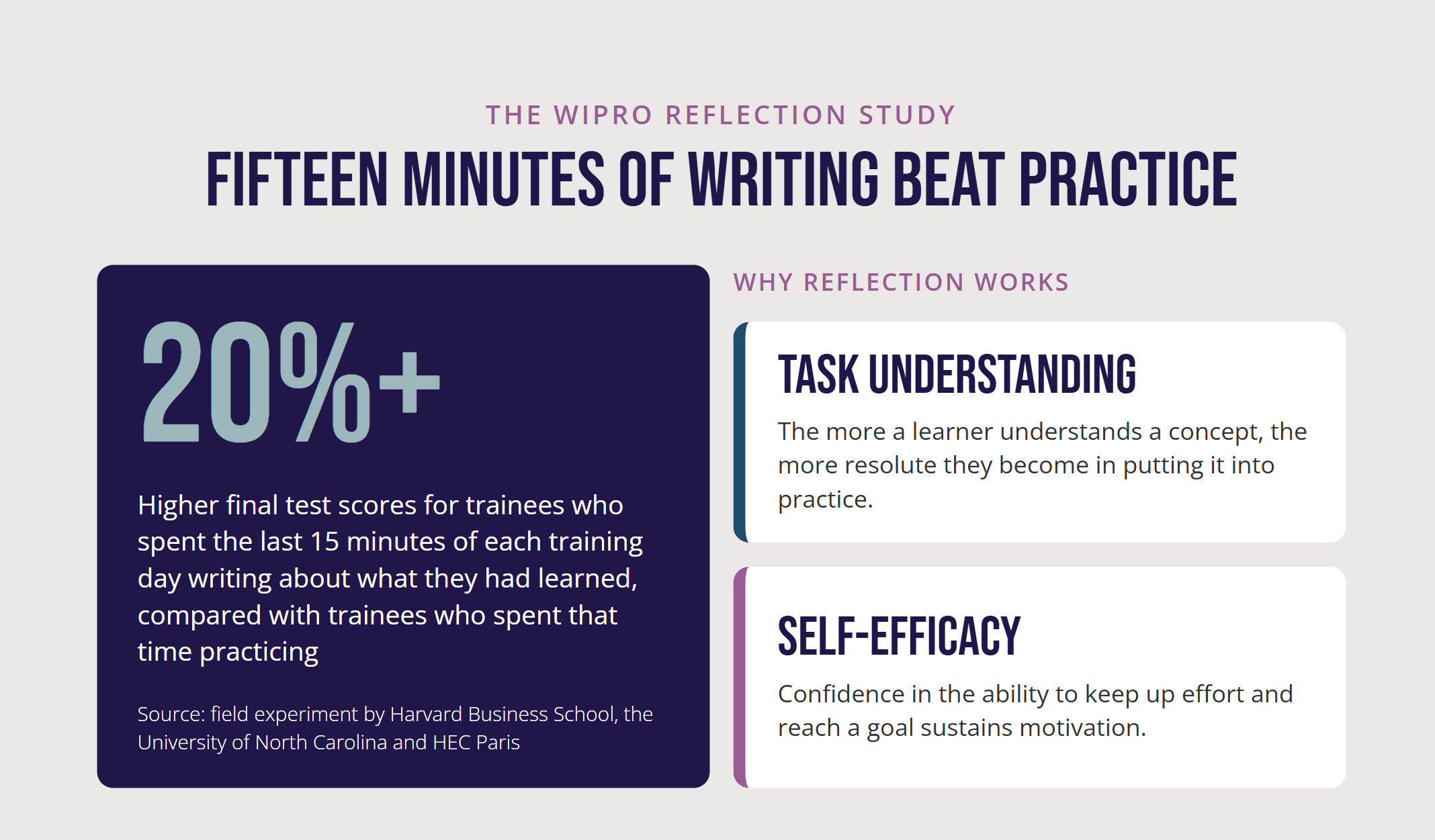
Many believe the most effective way to develop new skills is to "learn by doing." Researchers at Harvard Business School, the University of North Carolina, and HEC Paris found that once a person has some experience with a task, deliberately articulating that experience can benefit learning more than accumulating additional experience. In a field experiment with trainees at Wipro, people who spent the last 15 minutes of each training day writing about what they had learned scored more than 20% better on the final test than people who spent that time practising.
Why does reflection work?
The researchers explain the result through improved task understanding and increased self-efficacy:
- Task understanding: The knowledge needed to achieve an outcome. The more one understands a concept, the more resolute they become in putting it into practice.
- Self-efficacy: One's confidence in their ability to exert continued effort and reach a goal. This sense of competence is critical for maintaining motivation.
Reflection can look like wandering disengagement, which is why many people skip it in favour of more experience. But learners who take the time to reflect outperform those who don't. Competing sellers have access to the same information and analytics, and those who are better prepared to use the full value of training will succeed.
Does testing yourself before learning help?
Traditionally, tests measure what we know, and for most of us they instil anxiety. Researchers from the University of California, Irvine, uncovered what they call the "pretesting effect." Across five experiments, participants who were asked questions about an essay before reading it remembered more than participants given extra study time — even when only the questions they had answered incorrectly were counted. Independent research reached a similar conclusion: taking challenging tests, instead of avoiding errors, may be one key to effective learning. A 2025 review in the Journal of Cognition finds the benefit holds when unsuccessful attempts are followed by corrective feedback.
Attempting an answer matters. In the original research, trying to answer a question was more effective than reading it and trying to memorise it.
Why does pretesting work?
Researchers aren't certain, but there are a few theories:
- Attempting to retrieve information during the pretest lays the groundwork for building "retrieval routes" between the question and the correct answer, and may encourage deeper processing of the question.
- Incorrect answers may prevent the "fluency illusion," our misperception of what we think we know.
- Pretesting supports calibration, an objective measure of what someone knows. A learner begins with a realistic notion of what they know and don't know, and a low pretest score may boost their resolve to learn.
Calibration only works when the learner truly answers the question. Put pencil to paper rather than assuming you have a response. A poor pretest score is also less demoralising when the score doesn't matter. The pretest serves the learner more than anyone, like loosening the soil in preparation for planting new information.
How does asking "why" deepen learning?
Asking questions is among the oldest ways to expand knowledge, dating back more than 2,000 years to Socrates. Elaborative interrogation is a modern take on the Socratic method. It is the simple practice of asking why: the learner forms an explanation for a fact they've learned, such as "Why was this the most likely outcome?" A related technique, self-explanation, asks learners what the material means to them and how they reached their understanding. Researchers rate both techniques as moderately useful, and the act of answering moves learning forward because it helps the learner make sense of the material.
Why does elaborative interrogation work?
Many researchers believe it works by integrating new information with prior knowledge, which encourages the learner to connect the new and the old. Others suggest that forming an answer makes the information more personal to the learner's own understanding. It may also work simply because it makes the learner work harder, which increases attention and effort.
How do you use it?
- Ask specific "how" and "why" questions. Avoid surface-level retrieval questions.
- Ask about both the similarities and differences between related pieces of material.
- If your trainer doesn't use the technique, use self-explanation to talk through your reasoning for why an outcome occurred or the steps you took to solve a problem.
Do learning styles matter?
Most of us have a preferred learning style. Some call themselves "visual learners," others "verbal learners" or "logical learners." These preferences are genuine, but their importance to learning has long been overstated.
A 2008 review by four researchers examined the "meshing hypothesis," the idea that instruction is most effective when it matches the learner's preferred style. They concluded that "there is no adequate evidence base to justify incorporating learning-styles assessments into general educational practice." Preference doesn't dictate proficiency. The better question is what the subject matter calls for, because some concepts suit hands-on work, some suit lectures, and some suit group discussion.
The practical cost of the myth is that many people limit themselves to material that suits their "style" and ignore useful material in other formats.
How can professionals put these strategies to work?
In a knowledge economy, every professional has access to a vast reservoir of knowledge. What differentiates one person from another is the ability to identify the pertinent information and absorb it efficiently into their routines. Professional training also carries the high opportunity cost of time away from revenue-producing activities, so it pays to make the most of it.
- Put time between study sessions. Use more spacing for material you've already mastered and less for difficult material, and keep refreshing — the need never disappears.
- Take a pretest before you learn. Find existing test materials on the subject and answer the questions in writing.
- Approach material with an interleaved structure, and define the contrasts between similar concepts.
- Take at least 15 minutes to reflect on training. Write about at least two key lessons learned, be specific, and return to the notes periodically.
- Ask specific "how" and "why" questions about what you've learned rather than simple fact-based questions.
- Seek out manager-led reinforcement sessions that give a team time to practise and discuss what they've learned.