The B2B Buyer’s Journey: Five Stages and What Sellers Should Do at Each
Sales performance improvement

Written by: Ben Taylor, MBA, Content Marketing Manager, Richardson
Published: November 24, 2026
Two major factors characterise the customer’s buying journey: increased rigour and decreased resources.
Customers are performing more upfront research and following an increasingly formalised process when exploring buying options. More stakeholders are involved, leading to elevated expectations. Simultaneously, customers are working under constraints as other priorities compete for their attention. Time is in short supply, and stakeholders are dispersed across the organisation.
Key Takeaways
- The modern buyer’s journey has five stages: Explore, Investigate, Evaluate, Confirm, and Negotiate and Commit.
- Three interrelated buying factors — the case for change, stakeholder dynamics, and the decision process — propel buyers through those stages.
- Each stage calls for a different set of seller skills.
- Stage-specific coaching questions help sellers and managers diagnose the buyer’s position and decide what to do next.
What drives the modern buyer’s journey?
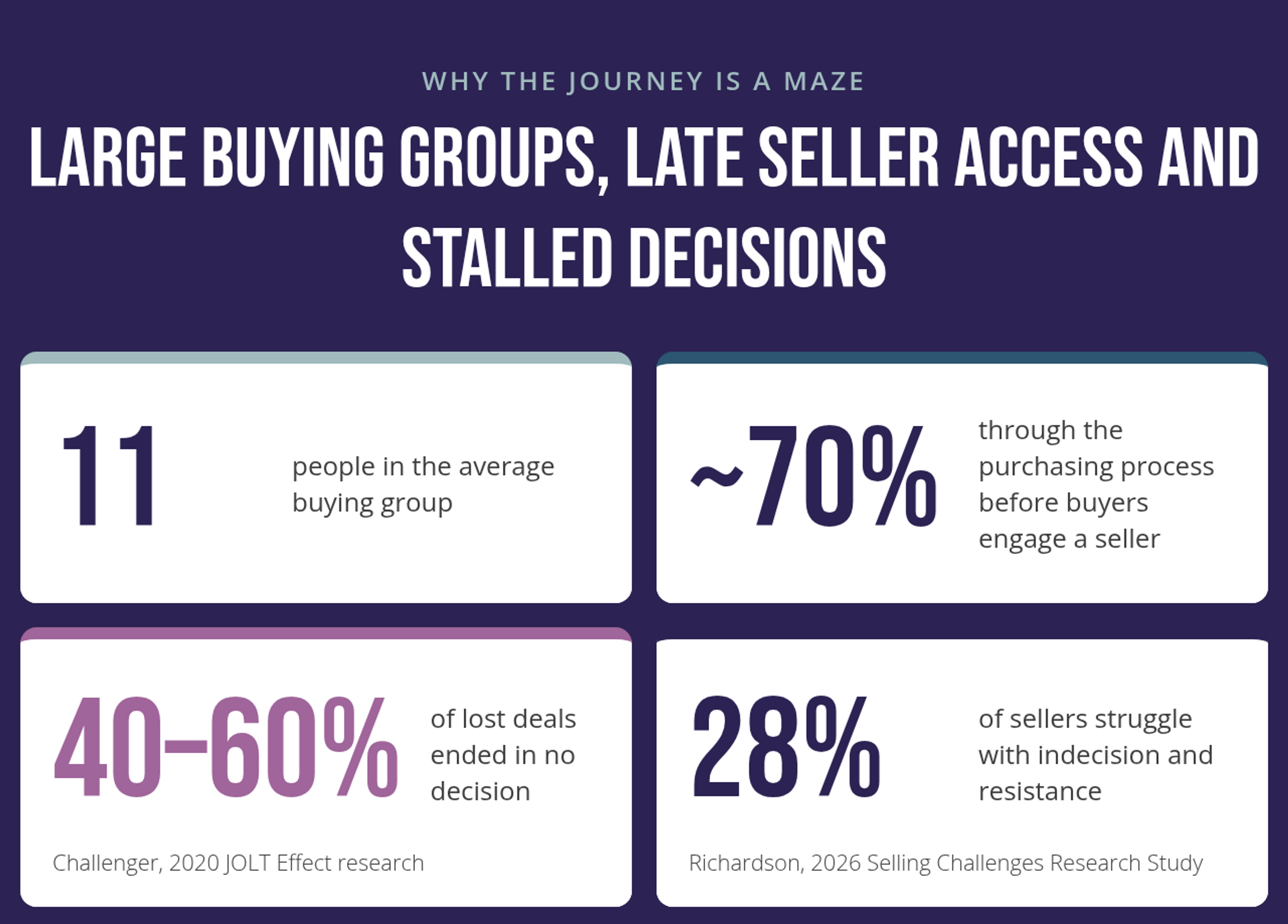
These factors have created a buying journey that is complex, iterative, and twisting. Buying groups now average 11 people, and buyers are nearly 70% through their purchasing process before they engage a seller. The journey is more like a maze than a straight line. Therefore, it is helpful for sales professionals to understand the buying factors that drive it. The buying factors are the set of facts, influences, and circumstances that all contribute to the decision to buy or to not buy. Three dynamic and interrelated factors shape every deal.
The case for change
To reach a buying decision, the case for change must be strong enough to prevail against the status quo. It is the sales professional’s job to strengthen it. Doing so means focusing on the solution’s competitive differentiation. No matter how effective or strong the solution is, it will never be enough to make the case for change on its own. Compelling a customer or a group of stakeholders to move forward means making the value of change clear, watching for weak points, and proactively addressing customer risk.
Building the case for change is more difficult than it has ever been. Solutions are becoming more complex and have far-reaching implications across organisations. Therefore, more segments of the customer’s business are impacted. As a result, more stakeholders must endorse the solution and become comfortable with key issues like implementation and sustainment. Becoming comfortable with these factors also demands that decision makers pull themselves away from critical daily responsibilities.
Stakeholder dynamics
Managing stakeholder dynamics means influencing and engaging the group of people who make the decision to buy. Sales professionals need to build relationships, facilitate alignment, and drive consensus. This cycle takes time. Building alignment is rarely a process of accumulating supporters one by one, because an early supporter will occasionally become hesitant or even change their mind. Sales professionals often need to repeat the process and check for changes in each stakeholder’s perspective. They must solidify allies and remember that a show of support today promises nothing for tomorrow.
The key is acknowledging that critics will always be present. In fact, critics are a good sign that buyers are thoughtfully exploring the solution and evaluating its effectiveness. This is a far better scenario than facing customers who have gone silent and dismissed the solution. Progress comes from surfacing criticism and seizing the opportunity to address it.
The decision process
The sales professional must help the customer move the decision forward. However, increased complexity makes the decision process difficult to navigate. Momentum can stall as new stakeholders emerge, requirements change, and projects get reprioritised. Many customers put significant time and energy into the process, only to abandon it later. Challenger’s 2020 JOLT Effect research found that 40–60% of lost deals ended in no decision. In Richardson’s 2026 Selling Challenges Research Study, 28% of sellers said they struggle with indecision and resistance.
The sales professional’s best tool to overcome this challenge is information. The more they know about how the decision process works, the better prepared they are to be alert to discrepancies and to cues revealing who the influencers are. With this information, they can redirect the process when necessary. Rather than push forward amid resistance, they can encourage those with differing perspectives to come together and discuss where they disagree. Everyone involved must be willing to speak the truth and be upfront about concerns. Knowing a stakeholder’s doubts early can prevent last-minute failures that arise because a decision maker was holding back on a contrary position.
What are the five stages of the buyer’s journey?
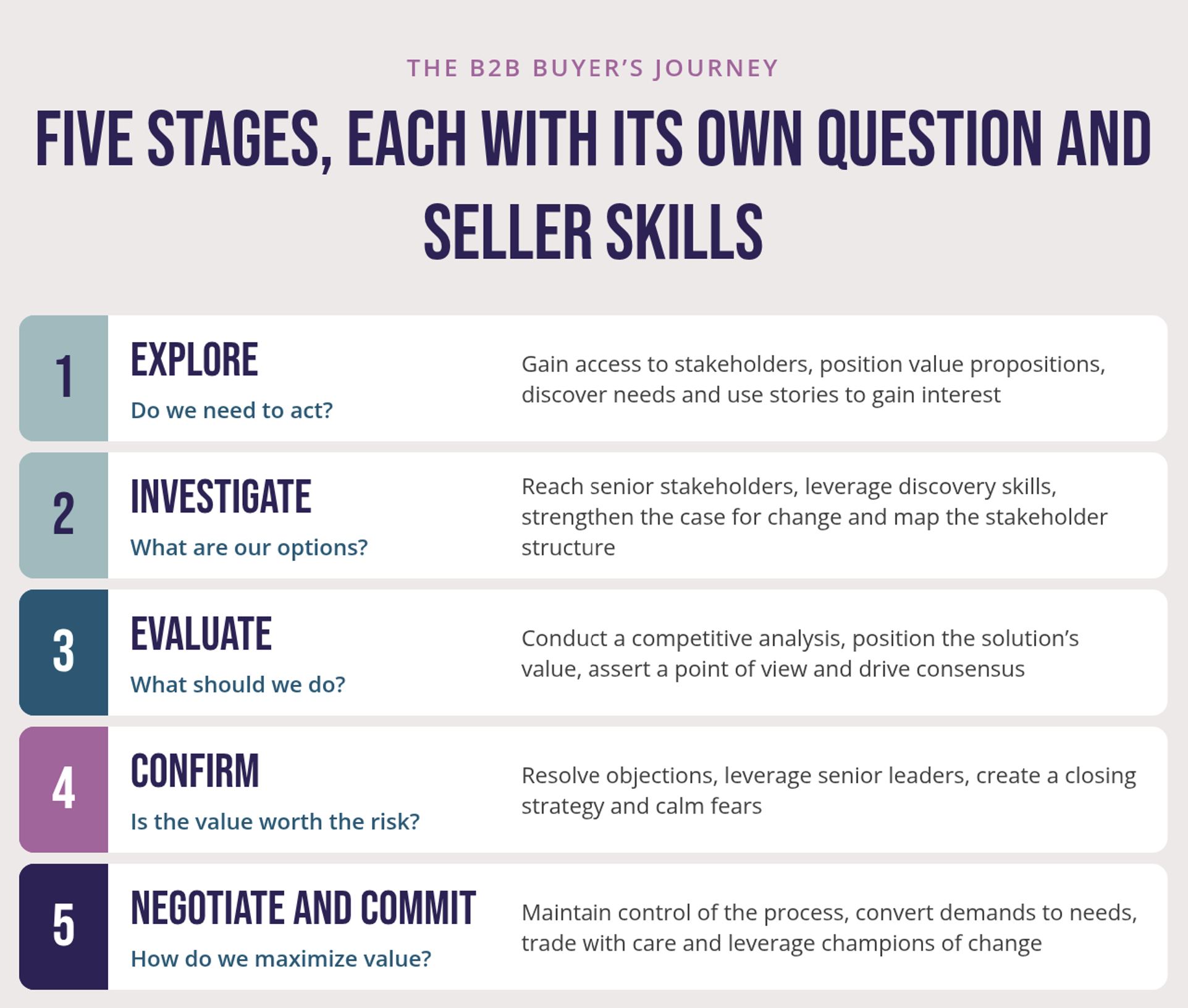
These three factors propel the customer through the buying journey, which spans the buying process from business as usual through implementation of a new solution. It consists of five parts in the following order: Explore, Investigate, Evaluate, Confirm, and Negotiate and Commit. Each requires specific skills from sales professionals to help the customer advance.
Explore: Do we need to act?
Initially, the customer is asking themselves if they need to act. Here, the customer is assessing if the problem or opportunity is big enough to warrant investigating a solution. Dissatisfaction with the current state or new circumstances triggers awareness of a problem or opportunity and a desire to act on it. The sales professional must generate interest and urgency on the issue by:
- Gaining access to stakeholders
- Positioning value propositions
- Using questioning skills to discover needs
- Floating ideas
- Using stories to gain interest and connect to emotions
Coaching questions:
- What is the customer trying to accomplish?
- What early insights can you share to shape and deepen the relationship?
- How well does this meet our qualifying criteria? Why?
Investigate: What are our options?
This stage begins when the customer decides to investigate options for addressing the issue. The customer researches solutions and screens partners to further evaluate their options. At this point, sales professionals must understand the customer’s needs, their strategy, and their decision criteria. To do so, they must:
- Reach senior stakeholders
- Leverage discovery skills
- Float ideas
- Strengthen the case for change
- Map the stakeholder structure
- Understand what the customer values
Coaching questions:
- What is the compelling event?
- How can we deliver value?
- How can we differentiate?
- What risks exist for the customer? For us?
Evaluate: What should we do?
In this stage, the customer engages partners for a deeper evaluation. They refine their requirements and vision for the solution and identify preferred partners with whom they want to continue the conversation. The sales professional’s focus should be on collaborating with the customer to construct a solution that is a tailored fit. Sales professionals must:
- Conduct a competitive analysis
- Position the solution’s value
- Assert a point of view
- Drive consensus
- Shape perceptions of needs
Coaching questions:
- What are the most important issues our solution must solve?
- Are stakeholders aligned? How do you know?
- What point of view do we need to share?
- How likely is the “do nothing” option?
Confirm: Is the value worth the risk?
Here, the customer addresses outstanding concerns and does a final evaluation of risk versus value. Fear of uncertainty and unmanageable risk can become heightened in this stage, leading to stalled momentum. The customer also evaluates whether the value is superior enough to justify investment in this solution over other priority issues. Sales professionals can advance the sale by maintaining momentum and reinforcing logic by reasserting the case for change. The critical selling skills here are:
- Resolving objections
- Leveraging senior leaders
- Creating a closing strategy
- Strengthening the value proposition
- Calming fears
Coaching questions:
- What is our unique value?
- What are the top three risks?
- What access are we lacking?
- What outstanding objections still exist?
- How can we drive consensus?
Negotiate and Commit: How do we maximise value?
In this final stage, the customer moves forward when contract negotiations begin. The customer negotiates price and terms with one or more partners, and the stage ends when the customer reaches agreement with and commits to the winning partner. Even at this advanced point, the sales professional cannot rest. They must continue to justify value and work toward a mutually successful outcome by:
- Maintaining control of the negotiation process
- Converting demands to needs
- Shaping perceptions of value
- Engaging in calculated trading
- Leveraging champions of change
Coaching questions:
- What do we need to do to maintain momentum?
- What is our opening position and bottom line?
- Why did we win or lose?
- How do we make a strong transition?
What does the buyer’s journey mean for sales teams?
Engaging the modern buyer requires a multifaceted, structured approach. Sales professionals need the ability to identify where they are in the buyer’s journey and what skills to deploy. They must remain vigilant about the customer’s forward and reverse movement through the process. Success requires a partnership between sales professionals, coaches, and the enablement team.