What Should a Sales Hiring Assessment Measure?
Sales performance improvement

Written by: Ben Taylor, MBA, Content Marketing Manager, Richardson
Published: November 13, 2026
To say that markets are changing rapidly in response to many forces is an understatement. In The Collaborative Sale, we described how buyer behavior is changing dramatically as a result of easy access to information, increased globalization, the rise of Millennials in business, the shortening time of competitive advantage, and other factors.
As a sales leader, you know you need to evolve constantly in the face of these changes. As you adapt your sales strategy to align with your changing corporate strategy, have you also adapted your sales talent strategy to follow suit? In other words, is the team that got you to your current state also able to fulfill your new growth strategy? The answer starts with how you assess and hire.
Key Takeaways
- A good sales hiring assessment measures the knowledge, skills, and abilities that drive results in the specific role.
- It follows a competency model built for that role, not an off-the-shelf template.
- It relies on behavioral methods, such as structured interviews and role-plays, in which candidates demonstrate skills instead of describing them.
- Personality results can inform cultural fit, but work best as a supporting input.
Why do most sales hiring assessments fall short?
Assessments are not equally good at predicting who will succeed. A major 2022 re-analysis of research on hiring methods found that structured interviews were the strongest predictor of job performance. It also found that job-specific assessments, such as job knowledge tests and work sample tests, ranked among the top five. Assessments connected to the demands of a specific role tend to predict better, and tailoring even personality questions to a work context raises their predictive power.
You can select a stronger assessment by following three guidelines: measure knowledge, skills, and abilities; tailor the assessment to the role; and place heavy emphasis on behavioral-based methods.
What should a sales hiring assessment measure?
It should measure knowledge, skills, and abilities, often shortened to KSAs. These are what a candidate knows, what they can do, and how well they can apply both on the job.
The most common type of assessment is a personality assessment. Personality scores describe how someone tends to behave, but they don't show what a candidate knows or can do. Sales candidates who bring success in the shortest amount of time tend to rely more on KSAs than on personality, and job knowledge tests rank among the strongest predictors of job performance.
A strong approach includes:
- Knowledge tests
- Behavioral interview guides
- Role-plays or simulations that let candidates demonstrate their skills and abilities
Why tailor an assessment instead of buying one off the shelf?
In the world of assessments, validity refers to how well a test measures what it intends to measure. Predictive validity is how accurately an assessment predicts future success, and it varies by assessment type. Assessments built from an analysis of the specific job tend to predict better than generic ones.
Tailoring starts with defining the role. When you make significant changes to your sales strategy, define your new sales roles clearly and develop accurate competency models for them. The bigger the strategic shift, the more likely the model of a top performer will differ from what it was before. Assessing your team against a competency model aligned with your new strategy shows you where people need help to make the transition, and gives you a benchmark for hiring new talent into these roles.
Why do behavioral assessments matter most in sales?
Behavioral-based assessments are the best type for helping hiring managers drill deep into a candidate's skills and abilities. Structured behavioral interview guides and role-plays or simulations are common examples.
Remember, the candidate sitting across the table is a seller, so they know how to sell themselves. Role-plays and simulations help separate the wheat from the chaff by having candidates demonstrate their skills and abilities, rather than just talk about them.
How do you build an assessment around a competency model?
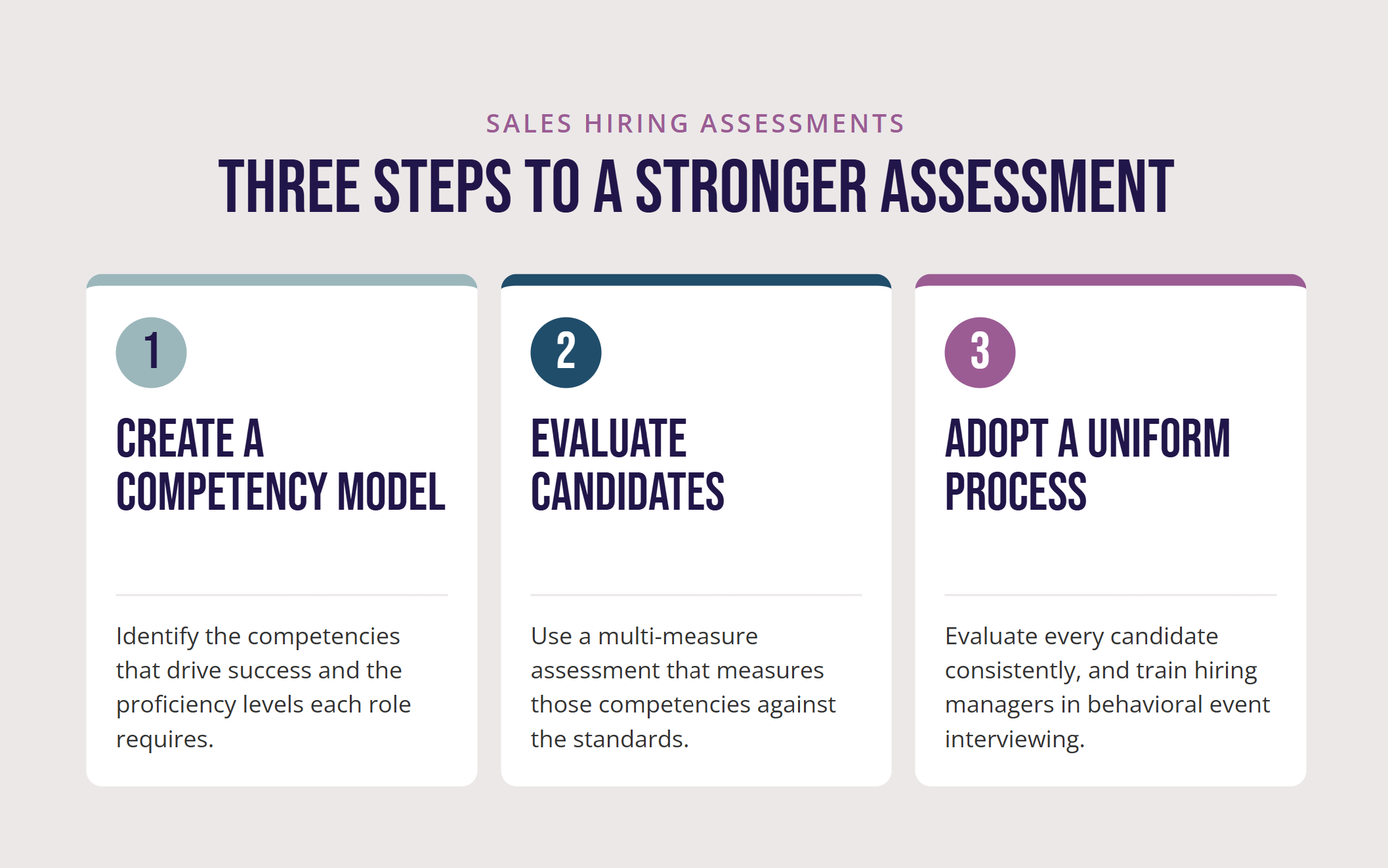
Three steps make the difference:
- Create a competency model for each role. Identify the competencies that drive success and the proficiency levels each role requires.
- Evaluate candidates against those standards. Use a multi-measure assessment that measures these competencies.
- Adopt a uniform hiring process. Evaluate every candidate consistently, and train hiring managers in behavioral event interviewing skills so they uncover the right information to make the best decision.
Here is how it played out for one software client. They had grown primarily through acquisition, and their sellers were often strong product specialists who excelled at positioning features and benefits to technical buyers. When the company shifted to organic growth and a go-to-market strategy built on selling a comprehensive enterprise solution to C-level buyers, some previous top performers kept delivering good results while others struggled badly with the transition.
To understand why, we started by developing a competency model for the future-state C-level solution seller and supporting roles. While each model is unique to the organization, we used our competency library and existing profiles as a starting point, then refined the model iteratively. We identified target proficiency levels for each competency on a scale of one to four. Not everybody needs to be a level four. One may only need level three in a competency to perform a role sufficiently. Then we assessed each incumbent to find their proficiencies and the gaps to close.
Our industrial and organizational psychologists then used the data to build performance models and isolate the behaviors of top performers. Out of more than 50 sales competencies, they identified the four most critical ones, which let the client focus on what mattered most. The client could take the guesswork out of hiring decisions and provide tailored coaching and development to current sellers based on their true needs.
Should you still use personality assessments?
Personality assessments, such as DISC or Myers-Briggs, have an understandable appeal. They are well-known and generally inexpensive. Personality offers a useful read on a candidate's cultural fit within an organization.
But on its own, personality gives you one dimension when you need to look at the whole person. The knowledge and behavior that predict productive hires are missing from the picture, which is why personality tools work best as a supporting input and not the primary assessment.
What does a stronger approach deliver?
A uniform process built on a competency model gives you consistent evaluation of every candidate against established standards, which reduces opportunities for bias in your hiring process. It also gives hiring managers a shared definition of what good looks like, and gives new hires a clear baseline for coaching.